
Selecting the right MPPT charge controller guide determines how efficiently your RV solar array converts sunlight into usable battery power. This guide examines specifications, sizing calculations, and real-world performance data to help you choose a controller that matches your system requirements.
TL;DR — Best Picks
Best Overall: Victron SmartSolar 100/30 – Exceptional tracking efficiency (up to 98%), Bluetooth monitoring, and proven reliability across temperature extremes.
Best Budget: Renogy Rover 40A – Solid 40A capacity with LCD display and multiple battery presets at roughly half the cost of premium units.
Best for Large Arrays: EPever Tracer 6415AN – Handles 150V input and 60A output for high-wattage systems without breaking the bank.
Buyer’s Guide
Power & Sizing
Proper sizing prevents both underperformance and wasted expenditure. Calculate your controller’s required amperage using this formula:
- Controller Amps = (Total Panel Wattage × 1.25) ÷ Battery Voltage
- The 1.25 multiplier accounts for MPPT conversion gains and safety margin.
- Example: 400W array on a 12V system → (400 × 1.25) ÷ 12 = 41.7A → select a 50A or 60A controller.
Input voltage matters equally. Most budget controllers cap at 100V PV input, which limits series wiring options. If you plan to wire three 40V panels in series (120V open-circuit), you need a 150V-rated controller.
Always check the panel’s Voc (open-circuit voltage) specification—cold temperatures can push Voc 10–15% higher than nameplate ratings.
Efficiency & Tracking Speed
MPPT controllers continuously adjust their input impedance to find the panel array’s maximum power point. Key efficiency metrics include:
- Peak conversion efficiency: Premium units reach 97–99%; budget models typically hit 93–96%.
- Tracking efficiency: How quickly the algorithm responds to changing conditions (clouds, shade). Victron’s ultra-fast tracking updates every few seconds; some budget controllers update every 30–60 seconds.
- Low-light performance: Better controllers maintain tracking accuracy down to 5–10% of rated input; cheaper units may lose tracking entirely below 15%.
A 5% efficiency difference on a 400W array translates to roughly 20W of continuous harvest—meaningful over a full day of charging.
Battery Compatibility
Modern RV systems increasingly use lithium iron phosphate (LiFePO4) batteries, which require specific charge profiles:
- Absorption voltage: Typically 14.2–14.6V for 12V LiFePO4 (versus 14.4–14.8V for AGM).
- Float voltage: Often disabled or set to 13.4–13.6V for lithium.
- Temperature compensation: Should be disabled for lithium; lead-acid batteries need –3 to –5 mV/°C/cell.
Verify your controller offers a dedicated lithium preset or fully programmable voltage setpoints. Some budget units advertise “lithium compatible” but lack the ability to disable temperature compensation—a potential issue if using an external temperature sensor.
Connectivity & Monitoring
Data visibility helps diagnose issues and optimize performance. Consider these connectivity options:
- Built-in Bluetooth: Victron SmartSolar models include Bluetooth for smartphone monitoring via the VictronConnect app—no additional hardware required.
- External display ports: EPever’s MT50 remote and Renogy’s BT-1 module add monitoring capability to base units.
- Data logging: Some controllers store 30+ days of historical data; others only show real-time values.
- Integration: VE.Direct (Victron) and RS485/Modbus (EPever) protocols allow connection to larger monitoring systems like Cerbo GX or custom setups.
Build Quality & Warranty
Warranty length often correlates with manufacturer confidence. Victron and Renogy Elite models carry 5-year warranties; most budget controllers offer 1–2 years.
Physical construction details matter too:
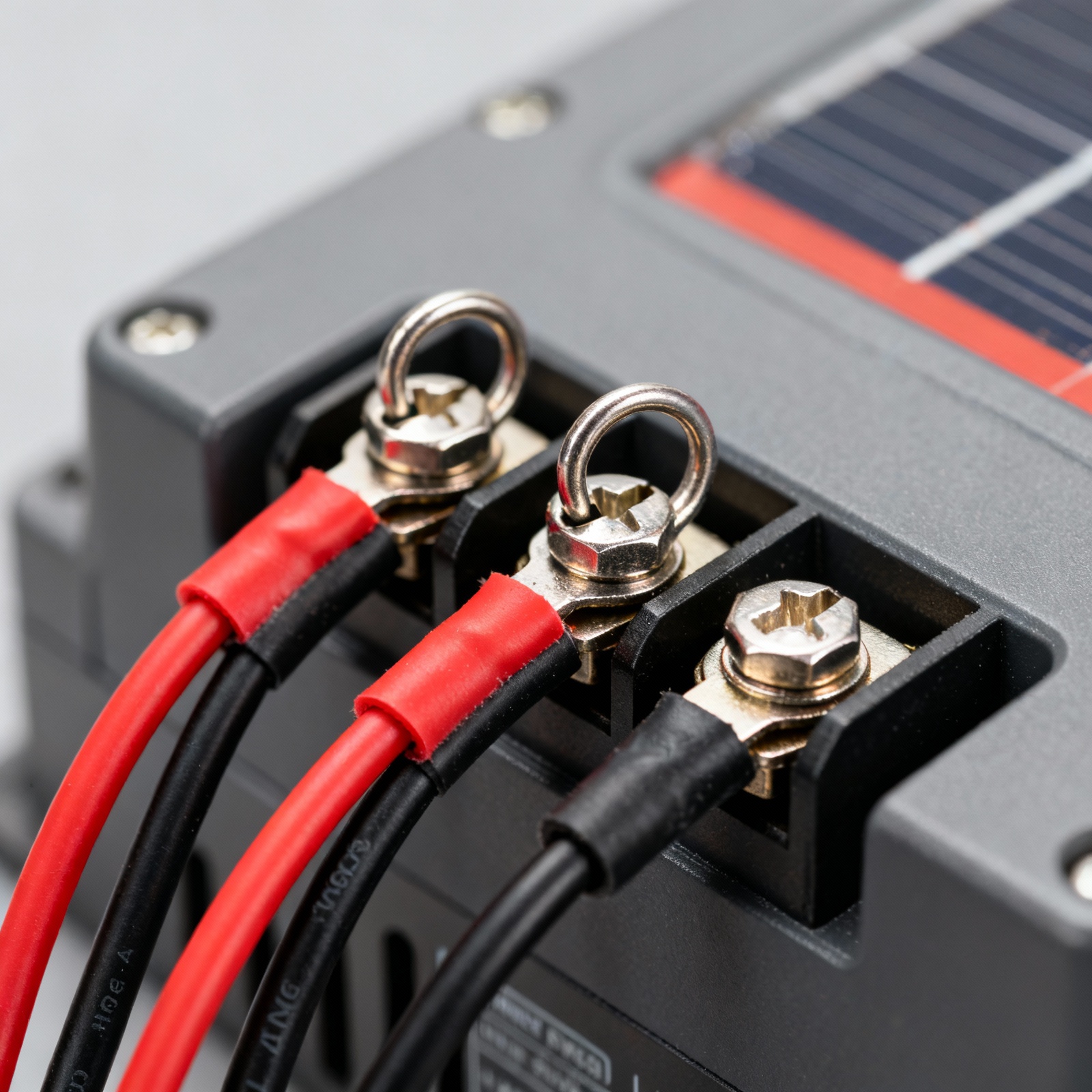
- Terminal size: Controllers rated above 40A should accept 6 AWG or larger wire.
- Heat dissipation: Aluminum housings and internal heatsinks prevent thermal derating in hot RV compartments.
- Ingress protection: IP ratings of IP32 or higher protect against dust and dripping water.
Product Details
Victron SmartSolar 100/30
Key specs: 30A output, 100V max PV input, 12/24V auto-detect, 1.3 kg (2.9 lb), 5-year warranty.
The SmartSolar 100/30 represents Victron’s entry point into their premium MPPT lineup. Its ultra-fast maximum power point tracking algorithm adjusts within seconds to changing light conditions—a measurable advantage during partly cloudy days. Built-in Bluetooth eliminates the need for external adapters, and the VictronConnect app provides real-time data plus 30-day history. View on Amazon
- Peak conversion efficiency reaches 98%, among the highest in this amperage class.
- Fully programmable charge profiles support flooded, gel, AGM, and LiFePO4 batteries.
- Compact dimensions (100 × 113 × 40 mm) fit easily in tight RV electrical compartments.
- VE.Direct port enables integration with Victron’s ecosystem (BMV monitors, Cerbo GX).
- Higher cost per amp compared to budget alternatives—roughly 2× the price of comparable Renogy units.
- 30A limit means larger systems (400W+ on 12V) may require the 100/50 model.
Renogy Rover 40A
Key specs: 40A output, 100V max PV input, 12/24V auto-detect, 1.1 kg (2.4 lb), 2-year warranty.
The Rover 40A has become a default recommendation in budget RV solar discussions for good reason. It delivers genuine MPPT performance—not the “MPPT-like” algorithms found in some ultra-cheap units—at a price point accessible to most RVers. The backlit LCD displays array voltage, battery voltage, charging current, and daily amp-hours harvested. View on Amazon
- Four preset battery types (sealed, gel, flooded, lithium) plus user-defined custom settings.
- RS232 communication port allows connection to Renogy’s monitoring hub or third-party data loggers.
- Self-diagnosis function displays error codes for troubleshooting.
- 40A capacity handles up to 520W on 12V systems or 1040W on 24V systems.
- Tracking speed is adequate but noticeably slower than Victron during rapid cloud transitions.
- 2-year warranty is half the coverage of premium competitors.
EPever Tracer 6415AN
Key specs: 60A output, 150V max PV input, 12/24/36/48V auto-detect, 3.5 kg (7.7 lb), 2-year warranty.
For RVers running large arrays—600W and above—the Tracer 6415AN offers high current capacity without the premium price tag. Its 150V input voltage accommodates longer series strings, reducing wire losses on roof-mounted installations. The unit supports 48V battery banks, making it suitable for larger Class A motorhomes or converted buses with higher-voltage systems. View on Amazon
- 60A output handles up to 780W on 12V, 1560W on 24V, or 3120W on 48V systems.
- 150V max PV input allows series wiring of three or four standard 60-cell panels.
- Compatible with EPever’s MT50 remote display and eBox Bluetooth/WiFi adapters.
- RS485 Modbus protocol enables integration with home automation and monitoring systems.
- Heavier and larger than lower-amperage units—requires adequate mounting space.
- Basic front-panel display; full programming requires MT50 remote or PC software.
Victron SmartSolar 150/35
Key specs: 35A output, 150V max PV input, 12/24/48V, 1.25 kg (2.75 lb), 5-year warranty.
The 150/35 variant addresses a specific need: higher input voltage for series-wired panel strings. This configuration reduces current on the roof-to-controller run, allowing smaller wire gauges and lower losses. The controller maintains Victron’s trademark efficiency and tracking speed while adding 48V battery support for larger systems. View on Amazon
- 150V input handles four 60-cell panels in series (typical Voc ~160V at STC, ~180V cold).
- Same ultra-fast tracking algorithm and 98% peak efficiency as the 100V models.
- Built-in Bluetooth and VE.Direct connectivity included.
- Compact form factor despite higher voltage rating.
- 35A output limits total array size on 12V systems to approximately 450W.
- Premium pricing—roughly 40% more than the 100/30 model.
RICH SOLAR 40A MPPT
Key specs: 40A output, 100V max PV input, 12/24V auto-detect, LCD display.
RICH SOLAR has gained traction in the budget segment by offering functional MPPT controllers at aggressive price points. The 40A model includes an LCD display, multiple battery presets, and a compact housing. It’s a reasonable choice for RVers prioritizing cost over brand pedigree. View on Amazon
- Lightest controller in this comparison at under 1 kg.
- Lithium battery preset with appropriate voltage parameters.
- LCD shows real-time charging data without external accessories.
- Price typically 30–40% below Renogy Rover equivalents.
- Limited long-term reliability data compared to established brands.
- Basic data logging; Bluetooth monitoring is available.
Comparison Table
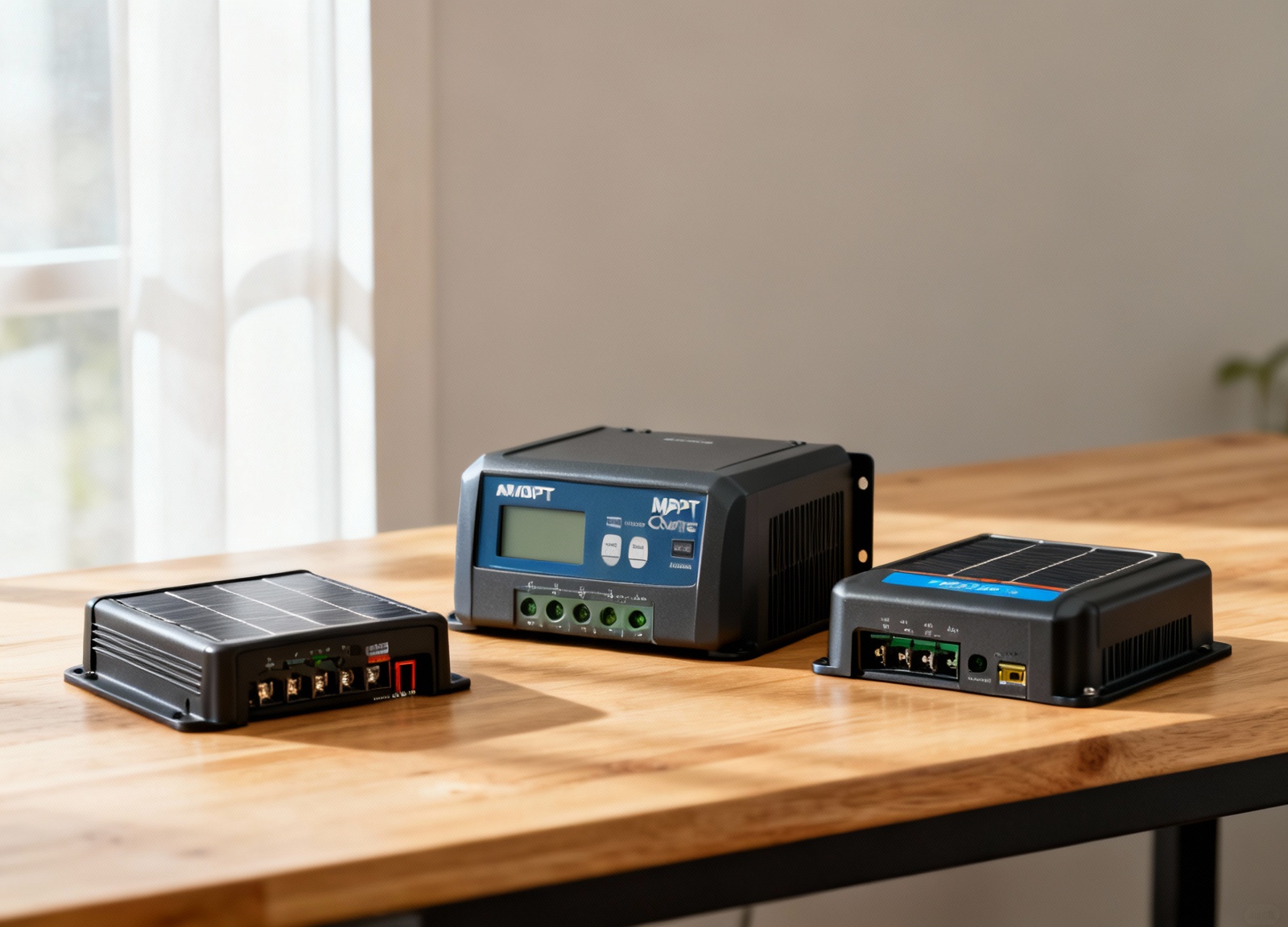
| Model | Type | Key Specs | Best for | Pros | Cons |
|---|---|---|---|---|---|
| Victron SmartSolar 100/30 | MPPT | 30A, 100V max PV, 12/24V auto, 1.3 kg, 5-year warranty | Premium efficiency seekers | 98% peak efficiency; built-in Bluetooth; ultra-fast tracking; excellent cold-weather performance | Higher price point; requires VE.Direct cable for full data logging |
| Renogy Rover 40A | MPPT | 40A, 100V max PV, 12/24V auto, 1.1 kg, 2-year warranty | Budget-conscious RVers | Affordable; backlit LCD; four battery presets including lithium; RS232 port | Shorter warranty; tracking speed slightly slower than premium units |
| EPever Tracer 6415AN | MPPT | 60A, 150V max PV, 12/24/36/48V, 3.5 kg, 2-year warranty | Large arrays (600W+) | High input voltage; handles 48V battery banks; MT50 remote compatible; competitive pricing | Heavier; requires external display for full programming |
| Victron SmartSolar 150/35 | MPPT | 35A, 150V max PV, 12/24/48V, 1.25 kg, 5-year warranty | Series-wired panel strings | 150V input allows longer strings; Bluetooth built-in; compact form factor | Premium pricing; 35A limit may require upsizing for future expansion |
| RICH SOLAR 40A MPPT | MPPT | 40A, 100V max PV, 12/24V auto, LCD display | Entry-level lithium setups | Lightweight; lithium preset; LCD display; very affordable | Limited brand track record; basic data logging |
| AMPINVT 60A MPPT | MPPT | 60A, 150V max PV, 12/24/36/48V, 2.8 kg, 1-year warranty | Budget high-current systems | 60A output at low cost; supports 48V batteries; LCD included | Shorter warranty; less community support; efficiency claims vary |
| Renogy Rover Elite 40A | MPPT | 40A, 100V max PV, 12/24V auto, 1.2 kg, 5-year warranty | Mid-range reliability | Extended 5-year warranty; Bluetooth module available; improved heat dissipation | Bluetooth adapter sold separately; slightly higher cost than base Rover |
Which One Should You Buy?

Your optimal choice depends on system size, budget constraints, and monitoring preferences.
If you prioritize maximum energy harvest and long-term reliability, the Victron SmartSolar 100/30 justifies its premium through superior tracking efficiency, built-in Bluetooth, and a 5-year warranty. The efficiency gains compound over years of use, and the robust build quality reduces replacement risk.
If cost matters most and you’re building a system under 500W on 12V, the Renogy Rover 40A delivers genuine MPPT performance at roughly half the price of Victron. The 2-year warranty is shorter, but Renogy’s established support network and parts availability mitigate long-term concerns.
If you’re running a large array (600W+) or planning significant expansion, the EPever Tracer 6415AN provides the headroom you need. Its 60A capacity and 150V input handle substantial systems without requiring multiple controllers. The trade-off is bulk and the need for external accessories to unlock full functionality.
For RVers wiring panels in series to minimize roof cable runs, the Victron SmartSolar 150/35 offers the necessary input voltage while maintaining premium efficiency. It’s particularly well-suited to installations where wire gauge and voltage drop are primary concerns.
Safety & Common Mistakes
- Install a correctly sized fuse within 18 inches of the battery positive terminal. Fuse rating should match or slightly exceed the controller’s maximum output current.
- Choose wire gauge for expected current and run length; target ≤3% voltage drop. Undersized wire causes heat buildup and energy loss.
- Use proper battery and array disconnects; de-energize the system before any work. Solar panels produce voltage whenever exposed to light.
- Avoid reversed polarity—double-check connections before powering on. Damage from reversed polarity may not be covered under warranty.
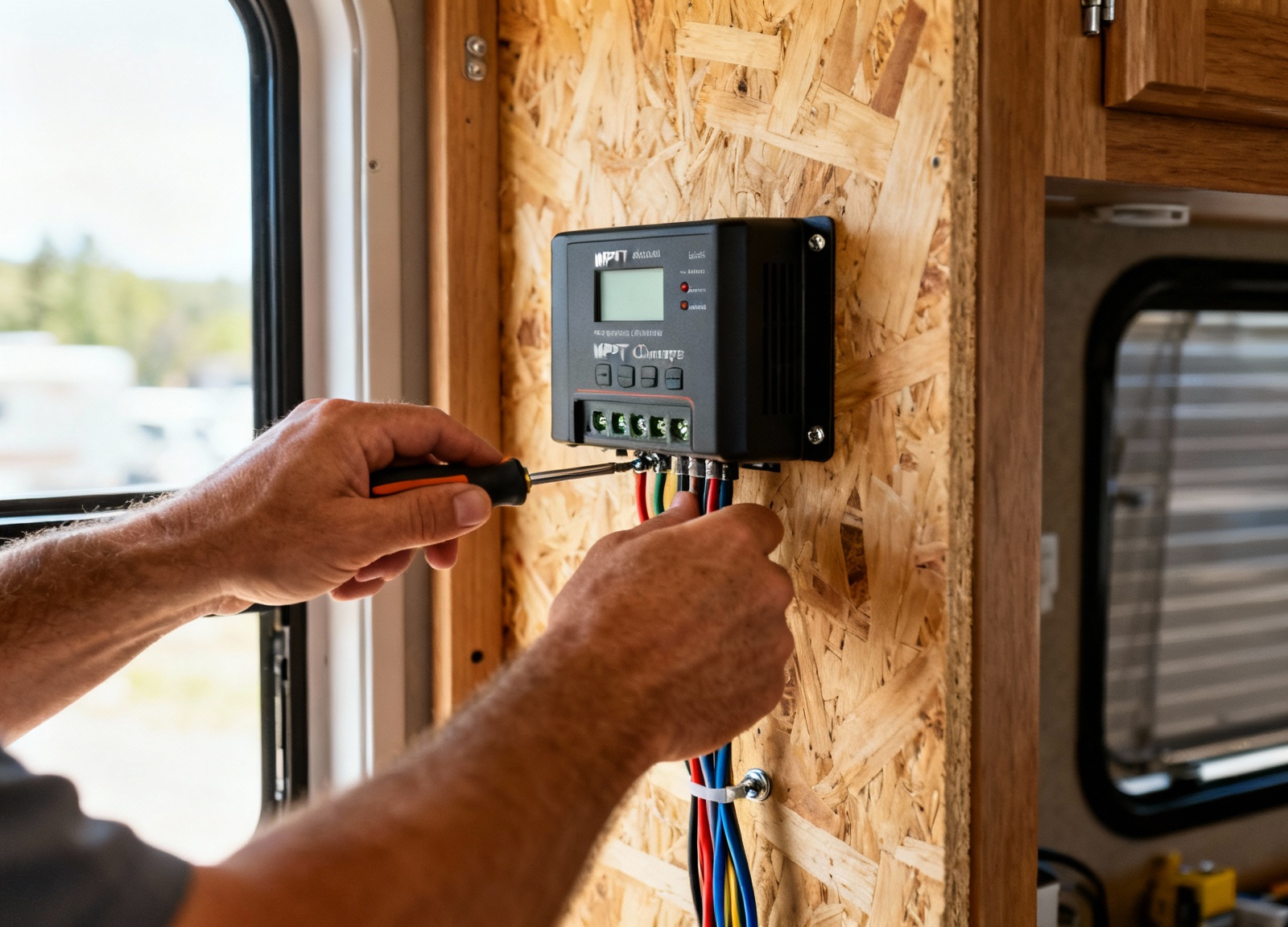
- Connect the battery to the controller before connecting the solar array. This sequence allows the controller to detect system voltage and configure itself properly.
- Verify temperature sensor placement if using lead-acid batteries. The sensor should contact the battery case directly for accurate compensation.
Always follow manufacturer installation guidelines and local electrical codes. When in doubt, consult a qualified RV electrical technician.
Recommended Gear
- Victron SmartSolar MPPT 100/30 — View on Amazon
- Renogy 100W Monocrystalline Panel — View on Amazon
- Battle Born 100Ah LiFePO4 Battery — View on Amazon
FAQs
- Do cheap MPPT charge controllers actually work? Yes, budget MPPT controllers from established brands like Renogy, EPever, and RICH SOLAR deliver genuine maximum power point tracking. However, they typically show 3–5% lower conversion efficiency than premium units, slower tracking response during variable conditions, and shorter warranty coverage. For systems under 400W where absolute efficiency is less critical, budget controllers represent reasonable value.
- MPPT vs PWM—which is better for RVs? MPPT controllers are typically 15–30% more efficient, especially in cold weather or partial shade. PWM is cheaper but wastes more potential power. The efficiency gap widens when panel voltage significantly exceeds battery voltage—common with standard 60-cell panels on 12V systems. For most RV installations, MPPT’s higher harvest justifies the cost difference within 1–2 years.
- Do I need lithium-compatible settings? Yes—if using LiFePO4 batteries, ensure the controller supports their specific charge profile to avoid damage or reduced lifespan. Key requirements include adjustable absorption voltage (typically 14.2–14.6V for 12V systems), the ability to disable or set appropriate float voltage, and the option to disable temperature compensation. Most modern MPPT controllers include lithium presets, but verify the specific voltage parameters match your battery manufacturer’s recommendations.
- How do I calculate the wire gauge I need? Use the voltage-drop formula based on current (A), round-trip cable length (ft), and target ≤3% drop. Online calculators simplify this—input your current, one-way distance, and system voltage to get a recommended gauge. For a 30A circuit running 15 feet on a 12V system with 3% drop target, you’d need approximately 6 AWG wire.
- Can I expand my system later? Yes—most MPPT controllers allow adding panels up to their rated input. Plan your initial wiring to accommodate future expansion by installing conduit with extra capacity, using a controller with headroom above your current array size, and ensuring your battery bank can accept the additional charge current. When expanding, verify that total panel Voc remains below the controller’s maximum input voltage, especially accounting for cold-temperature voltage rise.
- What happens if my controller is undersized? An undersized controller will limit charging current to its rated maximum, effectively wasting potential harvest from your array. For example, a 400W array on 12V could produce 33A+ under ideal conditions; a 20A controller would cap output at 20A, discarding roughly 40% of available power. Most controllers handle this gracefully without damage, but chronic undersizing defeats the purpose of your solar investment. Size your controller for your planned maximum array, not just your initial installation.
As an Amazon Associate, we earn from qualifying purchases. This helps keep SunAmpRV running.