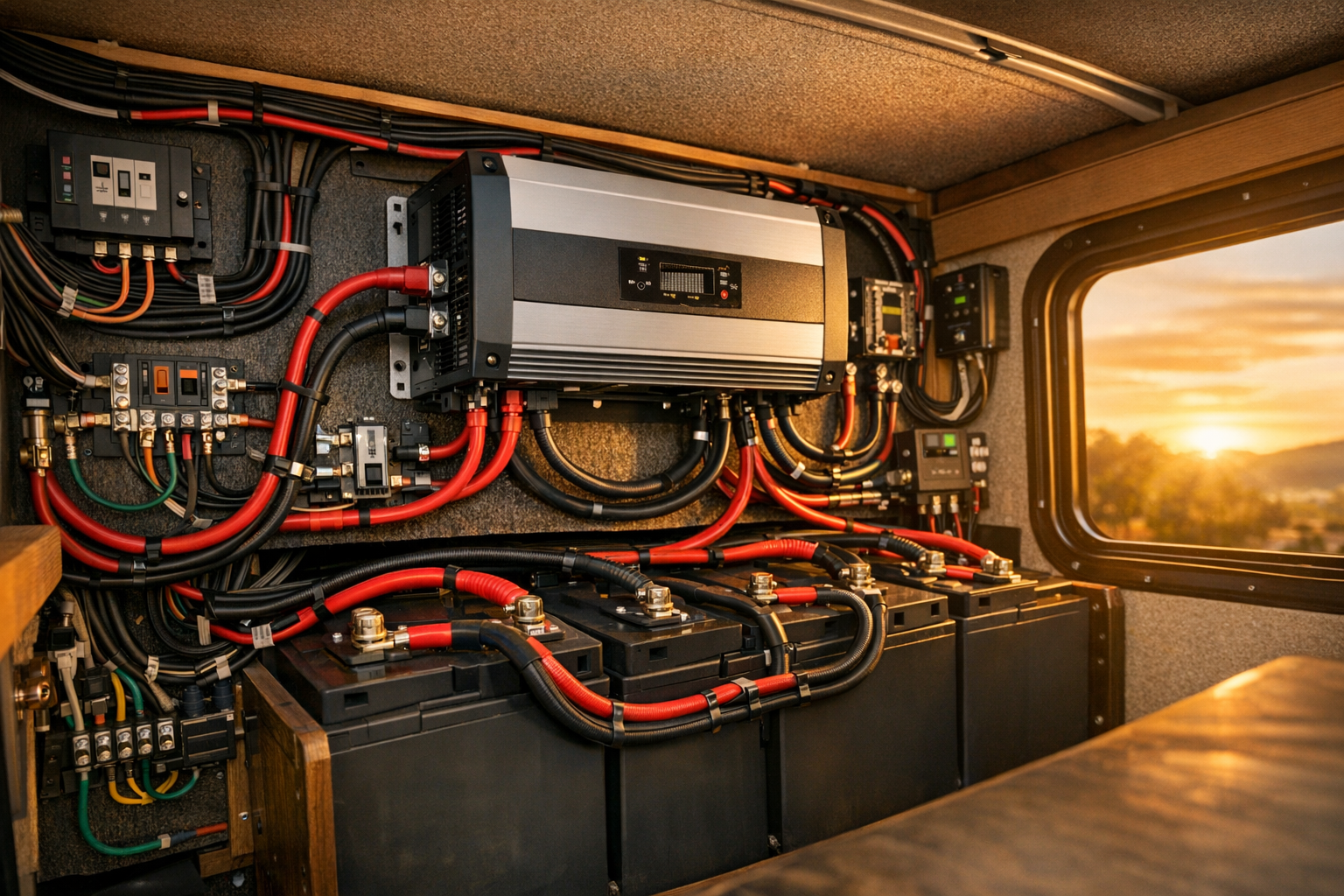
Pure sine wave inverters convert DC battery power into clean AC electricity that matches utility-grade output, making them essential for running sensitive electronics and modern appliances in your RV without risk of damage or malfunction.
TL;DR — Best Picks
Best Overall: High efficiency with comprehensive monitoring and proven reliability across demanding RV applications.
Best Budget: Renogy 3000W Pure Sine Wave Inverter – Delivers solid performance and safety certifications at roughly half the cost of premium competitors.
Best for Boondocking: Magnum Energy MS3012 Inverter/Charger – Integrated 125A charger and automatic transfer switch maximize off-grid capability with minimal component complexity.
Buyer’s Guide
Power Sizing and Load Calculation
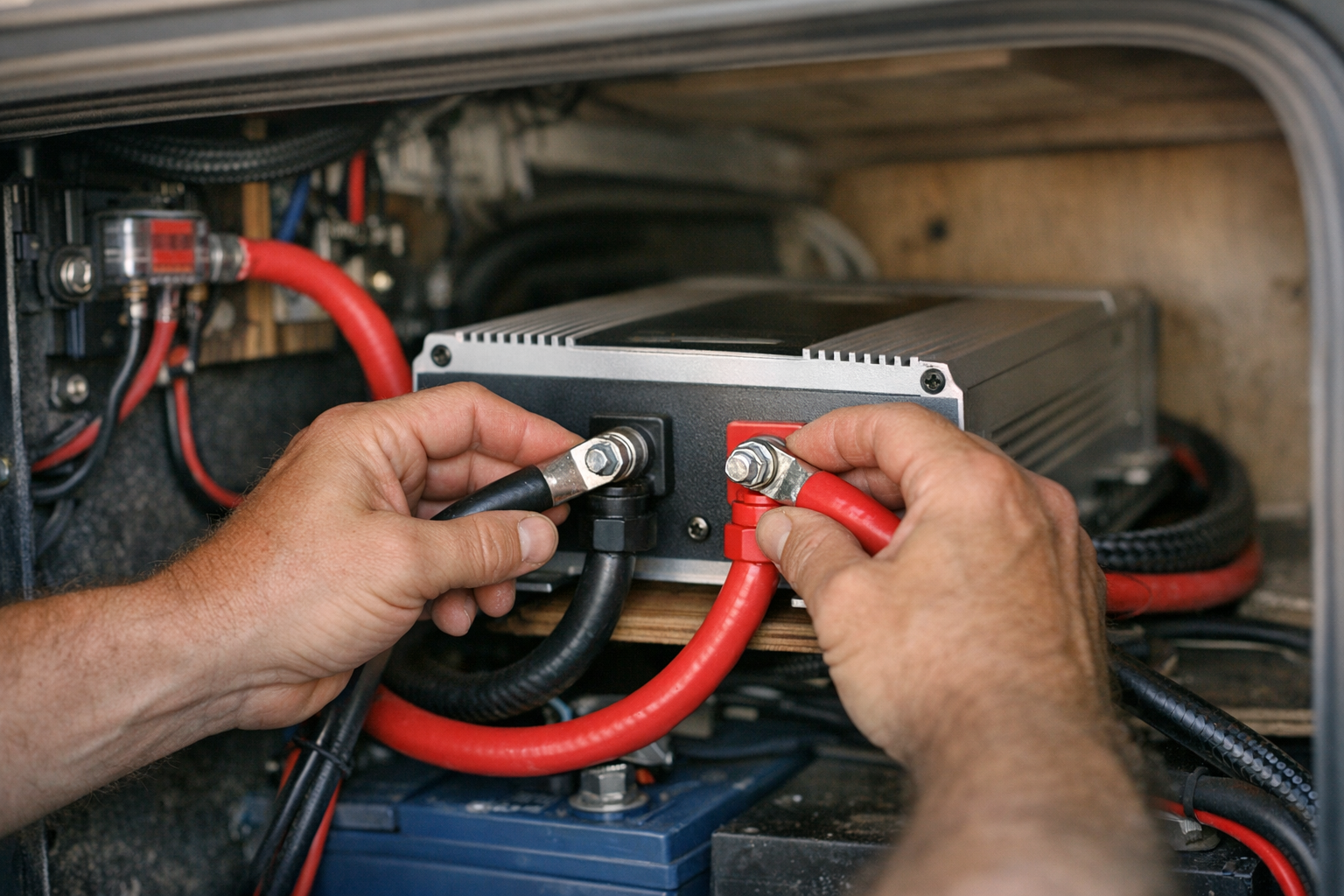
Proper inverter sizing begins with calculating your simultaneous load—the total wattage of all appliances you expect to run at the same time. List each device’s running wattage, sum them, then add a 20% safety margin.
For a typical RV running a residential refrigerator (150W), microwave (1000W), and entertainment system (100W) simultaneously, you need at minimum 1500W capacity, which becomes 1800W with the safety buffer.
Surge capacity matters significantly for motor-driven loads. Refrigerator compressors, air conditioner fans, and power tools draw 2–3× their running wattage during startup. A 3000W inverter with 6000W surge handles most RV scenarios comfortably, but if you’re running multiple motor loads or a residential air conditioner, verify the surge rating exceeds your combined startup demands.
- Running wattage: Check appliance labels or use a Kill-A-Watt meter for accurate readings
- Surge wattage: Multiply motor-driven appliance running watts by 2.5–3×
- Safety margin: Add 20% to calculated continuous load
- Derating: At high ambient temperatures (>95°F), expect 10–15% capacity reduction
Inverter vs Inverter/Charger Selection
Standalone inverters convert DC to AC only—they require a separate battery charger when connected to shore power or a generator. Inverter/chargers combine both functions and typically include an automatic transfer switch (ATS) that seamlessly switches between inverter power and shore/generator power without manual intervention.
For boondocking-focused RVers who occasionally connect to shore power, an inverter/charger simplifies the electrical system and reduces failure points. The integrated charger in units like the Magnum MS3012 (125A) or Xantrex Freedom XC Pro 3000 (150A) can fully recharge a depleted 400Ah lithium bank in 3–4 hours.
Standalone inverters make sense when you already have a quality charger installed or prefer modular component upgrades.
Efficiency and Idle Draw
Inverter efficiency directly impacts your battery runtime. A 94% efficient inverter wastes only 6% of input power as heat, while an 88% efficient unit wastes 12%—nearly double the losses. Over a day of moderate use (averaging 500W output), this difference equals roughly 35Wh of additional battery drain per hour with the less efficient unit.
Idle draw—the power consumed when the inverter is on but not supplying load—ranges from 8W to 25W depending on model. For overnight operation with minimal loads, a 25W idle draw consumes 200Wh over 8 hours, equivalent to running a small fan continuously.
Look for inverters with eco-mode or search-mode features that reduce idle draw to 2–5W by pulsing power and activating fully only when load is detected.
Battery Bank Pairing
Your battery bank must supply sufficient current for the inverter’s maximum output. At 12V nominal, a 3000W inverter draws approximately 275A at full load (3000W ÷ 10.5V under load = 285A). This demands substantial battery capacity:
- Lithium (LiFePO4): Minimum 300Ah recommended; can discharge to 80–90% depth safely
- AGM: Minimum 600Ah recommended; limit discharge to 50% for longevity
- Flooded lead-acid: Minimum 800Ah recommended; limit discharge to 50%
Lithium batteries deliver higher usable capacity, better efficiency under load, and longer cycle life, making them the preferred pairing for high-output inverters despite higher upfront cost.
Certifications and Safety Standards
UL 458 certification specifically covers mobile inverters and ensures the unit meets safety standards for RV and marine applications. ETL and CSA certifications provide equivalent safety validation. Avoid uncertified units—they may lack proper overcurrent protection, thermal management, or ground fault detection that prevents fires and equipment damage.
Key protection features to verify:
- Over-voltage protection: Shuts down if battery voltage exceeds safe limits
- Under-voltage protection: Prevents deep discharge damage to batteries
- Over-temperature protection: Reduces output or shuts down to prevent thermal damage
- Short-circuit protection: Immediately disconnects output during faults
- Ground fault protection: Detects current leakage to ground
Product Details
Victron Energy Phoenix 3000VA
Key specs: 3000VA inverter output, 12V/24V/48V model variants, pure sine wave output, optional monitoring.
The Phoenix 3000VA represents Victron’s engineering excellence in a pure inverter package. Its high efficiency translates to measurably longer battery runtime compared to competitors. The unit accepts 12V, 24V, or 48V input depending on model variant, accommodating various battery bank configurations.
Bluetooth connectivity via the optional VE.Direct dongle enables real-time monitoring through Victron’s VictronConnect app, displaying input voltage, output power, temperature, and fault codes. View on Amazon
- Pro: Industry-leading efficiency reduces battery drain by 4–6% versus budget alternatives
- Pro: Extensive global dealer network simplifies warranty service and technical support
- Pro: Modular integration with Victron ecosystem (Cerbo GX, BMV monitors, MPPT controllers)
- Con: Premium pricing at approximately 2× budget alternatives
- Con: Requires separate charger purchase for inverter/charger functionality
Renogy 3000W Pure Sine Wave Inverter
Key specs: 3000W continuous output, 6000W surge capacity, 12V DC input, >90% efficiency, 12.5 lbs, UL 458 listed, warranty coverage.
Renogy’s 3000W inverter delivers certified performance at a price point accessible to most RV budgets. The UL 458 listing confirms compliance with mobile inverter safety standards, and the included remote control allows convenient on/off switching from inside the RV.
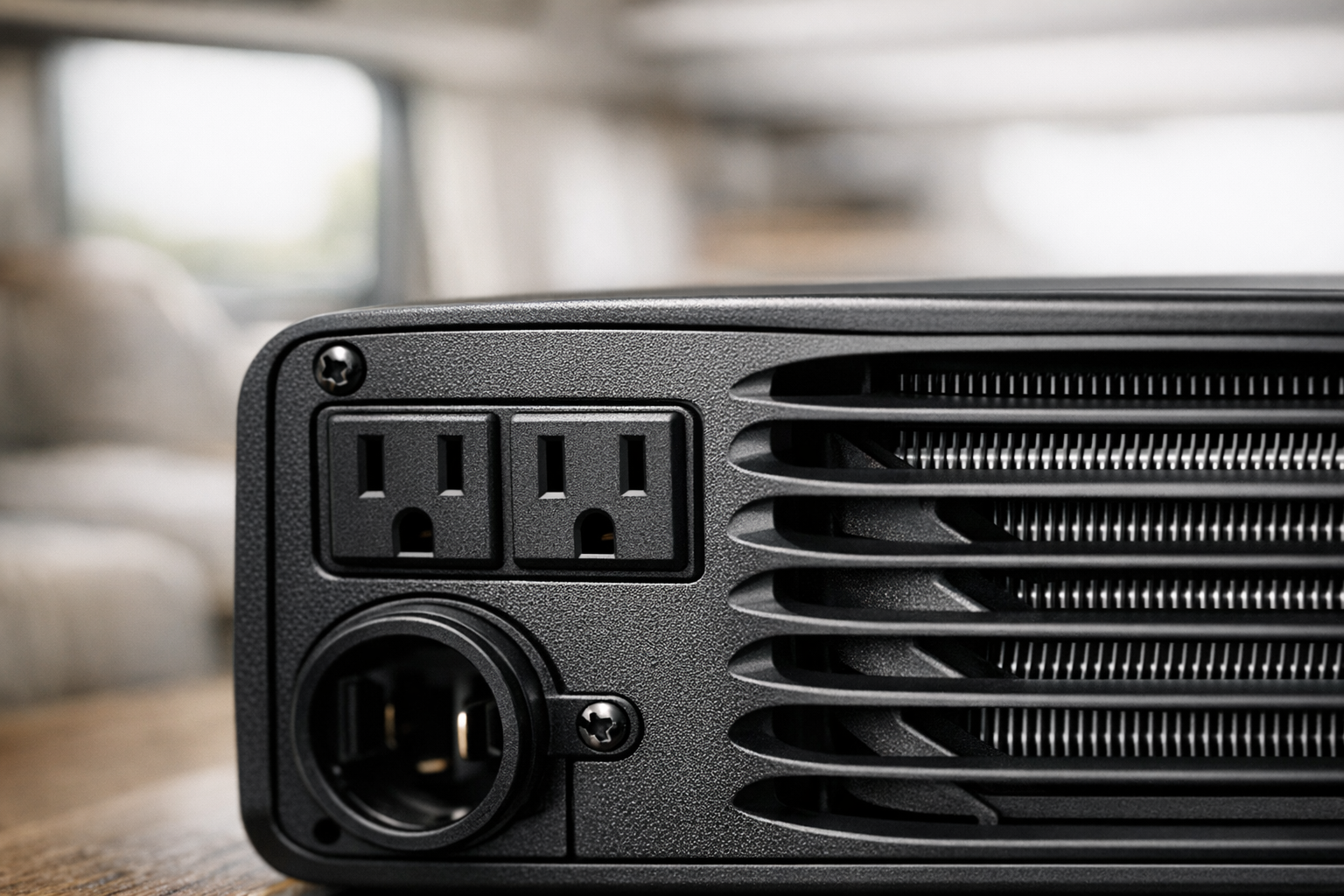
At 12.5 lbs, it’s among the lighter 3000W options, simplifying installation in space-constrained compartments. The unit features dual AC outlets, a hardwire terminal block for direct panel connection, and comprehensive LED status indicators. View on Amazon
- Pro: Approximately 50% cost savings versus premium brands with solid performance
- Pro: Lightweight design eases installation and reduces structural load
- Pro: Responsive US-based customer support with reasonable parts availability
- Con: 12V input only—not suitable for 24V or 48V battery systems
- Con: Warranty and support don’t match premium brands
Magnum Energy MS3012 Inverter/Charger
Key specs: 3000W continuous output, 6300W surge capacity, 125A multi-stage charger, 12V DC input, 91% inverter efficiency, automatic transfer switch, 62 lbs, 3-year warranty.
The MS3012 combines inverter, charger, and transfer switch in a single chassis, reducing installation complexity and potential failure points. Its 125A charger can replenish a 400Ah lithium bank from 20% to 100% in approximately 3 hours when connected to shore power or a generator.
The automatic transfer switch seamlessly transitions between inverter and AC input power within 16ms—fast enough that most electronics don’t register the switch. The optional ME-RC remote provides detailed system monitoring and configuration access.
- Pro: All-in-one design eliminates need for separate charger and transfer switch
- Pro: Field-proven reliability with decades of RV and marine deployment history
- Pro: 6300W surge capacity handles demanding motor startup loads
- Con: 62 lb weight requires robust mounting and may challenge single-person installation
- Con: Requires adequate ventilation clearance—minimum 2″ on all sides recommended
Xantrex Freedom XC Pro 3000
Key specs: 3000W continuous output, 150A multi-stage charger, 12V DC input, 2× surge for 5 seconds, 18.6 lbs.
Xantrex positions the Freedom XC 3000 as a lighter-weight alternative to the Magnum MS3012 while offering a more powerful 150A charger. The ignition lockout feature prevents inverter operation while the vehicle is running, addressing safety concerns in motorhome applications.
The unit is designed for RV installations with integrated charging and transfer functionality. The unit’s compact, lightweight design simplifies installation without sacrificing core functionality. View on Amazon
- Pro: 150A charger exceeds Magnum’s 125A, enabling faster battery replenishment
- Pro: 17 lbs lighter than comparable Magnum unit while maintaining similar output
- Pro: Ignition lockout feature adds safety layer for motorhome installations
- Con: Cooling fan operates frequently under moderate loads, producing noticeable noise
- Con: 2-year warranty shorter than Magnum’s 3-year and Victron’s 5-year coverage
Comparison Table
| Model | Type | Key Specs | Best for | Pros | Cons |
|---|---|---|---|---|---|
| Victron Energy Phoenix 3000VA | Pure Sine Wave Inverter | 3000VA inverter output, 12V/24V/48V model variants, optional monitoring | Premium builds requiring maximum efficiency | Exceptional efficiency; Bluetooth monitoring; robust build quality; extensive dealer network | Premium pricing; requires separate charger for inverter/charger functionality |
| Renogy 3000W Pure Sine Wave Inverter | Pure Sine Wave Inverter | 3000W continuous, 6000W surge, 12V DC input, >90% efficiency, 12.5 lbs, warranty coverage | Budget-conscious builds with standard power needs | Competitive pricing; UL listed; remote control included; good customer support | 12V only; shorter warranty; efficiency slightly lower than premium units |
| Magnum Energy MS3012 Inverter/Charger | Inverter/Charger with ATS | 3000W continuous, 6300W surge, 125A charger, 12V DC, 91% efficiency, 62 lbs, 3-year warranty | Extended boondocking with shore power flexibility | Built-in 125A charger; automatic transfer switch; field-proven reliability; ME-RC remote compatible | Heavy at 62 lbs; higher cost; requires adequate ventilation space |
| Xantrex Freedom XC Pro 3000 | Inverter/Charger with ATS | 3000W continuous, 150A charger, 12V DC input, 2× surge (5 sec), 18.6 lbs | RVers wanting integrated charging with lighter weight | Powerful 150A charger; compact design; ignition lockout feature | Fan noise under load, premium pricing |
| GIANDEL 3000W Pure Sine Wave Inverter | Pure Sine Wave Inverter | 3000W continuous, 6000W surge, 12V DC input, 88% efficiency, 15.4 lbs, 18-month warranty | Entry-level installations with basic power requirements | Lowest price point; lightweight; dual AC outlets plus USB ports; hardwire terminal block | Lower efficiency; shorter warranty; less robust protection circuitry |
| AIMS Power 3000W Pure Sine Wave Inverter | Pure Sine Wave Inverter | 3000W continuous, 12V DC input, pure sine wave output | High-surge applications like compressor-based refrigerators | ETL listed; thermal and overload protection; US-based support | Heavier than competitors; fan runs frequently; higher idle draw |
Which One Should You Buy?
If you prioritize maximum efficiency and long-term reliability, the Victron Energy Phoenix 3000VA justifies its premium pricing through 94% efficiency, 5-year warranty, and seamless integration with Victron’s monitoring ecosystem. The efficiency gains compound over years of use, potentially offsetting the higher initial cost through reduced battery cycling and longer component life.
If budget constraints drive your decision, the Renogy 3000W Pure Sine Wave Inverter delivers UL-certified performance at roughly half the cost of premium alternatives. The 90% efficiency rating remains competitive, and the 2-year warranty provides reasonable protection.
If extended boondocking defines your RV lifestyle, the Magnum Energy MS3012 Inverter/Charger consolidates three critical components—inverter, charger, and transfer switch—into a single proven package. The 125A charger rapidly replenishes batteries during generator runs or brief shore power connections, maximizing your off-grid capability.
If you need exceptional surge capacity for multiple motor-driven loads, consider the AIMS Power 3000W with its 9000W surge rating—50% higher than most competitors. This matters for RVs running residential refrigerators alongside other compressor-based equipment.
Safety & Common Mistakes
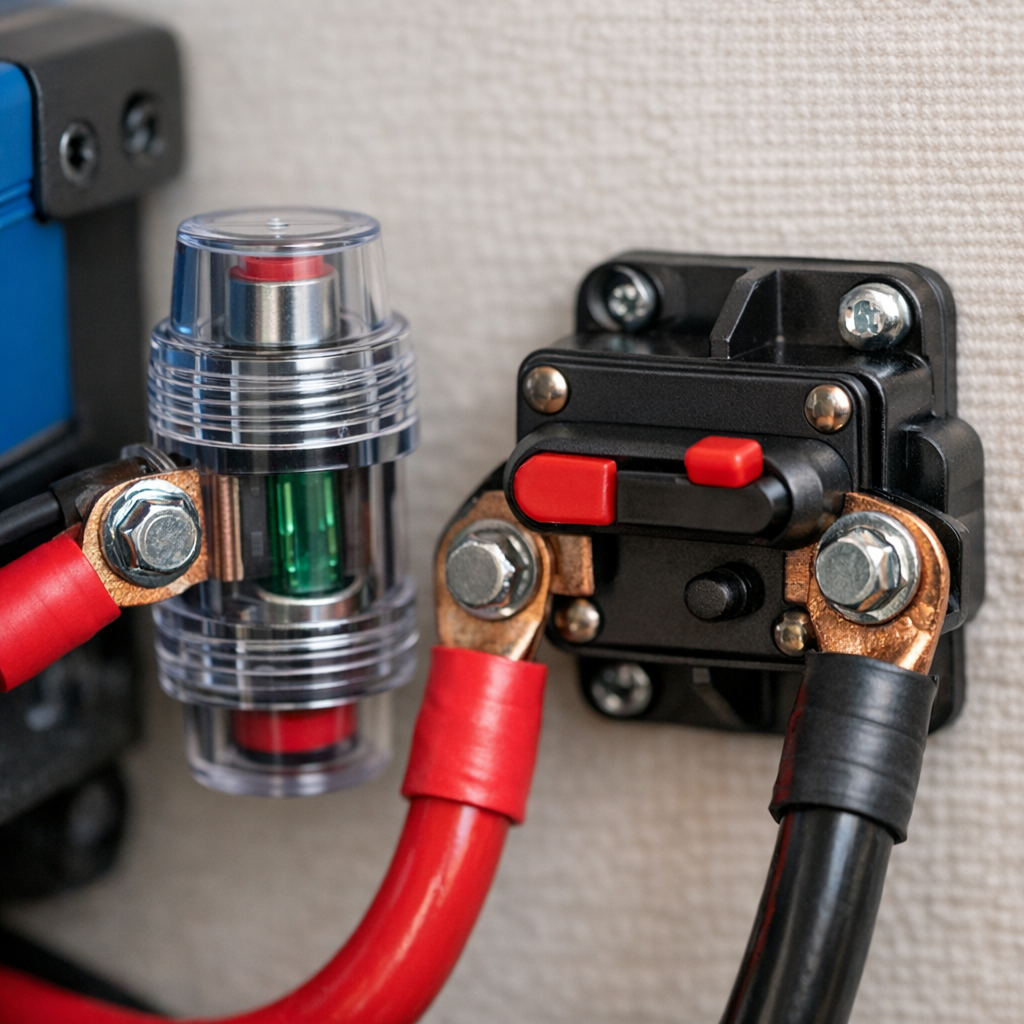
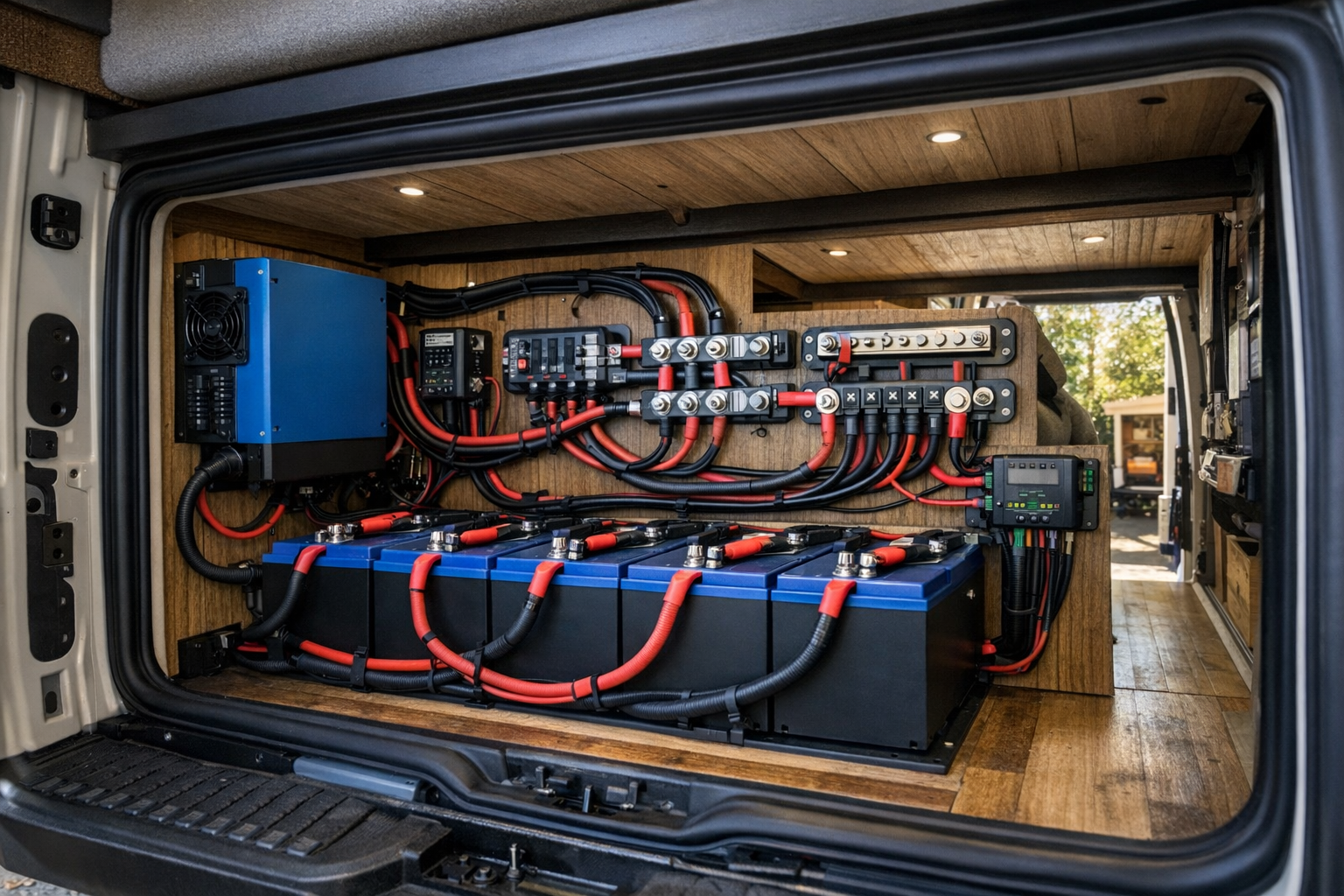
- Install a correctly sized fuse close to the battery positive terminal—typically a Class T fuse rated at 125% of maximum inverter draw (350A fuse for 3000W/12V inverter).
- Choose wire gauge for the expected current and run length; target ≤3% voltage drop. For 3000W at 12V with 6-foot cable run, use minimum 2/0 AWG copper.
- Avoid reversed polarity—double-check connections before powering on. Reversed polarity typically destroys inverter electronics instantly and voids warranty.
- Ensure adequate ventilation—most inverters require 2″ minimum clearance on all sides for cooling airflow.
- Torque all connections to manufacturer specifications; loose connections cause resistance heating and potential fires.
Always consult manufacturer documentation and local electrical codes before installation. When in doubt, hire a certified RV electrician.
Recommended Gear
- Victron SmartSolar MPPT 100/30 — View on Amazon
- Renogy 100W Monocrystalline Panel — View on Amazon
- Battle Born 100Ah LiFePO4 Battery — View on Amazon
FAQs
- What will a 3000W pure sine wave inverter run? A 3000W inverter handles most RV appliances including residential refrigerators (150W running, 400W surge), microwaves (1000–1500W), coffee makers (900–1200W), hair dryers (1500W), and entertainment systems. It can run multiple moderate loads simultaneously but typically cannot power rooftop air conditioners (which require 2800–3500W starting watts) unless the inverter’s surge capacity exceeds the AC’s startup demand.
- What is the difference between pure sine wave and modified sine wave inverters? Pure sine wave inverters produce smooth AC output with total harmonic distortion (THD) below 5%, matching utility power quality. Modified sine wave inverters produce stepped approximations with THD of 25–40%. Sensitive electronics (laptops, medical devices, variable-speed motors) may malfunction, overheat, or suffer reduced lifespan on modified sine wave power. Pure sine wave is strongly recommended for all modern RV applications.
- How do I calculate battery capacity requirements for my inverter? Divide your expected average load (watts) by battery voltage, then multiply by desired runtime in hours. For example: 500W average load ÷ 12V = 41.7A × 4 hours = 167Ah minimum. For lithium batteries, add 10% buffer; for lead-acid, double the calculated capacity since you should only discharge to 50%. A 3000W inverter at full load requires approximately 275A, demanding substantial battery capacity for extended operation.
- Do inverters work with lithium batteries? Yes, and lithium batteries are the preferred pairing for high-output inverters. Lithium (LiFePO4) batteries deliver consistent voltage under heavy loads, accept high charge rates, and provide 80–90% usable capacity versus 50% for lead-acid. Ensure your inverter’s low-voltage cutoff is set appropriately for lithium chemistry (typically 10.5–11V for 12V systems) to prevent over-discharge.
- Should I choose an inverter or inverter/charger for my RV? Choose an inverter/charger if you regularly connect to shore power or run a generator—the integrated charger and automatic transfer switch simplify your system and eliminate separate components. Choose a standalone inverter if you already have a quality charger installed, prefer modular upgrades, or primarily rely on solar charging. Inverter/chargers cost more upfront but reduce total system complexity.
- What certifications should I look for in an RV inverter? UL 458 certification specifically addresses mobile inverter safety for RV and marine applications. ETL and CSA certifications provide equivalent safety validation. These certifications verify proper overcurrent protection, thermal management, ground fault detection, and construction quality. Avoid uncertified units regardless of price—the safety risks and potential insurance implications outweigh any cost savings.
As an Amazon Associate, we earn from qualifying purchases. This helps keep SunAmpRV running.