
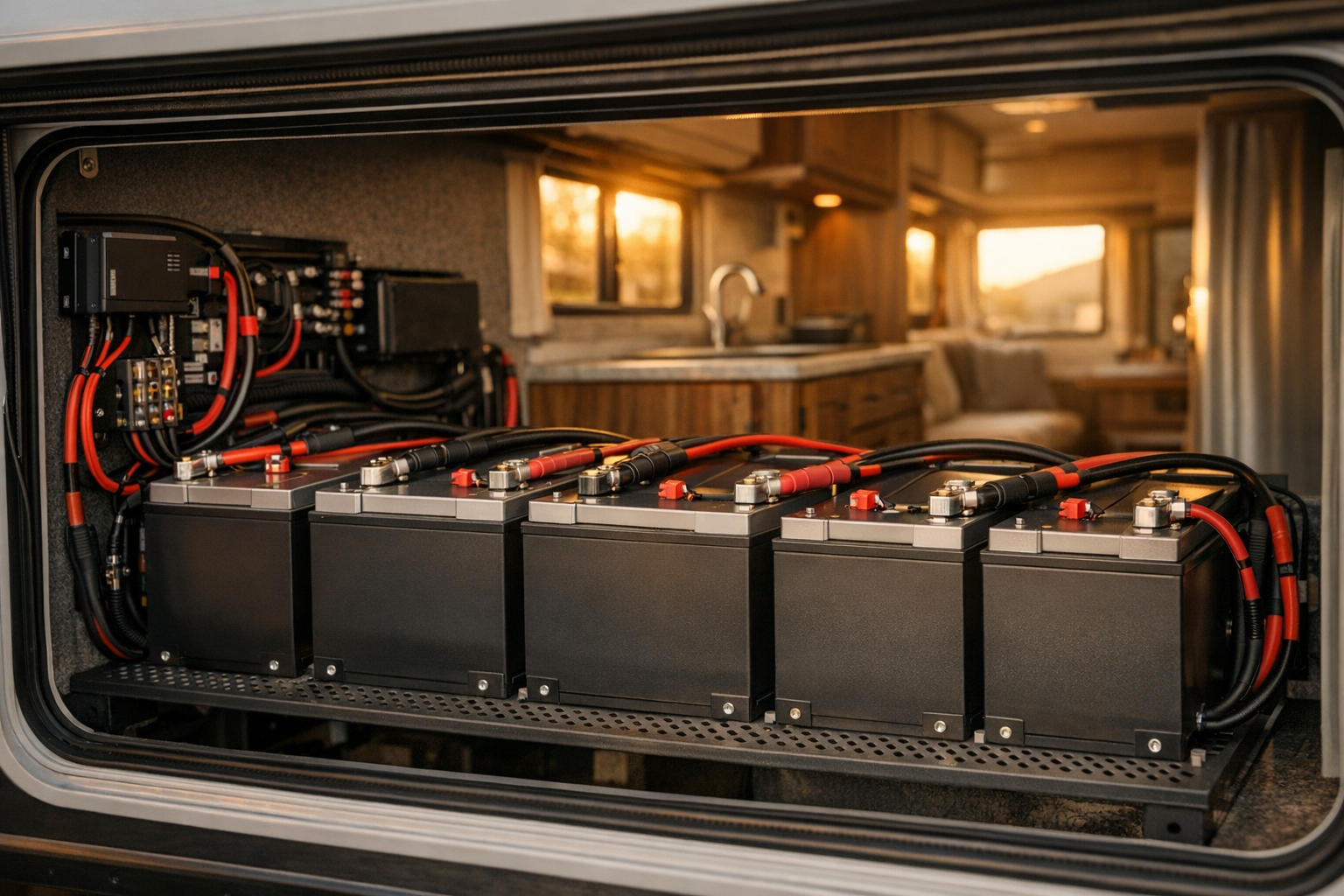
Selecting the right lithium battery for an RV solar system requires balancing capacity, chemistry, weight, and budget against your actual energy consumption patterns and installation constraints.
TL;DR — Best Picks
Best Overall: Battle Born 100Ah 12V LiFePO4 – Industry-leading warranty with proven reliability and excellent customer support.
Best Budget: Redodo 100Ah 12V LiFePO4 – Delivers solid performance at roughly half the price of premium brands.
Best for Extended Boondocking: Victron Energy Smart Lithium 200Ah – Built-in Bluetooth monitoring and robust BMS for serious off-grid deployments.
Buyer’s Guide
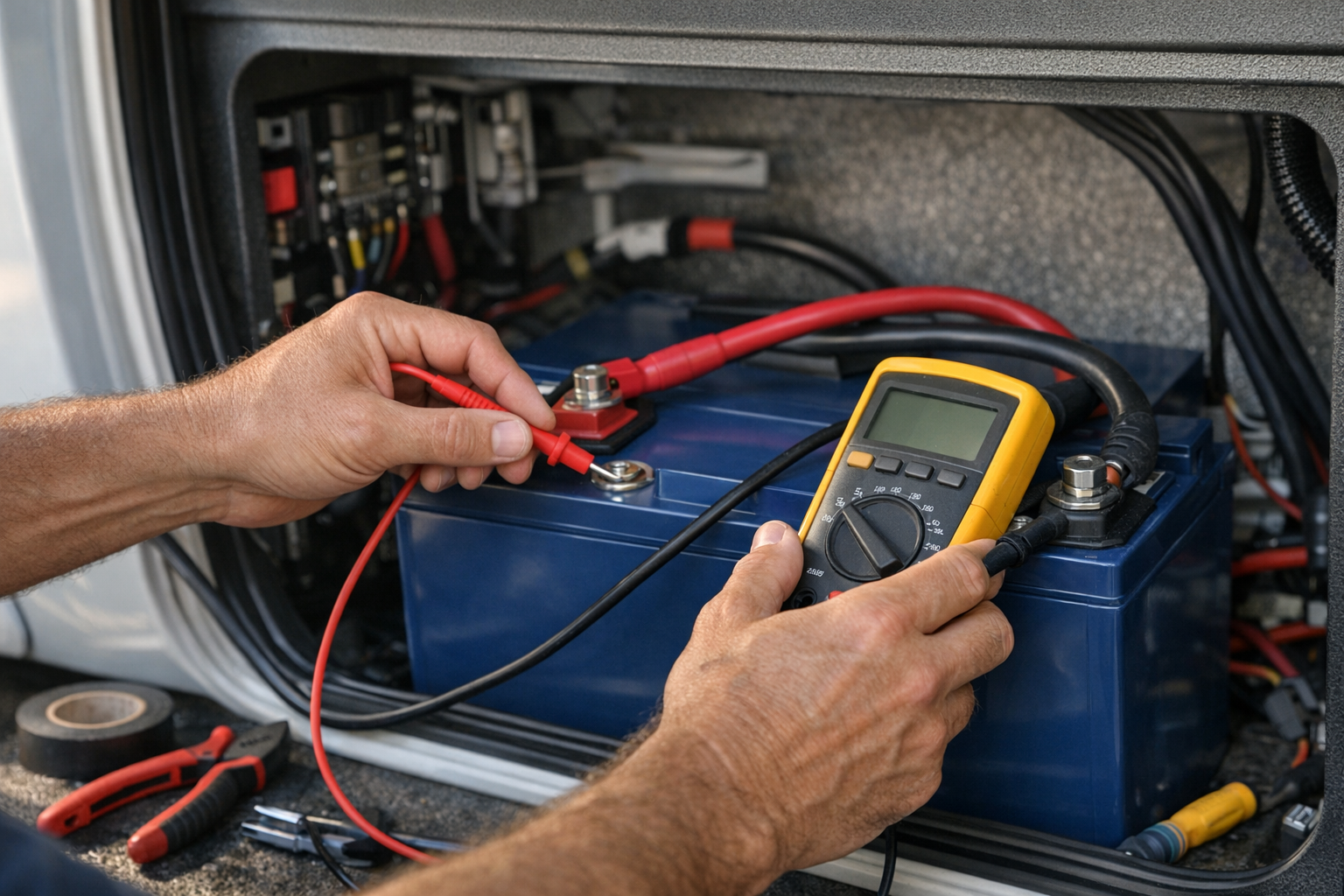
Capacity Sizing and Energy Math
Calculate your daily energy consumption in watt-hours (Wh) before selecting battery capacity. A typical RV running LED lights (50Wh), a 12V refrigerator (400–600Wh), phone charging (30Wh), and a water pump (50Wh) consumes roughly 530–730Wh daily. For comfortable margins, size your battery bank to provide 1.5–2× your daily consumption.
LiFePO4 batteries deliver 80–100% of their rated capacity versus 50% for lead-acid. This means a 100Ah lithium battery provides approximately 1,200Wh of usable energy at 12V. Two 100Ah batteries in parallel yield 200Ah (2,560Wh)—sufficient for most moderate-use RV setups.
Single Large Battery vs. Multiple Smaller Units
The debate between one 200Ah battery versus two 100Ah batteries involves several trade-offs:
- Weight distribution: Two 100Ah units (typically 24–31 lbs each) are easier to handle and position than a single 48–99 lb unit
- Redundancy: Parallel 100Ah batteries provide backup if one fails; a single 200Ah unit creates a single point of failure
- Expansion flexibility: Starting with 100Ah allows incremental upgrades
- Wiring complexity: Single batteries simplify installation; parallel configurations require matched cables and proper balancing
For most RVers, two 100Ah batteries offer the best balance of flexibility, redundancy, and manageability.
Chemistry Considerations: Why LiFePO4 Dominates RV Applications
Lithium iron phosphate (LiFePO4) has become the standard for RV solar systems due to several technical advantages:
- Cycle life: 2,000–5,000+ cycles at 80% depth of discharge versus 300–500 for lead-acid
- Weight: 50–70% lighter than equivalent lead-acid capacity
- Efficiency: 95–98% charge/discharge efficiency versus 80–85% for AGM
- Flat discharge curve: Maintains voltage above 12.8V through most of discharge cycle
- No maintenance: No watering, equalization, or sulfation concerns
Other lithium chemistries (NMC, NCA) offer higher energy density but present thermal runaway risks unsuitable for enclosed RV compartments. LiFePO4’s thermal stability makes it the safest lithium option for mobile applications.
BMS Features and Quality Indicators
The Battery Management System (BMS) protects cells from damage and determines real-world reliability.
Key BMS specifications to evaluate:
- Continuous discharge current: Should exceed your inverter’s maximum draw; 100A continuous is typical for 100Ah batteries
- Peak discharge current: Brief surge capacity for motor startups; 200A for 3–5 seconds is common
- Low-temperature cutoff: Most LiFePO4 batteries cannot charge below 32°F (0°C); some include heating elements
- Cell balancing: Active balancing is superior to passive; ensures even cell wear
- Communication: Bluetooth monitoring allows real-time state-of-charge tracking
Voltage Configuration: 12V vs. 24V vs. 48V
Most RVs use 12V systems for compatibility with existing appliances and charging infrastructure. However, higher voltage configurations offer efficiency advantages:
- 12V: Universal compatibility; largest product selection; higher current (thicker wires) for same power
- 24V: Halves current for same power; reduces wire gauge requirements; limited appliance compatibility
- 48V: Most efficient for large systems (3,000W+); requires DC-DC converters for 12V loads
For systems under 2,000W, 12V remains practical. Systems exceeding 3,000W benefit from 24V or 48V configurations to reduce wiring costs and losses.
Warranty and Support Evaluation
Warranty terms vary significantly across manufacturers:
- Duration: Ranges from 3 years (budget brands) to 11 years (Dakota Lithium)
- Cycle guarantees: Some warranties specify minimum cycle counts (e.g., 3,000 cycles)
- Capacity retention: Premium warranties guarantee 80% capacity retention at end of term
- Support location: US-based support (Battle Born, RELiON) typically provides faster resolution than overseas manufacturers
Product Details
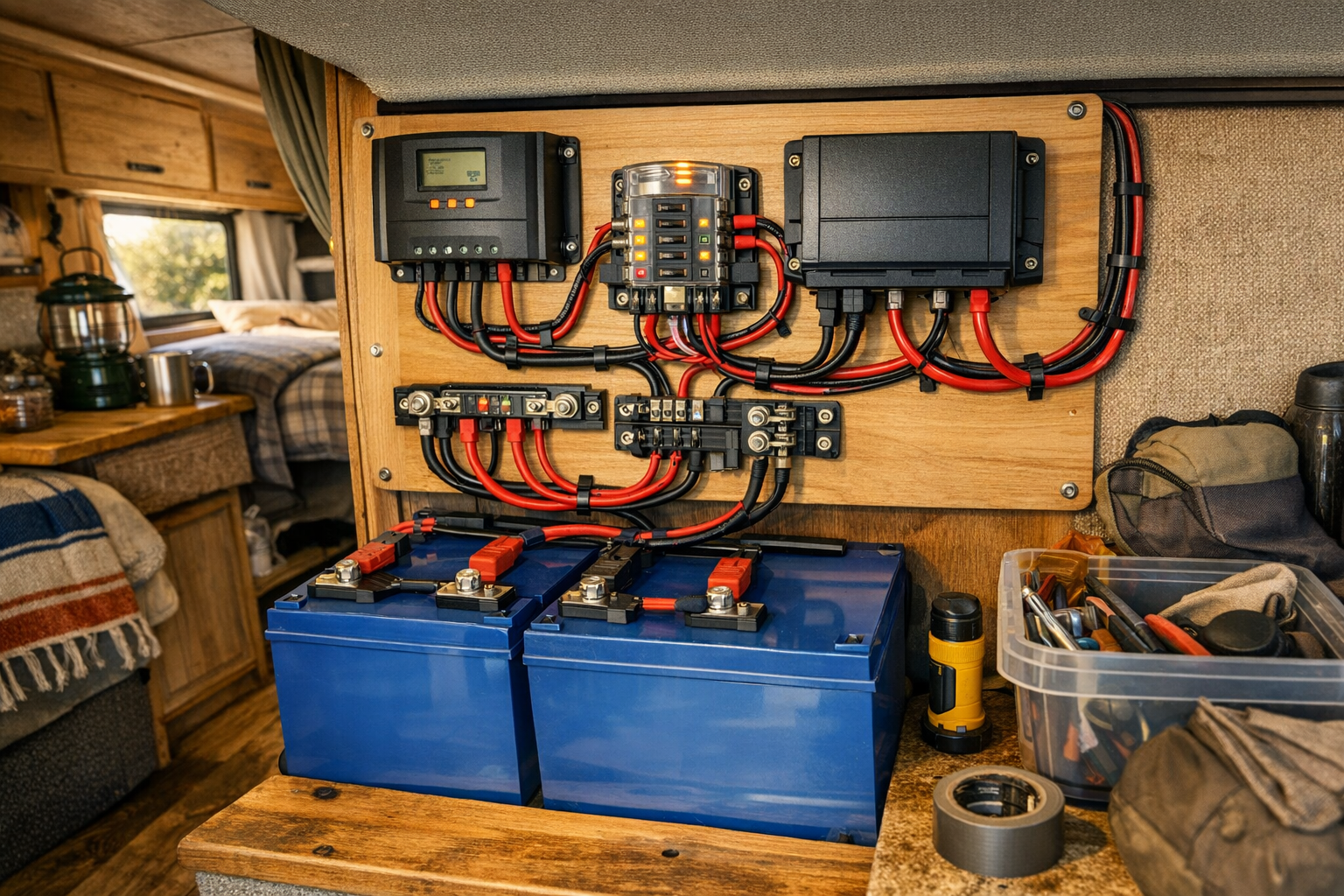
Battle Born 100Ah 12V LiFePO4
Key specs: 100Ah capacity, 12V nominal, 1280Wh usable energy, 31 lbs. View on Amazon
- Industry-leading warranty backed by responsive customer support
- Drop-in replacement for Group 27/31 lead-acid batteries
- Proven track record with thousands of RV installations since 2013
- Internal heating available in GC3 model for cold-weather charging
- Higher price point than competitors—approximately $899–$999 retail
- No built-in Bluetooth; requires external monitor for state-of-charge tracking
Battle Born has established itself as the premium benchmark in RV lithium batteries. Their 10-year warranty isn’t just marketing—the company has demonstrated consistent warranty fulfillment. The 100A continuous discharge handles most inverter loads, though users running 3,000W+ inverters should consider paralleling two units.
Redodo Mini 100Ah 12V LiFePO4
Key specs: 100Ah capacity, 12V nominal, 1280Wh usable energy, 19.84 lbs. View on Amazon
- Exceptional value at approximately $200–$280 retail
- Lighter than most competitors at 19.84 lbs
- Automotive-grade LiFePO4 cells with long cycle lifespan
- Compatible with most MPPT controllers and inverter/chargers
- Shorter warranty than premium brands
- Less established customer support infrastructure
Redodo represents the best value proposition in the current market. At roughly one-third the price of Battle Born, these batteries deliver comparable specifications. The 5-year warranty provides reasonable protection, and user reports from RV forums indicate solid real-world reliability.
For budget-conscious builds, Redodo enables larger capacity banks without premium pricing.
Victron Energy Smart Lithium 200Ah
Key specs: 200Ah capacity, 12.8V nominal, 2560Wh usable energy, 44.1 lbs, integrated Bluetooth. View on Amazon
- Premium BMS with Bluetooth monitoring via VictronConnect app
- Seamless integration with Victron MPPT controllers and inverters
- Expandable to 48V systems via series connection
- Robust construction rated for marine and mobile applications
- Significant weight at 44.1 lbs complicates installation
- Premium pricing—approximately $2,500–$3,000 retail
- Full feature utilization requires Victron ecosystem components
Victron targets serious off-grid users who prioritize system monitoring and integration. The built-in Bluetooth provides real-time cell voltages, temperatures, and state-of-charge without additional hardware. For extended boondocking where battery health monitoring matters, Victron’s ecosystem approach delivers unmatched visibility into system performance.
Renogy 100Ah Smart LiFePO4
Key specs: 100Ah capacity, 12V nominal, 1280Wh usable energy, 28.7 lbs, Bluetooth monitoring. View on Amazon
- Built-in Bluetooth with dedicated smartphone app
- Self-heating model available for cold-weather charging below 32°F
- Extensive documentation and DIY-friendly support resources
- Mid-range pricing at approximately $400–$500 retail
- BMS can trip under sustained high-current loads near rated maximum
- App connectivity occasionally inconsistent per user reports
Renogy occupies the middle ground between budget and premium options. The integrated Bluetooth monitoring adds value for users wanting state-of-charge visibility without external monitors. Their self-heating variant addresses cold-weather charging limitations that affect standard LiFePO4 batteries—a significant advantage for four-season RVers.
Dakota Lithium 100Ah 12V
Key specs: 100Ah capacity, 12V nominal, 1280Wh usable energy, 100A continuous discharge, 29 lbs, 11-year warranty, -20°F discharge rating.
- Industry-longest warranty at 11 years
- Superior cold-weather discharge performance to -20°F
- Rugged construction designed for harsh environments
- US-based company with responsive support
- Premium pricing comparable to Battle Born
- Heavier than budget alternatives at 29 lbs
Dakota Lithium differentiates through cold-weather performance and warranty length. While most LiFePO4 batteries struggle below freezing, Dakota’s cells maintain discharge capability to -20°F—though charging still requires temperatures above 32°F. For winter camping in northern climates, this cold-weather resilience provides meaningful operational advantages.
Comparison Table
| Model | Type | Key Specs | Best for | Pros | Cons |
|---|---|---|---|---|---|
| Battle Born 100Ah 12V | LiFePO4 | 100Ah, 12V, 1280Wh, 31 lbs | Premium reliability seekers | Industry-best warranty; US-based support; drop-in replacement | Higher price point; no built-in Bluetooth |
| Redodo Mini 100Ah 12V | LiFePO4 | 100Ah, 12V, 1280Wh, 19.84 lbs | Budget-conscious RVers | Excellent price-to-capacity ratio; lightweight; long cycle life | Shorter warranty; less established brand |
| Victron Smart Lithium 200Ah | LiFePO4 | 200Ah, 12.8V, 2560Wh, 44.1 lbs, bluetooth | Extended boondocking | Bluetooth monitoring; premium BMS; expandable via series connection | Heavy; requires Victron ecosystem for full features |
| Renogy 100Ah Smart LiFePO4 | LiFePO4 | 100Ah, 12V, 1280Wh, 28.7 lbs, bluetooth | DIY installers | Built-in Bluetooth; self-heating option available; good documentation | BMS occasionally trips under high loads; mid-tier pricing |
| RELiON RB100 100Ah | LiFePO4 | 100Ah, 12V, 1280Wh, 30 lbs, 10-year warranty | Commercial/fleet applications | Robust construction; excellent cycle life; UL listed | Premium pricing; no integrated monitoring |
| Ampere Time 200Ah 12V | LiFePO4 | 200Ah, 12V, 2560Wh, 48.5 lbs, 5-year warranty | High-capacity single-battery setups | Large capacity in one unit; competitive pricing; 4000+ cycles | Heavier than two 100Ah units combined; limited cold-weather performance |
| Dakota Lithium 100Ah 12V | LiFePO4 | 100Ah, 12V, 1280Wh, 29 lbs, 11-year warranty | Cold-weather camping | Excellent low-temp discharge; longest warranty; rugged build | Higher cost; heavier than competitors |
Which One Should You Buy?
If you prioritize long-term reliability and value responsive customer support, Battle Born justifies its premium through proven warranty fulfillment and US-based service. The 10-year warranty effectively amortizes the higher upfront cost across the battery’s lifespan.
If budget constraints drive your decision, Redodo delivers approximately 90% of premium battery performance at 30% of the cost. For RVers building larger capacity banks (400Ah+), the savings compound significantly—potentially funding additional solar panels or a better inverter.
If you’re planning extended off-grid deployments where system monitoring matters, Victron’s integrated Bluetooth and ecosystem compatibility provide visibility that standalone batteries cannot match.
If cold-weather camping is your primary use case, Dakota Lithium’s -20°F discharge rating and 11-year warranty address specific operational requirements that other batteries cannot meet.
Safety & Common Mistakes
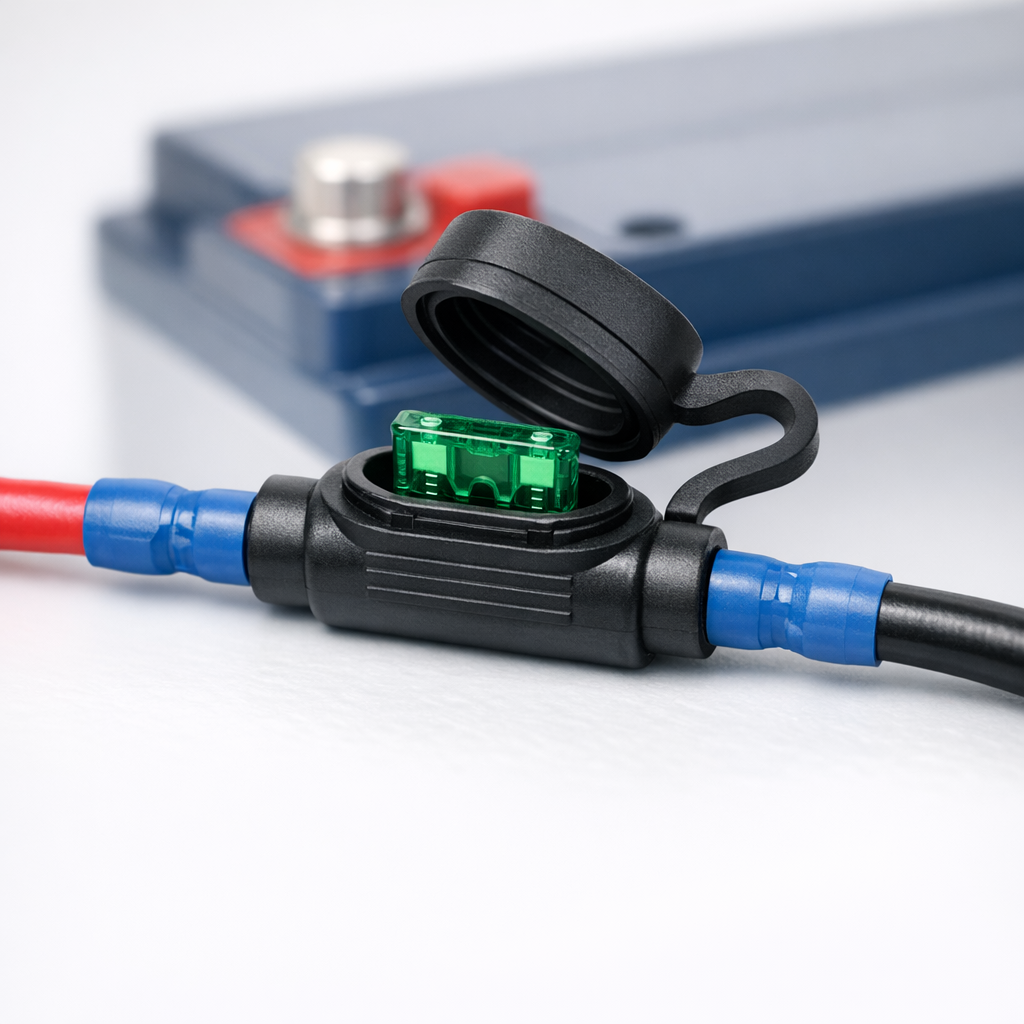
- Install a correctly sized fuse close to the battery positive terminal—typically a Class T fuse rated at 125–150% of maximum expected current
- Choose wire gauge for the expected current and run length; target ≤3% voltage drop using AWG charts or online calculators
- Use proper battery and array disconnects; de-energize the system before any work
- Avoid reversed polarity—double-check connections before powering on; LiFePO4 BMS units will not recover from reverse polarity damage
- Configure charge controllers for LiFePO4 profiles—typically 14.2–14.6V absorption, 13.6V float
- Ensure adequate ventilation around batteries; while LiFePO4 generates minimal heat, airflow prevents thermal buildup
Always consult manufacturer documentation and local electrical codes before installation.
Recommended Gear
- Victron SmartSolar MPPT 100/30 — View on Amazon
- Renogy 100W Monocrystalline Panel — View on Amazon
- Battle Born 100Ah LiFePO4 Battery — View on Amazon
FAQs
- What is the best lithium battery for solar RV? Battle Born 100Ah represents the best overall choice for most RVers due to its 10-year warranty, proven reliability, and US-based support. Budget-conscious buyers should consider Redodo for comparable performance at significantly lower cost.
- Is it better to have 2 100Ah batteries or 1 200Ah battery? Two 100Ah batteries typically offer advantages in weight distribution, redundancy, and installation flexibility. Individual 100Ah units (24–31 lbs) are easier to handle than single 200Ah units (48–99 lbs), and parallel configuration provides backup if one battery fails.
- Can I charge LiFePO4 batteries below freezing? Standard LiFePO4 batteries should not be charged below 32°F (0°C) as this can cause permanent lithium plating damage. Some models (Renogy Smart, Battle Born GC3) include internal heating elements that enable cold-weather charging. Discharge remains safe at lower temperatures.
- How long will a 100Ah lithium battery last in an RV? A 100Ah 12V LiFePO4 battery provides approximately 1,200Wh of usable energy. With typical RV consumption of 500–700Wh daily, expect 1.5–2 days of runtime without solar input. Cycle life typically exceeds 3,000–5,000 cycles, translating to 8–15 years of service depending on usage patterns.
- Do I need a special charger for lithium RV batteries? Yes—LiFePO4 batteries require chargers with appropriate voltage profiles (typically 14.2–14.6V bulk/absorption, 13.6V float). Most modern MPPT controllers and inverter/chargers include lithium presets. Using lead-acid charging profiles can undercharge lithium batteries or trigger BMS protection.
- Can I mix lithium and lead-acid batteries in my RV? Mixing battery chemistries is not recommended due to different voltage curves, charge requirements, and internal resistances. The batteries will not charge or discharge evenly, potentially damaging both types and reducing overall system performance and lifespan.
As an Amazon Associate, we earn from qualifying purchases. This helps keep SunAmpRV running.