
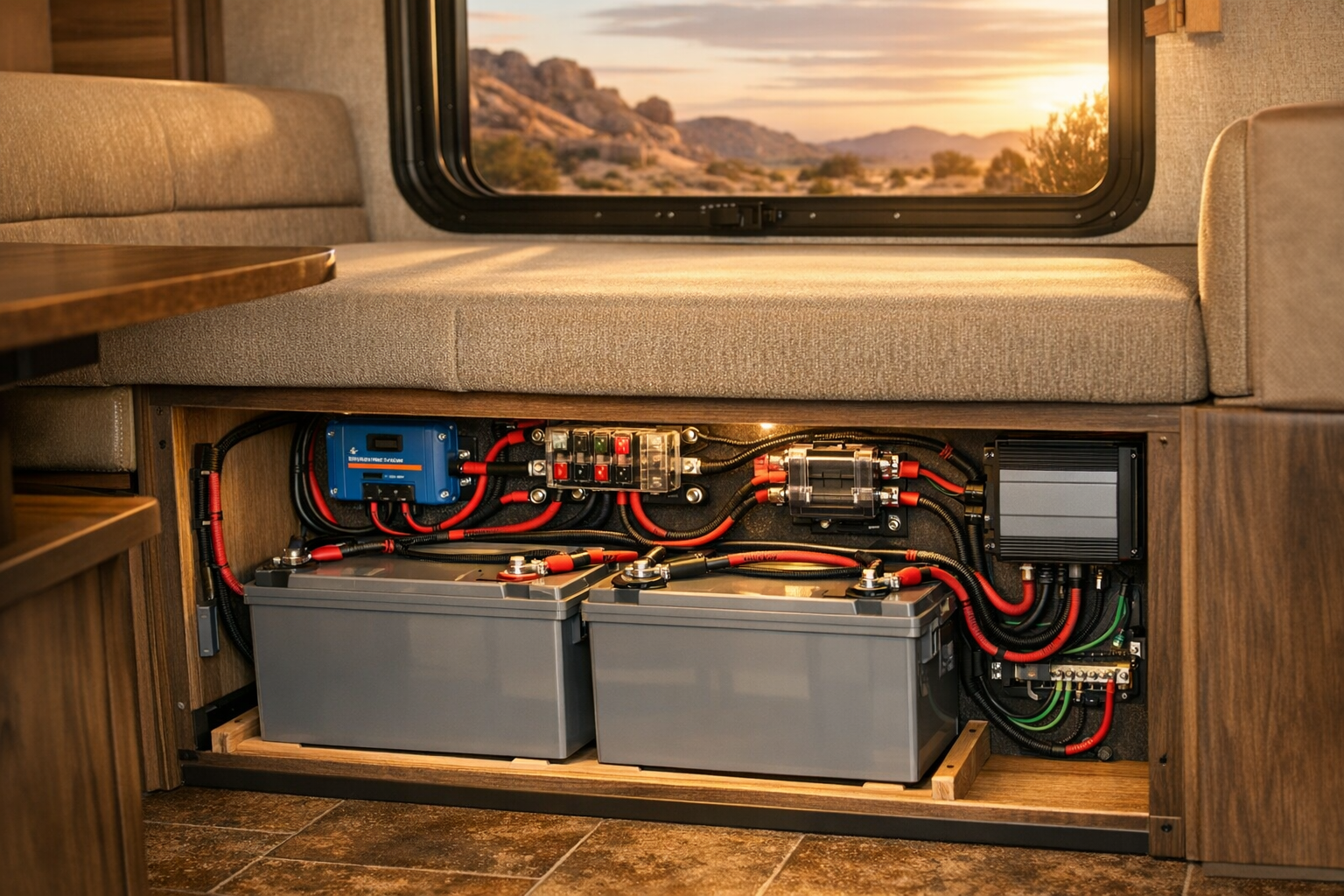
AGM (Absorbent Glass Mat) batteries remain a popular choice for RV solar systems due to their sealed, maintenance-free design and compatibility with standard charge controllers—offering a reliable middle ground between flooded lead-acid and lithium technologies.
TL;DR — Best Picks
Best Overall: VMAXTANKS VMAXSLR200 – 200Ah capacity with robust deep-cycle construction and excellent cycle life for extended boondocking.
Best Budget: Renogy Deep Cycle AGM 100Ah – Affordable entry point with solid specs and widespread availability.
Best for Compact Rigs: Optima BlueTop D31M – Dual-purpose design fits tight spaces while handling both starting and deep-cycle loads.
Buyer’s Guide
Capacity Sizing and Amp-Hour Requirements
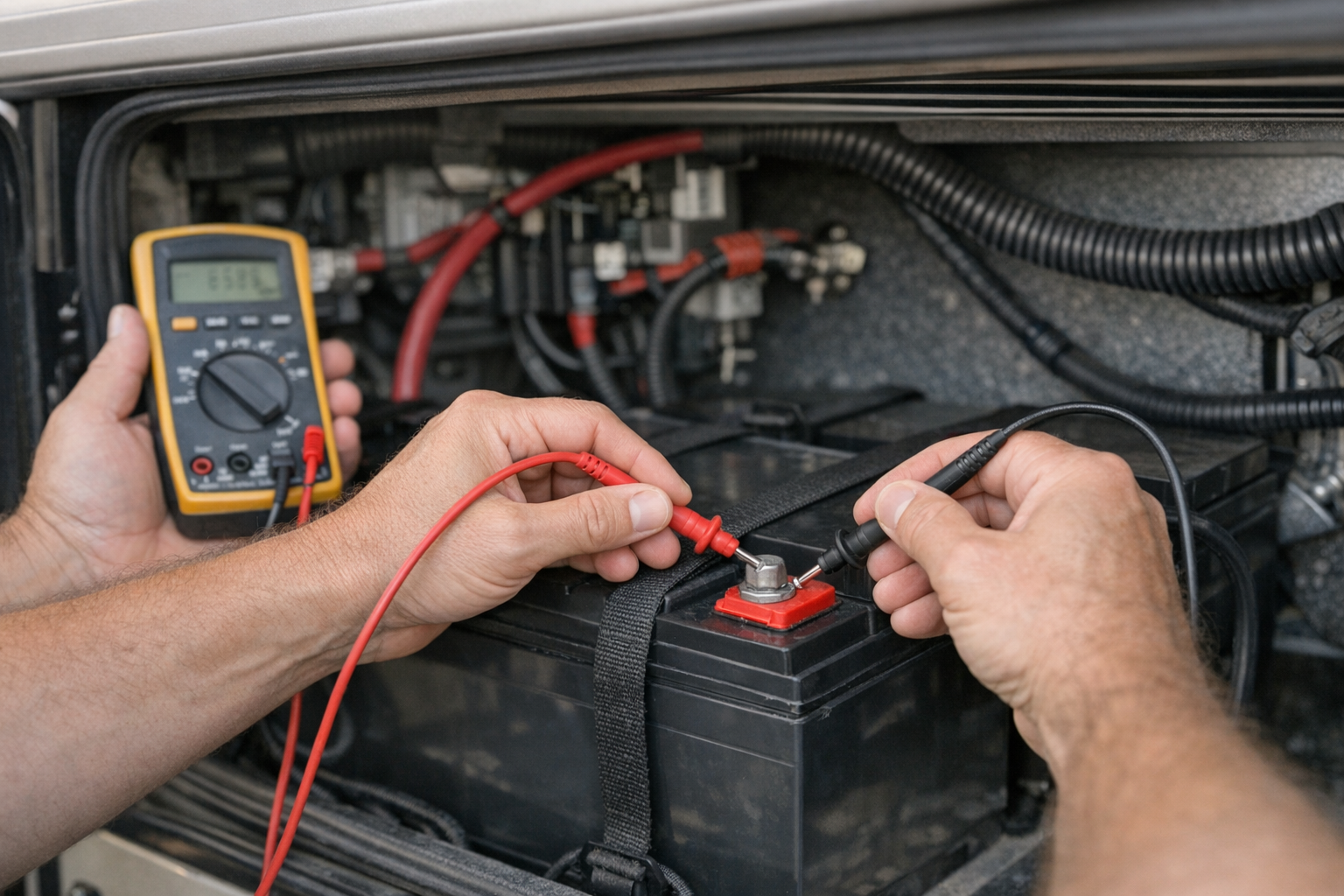
Determining the correct battery capacity starts with calculating your daily energy consumption. List every device you plan to run—lights, refrigerator, water pump, phone chargers, laptop—and multiply each device’s wattage by its expected hours of use. Divide the total watt-hours by 12V to get amp-hours consumed daily.
AGM batteries should not be discharged below 50% depth of discharge (DOD) regularly if you want to maximize cycle life. This means your usable capacity is roughly half the rated amp-hours.
For a 100Ah battery, plan on accessing only 50Ah before recharging. If your daily consumption is 60Ah, you need at least 120Ah of rated capacity—realistically 150–200Ah provides a comfortable buffer for cloudy days.
Consider these capacity tiers:
- 100Ah: Weekend trips, minimal loads (LED lights, phone charging, small 12V fridge)
- 200Ah: Extended boondocking, moderate loads (residential fridge, laptop, water pump)
- 300Ah+: Full-time living, heavy loads (multiple devices, inverter-powered appliances)
Single Large Battery vs. Multiple Smaller Units
The debate between one 200Ah battery versus two 100Ah units involves trade-offs in redundancy, weight distribution, and cost.
Two smaller batteries provide redundancy—if one fails, you retain partial capacity. They also allow flexible placement in separate compartments, distributing weight more evenly across your RV’s frame.
A single large battery simplifies wiring, reduces connection points (potential failure spots), and often costs slightly less than equivalent capacity in multiple units. However, a single 200Ah AGM battery typically weighs 110–135 lbs, requiring robust mounting and potentially exceeding compartment weight ratings.
For most RV solar installations, two 100Ah batteries wired in parallel offer the best balance of flexibility, redundancy, and manageable individual weight (60–70 lbs each).
Charge Profile Compatibility
AGM batteries require specific charging voltages that differ from flooded lead-acid and lithium chemistries. Standard AGM charge parameters:
- Bulk/Absorption: 14.4–14.8V
- Float: 13.2–13.8V
- Temperature compensation: -3mV/°C per cell recommended
Verify your solar charge controller supports AGM-specific settings. Most MPPT controllers include preset AGM profiles or allow custom voltage programming. Overcharging AGM batteries accelerates water loss and plate degradation—unlike flooded batteries, you cannot add water to compensate.
Cycle Life and Depth of Discharge
Cycle life varies dramatically based on discharge depth. A quality AGM battery might deliver:
- 1,200+ cycles at 30% DOD
- 500–600 cycles at 50% DOD
- 200–300 cycles at 80% DOD
For solar applications where daily cycling is expected, maintaining 50% DOD or shallower significantly extends battery lifespan.
Premium AGM batteries from manufacturers like Lifeline or VMAXTANKS use thicker plates and higher-quality separators, achieving better cycle life than budget alternatives.
Weight and Mounting Considerations
AGM batteries are substantially heavier than lithium alternatives—roughly 2–2.5 lbs per Ah versus 0.5–0.7 lbs per Ah for LiFePO4. A 200Ah AGM bank weighs approximately 130 lbs compared to 50–60 lbs for equivalent lithium capacity.
Ensure your battery compartment and mounting hardware can support this weight, especially in travel trailers where tongue weight affects towing dynamics. Batteries mounted in slide-out trays need heavy-duty drawer slides rated for the load.
Product Details
VMAXTANKS VMAXSLR200
Key specs: 200Ah, 12V nominal, 132 lbs, dimensions 20.5″ × 9.4″ × 8.9″, 8–10 year float service life, heavy-duty military-grade plates.
The VMAXSLR200 represents VMAXTANKS’ solar-specific line, engineered for daily cycling in off-grid applications. The “SLR” designation indicates optimized plate thickness and electrolyte absorption for renewable energy systems rather than standby UPS duty. View on Amazon
- Custom-built plates provide 500+ cycles at 50% DOD, exceeding many competitors
- Sealed, non-spillable design allows flexible mounting orientations
- Handles high charge/discharge currents without excessive heat buildup
- Premium pricing—expect $400–500 per unit
- Weight requires sturdy mounting; not suitable for lightweight trailers with limited payload
This battery suits RVers planning extended boondocking trips where reliable deep cycling matters more than upfront cost.
Renogy Deep Cycle AGM 100Ah
Key specs: 100Ah, 12V nominal, 63.9 lbs, dimensions 13.1″ × 6.9″ × 8.6″, 1-year warranty, self-discharge rate <3% monthly.
Renogy’s AGM offering provides solid baseline performance at an accessible price point, typically $180–220 per unit. The company’s reputation in the solar space means good parts availability and customer support. View on Amazon
- Excellent value for entry-level solar builds
- Pairs well with Renogy charge controllers for simplified system integration
- Manageable 63.9 lb weight allows easier installation
- 1-year warranty is shorter than premium competitors
- Cycle life adequate for weekend use but may degrade faster under daily heavy cycling
Two Renogy 100Ah batteries in parallel create a 200Ah bank for approximately $400—competitive with single 200Ah units while providing redundancy. This configuration works well for RVers building their first solar system who may upgrade to lithium later.
Optima BlueTop D31M
Key specs: 155-minute reserve capacity, 12V, 59.8 lbs, SpiralCell AGM technology, dual-purpose (starting and deep-cycle).
Optima’s SpiralCell design uses tightly wound lead plates rather than flat plates, creating exceptional vibration resistance and consistent performance. The BlueTop line specifically targets marine and RV applications. View on Amazon
- Dual-purpose capability eliminates need for separate starting and house batteries in smaller rigs
- SpiralCell construction handles rough roads and off-road travel better than conventional AGM
- Compact dimensions fit tight battery compartments
- Lower total capacity than dedicated deep-cycle batteries
- Higher cost per amp-hour—approximately $300 for 75Ah effective capacity
The D31M excels in Class B vans and compact trailers where space constraints prevent separate battery banks.
Lifeline GPL-4CT (6V Pair)
Key specs: 220Ah each at 6V (two in series = 12V 220Ah), 66 lbs per battery, dimensions 10.3″ × 7.1″ × 10.8″, 5-year warranty, US-manufactured.
Lifeline batteries represent the premium tier of AGM technology, manufactured in the USA with stringent quality control. The GPL-4CT uses proprietary plate formulations achieving cycle life that approaches—though doesn’t match—lithium performance. View on Amazon
- 1,000+ cycles at 50% DOD—exceptional for AGM chemistry
- 5-year warranty reflects manufacturer confidence
- Consistent performance across temperature extremes
- Requires two batteries wired in series for 12V systems
- Premium pricing—approximately $350–400 per battery ($700–800 for 12V pair)
- Combined weight of 132 lbs for the pair
The 6V configuration actually benefits large battery banks—wiring multiple 6V batteries in series-parallel combinations can achieve higher total capacity with better balance than parallel-only 12V configurations.
Mighty Max ML4D-12
Key specs: 200Ah, 12V nominal, 113.7 lbs, dimensions 20.87″ × 9.45″ × 8.74″, 1-year warranty, maintenance-free sealed design.
Mighty Max positions itself as the budget option for high-capacity needs, typically priced $300–350—significantly below premium 200Ah alternatives. View on Amazon
- Lowest cost per amp-hour in the 200Ah category
- Sealed AGM construction with standard charge compatibility
- Adequate for moderate cycling applications
- Shorter expected lifespan under heavy daily use
- 1-year warranty limits long-term protection
- Quality control reports vary—inspect upon delivery
This battery suits RVers with limited budgets who understand they may need replacement sooner than premium alternatives.
Comparison Table
| Model | Type | Key Specs | Best for | Pros | Cons |
|---|---|---|---|---|---|
| VMAXTANKS VMAXSLR200 | Deep Cycle AGM | 200Ah, 12V, 132 lbs, 8–10 year float life | Extended boondocking | High capacity; military-grade plates; excellent cycle life (500+ cycles at 50% DOD) | Heavy; premium price tier |
| Renogy Deep Cycle AGM 100Ah | Deep Cycle AGM | 100Ah, 12V, 63.9 lbs, 1-year warranty | Budget-conscious builds | Affordable; widely available; good baseline performance | Shorter warranty; moderate cycle life |
| Optima BlueTop D31M | Dual-Purpose AGM | 155-min reserve, 12V, 59.8 lbs, SpiralCell design | Compact rigs needing start + house power | Vibration resistant; dual-purpose capability; compact footprint | Lower Ah capacity; higher cost per Ah |
| Universal Power Group (UPG) 100Ah | Deep Cycle AGM | 100Ah, 12V, 64 lbs, 12-month warranty | Entry-level solar setups | Very affordable; decent performance for light use | Shorter lifespan under heavy cycling |
| Lifeline GPL-4CT | Deep Cycle AGM | 220Ah, 6V (pair for 12V), 66 lbs each, 5-year warranty | High-capacity bank builds | Premium quality; excellent cycle life (1,000+ at 50% DOD); US-made | Requires two units for 12V; expensive |
| Mighty Max ML4D-12 | Deep Cycle AGM | 200Ah, 12V, 113.7 lbs, 1-year warranty | Budget high-capacity needs | Large capacity at lower price point; sealed maintenance-free | Heavier than competitors; shorter warranty |
| Fullriver DC260-12 | Deep Cycle AGM | 260Ah, 12V, 167 lbs, 2-year warranty | Maximum single-battery capacity | Highest capacity single 12V AGM; robust construction | Extremely heavy; requires reinforced mounting |
Which One Should You Buy?
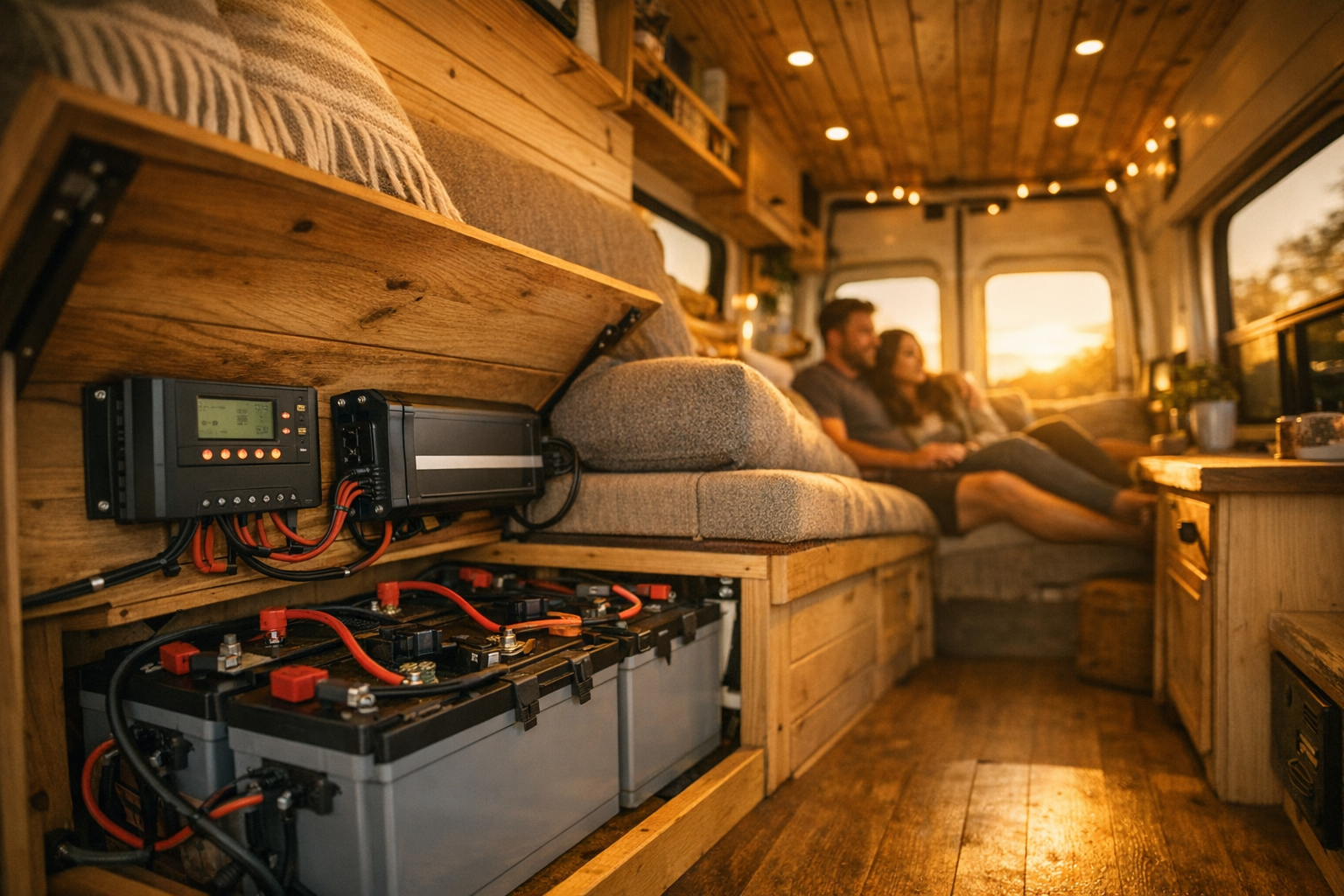
If you prioritize long-term reliability and plan extensive off-grid camping, the VMAXTANKS VMAXSLR200 delivers the best combination of capacity, cycle life, and build quality. The higher upfront cost amortizes over years of dependable service.
If budget constraints drive your decision, the Renogy Deep Cycle AGM 100Ah provides legitimate performance at an accessible price. Purchasing two units creates a 200Ah bank with redundancy benefits, and the manageable weight simplifies installation.
If you’re working with a compact rig where space and weight are critical, the Optima BlueTop D31M’s dual-purpose design and vibration-resistant construction justify its premium. Van lifers and small trailer owners particularly benefit from consolidating starting and house battery functions.
For maximum cycle life within AGM chemistry, the Lifeline GPL-4CT pair approaches lithium longevity while maintaining AGM’s simpler charging requirements and cold-weather performance. The 5-year warranty provides peace of mind for full-time RVers depending on their battery bank daily.
Budget-conscious buyers needing high capacity should consider the Mighty Max ML200-12, understanding the trade-off between upfront savings and potentially shorter service life.
Safety & Common Mistakes
- Install a correctly sized fuse within 6 inches of the battery positive terminal—for a 200Ah bank, use a 200–300A Class T fuse.
- Choose wire gauge for expected current and run length; target ≤3% voltage drop. For 30A loads over 10 feet, use minimum 8 AWG; for 50A, use 4 AWG or larger.
- Use proper battery and array disconnects; de-energize the system before any work.
- Avoid reversed polarity—AGM batteries can deliver hundreds of amps into a short circuit, causing fires or explosions.
- Provide strain relief for all cables passing through the roof or walls to prevent chafing during travel.
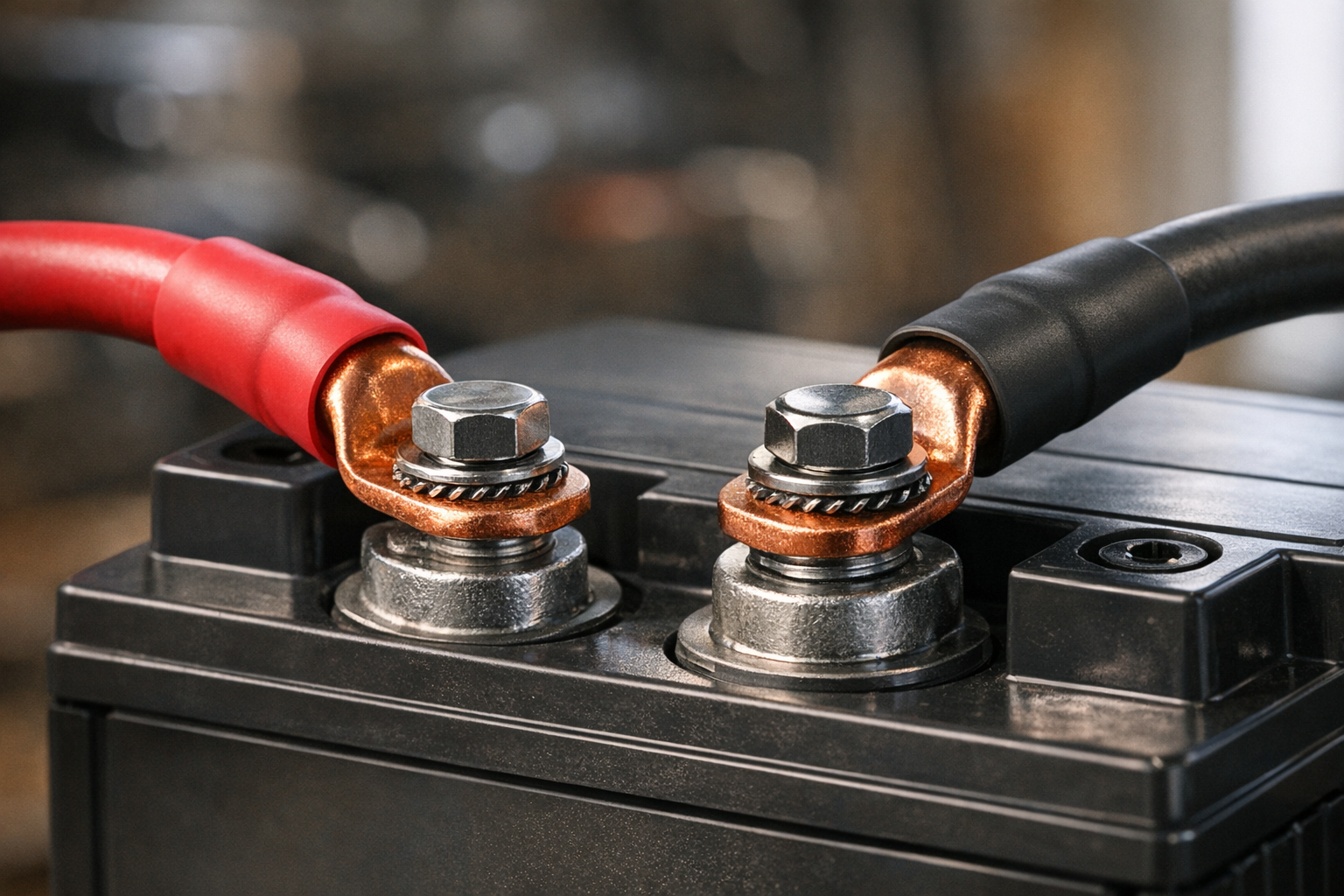
- Torque battery terminal connections to manufacturer specifications—loose connections cause resistance heating.
Always consult manufacturer documentation and local electrical codes before installation.
Recommended Gear
- Victron SmartSolar MPPT 100/30 — View on Amazon
- Renogy 100W Monocrystalline Panel — View on Amazon
- Battle Born 100Ah LiFePO4 Battery — View on Amazon
FAQs
- Do AGM batteries work well with solar charging? Yes—AGM batteries pair excellently with solar systems. Their sealed construction prevents electrolyte loss from the variable charging patterns inherent to solar power. Most MPPT and PWM controllers include AGM-specific charge profiles that optimize absorption and float voltages for maximum battery life.
- Is it better to have 2 100Ah batteries or 1 200Ah battery? Two 100Ah batteries offer redundancy (partial capacity if one fails), easier handling during installation (60–70 lbs each versus 130+ lbs), and flexible placement options. A single 200Ah battery simplifies wiring and reduces connection points. For most RV applications, two smaller batteries provide better practical advantages despite slightly higher total cost.
- How long will an AGM battery last in an RV solar system? Lifespan depends heavily on depth of discharge and cycle frequency. Quality AGM batteries maintained at 50% DOD typically deliver 500–600 cycles—approximately 3–5 years for daily cycling or 7–10 years for weekend use. Premium brands like Lifeline can exceed 1,000 cycles under proper management.
- Can I mix AGM batteries with my existing flooded battery? Mixing battery types is not recommended. Different chemistries have different charge voltage requirements and internal resistances. The mismatched batteries will charge unevenly, with one type consistently overcharged or undercharged, dramatically shortening both batteries’ lifespans.
- What charge controller settings should I use for AGM batteries? Standard AGM parameters: Bulk/Absorption voltage 14.4–14.8V, Float voltage 13.2–13.8V. Enable temperature compensation if your controller supports it (-3mV/°C per cell). Avoid equalization charging unless specifically recommended by your battery manufacturer—most AGM batteries don’t require or tolerate equalization.
- How do AGM batteries compare to lithium for RV solar? AGM batteries cost 30–50% less upfront but offer roughly half the usable capacity (50% DOD vs. 80–100% for lithium) and weigh 3–4 times more per usable amp-hour. Lithium provides 2,000–5,000 cycles versus 500–1,000 for AGM. AGM advantages include simpler charging requirements, better cold-weather performance without heating, and no BMS complexity. For budget-conscious builds or cold-climate use, AGM remains viable; for weight-sensitive or long-term installations, lithium’s total cost of ownership often proves lower.
As an Amazon Associate, we earn from qualifying purchases. This helps keep SunAmpRV running.