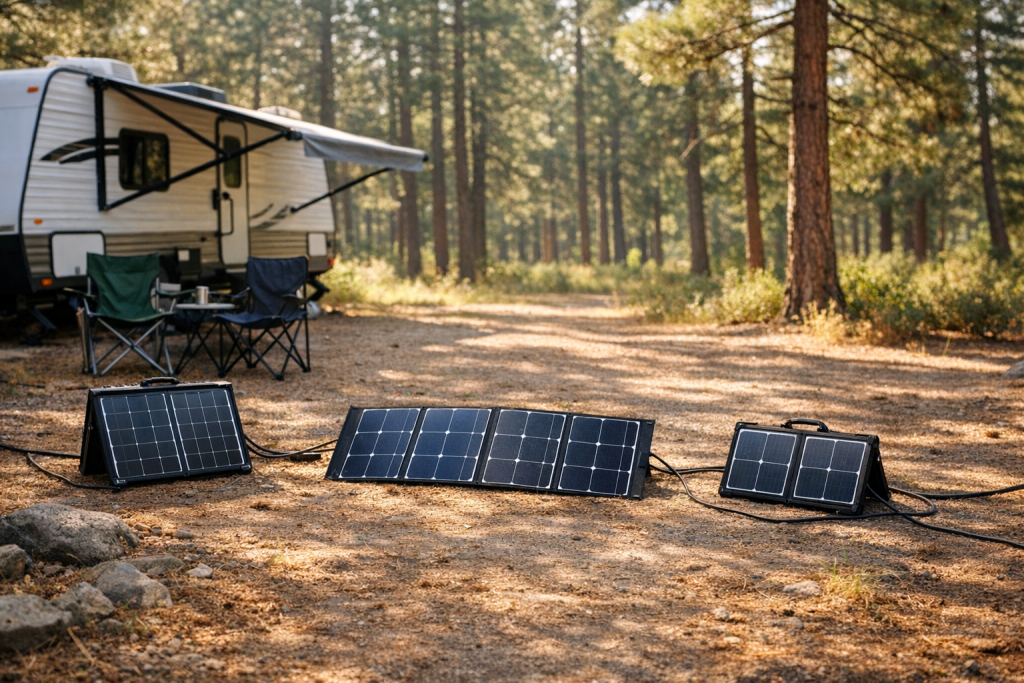

You’ve just pulled into a dispersed campsite with no hookups, and your RV’s house battery is sitting at 60 percent. You need enough solar to keep the fridge cold, the lights on, and your devices charged—without bolting a massive array to your roof or blowing your budget. A 200W RV solar kit hits that sweet spot: roughly 800–1,000 Wh of daily harvest in peak summer sun, enough to sustain moderate off-grid living, yet compact and affordable enough for a single-weekend install. Below, we break down the best 200W RV solar kits by the specific camping scenario each one serves best.
TL;DR
- Best Overall: Renogy 200W 12V Monocrystalline Solar Kit — Complete kit with 30A PWM controller, all wiring, and proven reliability for roof-mounted RV setups.
- Best Budget: ECO-WORTHY 200W 12V/24V Solar Panel Kit — Affordable monocrystalline kit with dual-voltage support and a solid charge controller for cost-conscious campers.
- Best for Curved Roofs: BougeRV 200W Flexible Solar Kit — Ultra-thin, lightweight panels that conform to curved RV roofs and fiberglass surfaces.
- Best for Expandability: Rich Solar MEGA 200 Panel Kit — High-efficiency cells and robust build designed to scale into a larger array over time.
- Best for Portable Use: ACOPOWER 200W Portable Solar Kit — Foldable suitcase-style panels you can angle toward the sun without any roof mounting.
Renogy 200W 12V Monocrystalline Solar Kit
Best for: The all-around boondocker who wants a proven, roof-mounted system out of the box.
Renogy’s 200W kit has become the default recommendation in RV solar forums for good reason. It ships with two 100W monocrystalline panels (each roughly 42.2 × 19.6 × 1.4 in), a Renogy Wanderer 30A PWM charge controller, Z-brackets for flush roof mounting, 20 ft of 10 AWG tray cable, and all necessary MC4 connectors and fuses. The panels carry a rated efficiency of approximately 21 percent, and each weighs about 14.3 lb—light enough for one person to lift onto the roof.
In real-world conditions with five peak sun hours, expect roughly 800–900 Wh per day. That comfortably powers a 12V compressor fridge (drawing around 30–45 Ah/day), LED lighting, phone and laptop charging, and a water pump. Renogy backs the panels with a 25-year performance warranty and a 5-year material warranty, and the Wanderer controller includes battery-type presets for AGM, gel, sealed, lithium, and flooded batteries.
The main trade-off is the PWM charge controller. A PWM unit is simpler and cheaper but leaves roughly 15–30 percent of potential harvest on the table compared to an MPPT controller. If you plan to stay at 200W, the included Wanderer is perfectly adequate. If you intend to expand to 400W or more, budget for an MPPT upgrade. Renogy sells an MPPT-equipped version of this kit at a higher price point.
Rich Solar MEGA 200 Panel Kit
Best for: The future full-timer who plans to expand beyond 200W.
Rich Solar’s MEGA 200 is a single 200W monocrystalline panel rather than a two-panel setup, measuring approximately 58.7 × 26.8 × 1.4 in. It uses 9-busbar PERC cells rated at up to 22.8 percent efficiency—among the highest in this wattage class. The kit version includes a 20A MPPT charge controller guide, mounting hardware, and wiring.
Why does a single large panel matter for expandability? Fewer junction points mean lower resistance losses, and the MPPT controller can handle additional panels wired in series up to its voltage ceiling (typically 100V open-circuit). You can add a second or third MEGA 200 panel without replacing the controller, scaling your system to 400–600W as your energy appetite grows. The panel’s robust 35 mm aluminum frame and tempered glass also handle highway vibration and hail better than many budget alternatives.
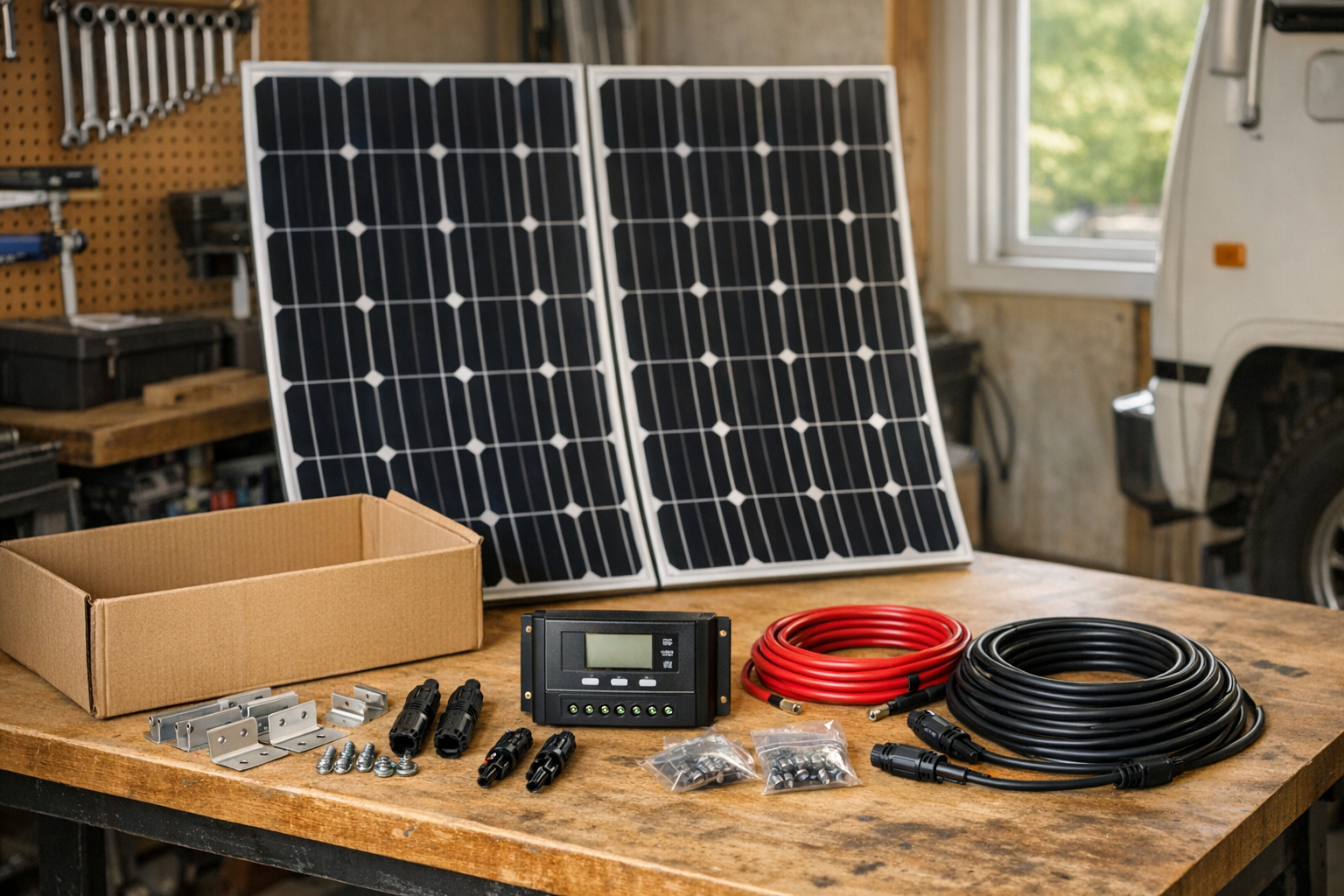
The downside: a single 200W panel is physically larger and heavier (roughly 26 lb) than two 100W panels, making solo installation trickier. You also need a roof section free of vents and AC units that can accommodate the nearly 5-foot length. For smaller Class B vans, this can be a tight fit.
ECO-WORTHY 200W 12V/24V Solar Panel Kit
Best for: The budget-conscious weekend camper who needs reliable power without premium pricing.
ECO-WORTHY consistently undercuts the competition on price while delivering respectable performance. This kit includes two 100W monocrystalline panels, a 30A PWM charge controller with LCD display, Z-bracket mounts, 16 ft of solar cable, and MC4 connectors. The panels feature multi-busbar cells with an efficiency rating around 21 percent and carry an IP65-rated junction box for weather resistance.
A standout feature is dual-voltage compatibility: wire the two panels in parallel for a 12V system or in series for a 24V system. If you ever upgrade your RV’s battery bank to 24V (common with larger lithium setups), you won’t need new panels. Daily output in five peak sun hours runs approximately 750–900 Wh at 12V—enough for lights, fans, device charging, and a small fridge.
Where ECO-WORTHY cuts costs is in the charge controller. The included PWM unit is functional but basic; it lacks Bluetooth monitoring and the temperature compensation sensor that higher-end controllers offer. The mounting brackets are also thinner-gauge aluminum than Renogy’s. For weekend warriors who aren’t pushing their system to the limit, these compromises are easy to live with. For full-timers in extreme heat or cold, consider swapping in an aftermarket MPPT controller.
ACOPOWER 200W Portable Solar Kit
Best for: The ground-camper or renter who can’t (or won’t) drill into the roof.
ACOPOWER’s 200W portable kit consists of two foldable 100W monocrystalline suitcase panels, each with a built-in kickstand and a carrying handle. The kit includes a 20A waterproof charge controller with an LCD screen, alligator clips for direct battery connection, and a 15 ft extension cable with MC4 connectors.
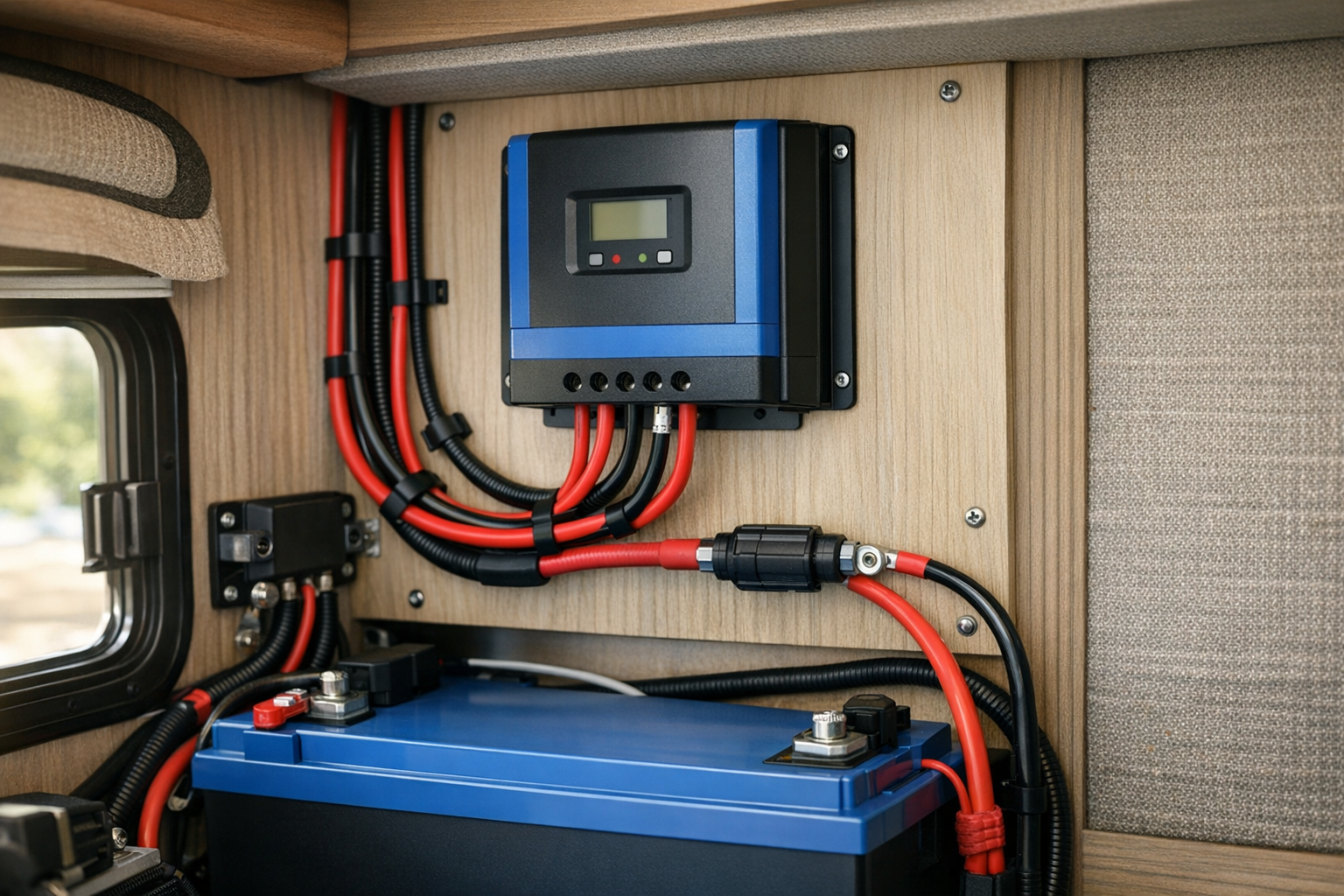
Portability changes the solar equation entirely. Instead of being locked into whatever angle your parked RV’s roof happens to face, you set the panels on the ground and tilt them directly at the sun. In practice, this can boost daily harvest by 20–30 percent compared to a flat roof-mounted panel, because you eliminate the cosine losses from a non-optimal tilt angle. Each folded panel measures roughly 21 × 20 × 2.5 in and weighs about 15 lb—manageable for carrying from your RV to a sunny clearing.
The trade-off is obvious: you must deploy and retrieve the panels every time you set up or break camp, and they’re vulnerable to wind, theft, and accidental damage while sitting on the ground. If you’re a park-and-stay boondocker, the extra effort pays off. If you move daily, a roof-mounted kit will save you significant hassle.
BougeRV 200W Flexible Solar Kit
Best for: Curved-roof vans, pop-up campers, and weight-sensitive rigs.
BougeRV’s flexible 200W kit uses two thin-film-style monocrystalline panels that can bend up to 248 degrees (a roughly 30-degree arc), making them ideal for the curved roofs of Airstreams, teardrop trailers, and Class B camper vans. Each panel is only about 0.1 in thick and weighs roughly 6.2 lb—less than half the weight of a comparable rigid panel. The kit ships with a 30A PWM charge controller, adhesive mounting pads, and MC4 cabling.
Flexible panels adhere directly to the roof surface with VHB tape or Dicor sealant, eliminating drill holes that risk delamination on fiberglass or composite roofs. The low-profile installation also adds virtually no wind resistance—a real benefit for aerodynamic vans and lightweight trailers.
The caveat: flexible panels typically run 1–3 percent lower in conversion efficiency than rigid counterparts, and their lifespan is shorter—most manufacturers warrant them for 5–10 years versus 25 years for rigid glass panels. Heat dissipation is also a concern; because flexible panels sit flush against the roof with no air gap, they can run hotter, reducing output by roughly 0.3–0.5 percent per degree Celsius above 25 °C. If your roof is flat with good airflow underneath, rigid panels will outperform and outlast flexible ones. But if your roof is curved or you’re weight-limited, BougeRV’s kit is the practical choice.
Newpowa 200W 12V Monocrystalline Solar Kit
Best for: The value hunter who wants MPPT efficiency at a mid-range price.
Newpowa’s 200W kit pairs two 100W monocrystalline panels with a 20A MPPT charge controller guide—a combination that’s hard to find at this price tier. The panels use half-cut cell technology, which reduces internal resistance and improves shade tolerance compared to full-cell designs. Each panel measures approximately 40.2 × 20.1 × 1.2 in and weighs about 13.7 lb.
The included MPPT controller is the star here. In partial-shade conditions or during early morning and late afternoon hours when panel voltage is high but current is low, an MPPT controller converts that excess voltage into usable current, squeezing out 15–30 percent more energy than a PWM unit. Over a full day of mixed sun, that can mean the difference between a fully charged battery and one still at 80 percent by sundown.
Newpowa is a smaller brand than Renogy, which means fewer accessories in the ecosystem and a smaller support community. The mounting hardware is adequate but not premium, and the wiring length (16 ft) may be tight for larger Class A or fifth-wheel rigs. Still, for the camper who wants MPPT performance without paying Renogy’s MPPT-kit premium, Newpowa delivers genuine value.
Comparison Table
| Model | Type | Key Specs | Best for | Pros | Cons | Where to buy |
|---|---|---|---|---|---|---|
| Renogy 200W 12V Monocrystalline Kit | Rigid (2 × 100W) | ~21% eff.; 30A PWM controller; 25-yr panel warranty | All-around boondocking | Complete kit; proven reliability; wide accessory ecosystem | PWM controller leaves energy on the table; MPPT version costs more | Amazon ↗ |
| Rich Solar MEGA 200 Panel Kit | Rigid (1 × 200W) | ~22.8% eff. (PERC); 20A MPPT controller; 35 mm frame | Expandable full-time systems | High efficiency; MPPT included; scales to 600W+ | Large single panel harder to solo-install; tight fit on small roofs | Amazon ↗ |
| ECO-WORTHY 200W 12V/24V Kit | Rigid (2 × 100W) | ~21% eff.; 30A PWM controller; 12V/24V compatible | Budget weekend camping | Low price; dual-voltage wiring; IP65 junction box | Basic PWM controller; thinner mounting brackets | Amazon ↗ |
| ACOPOWER 200W Portable Kit | Portable/Foldable (2 × 100W) | ~21% eff.; 20A controller; built-in kickstands; 15 ft cable | No-drill ground deployment | Angle toward sun for 20–30% more harvest; no roof penetrations | Must deploy/retrieve each use; vulnerable to wind and theft | Amazon ↗ |
| BougeRV 200W Flexible Kit | Flexible (2 × 100W) | ~19–20% eff.; 30A PWM controller; bends to ~30°; ~6.2 lb/panel | Curved roofs & lightweight rigs | Ultra-light; no drill mounting; low profile | Shorter lifespan (5–10 yr); runs hotter without air gap | Amazon ↗ |
| Newpowa 200W 12V Monocrystalline Kit | Rigid (2 × 100W) | ~21% eff. (half-cut cells); 20A MPPT controller; 13.7 lb/panel | Mid-range MPPT value | MPPT controller included at mid-range price; half-cut cell shade tolerance | Smaller brand ecosystem; 16 ft wiring may be short for large rigs | Amazon ↗ |
Which One Should You Buy?
Weekend boondocking with a standard travel trailer or Class C: The Renogy 200W 12V kit is the safest bet. Its two-panel design distributes weight evenly on the roof, the included PWM controller handles a single 12V battery bank with ease, and the Z-bracket mounting system is straightforward for a first-time installer. The massive Renogy accessory catalog means you can add Bluetooth monitoring modules, fuse boxes, and additional panels without mixing brands.
Full-time living or plans to grow the system: Go with the Rich Solar MEGA 200 kit. The included MPPT controller and high-efficiency PERC cells give you the best energy harvest per square foot right now, and the controller’s higher voltage ceiling means you can wire additional panels in series later without swapping hardware. Full-timers typically need 400–600W to cover air-conditioner-free summer days; starting with the MEGA 200 and adding a second panel in six months is a clean upgrade path.

Tight budget, occasional use: The ECO-WORTHY 200W kit delivers roughly 90 percent of the Renogy experience at a noticeably lower price. The dual 12V/24V wiring option future-proofs you if you ever move to a 24V lithium battery bank. For a camper who heads out two or three weekends a month, the lighter-gauge brackets and basic PWM controller are negligible compromises.
Renting your RV or refusing roof penetrations: The ACOPOWER 200W portable kit is your answer. No drilling, no sealant, no permanent modification. The ability to tilt panels optimally can actually out-produce a flat roof-mounted system of the same wattage. The downside is the daily setup and teardown ritual—fine for a weekend, tedious for a month-long trip.
Curved roof or extreme weight sensitivity: BougeRV’s flexible panels weigh less than 13 lb combined for the pair and conform to Airstream curves, pop-up camper lids, and fiberglass van tops. Accept the shorter warranty and slightly lower efficiency as the price of admission for a no-drill, ultra-low-profile installation.
Best value with MPPT performance: Newpowa’s kit bundles an MPPT controller at a price point where most competitors include only PWM. If you camp in areas with frequent partial shade—forest clearings, mountain valleys—the MPPT controller’s ability to convert excess voltage into current will recoup its cost difference within a season. The half-cut cell design also reduces power loss when a branch shadow falls across part of a panel.
One universal consideration: battery type. All six kits work with AGM, gel, and flooded lead-acid batteries. If you’re running lithium (LiFePO4), verify that the included charge controller has a lithium profile or plan to replace it with one that does. Charging a lithium battery with an incorrect absorption voltage can reduce its lifespan or trigger the BMS to disconnect.
Safety & Common Mistakes
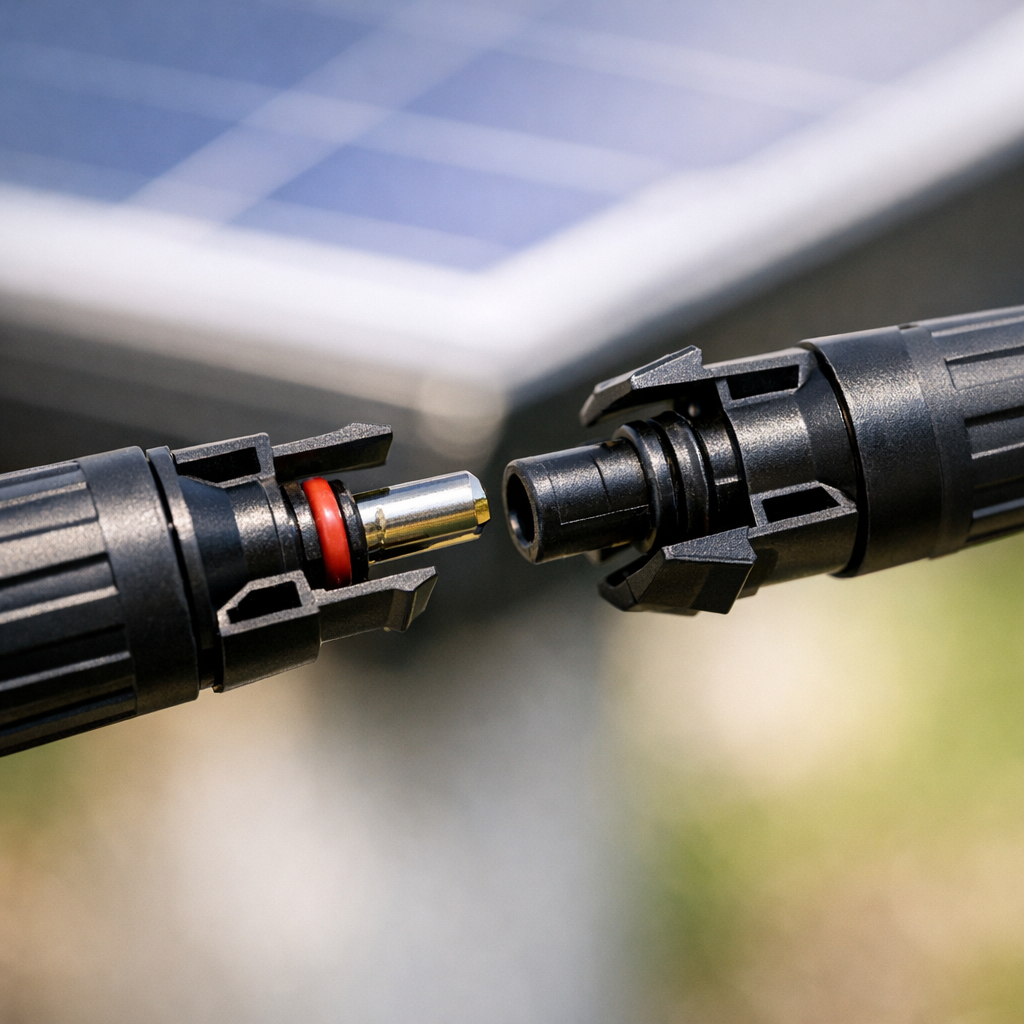
- Skipping the fuse between controller and battery. A 200W system at 12V can push over 16A. Without an inline fuse (typically 25–30A) on the positive cable between the charge controller and the battery, a short circuit can melt wiring or start a fire. Most kits include a fuse—install it.
- Connecting panels before the battery. Always connect the charge controller to the battery first, then connect the solar panels. Connecting panels first can send unregulated voltage into the controller and damage its capacitors. Disconnection order is the reverse: panels off first, then battery.
- Using undersized wire for long runs. If your panels are on the roof and your battery is 25+ ft away, the 10 AWG or 12 AWG cable included in most kits may cause excessive voltage drop (more than 3%). Calculate voltage drop for your specific run length and upgrade to 8 AWG or 6 AWG if needed.
- Mounting flexible panels without an air gap. Flexible panels glued flat to a dark roof can reach surface temperatures above 70 °C (158 °F), dramatically reducing output and accelerating degradation. Where possible, use standoff mounts or adhesive strips that create even a 0.5 in air gap for passive cooling.
- Ignoring roof sealant maintenance. Every bolt hole you drill for Z-brackets is a potential leak point. Use self-leveling Dicor sealant (not silicone) around all roof penetrations and inspect it at least twice a year. UV exposure causes sealant to crack over time.
- Mixing panel brands or wattages in parallel. Connecting panels from different manufacturers can create current mismatch if their voltage-at-max-power (Vmp) values differ. Stick with matched panels from the same kit, or verify that Vmp values are within 0.5V of each other before paralleling.
Always follow the charge controller manufacturer’s wiring instructions and local electrical codes. If you are unsure about any step, consult a certified RV electrician.
Recommended Gear
- Victron SmartSolar MPPT 100/30 — View on Amazon
- Renogy 100W Monocrystalline Panel — View on Amazon
- Battle Born 100Ah LiFePO4 Battery — View on Amazon
FAQs
- Is 200W of solar enough for an RV? For moderate use—LED lights, a 12V compressor fridge, phone and laptop charging, a water pump, and a vent fan—200W is sufficient. In five peak sun hours, a 200W kit produces roughly 800–1,000 Wh per day, which translates to about 65–83 Ah into a 12V battery. That covers the daily draw of most weekend and part-time boondockers. Full-timers running a microwave, hair dryer, or residential fridge through an inverter will need 400W or more.
- How many batteries can a 200W solar kit charge? A 200W kit can effectively maintain one to two 100 Ah 12V batteries. With five peak sun hours, you’ll harvest approximately 65–83 Ah per day. A single 100 Ah lead-acid battery discharged to 50 percent (the safe depth-of-discharge floor) needs about 50 Ah to refill—well within the kit’s daily capacity. Two batteries double the storage but also double the potential daily draw, so your consumption habits matter as much as panel output.
- Should I choose a PWM or MPPT charge controller guide for a 200W RV solar kit? An MPPT (Maximum Power Point Tracking) controller harvests 15–30 percent more energy than a PWM (Pulse Width Modulation) controller, especially in cold weather or partial shade when panel voltage is high relative to battery voltage. For a 200W system, the real-world difference can be 100–250 Wh per day. If your kit includes a PWM controller and you’re satisfied with your daily harvest, there’s no urgent need to upgrade. But if you plan to expand or camp in variable conditions, investing in an MPPT controller—or buying a kit that includes one, like the Rich Solar MEGA 200 or Newpowa kit—pays dividends.
- Can a 200W solar panel run an RV air conditioner? Not directly. Even a small RV rooftop AC unit draws 1,200–1,500W while running and surges to 2,000–3,000W at startup. A 200W solar kit produces a maximum of 200W instantaneously—far short of the AC’s demand. You would need a very large battery bank (400 Ah+ lithium), a powerful inverter (3,000W+), and significantly more solar (800–1,200W minimum) to run an AC unit for any meaningful duration off-grid.
- Are flexible 200W solar panels as good as rigid ones for RV use? Flexible panels are lighter (often 50–60 percent less weight), thinner, and conform to curved surfaces—clear advantages for vans, pop-ups, and weight-sensitive rigs. However, rigid monocrystalline panels generally deliver 1–3 percent higher efficiency, dissipate heat better thanks to their aluminum frame and air gap, and last significantly longer (25-year warranties versus 5–10 years for most flexible panels). If your roof is flat and can handle the weight, rigid panels are the better long-term investment. If your roof is curved or you can’t drill, flexible panels are the practical solution.
- How long does it take to install a 200W RV solar kit? A basic roof-mounted installation with two 100W rigid panels, Z-brackets, and a PWM or MPPT controller typically takes two to four hours for someone with basic DIY skills. The main steps are: positioning and drilling bracket holes, sealing penetrations with Dicor, running cables through the roof via a cable entry plate, mounting the charge controller inside, and wiring the controller to the battery and panels. Portable kits require no installation—just unfold, connect, and charge. Flexible panel kits usually take one to two hours since you’re adhering panels with tape or adhesive rather than drilling brackets.
As an Amazon Associate, we earn from qualifying purchases. This helps keep SunAmpRV running.