

Flexible solar panels have become the go-to solution for RV owners who need lightweight, low-profile power generation without the bulk and weight of traditional rigid panels. These thin-film and monocrystalline PERC modules conform to curved roofs, weigh 70–80% less than glass-framed alternatives, and eliminate the need for bulky mounting hardware.
TL;DR — Best Picks
Best Overall: Renogy 175W Flexible Panel – Highest efficiency (22.8%) with robust 25-year output warranty and proven durability.
Best Budget: Rich Solar 100W Flexible Panel – Solid 23% efficiency at approximately half the cost per watt of premium competitors.
Best for Curved Roofs: BougeRV Yuma 200W CIGS – Ultra-thin 2mm profile with 248° flex arc for extreme contours.
Buyer’s Guide
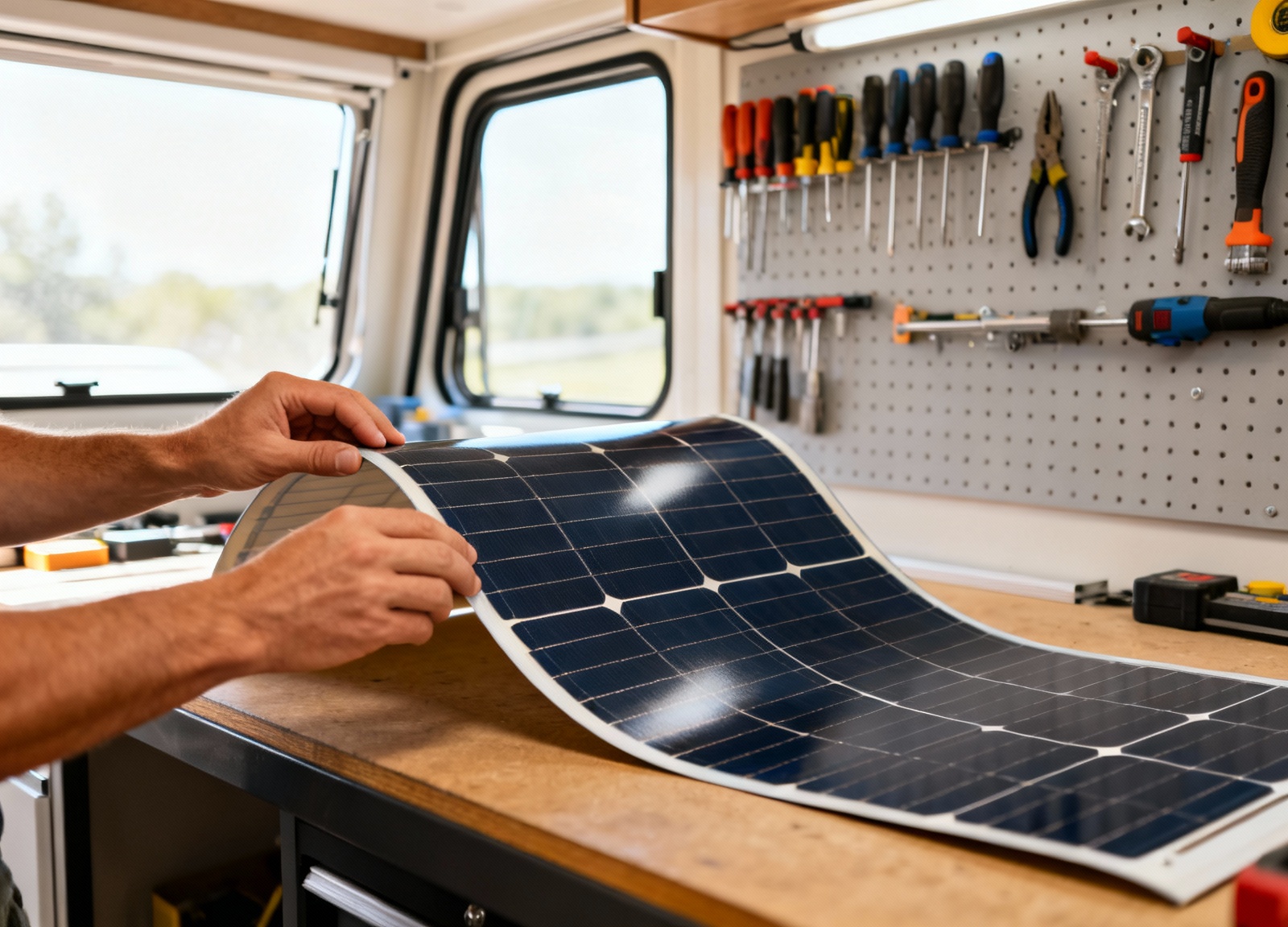
Power & Sizing
Calculate your daily watt-hour (Wh) consumption first. A typical RV running LED lights, a 12V fridge, phone chargers, and a laptop might consume 800–1,200 Wh/day. Divide by average sun-hours (4–6 hours in most US locations) to determine minimum panel wattage:
- 1,000 Wh ÷ 5 sun-hours = 200W minimum array
- Add 20–25% buffer for system losses (controller efficiency, wiring, temperature derating)
- Target 240–300W for a 1,000 Wh/day load
Flexible panels typically range from 50W to 200W per unit. Larger rigs often combine multiple 100W or 175W panels in series or parallel configurations to reach 400–600W total capacity.
Cell Technology Comparison
Three primary technologies dominate the flexible panel market:
- Monocrystalline PERC: 21–23% efficiency; best power density; most common choice
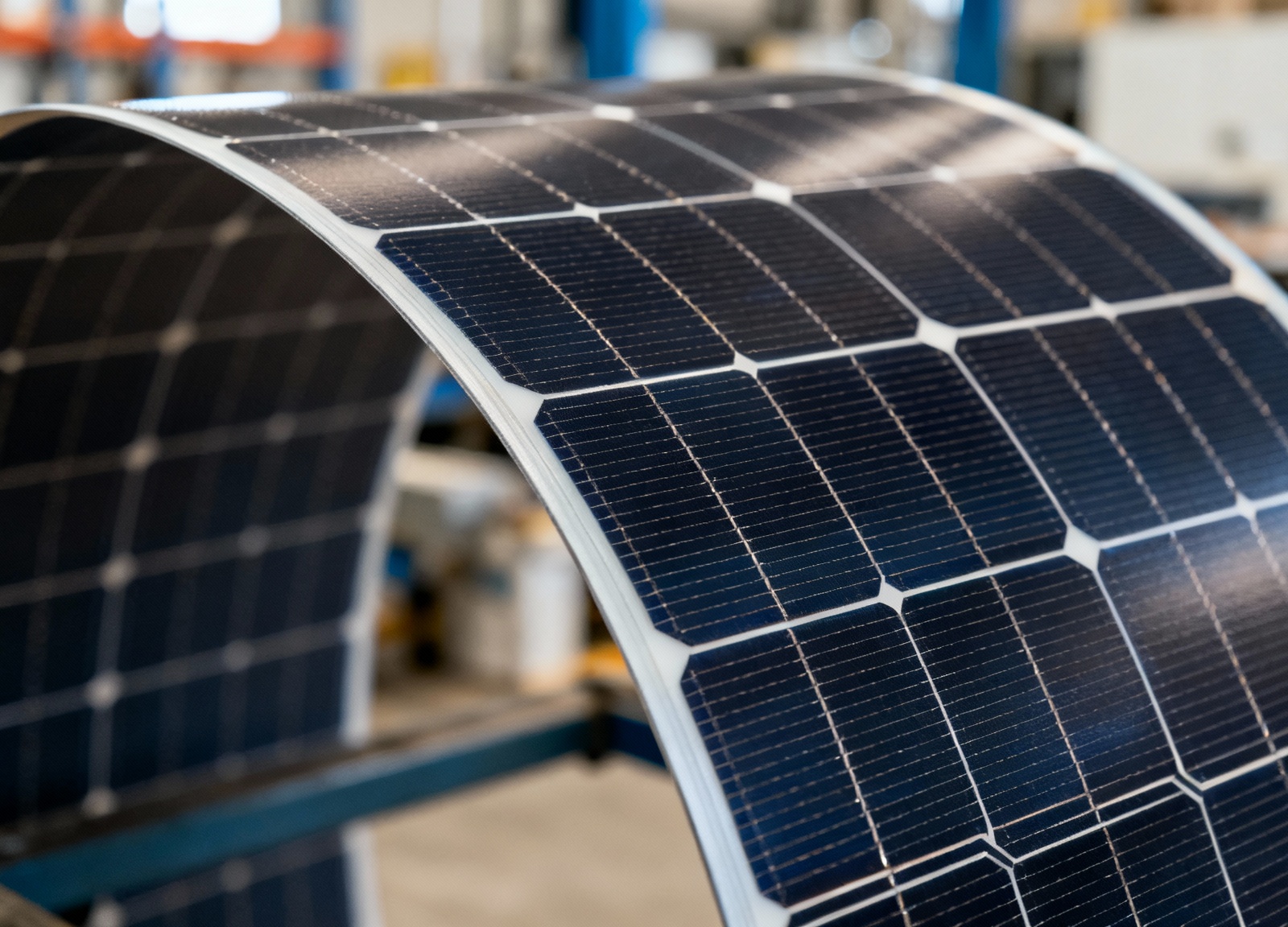
- CIGS Thin-Film: 15–17% efficiency; superior flexibility (down to 2mm thickness); better shade tolerance
- Maxeon IBC: 23–24% efficiency; lowest degradation rate (~0.25%/year); premium pricing
For most RV applications, monocrystalline PERC offers the optimal balance of efficiency, durability, and cost. CIGS excels on severely curved surfaces like Airstream roofs or pop-up camper lids where standard panels cannot conform.
Mounting & Adhesion Methods
Flexible panels require careful mounting to prevent delamination and ensure longevity:
- VHB tape: 3M VHB 4991 (2.3mm thickness) provides strong adhesion; clean surface with isopropyl alcohol first
- Sikaflex 252: Polyurethane adhesive allows slight flex; apply in beads, not full coverage
- Mechanical fasteners: Stainless steel screws with EPDM washers through grommets; requires sealant
- Z-brackets: Creates air gap for cooling; adds 1–2″ height but improves thermal performance
Direct adhesion without an air gap can increase panel temperature by 15–25°C, reducing output by 8–12%. Consider Z-brackets or standoffs if roof space permits.
Compatibility (MPPT/Inverter)
Match your panel array voltage to your charge controller’s input range:
- 12V battery systems: Panels with 18–22V Vmp work well; series strings should not exceed controller Voc limits
- 24V battery systems: Wire two 12V-nominal panels in series (36–44V Vmp)
- MPPT controllers: Accept wider voltage ranges (up to 100–150V input on common models); more efficient with higher-voltage strings
- PWM controllers: Require panel Vmp close to battery voltage; waste excess voltage as heat
Always verify your controller’s maximum input voltage (Voc) rating. Cold temperatures increase Voc by approximately 0.3%/°C below STC (25°C). A panel rated at 24V Voc could reach 28–30V in freezing conditions.
Weight & Structural Considerations
Flexible panels weigh 2–4 lbs per 100W versus 15–20 lbs for equivalent rigid panels.
This matters for roof load limits on older RVs (typically 300–500 lbs distributed), fuel economy (every 100 lbs reduces MPG by ~1–2%), and center of gravity on Class B vans and truck campers.
A 400W flexible array weighs approximately 16–20 lbs total versus 60–80 lbs for rigid equivalents—a meaningful difference for weight-sensitive builds.
Warranty & Degradation
Flexible panel warranties vary significantly:
- Budget tier: 1–5 year product warranty; 80% output at 10 years
- Mid-range: 5–10 year product warranty; 80% output at 15–20 years
- Premium: 25-year linear warranty; 92% at year 1, 0.25–0.5% annual degradation
Real-world degradation on flexible panels often exceeds manufacturer claims due to thermal stress from direct adhesion. Expect 1–2% annual degradation in typical RV installations versus 0.5% for properly ventilated rigid panels.
Product Details
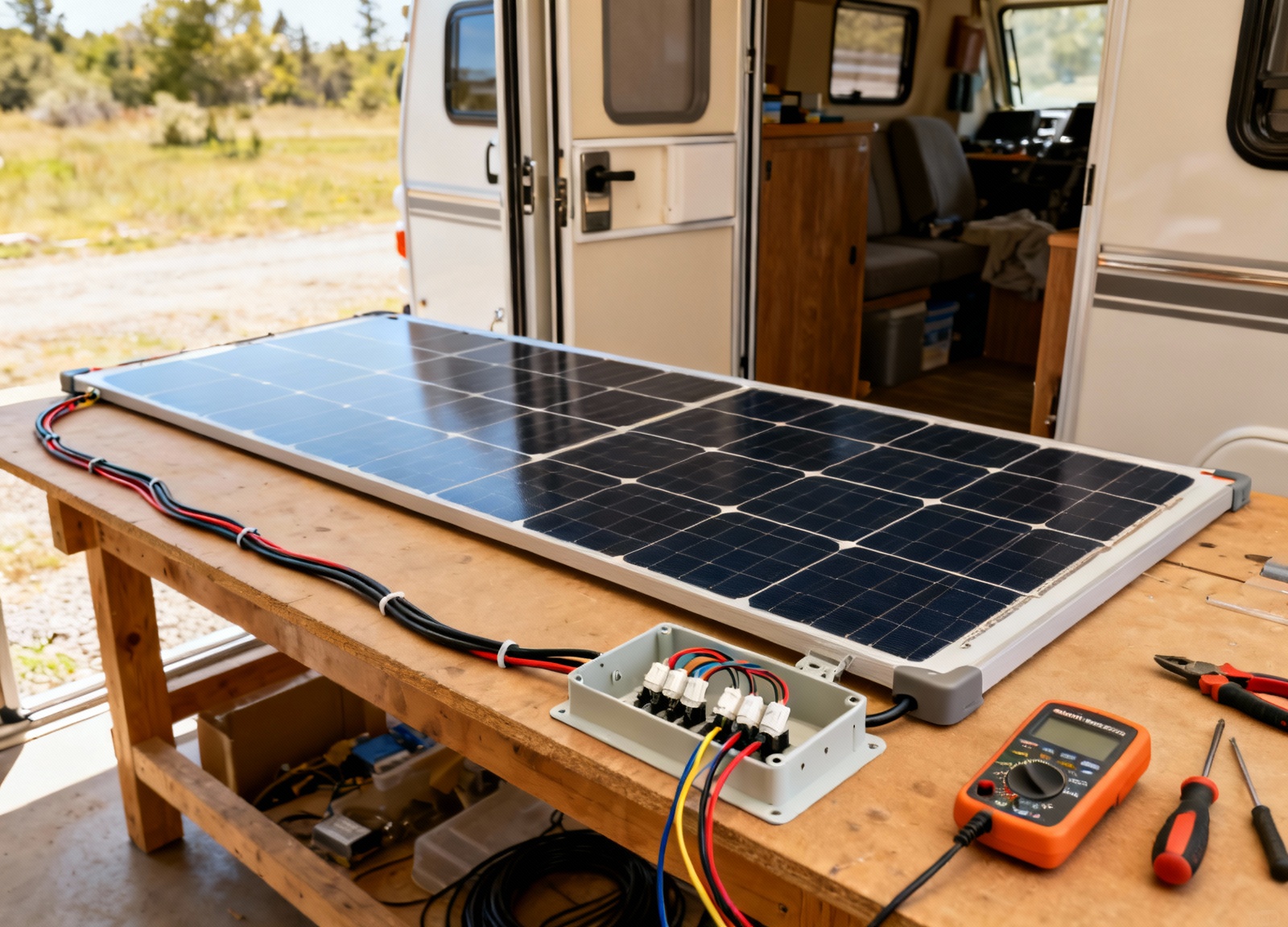
Renogy 175W Flexible Panel
Key specs: 175W, 19.8V Vmp, 8.84A Imp, 24.3V Voc, 9.72A Isc, 6.2 lbs, 59.1″ × 26.7″ × 0.08″, 25-year output warranty. View on Amazon
- 22.8% cell efficiency using Grade A monocrystalline PERC cells
- IP68-rated junction box with integrated bypass diodes for shade tolerance
- ETFE lamination rated for 2,400 Pa snow load and 2,400 Pa wind load
- Pre-installed MC4 connectors with 3-foot leads
- Flex radius down to 248° (approximately 30° bend)
- Pro: Best-in-class efficiency for monocrystalline flexible panels; extensive warranty coverage
- Pro: Proven track record with thousands of RV installations
- Con: Premium pricing at approximately $1.40–1.60/W
- Con: Larger footprint may not fit smaller RV roofs
Rich Solar 100W Flexible Panel
Key specs: 100W, 18.9V Vmp, 5.29A Imp, 22.8V Voc, 5.59A Isc, 4.8 lbs, 40.6″ × 21.3″ × 0.1″, 5-year product warranty. View on Amazon
- 23% cell efficiency with monocrystalline silicon
- TPT back sheet with ETFE front lamination
- Flex capability up to 30° arc
- IP67-rated junction box
- Price point typically $80–100 per panel
- Pro: Excellent value at approximately $0.80–1.00/W
- Pro: Compact size fits between roof vents and AC units
- Con: Shorter warranty than premium alternatives
- Con: Junction box is IP67 (not IP68), so it’s less sealed than top-tier waterproof models
BougeRV Yuma 200W CIGS Panel
Key specs: 200W, 24.0V Vmp, 8.52A Imp, 30.4V Voc, 9.48A Isc, 5.95 lbs, 82.77″ × 27.14″ × 0.06″, 10-year product warranty. View on Amazon
- CIGS (Copper Indium Gallium Selenide) thin-film technology
- 2mm total thickness—thinnest flexible panel available
- 360° flexible design for extreme curvature applications
- Superior partial-shade performance versus crystalline panels
- Higher Vmp suits direct connection to 24V systems
- Pro: Unmatched flexibility for Airstreams, fiberglass trailers, and curved van roofs
- Pro: Better shade tolerance due to thin-film cell architecture
- Con: Lower efficiency (~16%) requires more roof space per watt
- Con: Premium pricing at approximately $1.75–2.00/W
EcoFlow 100W Flexible Panel
Key specs: 100W, 20.3V max, 5.1 lbs, 41.5″ × 24.1″ × 1″, 12-month warranty. View on Amazon
- IP68-rated for superior water and dust resistance
- Designed for seamless integration with EcoFlow Delta and River series
- Includes proprietary XT60 connector plus MC4 adapter
- 23% cell efficiency monocrystalline
- Pro: Plug-and-play with EcoFlow portable power stations
- Pro: Highest IP rating in this comparison
- Con: 12-month warranty is shortest in class
- Con: Proprietary connectors limit compatibility with other systems
SunPower 110W Flexible Panel
Key specs: 110W, 18.8V Vmp, 5.9A Imp, 22.8V Voc, 6.3A Isc, 4.4 lbs, 45.9″ × 21.9″ × 0.1″, 5-year warranty. View on Amazon
- Maxeon IBC (Interdigitated Back Contact) cell technology
- 24.1% cell efficiency—highest in flexible panel category
- 0.25% annual degradation rate (industry-leading)
- Solid copper foundation eliminates corrosion-prone grid lines
- Pro: Best long-term value due to minimal degradation
- Pro: Premium build quality with aerospace-grade materials
- Con: Highest cost at approximately $2.50–3.00/W
- Con: Limited retail availability; often requires direct ordering
Comparison Table
| Model | Type | Key Specs | Best for | Pros | Cons |
|---|---|---|---|---|---|
| Renogy 175W Flexible | Monocrystalline PERC | 175W, 19.8V Vmp, 8.84A Imp, 6.2 lbs, 25-yr warranty | Maximum efficiency seekers | 22.8% cell efficiency; IP68 junction box; bypass diodes | Higher price point; 248° flex only |
| Rich Solar 100W Flexible | Monocrystalline | 100W, 18.9V Vmp, 5.29A Imp, 4.8 lbs, 5-yr warranty | Budget-conscious builds | 23% efficiency; lightweight; affordable $/W | Shorter warranty; smaller wattage per panel |
| BougeRV Yuma 200W CIGS | CIGS Thin-Film | 200W, 24.0V Vmp, 8.52A Imp, 5.95 lbs, 10-yr warranty | Extreme curved surfaces | 2mm thickness; 248° flex arc; shade-tolerant | Lower efficiency (~16%); premium pricing |
| EcoFlow 100W Flexible | Monocrystalline | 100W, 20.3V max, 5.1 lbs, 12-mo warranty | EcoFlow ecosystem users | Plug-and-play with Delta series; IP68 rated | Short warranty; proprietary connectors |
| Renogy 100W Flexible | Monocrystalline | 100W, 20.7V Vmp, 4.84A Imp, 5.3 lbs, 5-yr warranty | Entry-level installations | Proven reliability; wide dealer network | Lower efficiency than 175W sibling |
| SunPower 110W Flexible | Maxeon IBC | 110W, 18.8V Vmp, 5.9A Imp, 4.4 lbs, 5-yr warranty | Premium long-term investment | 24.1% cell efficiency; superior degradation curve | Highest cost; limited availability |
| HQST 100W Flexible | Monocrystalline | 100W, 18.0V Vmp, 5.56A Imp, 4.2 lbs, 5-yr warranty | Value-oriented DIYers | Competitive pricing; decent build quality | Less brand recognition; basic junction box |
Which One Should You Buy?
Your optimal choice depends on three primary factors: budget constraints, roof geometry, and system longevity expectations.
If you prioritize maximum power output per square foot and want proven reliability with strong warranty backing, the Renogy 175W Flexible delivers the best combination of efficiency, durability, and value. Its 22.8% efficiency means fewer panels for equivalent output, and the 25-year warranty provides long-term peace of mind.
Cost-conscious builders should consider the Rich Solar 100W Flexible. It offers compelling value at roughly half the per-watt cost of premium options. The shorter warranty is a trade-off, but the panel’s efficiency and build quality punch above its price point.
Severely curved surfaces demand the BougeRV Yuma 200W CIGS. Airstream trailers, fiberglass pop-ups, and rounded van roofs benefit from its unique ability to conform to extreme contours without stress cracking. The efficiency penalty is offset by its flexibility and shade tolerance.
EcoFlow ecosystem users who want seamless integration with Delta or River power stations will appreciate the EcoFlow 100W Flexible—it eliminates adapter hassles despite its shorter warranty.
Planning a 10+ year installation? The SunPower 110W will likely outperform cheaper alternatives over its lifespan due to its 0.25% annual degradation rate versus 1–2% for standard panels. The premium pricing pays dividends in longevity.
Safety & Common Mistakes
- Install a correctly sized fuse close to the battery positive terminal—typically 15A for 100W panels, 25A for 200W panels at 12V
- Choose wire gauge for expected current and run length; target ≤3% voltage drop (for 10A over 20 feet round-trip at 12V, use minimum 10 AWG)
- Use proper battery and array disconnects; de-energize the system before any work
- Avoid reversed polarity—double-check connections before powering on (reversed polarity can destroy MPPT controllers instantly)
- Provide strain relief for all cables passing through the roof using cable glands or weatherproof entry plates
- Never walk on flexible panels; even brief foot traffic can crack cells and cause invisible micro-fractures
Disclaimer: Always follow manufacturer instructions and local electrical codes. When in doubt, consult a qualified solar installer.
Recommended Gear
- Victron SmartSolar MPPT 100/30 — View on Amazon
- Renogy 100W Monocrystalline Panel — View on Amazon
- Battle Born 100Ah LiFePO4 Battery — View on Amazon
FAQs
- How long do flexible solar panels last on an RV? Expect 10–15 years of useful life with proper installation. Degradation rates of 1–2% annually mean a 100W panel may produce 80–85W after 10 years. Premium panels like SunPower with 0.25% degradation can exceed 20 years of service.
- Can flexible panels handle RV roof temperatures? Yes, but performance decreases approximately 0.4% per degree Celsius above 25°C (STC). On a 60°C (140°F) roof surface, expect 12–15% output reduction. Air gaps from Z-brackets or standoffs reduce this penalty significantly.
- Do flexible panels work with existing rigid panel systems? Yes, provided voltage and current ratings are compatible. Match Vmp within 10% when wiring in parallel. For series connections, ensure total Voc stays below your controller’s maximum input voltage, accounting for cold-weather increases.
- What’s the best adhesive for permanent flexible panel mounting? 3M VHB 4991 tape (2.3mm thickness) or Sikaflex 252 polyurethane adhesive are industry standards. Clean surfaces with isopropyl alcohol, apply in temperatures above 50°F, and allow 72 hours cure time before travel.
- Are flexible panels worth the premium over rigid panels? For weight-sensitive applications, curved roofs, or stealth installations, yes. The 70–80% weight savings and low profile justify the higher per-watt cost. For flat-roof installations where weight isn’t critical, rigid panels offer better long-term value due to lower degradation rates.
- Can I mix different wattage flexible panels in one array? Yes, but with caveats. Parallel connections work best when panels have similar Vmp (within 1V). Series connections require matching Imp (within 0.5A). Mismatched panels reduce overall array efficiency as the weakest panel limits string performance.As an Amazon Associate, we earn from qualifying purchases. This helps keep SunAmpRV running.