
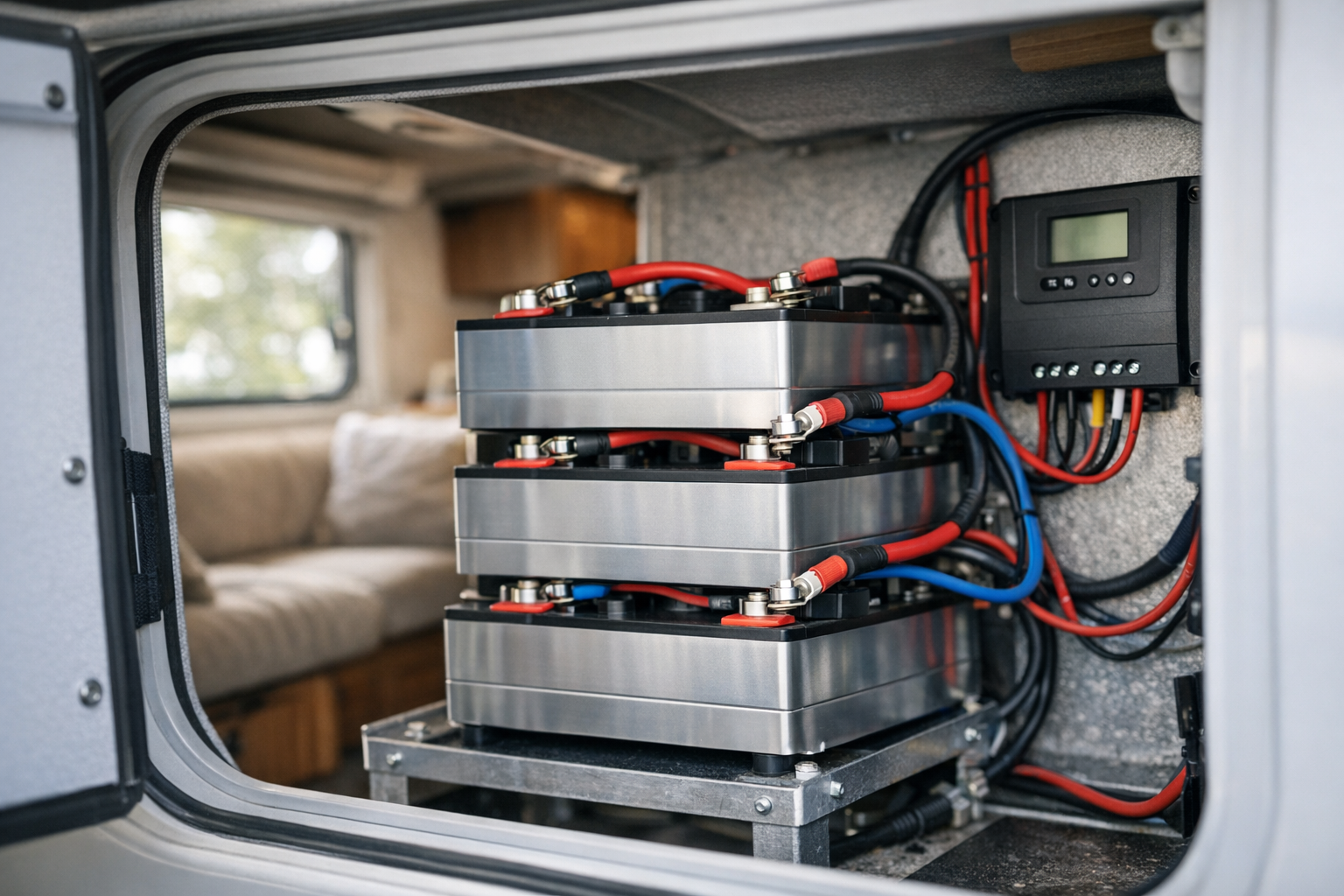
A single 12V compressor fridge cycling in a 95 °F desert campsite can pull 60–70 Ah per day—before you turn on lights, a fan, or charge a laptop. That baseline load is the engineering constraint that makes battery selection the most consequential decision in any RV solar power system. Choosing the wrong chemistry, capacity, or BMS configuration means either hauling dead weight or waking up to a dead fridge at 3 a.m. This guide evaluates the best lithium batteries for RV solar on measurable specs: usable capacity, continuous discharge rate, cycle life, charge acceptance, weight, and BMS protection thresholds.
TL;DR
- Best Overall: Battle Born BB10012 100Ah — Industry-leading 10-year warranty, robust low-temp cutoff BMS, and proven reliability across thousands of RV installs.
- Best Budget: Ampere Time (LiTime) 12V 100Ah — Solid LiFePO4 performance at roughly half the price of premium brands, with 4,000+ cycle rating.
- Best for Large Systems: Epoch Batteries 12V 460Ah — Massive single-unit capacity eliminates complex parallel wiring for high-demand boondocking rigs.
- Best Drop-In Replacement: Renogy 12V 100Ah Smart LiFePO4 — Bluetooth monitoring, Group 31 footprint, and seamless fit in standard RV battery trays.
- Best Lightweight: Rich Solar 12V 100Ah — Only 24.3 lbs, ideal for weight-sensitive Class B vans and truck campers.
Why Lithium Batteries Are the Best Choice for RV Solar
The core advantage of lithium iron phosphate (LiFePO4) over lead-acid in an RV solar system is usable capacity. A 100Ah AGM battery should only be discharged to 50% depth of discharge (DOD) to preserve cycle life, yielding roughly 50 Ah of usable energy. A 100Ah LiFePO4 battery can safely discharge to 80–100% DOD, delivering 80–100 Ah from the same rated capacity. That single difference means you need half the battery bank weight and volume for the same real-world runtime.
Charge acceptance rate is the second critical factor. Lead-acid batteries enter an absorption phase at roughly 80% state of charge, accepting progressively less current. On a partly cloudy day with intermittent solar production, a lead-acid bank may never fully recharge. LiFePO4 cells accept near-full charge current until approximately 95% SOC, so your solar panels spend more available wattage pushing energy into the battery rather than being throttled by rising internal resistance.
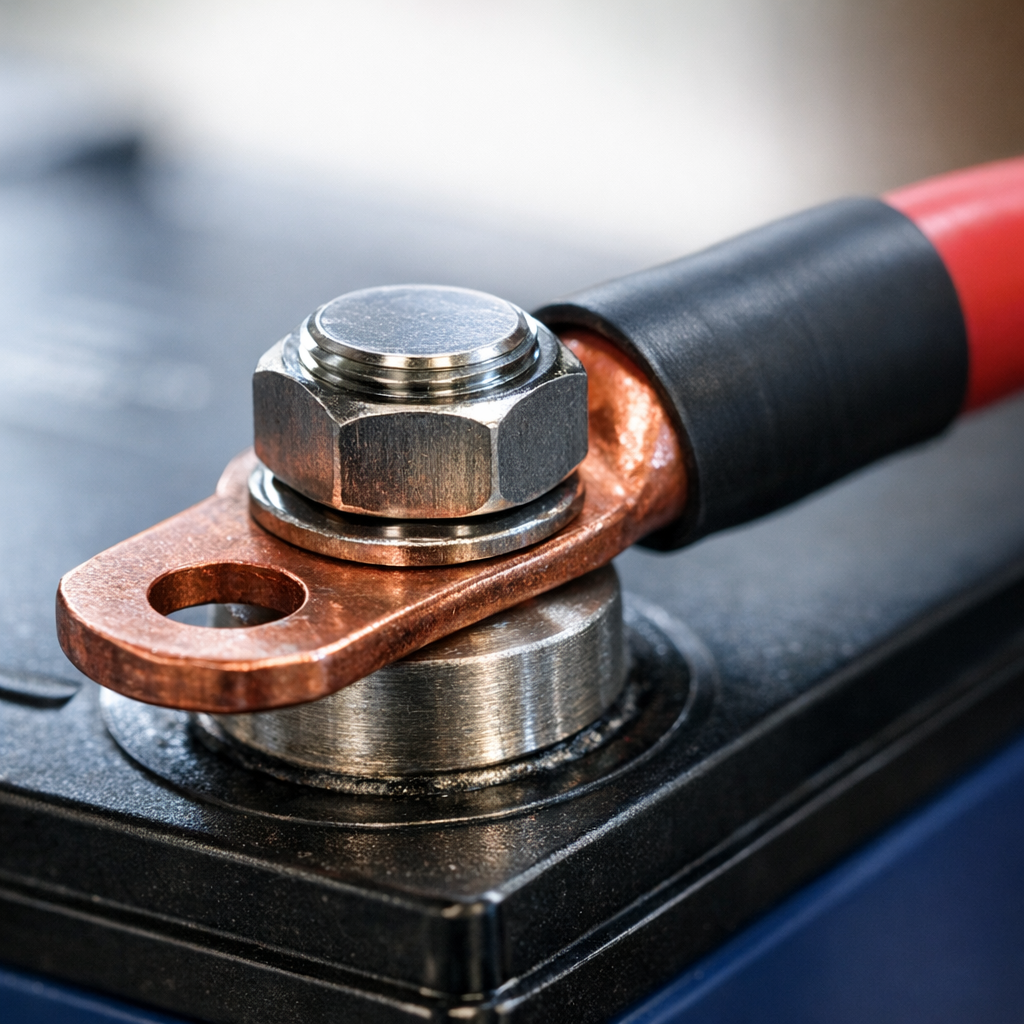
Lithium vs. Lead-Acid: Spec-by-Spec Comparison
Weight matters in RVs. A Group 31 AGM battery weighs 65–75 lbs and delivers ~50 Ah usable. A comparable 100Ah LiFePO4 battery weighs 24–31 lbs and delivers 80–100 Ah usable. For a 400Ah usable bank, you’re looking at roughly 260 lbs of AGM versus 100–125 lbs of lithium—a difference that directly affects payload capacity, fuel economy, and suspension wear.
Cycle life seals the long-term value argument. Quality AGM batteries deliver 300–500 cycles at 50% DOD. LiFePO4 batteries are rated for 3,000–5,000 cycles at 80% DOD. Even at a conservative 3,000-cycle estimate, a lithium battery used once daily lasts over 8 years. The upfront cost premium (typically 2–3× per Ah) is amortized across 6–10× the service life.
Self-discharge rates also favor lithium: AGM loses 3–5% per month sitting idle, while LiFePO4 loses roughly 2–3%. For seasonal RVers who store their rig for months, this reduces the risk of returning to a deeply discharged and potentially damaged bank.
Key Advantages of LiFePO4 Chemistry
LiFePO4 is the specific lithium chemistry recommended for RV solar—and the distinction matters. Unlike lithium cobalt oxide (LiCoO₂) in phones or lithium nickel manganese cobalt (NMC) in some EVs, LiFePO4 has an olivine crystal structure that is thermally stable up to approximately 270 °C (518 °F). Thermal runaway—the cascading exothermic failure that makes some lithium chemistries dangerous—is extremely unlikely under normal operating conditions.
The flat voltage discharge curve is another engineering benefit. A single LiFePO4 cell maintains approximately 3.2–3.3V across 80% of its discharge range, so your 12V appliances receive consistent voltage throughout the battery’s usable capacity. Lead-acid voltage sags progressively, which can cause sensitive electronics to behave erratically or shut down prematurely.
Calculating Your Daily Power Needs
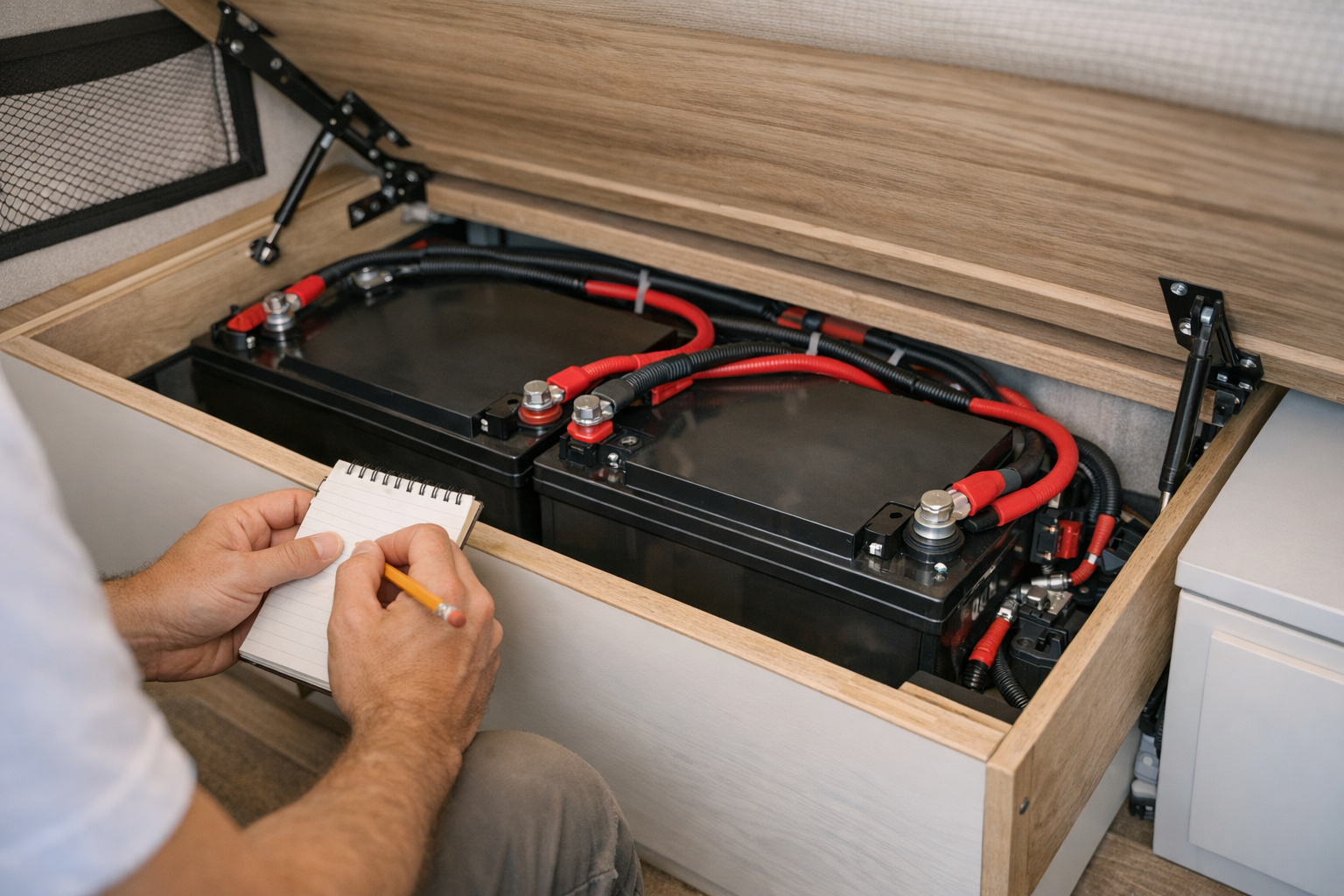
Start with an energy audit. List every 12V load, its current draw in amps, and estimated daily runtime in hours. Multiply amps × hours for each device to get amp-hours per day. A representative boondocking load profile:
- 12V compressor fridge: 4–5A average draw × 12–16 hours cycling = 48–80 Ah/day
- LED lighting: 2A × 5 hours = 10 Ah/day
- Vent fan (MaxxFan or similar): 1.5A × 8 hours = 12 Ah/day
- Phone/laptop charging (via inverter): 3–5A × 3 hours = 9–15 Ah/day
- Water pump: 4A × 0.5 hours = 2 Ah/day
- Inverter standby draw: 0.5–1A × 24 hours = 12–24 Ah/day
Total: approximately 93–143 Ah/day. A moderate boondocking setup typically lands in the 100–150 Ah/day range. Heavy users running residential refrigerators, coffee makers, or CPAP machines can easily exceed 200 Ah/day.
Matching Battery Capacity to Solar Panel Output
Your battery bank must bridge the gap between solar production and consumption, especially during cloudy days or short winter daylight. A common sizing rule: target 1.5–2× your daily consumption in lithium capacity. For a 120 Ah/day load, that means 200–240 Ah of battery. This provides a buffer without requiring a full recharge every single day.
On the solar side, a rough guideline is 100W of panel per 100Ah of lithium capacity in a sun-belt climate. In the Pacific Northwest or during winter, increase to 150–200W per 100Ah. A 400W array paired with a quality MPPT charge controller guide can realistically produce 120–160 Ah/day in good conditions (5–6 peak sun hours × ~80% system efficiency × array current).
One key constraint: your charge controller’s maximum input current must match or exceed your solar array’s output, and its lithium charging profile must be configurable to the correct absorption voltage (typically 14.2–14.6V for a 12V LiFePO4 bank) and float voltage (13.4–13.6V, or disabled entirely, as many LiFePO4 manufacturers recommend).
Best Overall: Battle Born BB10012 100Ah
The Battle Born BB10012 remains the benchmark for RV lithium batteries. Its 100Ah LiFePO4 cells deliver a true 100A continuous discharge rate, and the internal BMS provides protection against overcharge (14.6V cutoff), over-discharge (10.0V cutoff), overcurrent (100A), short circuit, and low-temperature charging (cutoff below 25 °F / −4 °C). That low-temp charge cutoff is critical—charging a lithium cell below freezing causes irreversible lithium plating on the anode.
At 31 lbs, the BB10012 is slightly heavier than some budget competitors but uses automotive-grade prismatic cells and a UL-listed BMS. Battle Born’s 10-year warranty is the longest in the consumer RV lithium market, and their Reno, Nevada-based technical support team is widely praised in RV forums. Up to four units can be wired in parallel (400Ah at 12V) or in series for 24V/48V configurations.
The main drawback is price: the BB10012 typically retails around $925, roughly 3× the cost of budget alternatives per amp-hour. The base model also lacks Bluetooth monitoring—you’ll need a separate battery monitor (Victron BMV-712, for example) or an upgrade to Battle Born’s newer Bluetooth-equipped models.
Best Budget: Ampere Time (LiTime) 12V 100Ah
Ampere Time—now rebranded as LiTime—has gained rapid market share by offering LiFePO4 batteries at aggressive price points without catastrophic quality compromises. The 12V 100Ah model delivers the same nominal capacity as the Battle Born at roughly $240–$300. It uses Grade A prismatic LiFePO4 cells and includes a 100A BMS with overcharge, over-discharge, overcurrent, and short-circuit protection.
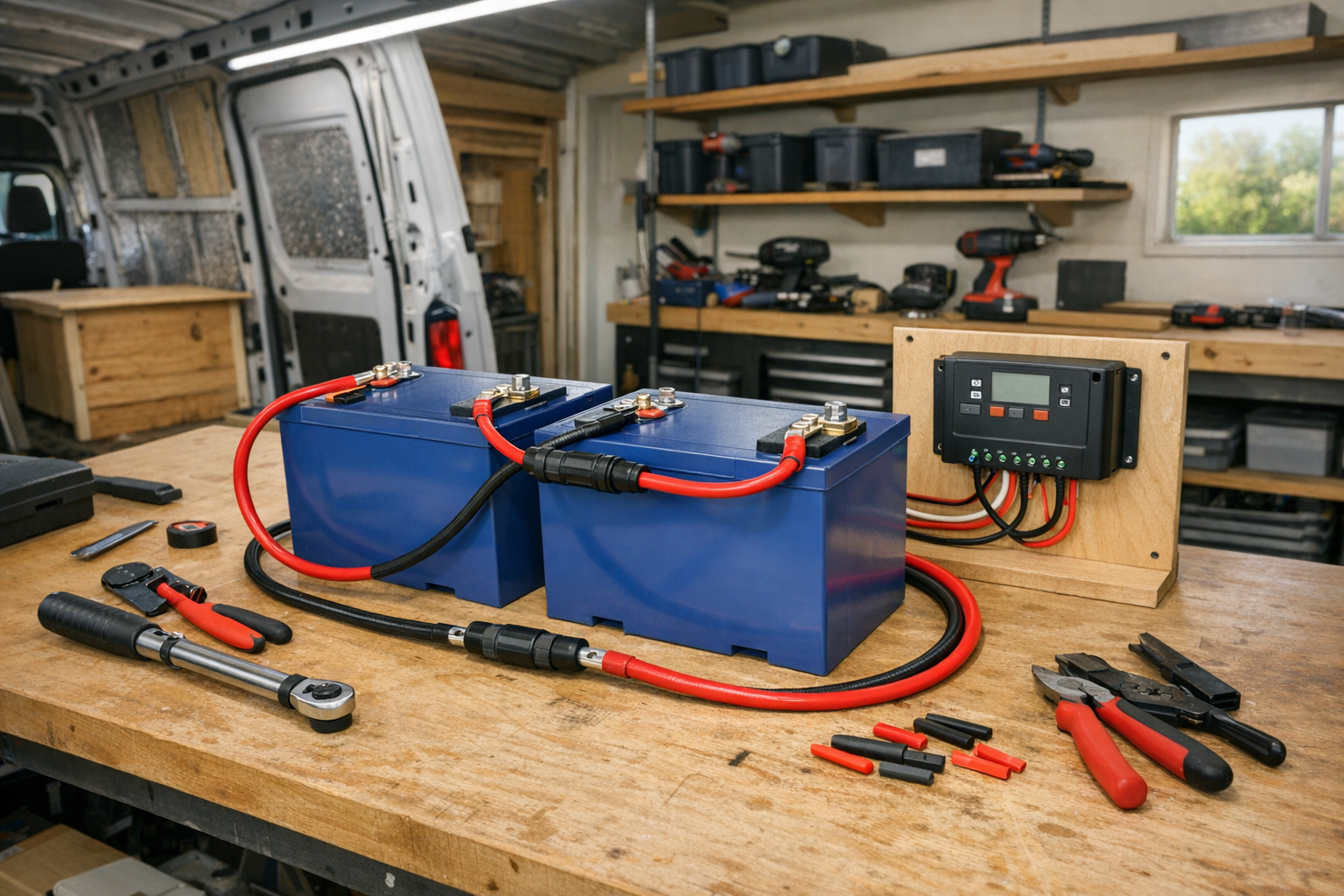
At 24.3 lbs, it’s one of the lightest 100Ah batteries available. The manufacturer rates it for 4,000+ cycles at 100% DOD—a bold claim, and real-world longevity data is still accumulating since the brand is relatively young. The 5-year warranty is respectable but significantly shorter than Battle Born’s 10-year coverage.
Where the LiTime falls short is documentation and support. The BMS low-temperature cutoff threshold is inconsistently specified across product listings (some versions include it, others may not), so verify the specific SKU before purchasing if you camp in freezing conditions. Customer support response times lag behind premium brands. For budget-conscious RVers in temperate climates, however, the value is compelling: you can build a 300Ah bank for less than the cost of a single Battle Born.
Best for Large Systems: Epoch Batteries 12V 460Ah
For RVers running residential refrigerators, air conditioning pre-cooling, or extended off-grid stays, the Epoch 12V 460Ah eliminates the complexity of paralleling multiple smaller batteries. This single unit packs 5,888 Wh—equivalent to nearly five 100Ah batteries—with a 200A continuous discharge BMS. That 200A rating supports inverter loads up to approximately 2,400W continuous at 12V without triggering overcurrent protection.
Epoch offers an optional self-heating feature that activates when cell temperature drops below 41 °F (5 °C), drawing power from the battery itself to warm the cells above the safe charging threshold. Built-in Bluetooth allows real-time monitoring of voltage, current, SOC, temperature, and individual cell voltages via a smartphone app.
The trade-offs are physical. At approximately 120 lbs with dimensions significantly larger than a Group 31 form factor, the Epoch 460Ah requires dedicated mounting space and structural support—it won’t fit a standard RV battery tray. Price is substantial at $2,200+, though on a per-Wh basis it’s competitive with mid-range 100Ah units. The 5,000+ cycle rating and robust BMS make it a serious contender for full-time RVers who need maximum capacity with minimum wiring complexity.
Best Drop-In Replacement: Renogy 12V 100Ah Smart LiFePO4
Renogy’s Smart LiFePO4 100Ah is engineered as a drop-in replacement for Group 31 lead-acid batteries. Its dimensions (13.0 × 6.8 × 8.4 inches) and terminal configuration fit standard RV battery compartments without modification. The integrated Bluetooth module connects to Renogy’s DC Home app, providing real-time SOC, voltage, current, temperature, and cycle count data—eliminating the need for a separate battery monitor in many setups.
The auto-balancing BMS handles cell equalization internally, simplifying parallel configurations. Renogy rates the battery for 4,000 cycles at 80% DOD and backs it with a 5-year warranty. Continuous discharge is rated at 100A with a 200A peak for short bursts. The low-temperature charging cutoff activates at 32 °F (0 °C).
Renogy’s broader solar ecosystem is a practical advantage: their Rover and Wanderer MPPT charge controllers include pre-configured lithium charging profiles that pair seamlessly with this battery. If you’re already using Renogy panels and controllers, integration is essentially plug-and-play. The downside: Bluetooth range is limited to approximately 10 feet, and the battery is slightly heavier at 26 lbs compared to the lightest competitors.
Best Lightweight: Rich Solar 12V 100Ah
For Class B campervans, truck campers, and teardrop trailers where every pound counts, the Rich Solar 12V 100Ah LiFePO4 weighs just 24.3 lbs—roughly one-third the weight of an equivalent AGM. It delivers 100A continuous discharge, includes a BMS with standard protections, and is rated for 3,500+ cycles at 80% DOD.
Rich Solar’s product line includes compatible MPPT charge controllers and solar panels, creating a cohesive ecosystem similar to Renogy’s. The battery supports up to four units in parallel for a 400Ah bank. Pricing typically falls between LiTime and Renogy.
The primary limitation is brand maturity. Rich Solar has a smaller install base than Battle Born or Renogy, which means less community troubleshooting data and fewer long-term reliability reports. Independent teardown and testing data is also limited. For weight-sensitive builds where the spec sheet meets your requirements, it’s a strong option—but buyers who prioritize proven longevity data may prefer a more established brand.
Capacity, Voltage, and Discharge Rate
Nominal capacity (Ah) is the headline spec, but usable capacity depends on the BMS low-voltage cutoff. Most LiFePO4 batteries cut off at 10.0–10.5V, corresponding to approximately 95–100% DOD. Verify the specific cutoff voltage in the datasheet—a battery that cuts off at 11.0V delivers noticeably less usable capacity than one that cuts off at 10.0V.
Continuous discharge rate determines the maximum sustained load. A 100A continuous discharge on a 12V battery supports approximately 1,200W of inverter load. If you plan to run a microwave (1,000–1,500W), coffee maker (800–1,200W), or hair dryer (1,500W+), you need either a higher-rated single battery or multiple batteries in parallel to share the current draw. Peak discharge ratings (often 150–200A for 30 seconds) handle motor startup surges but should not be relied upon for sustained loads.

Built-In BMS and Safety Features
Every quality LiFePO4 RV battery includes a battery management system (BMS) that monitors and protects individual cells. Critical BMS functions to verify before purchasing:
- Overcharge protection: Should cut off charging at 14.4–14.6V (for a 4S configuration).
- Over-discharge protection: Should cut off loads at 10.0–10.5V.
- Overcurrent protection: Must match or exceed your maximum expected load.
- Short-circuit protection: Instantaneous cutoff with auto-reset or manual reset.
- Low-temperature charge cutoff: Must prevent charging below 32 °F (0 °C). This is the single most important safety feature for RV use—charging LiFePO4 cells below freezing causes permanent capacity loss through lithium plating.
- Cell balancing: Active or passive balancing ensures all four cells in a 12V battery maintain equal voltage, preventing premature capacity degradation.
Bluetooth monitoring is increasingly common and genuinely useful. Checking SOC, cell voltages, and temperature from your phone without crawling into a battery compartment is a practical quality-of-life improvement, especially for diagnosing charging issues.
Warranty and Cycle Life
Warranty length is a proxy for manufacturer confidence. Battle Born’s 10-year warranty leads the industry; most competitors offer 5 years. Pay attention to warranty terms: some are prorated after a certain period, and some exclude batteries used in commercial applications (full-time RV living may or may not qualify, depending on the manufacturer’s interpretation).
Cycle life ratings are tested under controlled laboratory conditions (typically 25 °C, specific charge/discharge rates). Real-world cycle life varies with temperature extremes, discharge depth, charge rate, and vibration. A battery rated for 4,000 cycles at 80% DOD in a lab may deliver 3,000 cycles in a hot Arizona RV that regularly sees 110 °F ambient temperatures. Treat published cycle life as an upper bound, not a guarantee.
Comparison Table
| Model | Type | Key Specs | Best for | Pros | Cons | Where to buy |
|---|---|---|---|---|---|---|
| Battle Born BB10012 100Ah | 12V LiFePO4 | 100 Ah | 1,280 Wh | 100A cont. discharge | 31 lbs | 3,000–5,000 cycles | Best Overall | 10-year warranty; UL-listed BMS; excellent tech support; proven track record | Premium price (~$925); no Bluetooth on base model | Amazon ↗ |
| Ampere Time (LiTime) 12V 100Ah | 12V LiFePO4 | 100 Ah | 1,280 Wh | 100A cont. discharge | 24.3 lbs | 4,000+ cycles | Best Budget | Sub-$300 street price; lightweight; 5-year warranty; supports 4S4P paralleling | BMS low-temp cutoff less documented; customer support slower than premium brands | Amazon ↗ |
| Epoch Batteries 12V 460Ah | 12V LiFePO4 | 460 Ah | 5,888 Wh | 200A cont. discharge | ~120 lbs | 5,000+ cycles | Best for Large Systems | Single-unit high capacity; 200A BMS; self-heating option; Bluetooth built-in | Heavy; large footprint; higher upfront cost (~$2,200+) | Amazon ↗ |
| Renogy 12V 100Ah Smart LiFePO4 | 12V LiFePO4 | 100 Ah | 1,280 Wh | 100A cont. discharge | 26 lbs | 4,000 cycles | Best Drop-In Replacement | Bluetooth app monitoring; Group 31 form factor; auto-balancing BMS; 5-year warranty | Slightly heavier than competitors; Bluetooth range limited to ~10 ft | Amazon ↗ |
| Rich Solar 12V 100Ah | 12V LiFePO4 | 100 Ah | 1,280 Wh | 100A cont. discharge | 24.3 lbs | 3,500+ cycles | Best Lightweight | Among the lightest 100Ah options; competitive pricing; good solar ecosystem integration | Smaller brand presence; limited third-party testing data | Amazon ↗ |
| SOK 12V 206Ah | 12V LiFePO4 | 206 Ah | 2,637 Wh | 150A cont. discharge | 47 lbs | 4,000+ cycles | Best Mid-Size Capacity | High capacity in a single case; 150A BMS; Bluetooth; strong community reputation | Heavier; may not fit all standard battery trays; ~$800+ | Amazon ↗ |
Recommended Gear
- Victron SmartSolar MPPT 100/30 — View on Amazon
- Renogy 100W Monocrystalline Panel — View on Amazon
- Battle Born 100Ah LiFePO4 Battery — View on Amazon
FAQs
- How long will a 12V fridge run on a 100Ah lithium battery? A typical 12V compressor RV fridge averages 2.5–4A over 24 hours (cycling on and off). On a fully charged 100Ah LiFePO4 battery discharged to 90% DOD (90 Ah usable), expect approximately 22–36 hours of fridge-only runtime in moderate ambient temperatures (70–80 °F). In extreme heat (95 °F+), compressor run time increases and that window can shrink to 16–24 hours.
- How big of a lithium battery bank do I need for RV boondocking? Size your bank for 1.5–2× your daily consumption. Most moderate boondocking setups consume 100–150 Ah/day, so a 200–300Ah lithium bank provides a comfortable buffer. Full-time boondockers running residential fridges, CPAP machines, or frequent inverter loads should target 400Ah or more.
- Do I need lithium-compatible settings? Ensure your controller supports LiFePO4 profiles and proper voltages.
- What gauge wire should I use for solar? Match wire gauge to amperage and run length; 10 AWG handles 30 A up to about 15 ft.
As an Amazon Associate, we earn from qualifying purchases. This helps keep SunAmpRV running.