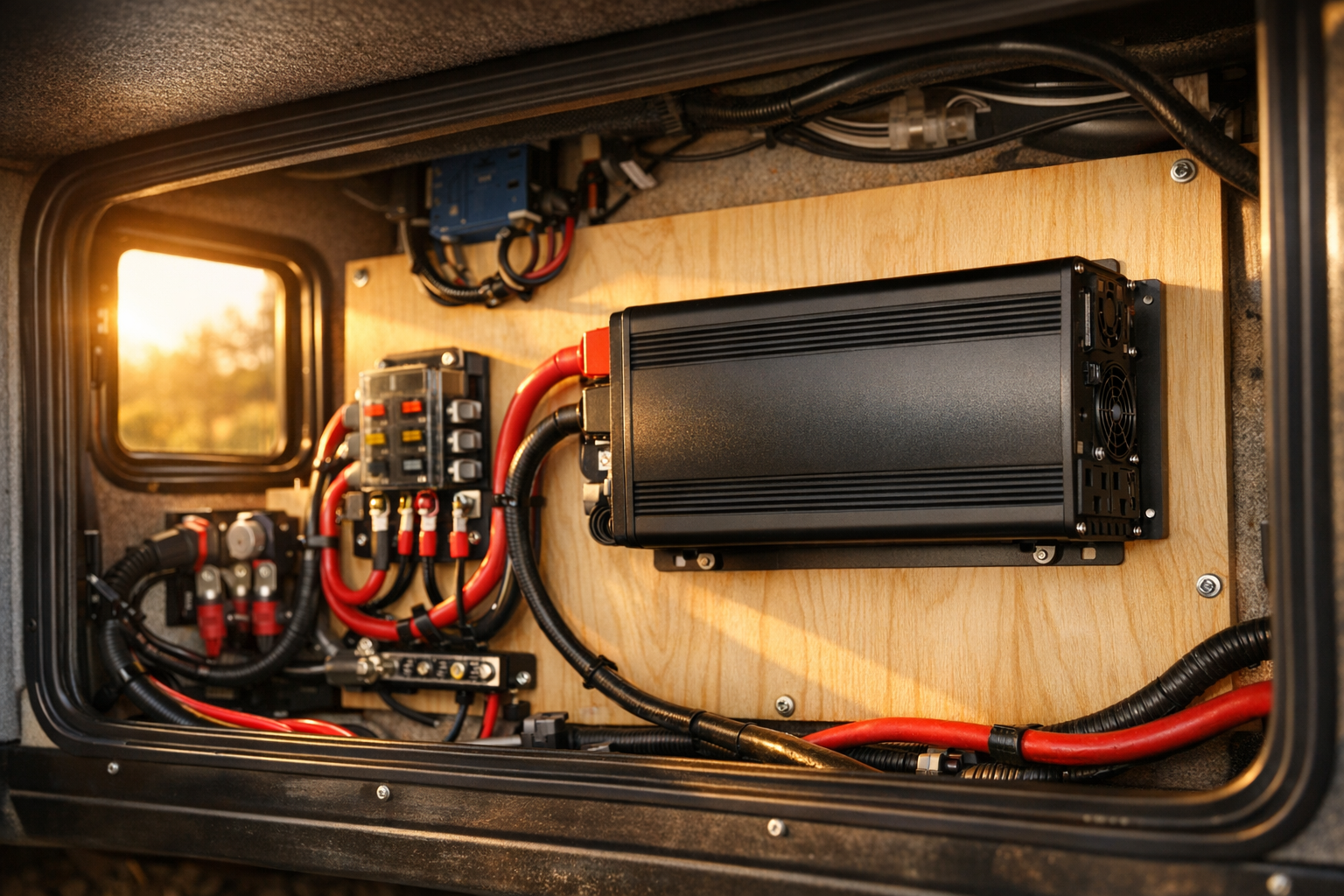
Running a 1,200-watt microwave while your CPAP machine charges overnight and a residential refrigerator cycles on and off—all from a 12V battery bank—demands an inverter that delivers utility-grade AC power without voltage distortion. A modified sine wave unit might technically spin a fan, but the moment you plug in a sensitive medical device or an induction cooktop, you risk malfunction, overheating, or outright damage. Choosing the best pure sine wave inverter for RV use is an engineering decision that hinges on continuous wattage, surge capacity, conversion efficiency, and thermal management—not marketing claims.
TL;DR
- Best Overall: Victron Energy Phoenix 3000VA 12V — Industry-leading efficiency (93%), robust surge handling, and programmable via Bluetooth for full-time RV boondocking.
- Best Budget: GIANDEL 2000W Pure Sine Wave Inverter — Reliable 2000W continuous output with remote switch and dual AC outlets at roughly half the price of premium brands.
- Best for Heavy Loads: AIMS Power 3000W 12V Pure Sine Wave Inverter — 9000W surge peak handles RV air conditioner startup loads with a heavy-duty transformer design.
- Best Compact Option: Go Power! GP-ISW1500-12 1500W — Lightweight, ETL-listed, and purpose-built for RV installations where cabinet space is limited.
- Best Inverter/Charger Combo: AIMS Power 2000W Inverter Charger — Combines pure sine wave inversion with a built-in 55A battery charger and automatic transfer switch for seamless shore-to-battery transitions.
What Is a Pure Sine Wave Inverter and Why Does Your RV Need One?
An inverter converts DC battery voltage (typically 12V in most RVs) into AC household power (120V, 60 Hz in North America). The critical distinction is the waveform shape. A pure sine wave inverter produces a smooth, continuous sinusoidal output virtually identical to grid electricity. A modified sine wave inverter approximates this with a stepped, blocky waveform that introduces harmonic distortion—typically 20–40% total harmonic distortion (THD) versus less than 3% THD for a quality pure sine unit.
Several categories of RV equipment are intolerant of dirty power:
- Medical devices — CPAP and BiPAP machines, oxygen concentrators, and insulin pumps often specify pure sine wave input in their manuals. Modified sine wave can cause motor whine, inaccurate pressure delivery, or outright shutdown.
- Variable-speed motors — Residential refrigerator compressors, high-efficiency fans, and washing machines use electronically commutated motors that rely on clean zero-crossings in the AC waveform.
- Sensitive electronics — Laptop chargers, smart TVs, and audio equipment may overheat, produce buzzing, or suffer shortened lifespans on modified sine wave.
- Inductive loads — Microwave magnetrons and laser printers draw reactive power that interacts poorly with stepped waveforms, reducing actual output and increasing waste heat.
If your RV carries anything beyond incandescent bulbs and a basic toaster, a pure sine wave inverter is a functional requirement, not a luxury.
How to Calculate Your RV Power Needs
Sizing an inverter correctly prevents two costly mistakes: buying too small (tripping overload protection mid-cook) or too large (wasting money and increasing idle parasitic draw). Follow this process:
- List every AC appliance you plan to run simultaneously. Check the nameplate wattage on each device or its manual.
- Sum the running watts. Example: microwave (1,000W) + coffee maker (900W) + laptop charger (65W) = 1,965W continuous.
- Identify the highest surge load. Motor-driven appliances like an RV air conditioner (1,200–1,500W running, 2,800–3,500W surge) or a residential fridge compressor (150W running, 600–800W surge) need brief peak power at startup.
- Add a 20% headroom buffer. If your calculated continuous load is 2,000W, target an inverter rated for at least 2,400W continuous.
Most RVers who do not intend to run air conditioning land comfortably in the 2,000W tier. Those who want to run a 13,500-BTU rooftop AC unit need a minimum of 3,000W continuous with a surge rating of at least 6,000W—and ideally 9,000W to handle hard-start compressors without a soft-start module.
Common Wattage Tiers: 1000W, 2000W, 3000W, and Beyond
1000W–1500W: Suitable for charging electronics, running a TV, powering a CPAP, or operating a small blender. Not enough for a microwave or hair dryer. Ideal for van conversions or minimalist boondockers.
2000W: The sweet spot for most travel trailers and Class B/C motorhomes. Handles a microwave, coffee maker, or toaster (one at a time), plus simultaneous small loads. Surge ratings of 4,000W cover most fridge compressor startups.
3000W: Required for running an RV air conditioner, an induction cooktop, or multiple high-draw appliances simultaneously. Expect higher idle draw (0.8–1.5A at 12V) and a heavier chassis (30–40 lb).
5000W+: Typically overkill for single-RV use unless you have a large Class A with dual AC units and a washer/dryer. These units demand 24V or 48V battery systems and 4/0 AWG cabling.
12V vs. 24V vs. 48V Systems
Most factory RVs run 12V DC systems. Higher voltage systems offer significant wiring advantages for retrofits or custom builds:
| System Voltage | Current at 3000W | Recommended Cable | Typical Use Case |
|---|---|---|---|
| 12V | ~275A | 4/0 AWG (short runs) | Most factory RVs, van builds |
| 24V | ~138A | 2 AWG | Large Class A, bus conversions |
| 48V | ~69A | 6 AWG | Off-grid cabins, skoolies with solar arrays >2 kW |
For the vast majority of RV owners, a 12V pure sine wave inverter matches the existing house battery bank without requiring series wiring of battery pairs. All six inverters are 12V models for this reason.
Key Features to Evaluate
Surge capacity and ratio. Look for a surge-to-continuous ratio of at least 2:1. Premium units like the AIMS Power 3000W achieve 3:1 (9,000W surge on 3,000W continuous), which is critical for hard-starting compressors. A low surge ratio means you may need an aftermarket soft-start device on your AC unit—an added $80–$120 expense.
Conversion efficiency. Efficiency equals AC output power divided by DC input power. Top-tier inverters reach 92–94% at moderate loads (40–80% of rated capacity). Budget models typically land at 85–90%. Over a 200Ah lithium bank, a 5% efficiency gap translates to roughly 30–40 minutes less runtime under a 1,000W load.
Idle / no-load draw. When no appliances are connected, the inverter still consumes power. Quality units draw 0.5–1.0A at 12V (6–12W). Cheaper models can idle at 2A+ (24W), draining a 100Ah battery by ~10% overnight. An ECO or search mode—where the inverter pulses briefly to detect a load and otherwise sleeps—can cut idle consumption to under 0.2A.
Safety protections. At minimum, verify the unit includes: over-voltage protection, under-voltage shutdown (typically 10.5V for 12V systems), over-temperature shutdown, short-circuit protection, and overload protection. GFCI-equipped outlets add another layer of safety in wet environments. ETL or UL listing confirms third-party safety testing.
Remote control and monitoring. A wired remote panel lets you switch the inverter on/off from inside the living space without crawling into a basement compartment. Bluetooth or Wi-Fi monitoring (as on the Victron Phoenix via the VictronConnect app) provides real-time data on watts, voltage, temperature, and fault codes—useful for diagnosing issues while boondocking.
Best Overall: Victron Energy Phoenix 3000VA 12V
Victron is the brand most frequently cited by experienced RV electrical installers, and the Phoenix 3000VA demonstrates why. Its rated continuous output is 2,400W (the “3000VA” designation refers to apparent power), with a peak surge of 6,000W. Peak conversion efficiency hits 93% at roughly half load—exactly where most RVers operate during typical evening use.
The unit uses a high-frequency switching topology to keep the output waveform within 1.5% THD under varying loads. Built-in Bluetooth connects to the VictronConnect app for real-time monitoring of output watts, input voltage, inverter temperature, and cumulative kWh. For larger systems, VE.Direct integration allows the Phoenix to communicate with Victron MPPT charge controllers and battery monitors for a unified energy dashboard.
ECO mode reduces no-load consumption to approximately 2W by pulsing the output and detecting load presence. When a load above the configurable threshold (default 15W) is detected, the inverter powers up within 2 seconds. This is particularly useful for keeping a residential fridge on the inverter circuit overnight without draining the battery bank.
Drawbacks: the Phoenix is a standalone inverter—no built-in charger or transfer switch. You will need a separate shore power charger and a transfer switch for automatic switchover. The unit weighs approximately 30 lb and measures 14.6 × 9.1 × 5.5 inches, which fits most RV compartments but is not compact. Price typically ranges from $900 to $1,100.
Best Budget Pick: GIANDEL 2000W Pure Sine Wave Inverter
For RVers who need clean AC power without a four-figure investment, the GIANDEL 2000W delivers solid capability at roughly $180–$220. Continuous output is a true 2,000W with a 4,000W surge rating—enough to start a residential fridge compressor and run a standard microwave.
The unit ships with a 15-foot wired remote control that includes an LED indicator for power status and fault conditions (overload, over-temperature, low battery). Two standard three-prong AC outlets and one 2.4A USB-A port cover most connection needs. Input voltage range is 10.5V–15.5V, with automatic shutdown at the low end to protect your batteries.

Efficiency is rated at approximately 88% at full load, which is respectable for this price tier but noticeably below the Victron’s 93%. The cooling fan is thermostatically controlled but can become audible (roughly 45–50 dB) under sustained loads above 1,200W. There is no ECO/search mode, so idle draw sits around 0.8–1.0A continuously.
Build quality is adequate: aluminum housing, internal fusing, and thermal paste on the MOSFETs. It lacks third-party safety certification (no ETL/UL listing), a common trade-off at this price point. For boondockers running a microwave, charging laptops, and powering a CPAP, the GIANDEL 2000W is a pragmatic choice that frees up budget for batteries or solar.
Best for Heavy Loads: AIMS Power 3000W 12V Pure Sine Wave Inverter
When the goal is running a 13,500-BTU RV air conditioner from battery power, the AIMS Power 3000W is purpose-built for the task. Its defining specification is a 9,000W surge capacity—a 3:1 ratio that handles the brutal inrush current of a compressor startup without requiring a soft-start module (though adding one further reduces stress on both the inverter and battery bank).
AIMS uses a low-frequency transformer design rather than the high-frequency topology found in lighter units. The trade-off is weight (approximately 38 lb) and size, but the benefit is superior surge handling and better tolerance of reactive (inductive) loads. The circuit boards are conformal-coated for moisture resistance—a meaningful advantage in humid RV environments or coastal boondocking.
Output includes a GFCI-protected duplex outlet, a standard duplex outlet, and a hardwire terminal block for direct panel integration. The unit accepts 12V input across a 10.0–16.0V range. Continuous efficiency is approximately 90% at half load. Idle draw is higher than average at roughly 1.2A (14.4W), reflecting the transformer’s magnetizing current.
AIMS Power is a US-based company (Reno, Nevada) with domestic technical support, which matters when troubleshooting a complex RV electrical system. The 3000W pure sine model typically retails between $650 and $800.
Best Compact / Lightweight Option: Go Power! GP-ISW1500-12
Go Power! is an established name in the RV OEM market—their inverters ship factory-installed in several Winnebago and Airstream models. The GP-ISW1500-12 delivers 1,500W continuous and 3,000W surge in a chassis that weighs only about 13 lb and measures roughly 15.4 × 6.9 × 3.5 inches. For van conversions, truck campers, or any RV where every cubic inch of storage matters, this footprint is a significant advantage.
The unit carries ETL listing to UL 458 (the standard for power converters/inverters for land vehicles and marine craft), which is relatively rare among sub-$500 inverters and provides verified safety compliance. Idle draw is impressively low at approximately 0.5A (6W), making it viable to leave powered on overnight for a fridge circuit.
The limitation is straightforward: 1,500W continuous means you cannot run a microwave and a coffee maker simultaneously, and an RV air conditioner is out of the question. This inverter is designed for the boondocker who runs a CPAP, charges devices, powers a TV, and occasionally uses a blender or small appliance. Price is typically $400–$500, higher per watt than the GIANDEL but justified by the ETL certification, compact form factor, and Go Power’s RV-specific engineering pedigree.
Safety & Common Mistakes
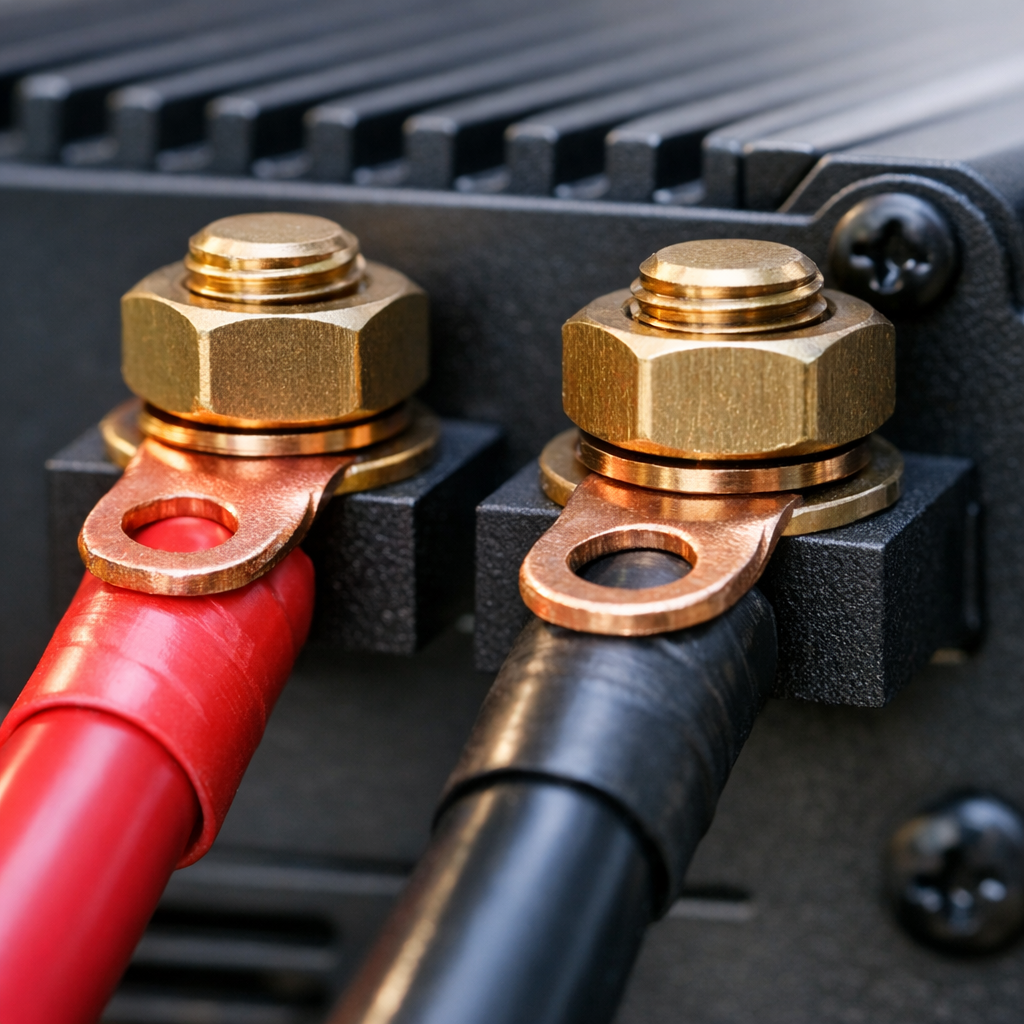
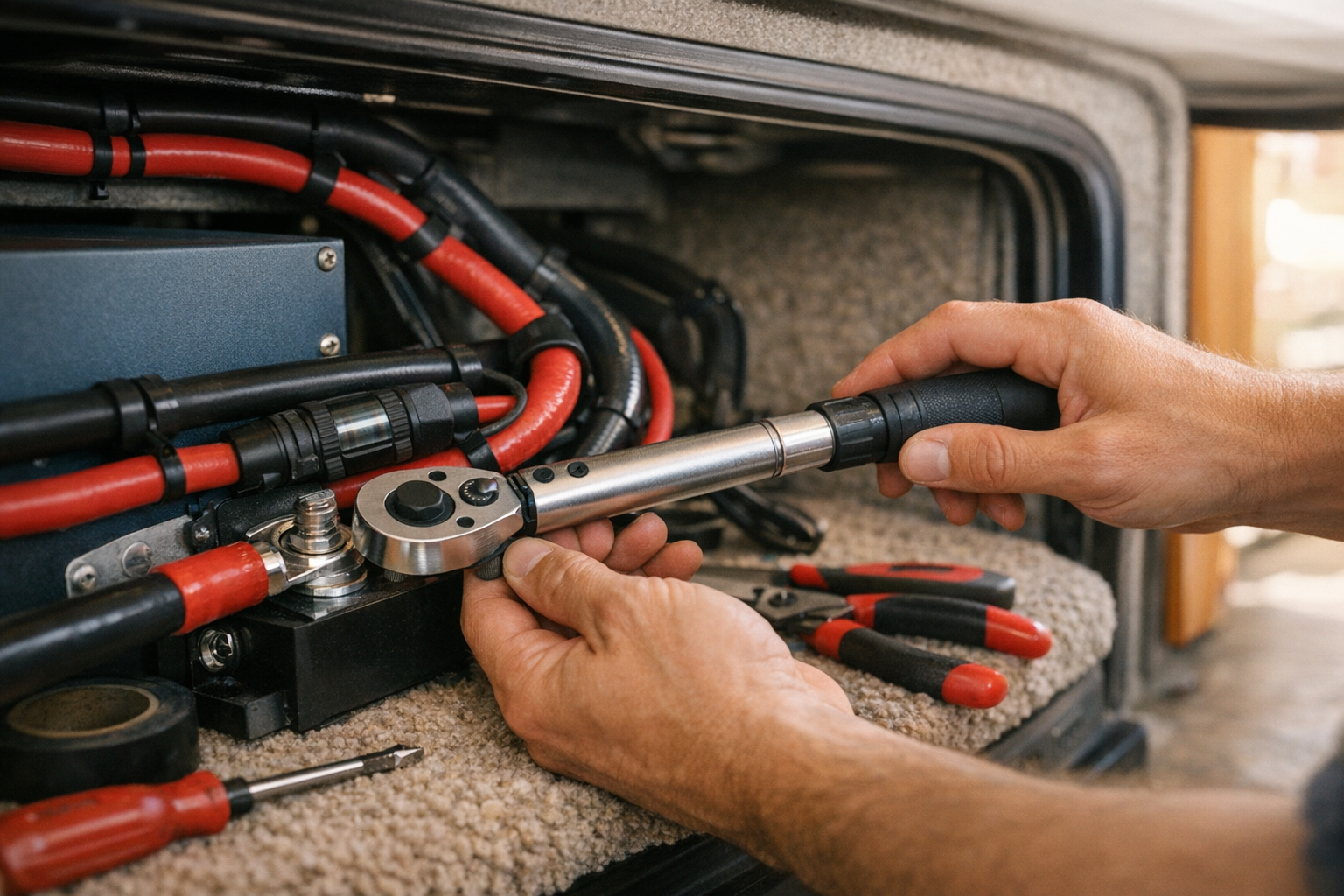
- Undersized cabling causes fires. A 3,000W inverter on a 12V system draws approximately 275A at full load. This requires 4/0 AWG copper cable for runs under 3 feet and a Class T fuse rated at 300–400A within 12 inches of the battery positive terminal. Using undersized wire (e.g., 4 AWG) creates dangerous resistive heating.
- Skipping the fuse is never acceptable. Every inverter installation must include an appropriately rated fuse or circuit breaker on the positive DC cable, as close to the battery as physically possible. A short circuit on unfused 4/0 cable connected to a lithium battery bank can deliver thousands of amps and cause an arc flash or fire within seconds.
- Poor ventilation leads to thermal shutdown or premature failure. A 3,000W unit at 90% efficiency produces roughly 300W of heat at full load. Mount the inverter in a ventilated compartment with at least 4 inches of clearance on all sides.
- Mixing battery chemistries or capacities causes imbalanced discharge. All batteries in your inverter bank should be the same type, capacity, age, and ideally the same brand. Mismatched batteries lead to uneven voltage sag and potential thermal runaway in lithium cells without proper BMS protection.
- Ignoring ground bonding creates shock hazards. The inverter’s AC neutral must be properly bonded to ground per your system design (either at the inverter or at the panel, but not both). Incorrect bonding can cause GFCI outlets to trip randomly or leave metal chassis components energized.
- Running the inverter with a depleted battery bank damages both components. Set the low-voltage disconnect (LVD) to 11.5V for lead-acid or per your lithium BMS cutoff (typically 10.5–11.0V at the inverter terminals under load).
Disclaimer: Always follow the manufacturer’s installation instructions and applicable electrical codes (NEC, ABYC). If you are not confident in your wiring skills, hire a certified RV electrician.
Comparison Table
| Model | Type | Key Specs | Best for | Pros | Cons | Where to buy |
|---|---|---|---|---|---|---|
| Victron Energy Phoenix 3000VA 12V | Pure Sine Wave Inverter | 2400W continuous / 6000W surge; 12V input; 93% peak efficiency; Bluetooth built-in | Best Overall | Exceptional efficiency; programmable ECO mode; VE.Direct monitoring; proven reliability | Premium price (~$900+); heavier at ~30 lb; no built-in transfer switch | Amazon ↗ |
| GIANDEL 2000W Pure Sine Wave Inverter | Pure Sine Wave Inverter | 2000W continuous / 4000W surge; 12V input; dual AC outlets; USB port; wired remote | Best Budget Pick | Affordable (~$200); includes remote on/off; LED fault indicators; solid build for the price | Fan can be audible under load; no app monitoring; efficiency ~88% | Amazon ↗ |
| AIMS Power 3000W 12V Pure Sine Wave | Pure Sine Wave Inverter | 3000W continuous / 9000W surge; 12V input; GFCI outlet; conformal-coated boards | Best for Heavy Loads | Massive 3× surge ratio; GFCI protection; thermally hardened; US-based support | Heavy (~38 lb); large chassis; higher idle draw (~1.2A) | Amazon ↗ |
| Go Power! GP-ISW1500-12 | Pure Sine Wave Inverter | 1500W continuous / 3000W surge; 12V input; ETL-listed; ~13 lb | Best Compact / Lightweight | ETL safety listing; very compact; low idle draw (~0.5A); designed for RV OEM installs | 1500W ceiling limits simultaneous loads; higher cost per watt; no USB ports | Amazon ↗ |
| AIMS Power 2000W Inverter Charger | Pure Sine Wave Inverter/Charger | 2000W continuous / 6000W surge; 12V; 55A charger; auto transfer switch; hardwire | Best Inverter/Charger Combo | Built-in charger + transfer switch; seamless shore power handoff; configurable charge profiles | Requires hardwired install; ~32 lb; fan runs during charging | Amazon ↗ |
| ROCKSOLAR 3000W 12V Pure Sine Wave | Pure Sine Wave Inverter | 3000W continuous / 6000W surge; 12V input; dual AC + USB-A; LCD display | Budget 3000W Option | Competitive price for 3000W; LCD readout for watts/voltage; multiple output ports | Newer brand with less field history; 2× surge ratio is modest; ~35 lb | Amazon ↗ |
Recommended Gear
- Victron SmartSolar MPPT 100/30 — View on Amazon
- Renogy 100W Monocrystalline Panel — View on Amazon
- Battle Born 100Ah LiFePO4 Battery — View on Amazon
FAQs
- What is the best pure sine wave inverter for an RV? Based on efficiency, build quality, monitoring capability, and long-term reliability, the Victron Energy Phoenix 3000VA 12V is the top overall choice for RV use. For budget-conscious buyers, the GIANDEL 2000W offers strong performance at a fraction of the cost. For heavy loads including air conditioning, the AIMS Power 3000W with its 9,000W surge capacity is the strongest performer.
- What size pure sine wave inverter do I need to run my entire RV? Most RVers need between 2,000W and 3,000W continuous to run common appliances like a microwave (1,000–1,200W), coffee maker (800–1,000W), and smaller loads simultaneously. If you plan to run a rooftop air conditioner, you need at least 3,000W continuous with a surge rating of 6,000W or higher. Calculate your specific loads by summing the wattage of every appliance you intend to run at the same time, then add a 20% buffer.
- Do I need lithium-compatible settings? Ensure your controller supports LiFePO4 profiles and proper voltages.
- What gauge wire should I use for solar? Match wire gauge to amperage and run length; 10 AWG handles 30 A up to about 15 ft.
As an Amazon Associate, we earn from qualifying purchases. This helps keep SunAmpRV running.