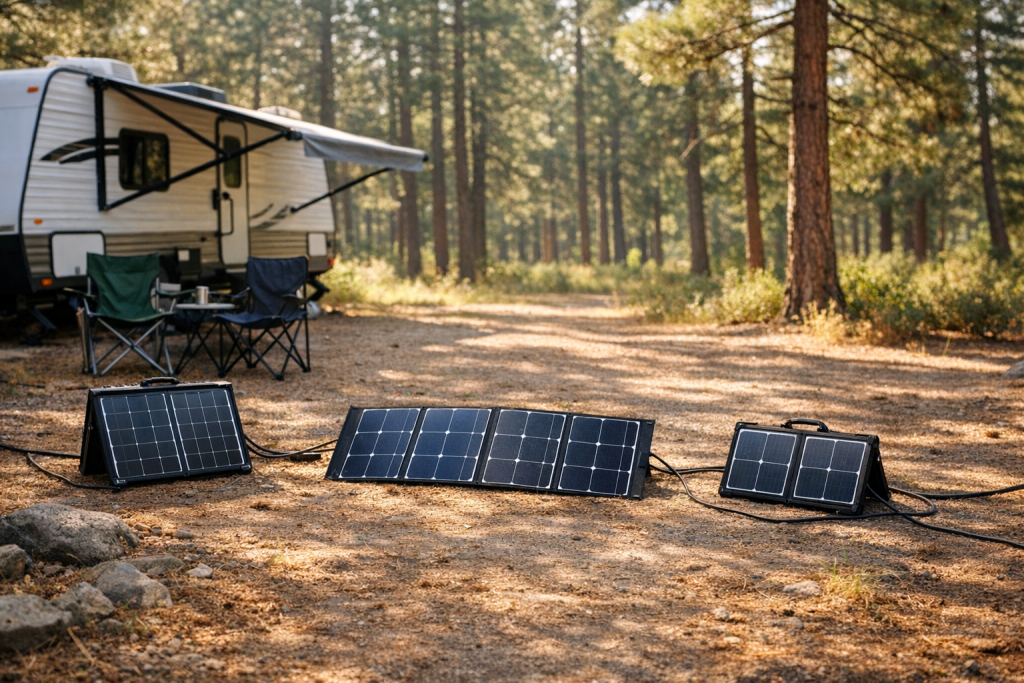

You’re standing on the roof of your RV, measuring out the last few inches of available space, and you need panels that will survive highway vibrations at 70 mph, bake under desert sun for years, and still deliver enough power to keep your fridge cold and your devices charged while boondocking miles from the nearest hookup. Choosing the best rigid RV solar panels is the single most consequential decision in your mobile solar build — get it right and you’ll enjoy decades of reliable, free energy; get it wrong and you’ll be chasing shade-related failures, cracked cells, and disappointing output for seasons to come.
TL;DR
- Best Overall: Renogy 200W 12V Monocrystalline Solar Panel — Proven efficiency, rock-solid 25-year warranty, and the perfect size for most RV roofs.
- Best Budget: HQST 100W 12V Monocrystalline Solar Panel — Reliable PERC cells at a price that lets you scale up without breaking the bank.
- Best High-Wattage: BougeRV Arch 400W Rigid Solar Panel — Massive output from a single panel for large Class A rigs that need serious power.
- Best Lightweight: Rich Solar MEGA 200W Monocrystalline Panel — Full rigid-frame durability at nearly half the weight of traditional panels.
- Best for Off-Grid Boondocking: Renogy 320W Monocrystalline Panel — High wattage density and excellent low-light performance for extended dry camping.
Renogy 200W 12V Monocrystalline Solar Panel — Best Overall
If you could only buy one rigid panel for your RV and never think about it again, the Renogy 200W is the one. It uses high-efficiency monocrystalline PERC cells rated at roughly 21% conversion efficiency, translating to real-world output that consistently hits 160–180W under good conditions. The panel measures approximately 64.6 × 26.4 × 1.4 inches and weighs about 26.5 lbs, making it manageable for a solo rooftop install.
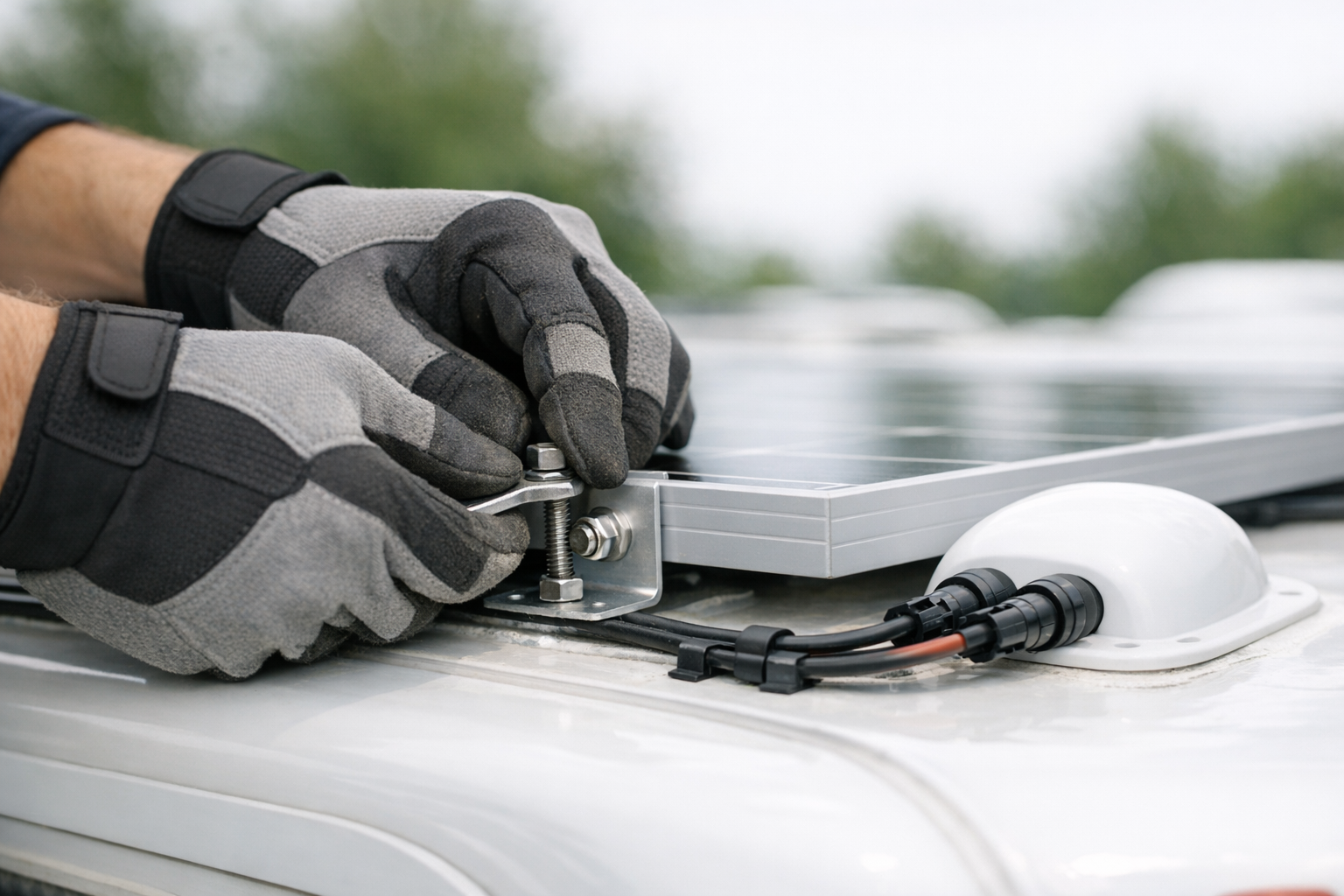
What sets Renogy apart in the RV community is the ecosystem. Pre-drilled mounting holes line up with Renogy’s Z-brackets and corner mounts, the MC4 connectors are factory-attached, and the junction box carries an IP67 rating. The 25-year performance warranty — with an 84% output guarantee at year 25 — is backed by a company with a U.S.-based customer service team, which matters when you’re troubleshooting from a campground in Utah.
The only real knock is weight. At 26.5 lbs, it’s heavier than some newer lightweight alternatives. But that heft comes from a robust anodized aluminum frame and 3.2mm tempered glass rated for 5,400 Pa snow loads and 2,400 Pa wind loads. For the vast majority of RVers, this is the panel to beat.
Rich Solar MEGA 200W Monocrystalline Panel — Best Lightweight
Weight matters on an RV, especially if you’re running a Class B van or a travel trailer already pushing its GVWR. The Rich Solar MEGA 200W delivers the same 200W nameplate output as the Renogy but tips the scales at just 15.4 lbs — roughly 42% lighter. Rich Solar achieves this with a proprietary lightweight aluminum alloy frame and thinner tempered glass without sacrificing structural rigidity.
Efficiency sits around 20.5%, and the panel dimensions (58.7 × 26.8 × 1.38 inches) are compact enough to fit in tight rooftop real estate. The junction box is IP68-rated — a step above most competitors — and the panel comes with pre-attached MC4 leads. Rich Solar offers a 25-year linear performance warranty with 80% output at end of life.
The trade-off? Rich Solar is a smaller brand with less widespread availability of matching accessories. You may need to source Z-brackets or tilt mounts separately. But if shaving pounds off your roof is a priority, this panel is genuinely hard to beat.
HQST 100W 12V Monocrystalline Solar Panel — Best Budget
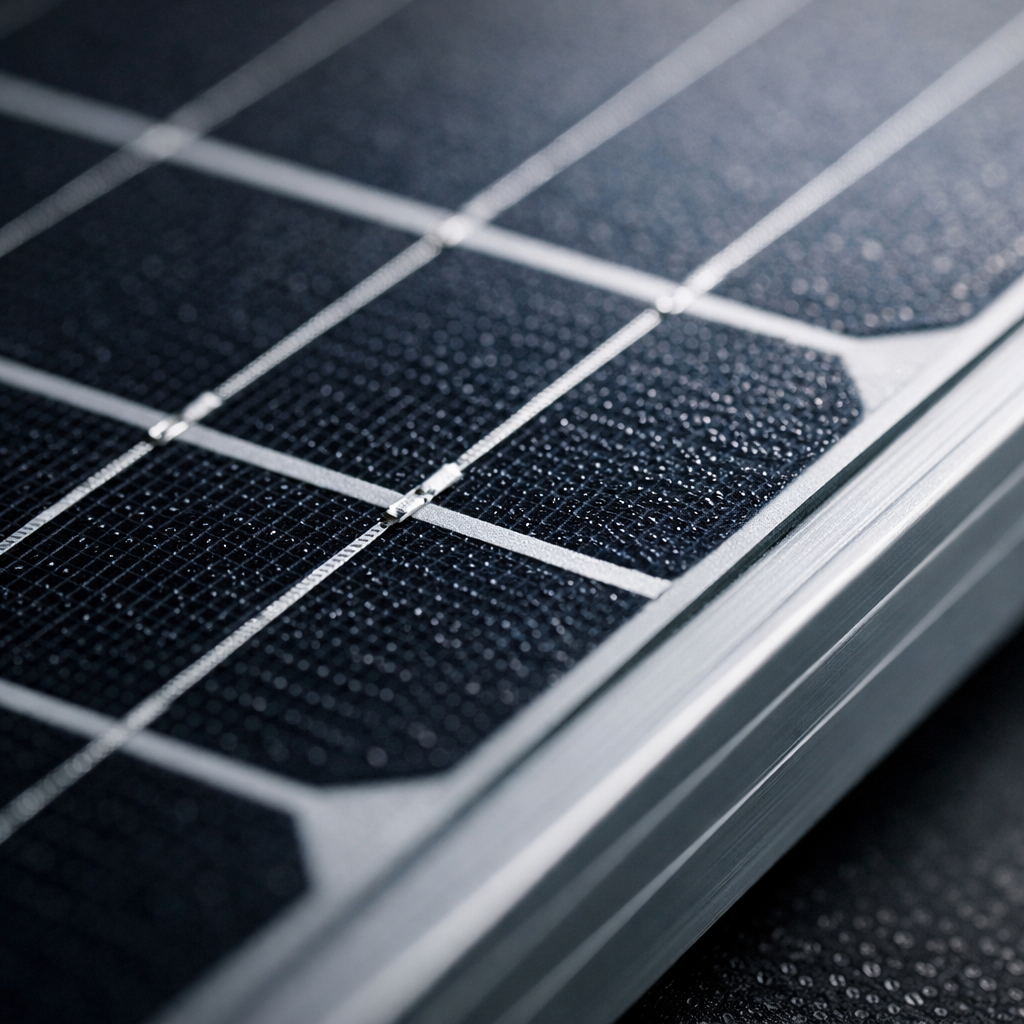
Not everyone needs — or can afford — a 200W+ panel right out of the gate. The HQST 100W has been a staple of budget RV solar builds for years. At roughly half the price of premium 100W panels, it delivers honest output from monocrystalline PERC cells with about 20% efficiency. Real-world users on DIY solar forums consistently report 75–90W under favorable conditions, which is right in line with expectations.
The panel measures 40.2 × 20.2 × 1.4 inches and weighs approximately 16.5 lbs. Build quality is solid — anodized aluminum frame, tempered glass, IP65 junction box — though the frame finish isn’t quite as refined as Renogy’s. HQST backs it with a 25-year output warranty and a 5-year materials warranty.
Where the HQST really shines is scalability. Its compact footprint means you can fit two or three across a typical RV roof and wire them in series or parallel depending on your charge controller. For RVers who want to start small and expand later, this is the smartest entry point.
BougeRV Arch 400W Rigid Solar Panel — Best High-Wattage for Large RVs
Class A motorhome owners and fifth-wheel travelers with expansive roofs often want maximum watts per panel to simplify wiring and reduce potential leak points from multiple mounting holes. The BougeRV Arch 400W delivers exactly that.
Using TOPCon (Tunnel Oxide Passivated Contact) cells, this panel pushes efficiency north of 22%, among the highest in the RV-specific market. The panel is large — roughly 79 × 40 × 1.4 inches — and weighs about 44 lbs, so it’s not a one-person job to hoist onto a roof. But once installed, you’re getting 400W from a single panel: fewer holes drilled, fewer connectors to weatherproof, and a cleaner rooftop layout. BougeRV includes pre-drilled mounting holes and MC4 connectors, and the junction box is IP68-rated.
The slight arch design (about 5° of curvature) is engineered to shed water and reduce wind resistance at highway speeds. BougeRV offers a 12-year product warranty and a 25-year performance warranty. The main caveat: at 400W and roughly 40V open-circuit voltage, you’ll need an MPPT charge controller guide — a PWM unit won’t cut it.
Renogy 320W Monocrystalline Solar Panel — Best for Off-Grid Boondocking
Extended boondocking demands panels that perform well not just at solar noon but also during the low-angle morning and evening hours when you’re trying to squeeze every last watt out of the sky. The Renogy 320W uses high-density monocrystalline cells with half-cut cell technology, which improves shade tolerance and low-light performance compared to standard full-cell designs.
At 65 × 39 × 1.4 inches and 40 lbs, it’s a substantial panel, but the watt-per-square-foot ratio is excellent. Efficiency hovers around 20.4%, and the half-cut cell architecture means that partial shading from an AC unit or antenna only reduces output from the affected cell string rather than dragging down the entire panel. For boondockers who park under trees or deal with intermittent cloud cover, this is a meaningful advantage.
Renogy’s bypass diodes and robust IP67 junction box round out the package, and the same 25-year warranty applies. Two of these (640W) paired with a quality MPPT controller and a 400Ah lithium battery bank creates a setup that can sustain most RV lifestyles indefinitely off-grid.
Newpowa 100W 12V Monocrystalline Solar Panel — Best Value for Multi-Panel Arrays
Newpowa flies under the radar compared to Renogy and HQST, but this 100W panel has quietly built a loyal following among DIY RV solar builders. The reason is simple: it’s affordable, it performs, and it’s available in bulk-friendly pricing that makes three- or four-panel arrays economically painless.
Specs are competitive — monocrystalline cells, approximately 19.5% efficiency, 22.2 × 39.7 × 1.18 inches, and about 15.4 lbs. The frame is anodized aluminum, the glass is tempered, and the junction box is IP65-rated with pre-attached MC4 connectors. Newpowa offers a 25-year performance warranty.
The slightly lower efficiency compared to PERC or TOPCon alternatives means you’ll need a bit more roof space per watt. But when you’re buying four or more panels for a large array, the per-watt cost savings add up quickly. It’s an honest, no-frills workhorse.
BougeRV 200W 12V Rigid Monocrystalline Solar Panel — Best Mid-Range All-Rounder
BougeRV’s standard 200W rigid panel occupies a sweet spot between the budget 100W options and the premium high-wattage monsters. It uses 9BB (nine-busbar) monocrystalline cells for improved current collection and crack resistance, achieving around 21.5% efficiency. The panel measures roughly 63.2 × 27.6 × 1.4 inches and weighs about 24.3 lbs.
Build quality is a step up from budget brands — the frame feels solid, the junction box is IP68-rated, and BougeRV includes a decent set of mounting hardware in the box. The 12-year product warranty is shorter than Renogy’s, but the 25-year performance warranty matches the industry standard.
This panel is ideal for the RVer who wants a reliable 200W setup without paying the Renogy premium and doesn’t need the extreme weight savings of the Rich Solar MEGA. It performs well in real-world conditions at a sensible price.
Comparison Table
| Model | Type | Key Specs | Best for | Pros | Cons | Where to buy |
|---|---|---|---|---|---|---|
| Renogy 200W 12V Mono | Monocrystalline PERC | 200W, ~21% eff., 26.5 lbs, 25-yr warranty | Best Overall | Proven ecosystem, excellent warranty, high efficiency | Heavier than lightweight alternatives | Amazon ↗ |
| Rich Solar MEGA 200W | Monocrystalline | 200W, ~20.5% eff., 15.4 lbs, IP68, 25-yr warranty | Best Lightweight | 42% lighter than standard panels, IP68 junction box | Smaller accessory ecosystem | Amazon ↗ |
| HQST 100W 12V Mono | Monocrystalline PERC | 100W, ~20% eff., 16.5 lbs, 25-yr warranty | Best Budget | Low cost, compact, easy to scale | Lower total output per panel | Amazon ↗ |
| BougeRV Arch 400W | TOPCon | 400W, ~22%+ eff., 44 lbs, IP68, 25-yr warranty | Best High-Wattage | Massive output, fewer roof penetrations, arch design | Heavy, requires MPPT controller | Amazon ↗ |
| Renogy 320W Mono | Monocrystalline Half-Cut | 320W, ~20.4% eff., 40 lbs, IP67, 25-yr warranty | Best for Boondocking | Half-cut cells for shade tolerance, strong low-light performance | Large footprint, heavy | Amazon ↗ |
| Newpowa 100W 12V Mono | Monocrystalline | 100W, ~19.5% eff., 15.4 lbs, 25-yr warranty | Best Value Multi-Panel | Excellent bulk pricing, lightweight for 100W class | Slightly lower efficiency | Amazon ↗ |
| BougeRV 200W 12V Rigid Mono | Monocrystalline 9BB | 200W, ~21.5% eff., 24.3 lbs, IP68, 25-yr warranty | Best Mid-Range | Good build quality, competitive price, IP68 box | Shorter product warranty (12 yr) | Amazon ↗ |
Which One Should You Buy?
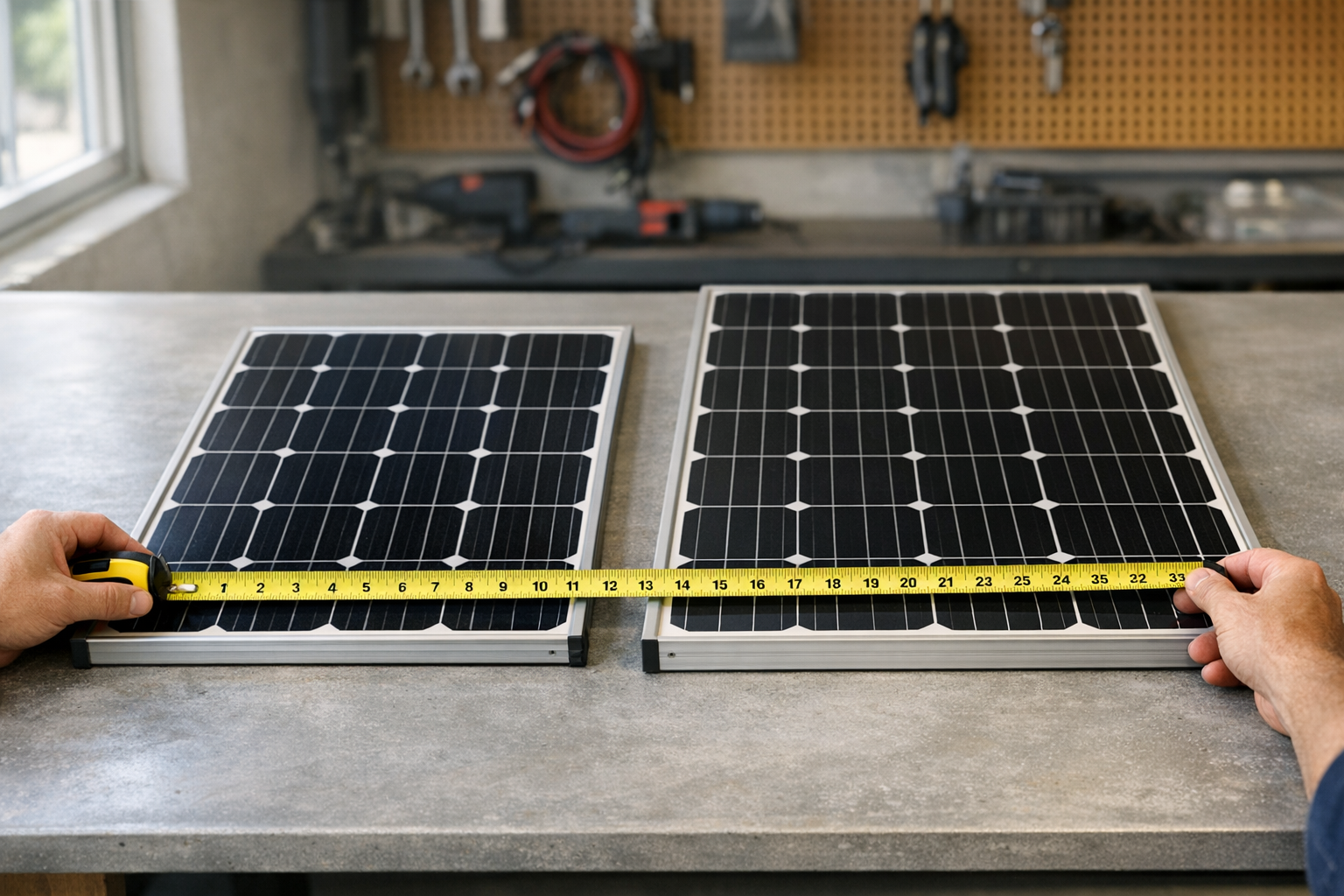
The “best” rigid RV solar panel depends on your rig, your travel style, and your budget. Here’s how to think through it.
Building your first RV solar system and want reliability? The Renogy 200W is the safest choice. The brand’s ecosystem of charge controllers, mounting hardware, and wiring kits means everything plays nicely together, and community support on forums and YouTube is unmatched. Two of these (400W total) paired with a 30A MPPT controller and a 200Ah lithium battery will comfortably power a residential fridge, LED lights, phone and laptop charging, and a few small appliances.

On a tight budget? Start with one or two HQST 100W panels. Wire two in series for a 24V nominal input to an MPPT controller, or run them in parallel with a PWM controller for simplicity. Either way, 200W of HQST panels will cost significantly less than a single premium 200W panel and deliver comparable total output.
Weight is your primary constraint? Maybe you’re in a Sprinter van conversion or a lightweight travel trailer. The Rich Solar MEGA 200W is the clear winner. Saving 11 lbs per panel adds up fast in a multi-panel array, and you’re not sacrificing meaningful efficiency to get there.
Large Class A or fifth-wheel with plenty of roof space? The BougeRV Arch 400W lets you get serious wattage from fewer panels. One panel replaces two 200W panels — two fewer sets of mounting hardware, two fewer junction boxes to weatherproof, and a cleaner installation overall. Make sure your charge controller can handle the higher voltage; you’ll want an MPPT unit rated for at least 40V input.
Spending weeks at a time boondocking on BLM land or in national forests? The Renogy 320W with half-cut cell technology gives you the best combination of high output and shade tolerance. Partial shading from a rooftop AC unit, antenna, or nearby tree branch won’t tank your entire system the way it would with a standard full-cell panel. Two of these (640W) with a quality MPPT controller and 400Ah of lithium storage is a serious off-grid setup.
Building a large array on a budget? Newpowa 100W panels offer the best per-watt value when purchased in quantity. Four panels (400W) wired in a series-parallel configuration give you a robust system at a fraction of the cost of premium alternatives. The slightly lower efficiency means you’ll use more roof space, but if space isn’t your limiting factor, the savings are substantial.
Safety & Common Mistakes
- Disconnect your battery bank before wiring panels. Solar panels produce voltage the moment they’re exposed to light. Even a single 100W panel can deliver 5–6A of short-circuit current — enough to cause burns or damage equipment. Cover panels with an opaque tarp during installation.
- Use the correct wire gauge for your run length. Undersized wiring causes voltage drop, heat buildup, and potential fire risk. For a typical 10-foot run from rooftop panels to a charge controller, 10 AWG wire handles up to about 30A. Use a voltage drop calculator for longer runs.
- Don’t mix panel wattages or brands in a series string. In series, the lowest-performing panel limits the entire string’s current output. If you must combine mismatched panels, wire them in parallel instead.
- Seal every roof penetration with self-leveling lap sealant, not silicone. Standard silicone caulk doesn’t adhere well to RV roof materials (EPDM, TPO, fiberglass) and will crack within a season. Dicor self-leveling lap sealant is the industry standard.
- Install a fuse or circuit breaker between your panels and charge controller. A 15A or 20A fuse (sized to your system) protects against short circuits in the wiring. Many RVers skip this step and regret it when a chafed wire causes a problem months later.
- Leave an air gap between rigid panels and the roof surface. Mounting panels flat traps heat, reducing efficiency by approximately 0.3–0.5% per degree Celsius above 25°C (77°F). Z-brackets or tilt mounts creating at least a 1-inch gap allow airflow underneath and can improve real-world output by 5–10%.
Disclaimer: Always follow local electrical codes and manufacturer instructions. If you’re unsure about any wiring or installation step, consult a certified electrician or solar installer.
Recommended Gear
- Victron SmartSolar MPPT 100/30 — View on Amazon
- Renogy 100W Monocrystalline Panel — View on Amazon
- Battle Born 100Ah LiFePO4 Battery — View on Amazon
FAQs
- Who makes the best solar panels for RVs? Renogy, BougeRV, Rich Solar, and HQST are consistently the top-rated brands for rigid RV solar panels. Renogy leads in overall ecosystem support and warranty backing, BougeRV has pushed the envelope with newer cell technologies like TOPCon, Rich Solar stands out for lightweight designs, and HQST remains the go-to for budget-conscious builders. All four have strong track records and active user bases on forums like DIY Solar Power Forum.
- Are rigid solar panels better than flexible for RVs? In most cases, yes. Rigid panels last 25+ years versus 5–10 years for typical flexible panels. They run cooler because they’re mounted with an air gap above the roof, improving efficiency. They’re also more resistant to micro-cracking from road vibrations. Flexible panels have their place on curved surfaces or when weight is an extreme concern, but for a standard flat RV roof, rigid panels are the superior long-term investment.
- How many watts of solar do I need on my RV? Most RVers need between 200W and 600W depending on energy consumption and travel style. A weekend camper who primarily stays at campgrounds with hookups might get by with 200W. A full-time boondocker running a residential fridge, laptop, CPAP machine, and occasional microwave will want 400–600W or more. To calculate your needs, add up your daily watt-hour consumption (use a kill-a-watt meter for accuracy) and divide by the average peak sun hours for your typical camping region — usually 4–6 hours.
- Which is better for an RV, TOPCon or bifacial? For flat RV roof mounts, TOPCon panels are generally more practical. TOPCon cells achieve higher front-side efficiency — often 22% or above — which means more watts per square foot of roof space. Bifacial panels capture reflected light on their rear side, but on an RV roof there’s minimal reflected light reaching the underside. Bifacial technology excels in ground-mount or elevated tilt-mount installations where light bounces off the surface below. On an RV roof, you’re paying for a feature you can’t fully utilize.
- How long do rigid RV solar panels last? Quality rigid solar panels are designed to last 25 years or more. Most reputable manufacturers guarantee at least 80–84% of rated output at the 25-year mark. In practice, the panels themselves rarely fail — it’s the wiring, connectors, and sealant around mounting points that need periodic maintenance. Inspect your MC4 connections and roof sealant at least once a year, and your rigid panels should outlast the RV they’re mounted on.
- Do RV solar panels work on cloudy days? Yes, but with significantly reduced output. Rigid monocrystalline panels typically produce 10–25% of their rated capacity under heavy overcast conditions. Light cloud cover may only reduce output by 20–40%. Half-cut cell panels like the Renogy 320W tend to perform slightly better in diffuse light. If you frequently camp in cloudy regions like the Pacific Northwest, oversizing your array by 25–50% beyond your calculated needs helps compensate for reduced solar hours.
As an Amazon Associate, we earn from qualifying purchases. This helps keep SunAmpRV running.