

A battery monitor transforms guesswork into precision for RV solar systems, providing real-time data on state of charge, current flow, and remaining capacity that prevents unexpected power failures during boondocking trips.
TL;DR — Best Picks
Best Overall: Victron SmartShunt 500A – Bluetooth connectivity with ±0.4% accuracy and seamless VictronConnect app integration for comprehensive system monitoring.
Best Budget: Renogy 500A Battery Monitor – Full-featured shunt-based monitoring under $80 with programmable alarms and multiple battery chemistry support.
Best for Large Systems: Victron BMV-712 Smart – Additional input tracks starter battery voltage or midpoint voltage, with a dedicated display + Bluetooth for daily monitoring.
Buyer’s Guide

Shunt Sizing and Current Ratings
The shunt is the heart of any coulomb-counting battery monitor. It measures all current flowing in and out of your battery bank by detecting the tiny voltage drop across a precision resistor.
For RV applications, a 500A shunt handles most systems comfortably, accommodating:
- Inverter surge currents up to 400–500A on 12V systems
- Simultaneous charging from solar, alternator, and shore power
- High-draw appliances like air conditioners or induction cooktops
Undersizing the shunt causes inaccurate readings during high-current events. Oversizing slightly—choosing 500A when your max draw is 300A—maintains accuracy without penalty. The standard 75mV shunt drop at rated current is an industry convention that most monitors expect.
Accuracy and State of Charge Algorithms
Battery monitors calculate state of charge (SOC) using coulomb counting—integrating current over time. Accuracy depends on several factors:
- Shunt precision: ±0.4% (Victron) vs ±1% (budget units) affects cumulative error
- Synchronization: Monitors must periodically sync to 100% when batteries reach full charge voltage and tail current drops below threshold
- Peukert compensation: Lead-acid batteries deliver less capacity at high discharge rates; advanced monitors correct for this
- Temperature compensation: Battery capacity varies with temperature; some monitors accept external sensors
Lithium batteries exhibit minimal Peukert effect, making basic coulomb counting more accurate. Lead-acid users benefit from monitors with configurable Peukert exponents (typically 1.1–1.3 for AGM, 1.2–1.4 for flooded).
Display Options: Wired vs Bluetooth vs Both
Modern battery monitors offer three interface approaches, each with trade-offs:
- Wired display only: Always-on visibility, no phone dependency, limited placement flexibility (cable length typically 10–30 ft)
- Bluetooth only: Compact shunt installation, smartphone app provides rich data visualization, requires phone access for readings
- Hybrid (display + Bluetooth): Best of both worlds, higher cost, more installation complexity
For full-time RVers, a dedicated display ensures monitoring even when phones are charging or unavailable. Weekend users often prefer Bluetooth-only solutions for cleaner installations.
Voltage Range and Battery Chemistry Compatibility
Verify the monitor’s voltage range matches your system:
- 12V systems: 10–16V operating range typical
- 24V systems: 20–32V range required
- 48V systems: Fewer options; verify 40–60V compatibility
Battery chemistry settings affect charge detection thresholds. LiFePO4 batteries require different charged voltage (14.2–14.6V) and tail current parameters than AGM (14.4–14.8V) or flooded lead-acid (14.8–15.2V). Monitors with preset profiles simplify configuration; those with fully programmable parameters offer maximum flexibility.
Relay Outputs and Alarm Functions
Programmable relay outputs enable automated protection:
- Disconnect loads when SOC drops below threshold (e.g., 20%)
- Trigger generator auto-start at low battery
- Activate charging sources when voltage drops
- Sound alarms for high/low voltage conditions
Budget monitors typically offer audible alarms only. Mid-range and premium units include voltage-free relay contacts rated for 1–4A, sufficient for triggering external contactors or generator start circuits.
Product Details
Victron SmartShunt 500A
Key specs: 500A continuous rating, 6.5–70V DC supply range, ±0.4% current accuracy, 5-year warranty, Bluetooth connectivity, VE.Direct port.
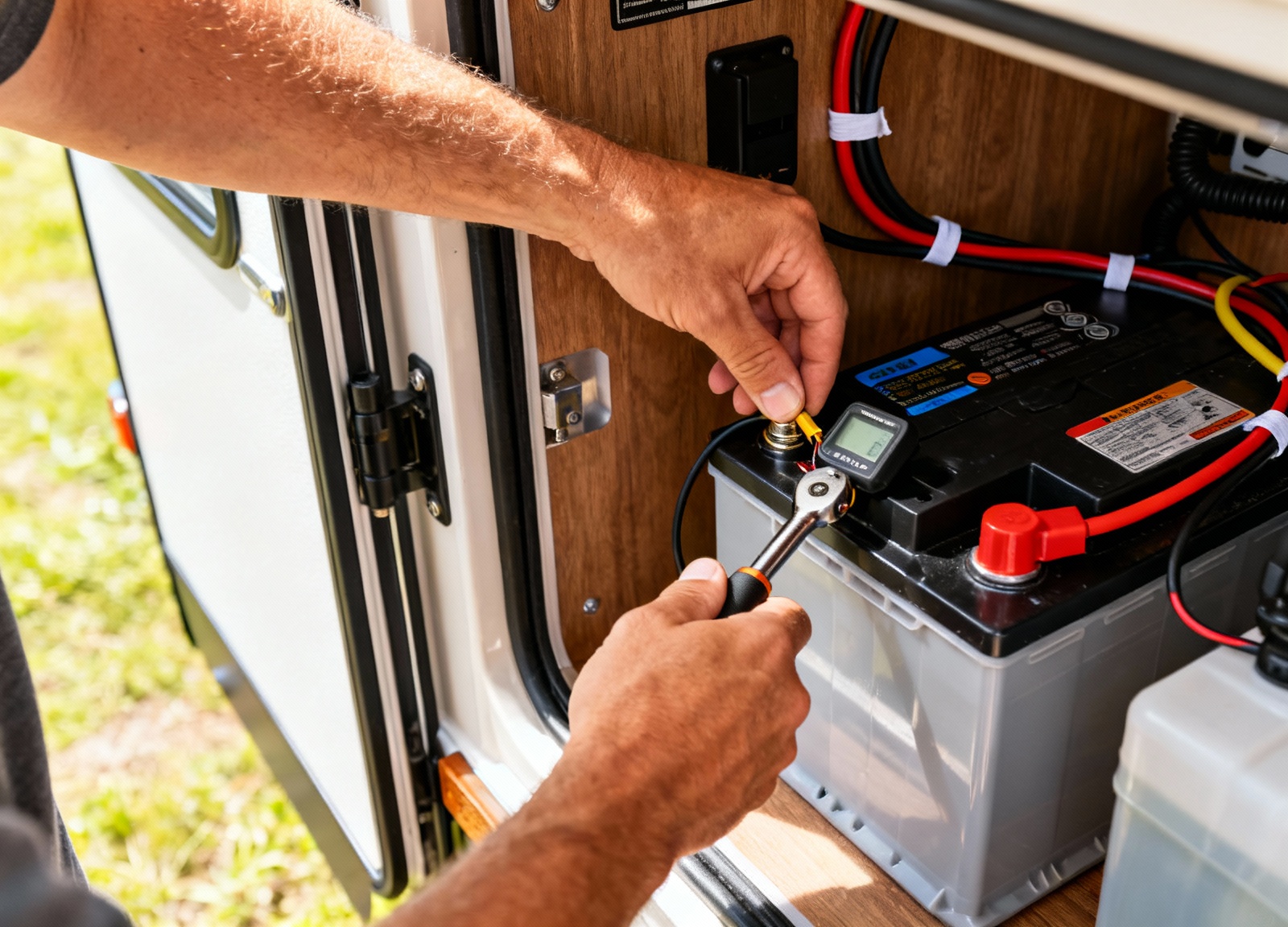
The SmartShunt represents Victron’s display-less approach to battery monitoring. The compact shunt installs at the battery negative terminal, with all data accessed through the VictronConnect smartphone app. This design eliminates display cable routing and reduces installation complexity. View on Amazon
- VictronConnect app provides historical data, trend graphs, and remote monitoring when paired with GX devices
- No programmable relay—use VE.Direct/GX integration for system-wide automation instead
- Aux input monitors starter battery voltage or midpoint voltage in series banks
- Firmware updates via Bluetooth maintain feature parity with newer products
- No standalone display option—requires smartphone for all readings
- Bluetooth range limited to approximately 30 ft in typical RV construction
Victron BMV-712 Smart
Key specs: 500A/50mV shunt included, 6.5–70V DC range, additional input (second battery/temperature/midpoint), programmable relay, backlit LCD display, Bluetooth integrated.
The BMV-712 combines a dedicated display unit with Bluetooth connectivity, addressing users who want both always-visible readings and smartphone integration. The second input channel monitors starter battery voltage without requiring an additional shunt. View on Amazon
- Midpoint voltage monitoring detects imbalanced cells in series battery configurations
- Programmable relay with hysteresis prevents rapid cycling
- Display shows SOC, voltage, current, power, consumed Ah, and time remaining
- Synchronization parameters fully configurable for any battery chemistry
- Higher price than SmartShunt for users who don’t need the display
- Display cable routing adds installation complexity
Renogy 500A Battery Monitor
Key specs: 500A maximum current, 10–120V DC range, ±1% accuracy, 2.1″ LCD display, 20 ft display cable, programmable high/low alarms, supports AGM/GEL/flooded/lithium profiles.
Renogy’s battery monitor delivers core functionality at an accessible price point. The shunt-based design provides accurate coulomb counting, while preset battery profiles simplify setup for common chemistries. View on Amazon
- Wide 10–120V range accommodates 12V through 48V systems
- Programmable voltage and SOC alarms with audible alert
- Clear backlit display readable in various lighting conditions
- Straightforward installation with included hardware and shunt
- No Bluetooth connectivity—display-only interface
- 20 ft cable may still limit display placement options in larger RVs
- ±1% accuracy adequate but less precise than premium alternatives
Simarine Pico Blue Set
Key specs: SC503 500A shunt included, 6–35V DC operating range, color TFT display, tank level monitoring inputs, expandable architecture.
The Simarine Pico targets users wanting consolidated system monitoring beyond just batteries. The sleek display integrates tank levels, multiple battery banks, and solar input data into customizable screens. View on Amazon
- Modern interface with touch buttons and customizable data layouts
- Tank level monitoring eliminates separate gauges
- Expandable via additional shunts and sensor modules
- Optional modules enable remote monitoring and data logging
- Premium pricing reflects expanded feature set
- Full functionality requires purchasing additional modules
- More complex installation than single-purpose monitors
Bogart TrueMetric TM-2030-RV
Key specs: Shunt required (sold separately), 12–48V DC compatibility, advanced Peukert compensation, amp-hour efficiency tracking, wired display, proven long-term reliability.
The TrueMetric represents old-school engineering focused on accuracy over aesthetics. Its Peukert compensation algorithm provides superior SOC accuracy for lead-acid batteries, making it popular among technical users who prioritize data precision. View on Amazon
- Configurable Peukert exponent for precise lead-acid capacity tracking
- Efficiency percentage shows charging system effectiveness
- Days-since-full-charge counter encourages proper battery maintenance
- Proven reliability with decades of field use
- Interface appears dated compared to modern touchscreen alternatives
- No Bluetooth or app connectivity
- Steeper learning curve for initial configuration
Comparison Table
| Model | Type | Key Specs | Best for | Pros | Cons |
|---|---|---|---|---|---|
| Victron SmartShunt 500A | Shunt-based, Bluetooth | 500A continuous, 6.5–70V DC, ±0.4% accuracy, VE.Direct port | Tech-savvy users wanting app-based monitoring | Compact design; VictronConnect integration; historical data logging; no display required | No included display; requires smartphone for readings |
| Victron BMV-712 Smart | Shunt-based, Display + Bluetooth | 500A/50mV shunt, 6.5–70V DC, additional input (2nd battery/temperature/midpoint) | Multi-battery systems and series banks | Dual-input monitoring; programmable relay; backlit display; Bluetooth built-in | Higher price point; complex setup for beginners |
| Renogy 500A Battery Monitor | Shunt-based, Wired Display | 500A max, 10–120V DC, ±1% accuracy, 2.1″ LCD, 20 ft cable | Budget-conscious RVers needing reliable basics | Affordable; supports multiple chemistries; programmable high/low alarms; clear display | No Bluetooth; display cable length limits placement |
| Bayite DC 500A Battery Monitor | Shunt-based, Wired Display | 500A max, 0–200V DC, 2.4″ LCD, includes 500A/75mV shunt | Entry-level monitoring on tight budgets | Very low cost; simple installation; wide voltage range; basic SOC display | Lower accuracy; no programmable alarms; basic feature set |
| Balmar SG200 | Shunt-based, Bluetooth + Display | 500A continuous, 8–32V DC, NMEA 2000 compatible, 3.5″ color display | Marine crossover and networked systems | NMEA 2000 integration; color touchscreen; historical graphing; premium build | Premium pricing; overkill for simple setups |
| Simarine Pico Blue Set | Shunt-based, Integrated Display | SC503 500A shunt, 6–35V DC, color TFT display, tank level inputs | All-in-one system monitoring enthusiasts | Tank monitoring integration; sleek modern display; customizable screens; expandable | Higher cost; requires additional modules for full features |
| Bogart TrueMetric TM-2030-RV | Shunt-based, Wired Display | Shunt required (sold separately), 12–48V DC, Peukert compensation, amp-hour counting | Technical users wanting detailed battery analysis | Advanced Peukert correction; detailed efficiency tracking; proven reliability | Dated interface; steeper learning curve; no Bluetooth |
Which One Should You Buy?

If you prioritize accuracy and seamless app integration with room for system expansion, the Victron SmartShunt delivers premium performance in a compact package—ideal for users comfortable with smartphone-based monitoring and those already invested in the Victron ecosystem.
If budget constraints drive your decision and you need reliable SOC tracking without premium features, the Renogy 500A Battery Monitor provides essential functionality at roughly half the cost of Victron alternatives. The wired display ensures readings remain accessible regardless of phone availability.
If you manage multiple battery banks or run series-configured lithium cells, the Victron BMV-712 Smart’s dual-input capability and midpoint monitoring justify the additional investment. The combination of dedicated display and Bluetooth connectivity addresses both convenience and reliability concerns.
If you want consolidated monitoring of batteries, tanks, and solar in a single modern interface, the Simarine Pico Blue Set’s expandable architecture eliminates multiple separate gauges—though the total system cost increases with each added module
Safety & Common Mistakes
- Install the shunt on the battery negative terminal with ALL negative connections passing through it—any bypassed loads create measurement errors
- Use appropriately sized cable between battery negative and shunt; undersized wire causes voltage drop that affects accuracy
- Mount the shunt in a ventilated location away from battery off-gassing to prevent corrosion
- Fuse the positive sense wire (typically 1–3A fuse) to protect against shorts in the display cable run
- Verify polarity before connecting—reversed shunt connections display negative current during discharge
- Configure synchronization parameters correctly; incorrect settings cause SOC drift over time
Always disconnect battery power before installing or modifying shunt connections to prevent arcing and potential injury.
Recommended Gear
- Victron SmartSolar MPPT 100/30 — View on Amazon
- Renogy 100W Monocrystalline Panel — View on Amazon
- Battle Born 100Ah LiFePO4 Battery — View on Amazon
FAQs
- Which is better: battery monitor with or without shunt? Shunt-based monitors provide significantly higher accuracy than voltage-only alternatives. Voltage-based monitors estimate SOC from battery voltage, which varies with load, temperature, and battery age. Shunt-based coulomb counting tracks actual current flow, maintaining accuracy within 1–2% when properly synchronized. For RV solar systems with variable loads and charging sources, shunt-based monitoring is strongly recommended.
- What size shunt do I need for my battery monitor? Select a shunt rated for your maximum expected current, including inverter surge loads. For 12V systems with inverters up to 3000W, a 500A shunt handles typical surge currents (3000W ÷ 12V × 1.5 surge factor ≈ 375A). Larger inverters or 24V/48V systems may require 1000A shunts. Slight oversizing doesn’t reduce accuracy, but undersizing causes clipping during high-current events.
- Can a smart shunt monitor multiple batteries? A single shunt monitors one battery bank’s total current flow. For separate banks (house and chassis), you need either a monitor with auxiliary voltage input (like the BMV-712) or separate shunts for each bank. The auxiliary input typically monitors voltage only, not current—sufficient for starter battery health checks but not full SOC tracking.
- Is a battery shunt necessary for accurate monitoring? For precise state-of-charge tracking, yes. Voltage-based estimation works poorly because battery voltage varies significantly with load current, temperature, and charge state. A fully charged lithium battery at rest reads 13.4V but may drop to 12.8V under load—both representing 100% SOC. Only current integration (coulomb counting) via a shunt provides reliable capacity tracking.
- How often should I synchronize my battery monitor? Synchronization should occur automatically when batteries reach full charge. Configure the monitor’s charged voltage threshold slightly below your charger’s absorption voltage, with tail current set to 1–2% of battery capacity. For a 200Ah bank, tail current of 2–4A indicates charging completion. If batteries never reach full charge (common in winter or heavy-use scenarios), manual synchronization may be needed monthly to prevent SOC drift.
- Do battery monitors work with lithium batteries? Yes, and lithium batteries actually provide more accurate monitoring than lead-acid. LiFePO4 cells exhibit minimal Peukert effect, meaning capacity remains consistent regardless of discharge rate. Configure the monitor for lithium chemistry: charged voltage around 14.2–14.4V (for 12V nominal), tail current at 2–3% of capacity, and disable Peukert compensation or set the exponent to 1.00.
As an Amazon Associate, we earn from qualifying purchases. This helps keep SunAmpRV running.