
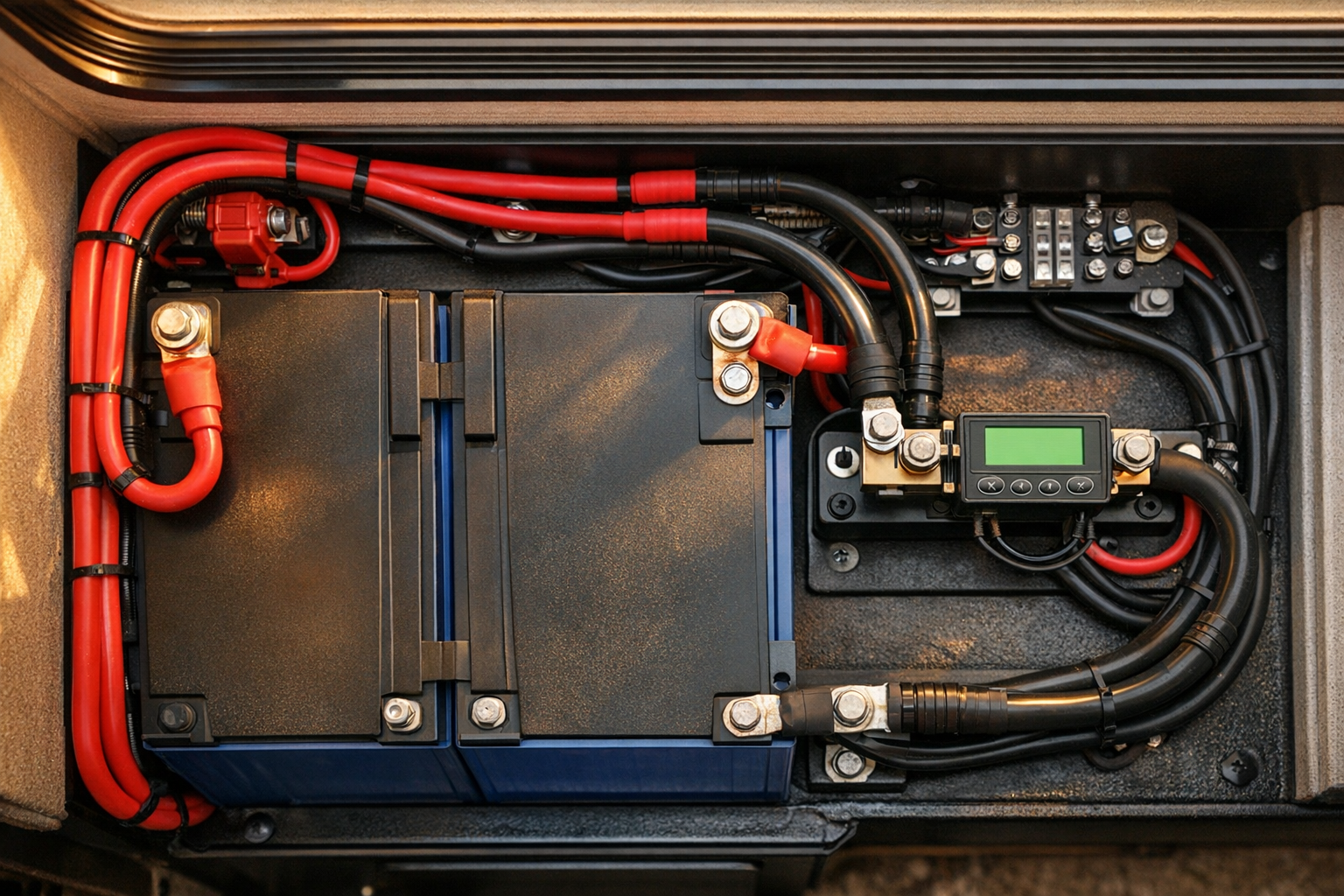
A 12V RV battery bank rated at 200 Ah can deliver anywhere from 2,400 Wh to nearly zero usable energy depending on chemistry, temperature, and discharge depth—yet without a precision shunt measuring every amp in and out, you are effectively guessing how much capacity remains. Shunt-based battery monitors solve this by intercepting the negative bus and coulomb-counting every electron, giving you state-of-charge accuracy that voltage-only meters simply cannot match, especially under load or during partial charging cycles.
TL;DR
- Best Overall: Victron SmartShunt 500A — Gold-standard accuracy, Bluetooth app with historical data logging, and seamless VE.Smart networking for under $160.
- Best Budget: Bayite 500A DC Current Monitor — Functional coulomb counting with a wired display for roughly $25–$35, hard to beat on price-per-feature.
- Best Premium Display: Victron BMV-712 Smart — Same precision shunt as the SmartShunt plus a dedicated backlit panel display and built-in Bluetooth.
- Best Mid-Range: Renogy 500A Battery Monitor — Solid 500A shunt with a clean LCD display and straightforward setup at around $70–$80.
- Best Compact Bluetooth: KVA 350A Bluetooth Battery Monitor — Small form factor with phone-app monitoring, ideal for van life builds with limited panel space.
Victron SmartShunt 500A
The Victron SmartShunt 500A is a headless (no display) shunt-based monitor that relies entirely on Bluetooth and the free VictronConnect app for iOS and Android. The shunt is a precision 500A/50mV unit with ±0.4% current measurement accuracy. It tracks state of charge (SoC), voltage, current, power, consumed amp-hours, and time remaining. A 30-day historical log stores charge/discharge cycles, deepest discharge, and average discharge depth.
What sets the SmartShunt apart from budget alternatives is VE.Smart networking. When paired with a Victron solar charge controller, the shunt shares real-time battery voltage and temperature data over Bluetooth, allowing the charger to compensate for cable voltage drop and thermal drift. This closed-loop feedback is particularly valuable for LiFePO4 banks where charge-voltage windows are narrow—typically 14.2–14.6 V for a 12V pack.
The unit also supports a midpoint voltage input for monitoring balance across series-connected batteries, a feature rarely found below $200.
Physical installation requires only three connections: battery negative to shunt, shunt to system negative bus, and a small auxiliary wire to battery positive for voltage sensing. The shunt body measures approximately 62 × 25 × 32 mm (2.4 × 1.0 × 1.3 in) and weighs about 100 g, making it easy to tuck into tight battery compartments. Rated battery capacity range: 1–9,999 Ah. Compatible chemistries: LiFePO4, AGM, gel, flooded lead-acid. Operating temperature: −40 °C to +50 °C (−40 °F to +122 °F). Street price typically falls between $100 and $160.
Victron BMV-712 Smart
The BMV-712 Smart is essentially the SmartShunt 500A packaged with a dedicated 1.3-inch backlit LCD panel and a longer communication cable (up to 10 m / 33 ft). The display shows SoC percentage, voltage, current, consumed Ah, and time-to-go on a rotating or user-selected screen. Built-in Bluetooth connects to the same VictronConnect app, so you get both a physical readout and phone-based monitoring.
Internally, the shunt is identical: 500A/50mV, ±0.4% accuracy, with the same VE.Smart networking, midpoint monitoring, and programmable relay output. The relay can trigger an alarm or disconnect a load at a user-defined SoC, voltage, or current threshold—useful for protecting lithium cells from over-discharge if your BMS lacks a low-voltage cutoff.
The display unit mounts in a standard 52 mm round cutout (like a marine gauge) or can be surface-mounted with the included bezel. Panel depth is roughly 31 mm (1.2 in). The BMV-712 typically retails between $150 and $200, making it the priciest option on this list but also the most feature-complete for users who want a glanceable dashboard gauge alongside app access.
Renogy 500A Battery Monitor
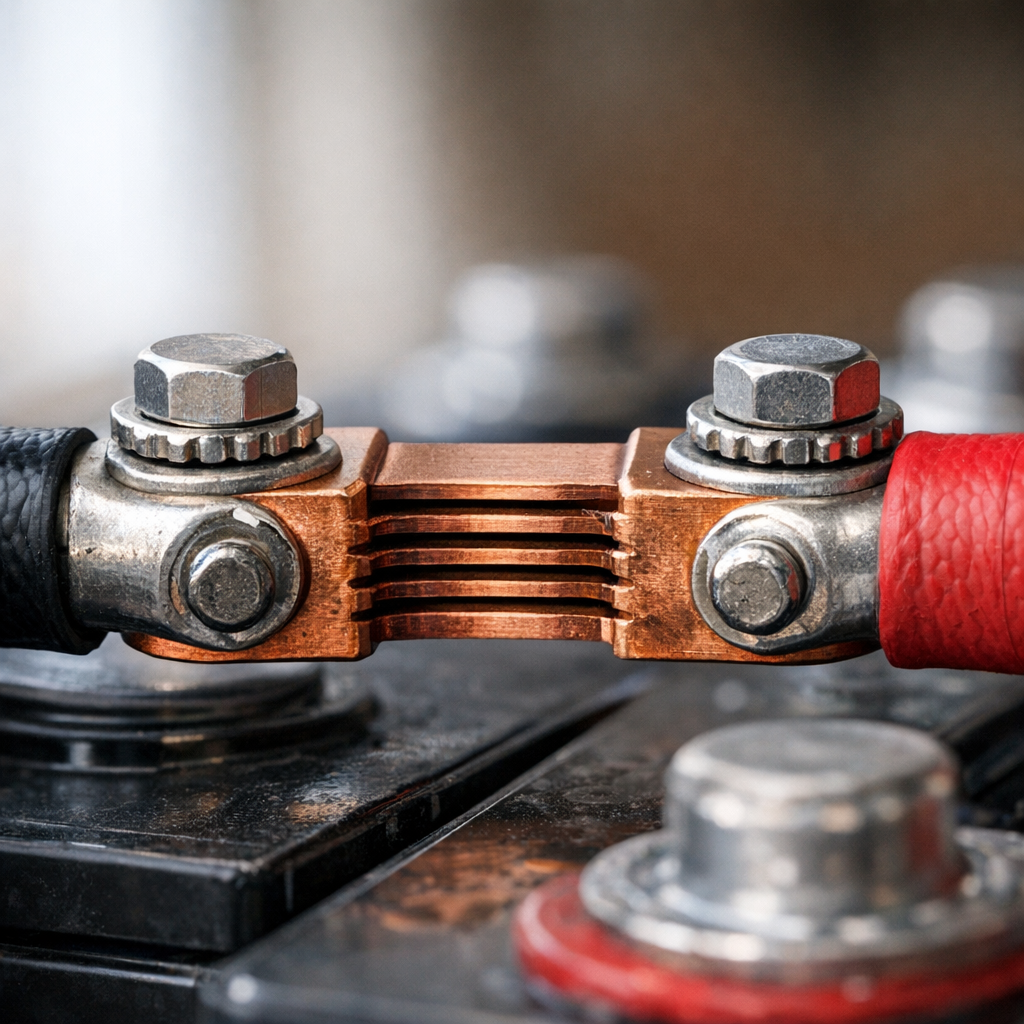
Renogy’s 500A battery monitor pairs a 500A/75mV shunt with a wired LCD display that shows voltage (0–120 V range), current (±500 A), power, consumed Ah, SoC percentage, and time remaining. The display is a 2.3-inch monochrome LCD with a backlight, connected to the shunt via a shielded cable up to 3 m (10 ft) long—extendable to 10 m (33 ft) with aftermarket RJ-series cable.
Setup involves programming battery capacity, chemistry type, and alarm thresholds through the display’s four-button interface. The monitor supports LiFePO4, AGM, gel, and flooded batteries. A programmable high/low voltage alarm and high current alarm provide basic protection alerts. Accuracy is rated at ±1% for current and ±0.2% for voltage.
One notable limitation: the Renogy 500A lacks Bluetooth or Wi-Fi. All interaction happens at the wired display. For builders who prefer a simple, self-contained system without phone dependency, this is actually an advantage—no app updates, no pairing issues, no Bluetooth range concerns. Street price hovers around $70–$80.
Bayite 500A DC Current Monitor
The Bayite 500A is the go-to budget shunt monitor in the van life and RV community. It ships with a 500A/75mV shunt and a compact wired LCD display showing voltage, current, power, energy (kWh), and a basic SoC percentage. The display is roughly 1.8 inches and uses a simple two-button interface for setup.
At $25–$35, the Bayite sacrifices several features found on premium units. There is no Bluetooth, no app, no historical data logging, and no programmable relay output. SoC calculation is simpler—primarily voltage-referenced with basic coulomb counting—so accuracy drifts more noticeably over time without periodic full-charge resyncs. Current accuracy is specified at ±1%, and voltage accuracy at ±0.5%.
Despite these trade-offs, the Bayite is remarkably popular because it answers the fundamental question—”How much power am I using right now?”—for a fraction of the cost. It works well as a secondary monitor on a specific circuit (e.g., inverter load) or as a primary monitor for small, simple systems under 200 Ah. The shunt and display are both compact, and installation is straightforward with ring-terminal connections.
KVA 350A Bluetooth Battery Monitor
The KVA 350A occupies a niche between the Bayite and the Victron SmartShunt. It includes a 350A shunt with Bluetooth connectivity to a free smartphone app (iOS and Android), displaying SoC, voltage, current, power, consumed Ah, and temperature via an included external sensor. The app provides basic historical graphs and alarm notifications.
The 350A rating is adequate for most single-battery van life setups but may be undersized for larger RV systems with high-draw inverters. A 3,000 W inverter on a 12V bank can pull 250 A+ at full load, leaving limited headroom on a 350A shunt. For systems regularly exceeding 300 A, a 500A-rated shunt is the safer choice.

Build quality is a step above the Bayite—the shunt housing is more robust, and the included temperature sensor adds a data point that budget monitors omit. Pricing typically lands between $50 and $70. The KVA lacks a physical display, so you are entirely dependent on the phone app, which some users find less polished than VictronConnect.
Simarine Pico Rev2
For builders who want a premium, fully integrated monitoring solution, the Simarine Pico Rev2 deserves mention. It uses external shunt modules (SC500 or SC302) that communicate digitally with a high-resolution color touchscreen display. The system can monitor multiple battery banks, tank levels, and temperatures simultaneously.
Accuracy is excellent—±0.1% voltage, ±0.5% current—and the display is arguably the best-looking panel in the RV monitoring space. However, the Pico Rev2 system (display + one shunt module) typically costs $300–$450, placing it well above the sub-$200 category most RVers target. It is best suited for high-end custom builds where aesthetics and multi-bank monitoring justify the investment.
Choosing the Right Shunt Amperage Rating
The shunt’s amperage rating must exceed the maximum current your system can draw. Calculate this by dividing your largest load (typically the inverter) by system voltage. A 2,000 W inverter on a 12V system draws roughly 167 A at full load, plus inefficiency losses—so a 200A shunt would be marginal, while a 500A shunt provides comfortable headroom. A 3,000 W inverter pushes 250 A+, making the 350A KVA shunt borderline; a 500A unit is the safer specification.
For minimal setups—a single 100 Ah battery powering LED lights, a fan, and phone charging—a 200A or 350A shunt is perfectly adequate. Since 500A shunts cost only marginally more than smaller ones, most experienced builders default to 500A for future-proofing.
Bluetooth App vs. Wired Display
This decision depends on your usage pattern. If you frequently check battery status from bed, from outside the RV, or while riding as a passenger, Bluetooth is a significant convenience. The Victron SmartShunt and KVA 350A both operate headlessly through phone apps, eliminating the need to route a display cable through your RV’s walls.
Wired displays (Renogy 500A, Bayite 500A, Victron BMV-712) are always on and always visible—no phone needed, no Bluetooth pairing delays. In cold weather, when phones may be slow to connect, a glanceable panel gauge is faster. The BMV-712 gives you both options, which is why it commands a premium.
If you already own a Victron solar charge controller, the SmartShunt’s VE.Smart networking adds genuine functional value. Shared voltage and temperature data improve charge accuracy, particularly for LiFePO4 banks where a 0.2 V error in charge voltage can mean the difference between a full charge and a premature cutoff.
Budget Allocation: Under $50, Under $100, Under $200
Under $50: The Bayite 500A is the clear pick. It lacks polish but delivers the core data—voltage, current, power, and a rough SoC—for less than $35. Pair it with periodic full-charge resyncs and it will keep you reasonably informed.
$50–$100: The Renogy 500A and KVA 350A compete here. Choose the Renogy if you want a wired display and no app dependency. Choose the KVA if Bluetooth and a temperature sensor matter more and your system stays under 300 A peak draw.
Under $200: The Victron SmartShunt 500A is the strongest value proposition in the RV battery monitor shunt category. If you also want a physical display, stretch to the BMV-712 Smart. Both deliver ±0.4% accuracy, robust app support, and ecosystem integration that budget monitors cannot match.
Comparison Table
| Model | Type | Key Specs | Best for | Pros | Cons | Where to buy |
|---|---|---|---|---|---|---|
| Victron SmartShunt 500A | Headless shunt + Bluetooth | 500A/50mV; ±0.4% accuracy; VE.Smart networking; midpoint monitoring | Best overall RV battery monitor shunt | Industry-leading accuracy; excellent app; VE.Smart ecosystem; compact | No physical display; requires phone for readout; ~$100–$160 | Amazon ↗ |
| Victron BMV-712 Smart | Shunt + wired display + Bluetooth | 500A/50mV; ±0.4% accuracy; programmable relay; 10 m cable | Best premium display shunt monitor | Physical LCD + Bluetooth; relay output; same Victron accuracy | Higher price ($150–$200); larger panel cutout needed | Amazon ↗ |
| Renogy 500A Battery Monitor | Shunt + wired display | 500A/75mV; ±1% current accuracy; 0–120 V range; programmable alarms | Best mid-range wired monitor | Reliable; no app dependency; good price (~$70–$80); wide voltage range | No Bluetooth; shorter included cable; basic SoC algorithm | Amazon ↗ |
| Bayite 500A DC Current Monitor | Shunt + wired display | 500A/75mV; ±1% current; 1.8″ LCD; two-button setup | Best budget shunt monitor | Extremely affordable ($25–$35); simple installation; compact | No Bluetooth; no relay; basic SoC; no historical data | – |
| KVA 350A Bluetooth Battery Monitor | Headless shunt + Bluetooth | 350A shunt; Bluetooth app; temperature sensor included | Best compact Bluetooth monitor for van life | Bluetooth + temp sensor at ~$50–$70; small footprint | 350A limit may be tight for large systems; app less polished; no display | – |
| Simarine Pico Rev2 + SC500 | Digital shunt module + color touchscreen | 500A module; ±0.1% voltage; multi-bank; tank level inputs | Best premium multi-bank monitoring | Stunning display; multi-bank + tank monitoring; top-tier accuracy | $300–$450 system cost; overkill for simple setups; complex install | – |

Safety & Common Mistakes
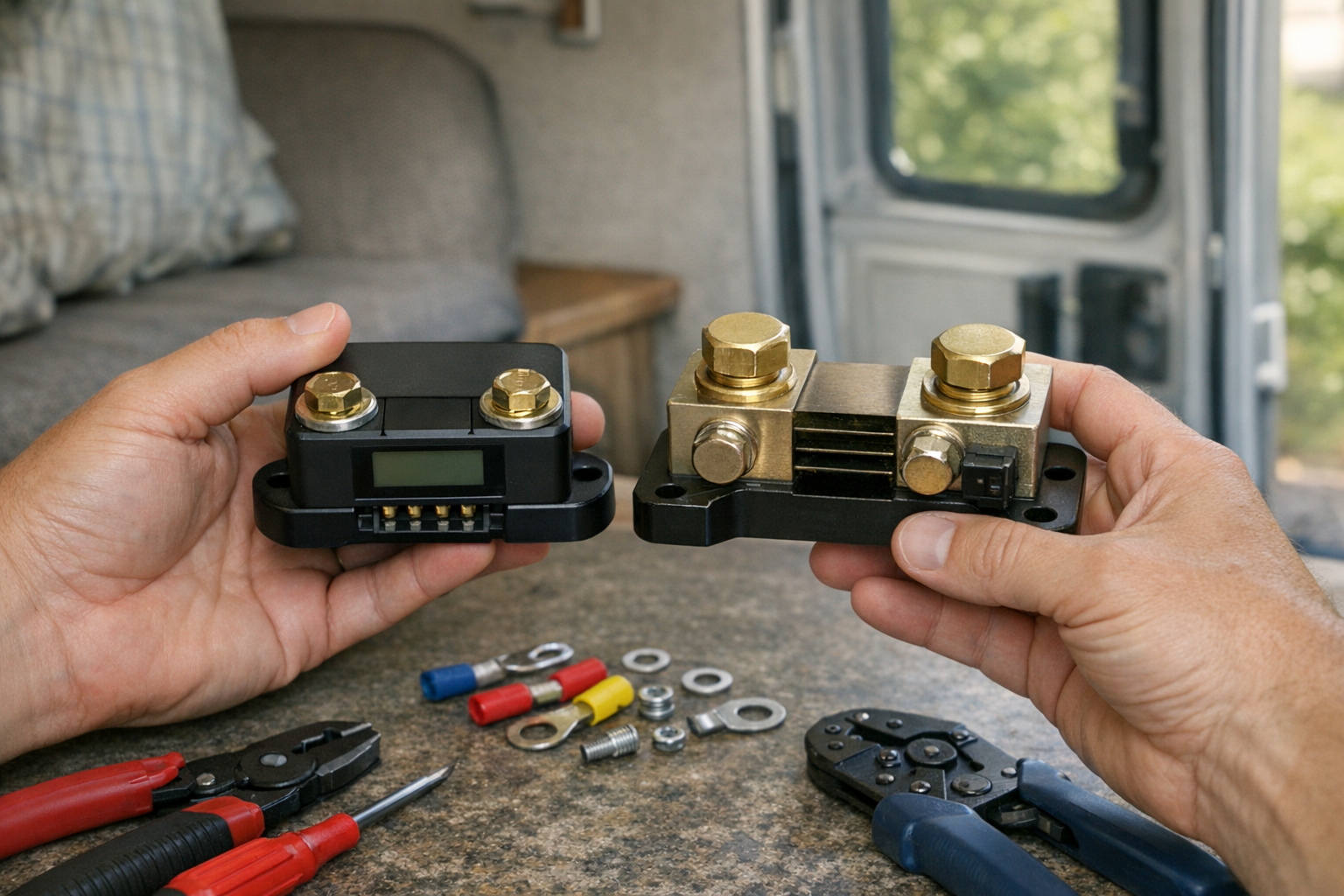
- Shunt placement error: The shunt must sit on the negative cable between the battery bank’s negative terminal and the system negative bus. All negative loads and charge sources must pass through the shunt. If any negative wire bypasses it (e.g., a chassis ground connected directly to the battery negative), the monitor will under-count current and SoC will drift progressively.
- Undersized wiring to the shunt: The cables connecting the battery negative to the shunt and the shunt to the negative bus must be rated for maximum system current. A 500A shunt connected with 6 AWG wire creates a dangerous bottleneck. Match wire gauge to your system’s maximum draw—typically 2/0 AWG or 4/0 AWG for large inverter loads.
- Skipping the fuse on the voltage-sense wire: The thin positive wire running from the battery positive to the monitor’s voltage-sense terminal carries full battery voltage. If it shorts, it can arc and start a fire. Always install an inline fuse (typically 1A–5A) on this wire, as close to the battery positive terminal as possible.
- Incorrect battery capacity programming: Shunt monitors calculate SoC by counting amp-hours relative to a programmed total capacity. If you enter 200 Ah but your bank is actually 300 Ah, the monitor will report 0% when 100 Ah remain. Always enter the actual rated capacity and update it if you add or remove batteries.
- Ignoring periodic full-charge resyncs: All coulomb-counting monitors accumulate small measurement errors over time. They resync to 100% SoC when the battery reaches a user-defined “charged voltage” at a user-defined “tail current.” If your charging system never fully tops off the bank (common with solar-only setups in winter), SoC accuracy degrades. Configure the sync parameters correctly and ensure a full charge at least every few weeks.
- Mounting the shunt in a wet or high-vibration area: Shunts are precision resistors. Corrosion on the terminal bolts increases resistance and introduces measurement error. Mount the shunt in a dry, ventilated battery compartment and use anti-corrosion washers or dielectric grease on all connections. Torque bolted connections to the manufacturer’s specification (typically 8–12 Nm for M8 bolts).
Disclaimer: Always follow the manufacturer’s installation instructions and local electrical codes. If you are unsure about any wiring, consult a certified RV electrician.
Recommended Gear
- Victron SmartSolar MPPT 100/30 — View on Amazon
- Renogy 100W Monocrystalline Panel — View on Amazon
- Battle Born 100Ah LiFePO4 Battery — View on Amazon
FAQs
- What is the best RV battery monitor shunt for most users? The Victron SmartShunt 500A is widely regarded as the best RV battery monitor shunt for the majority of users. It combines ±0.4% current accuracy, Bluetooth app connectivity, VE.Smart networking, and a compact headless design—all for around $100–$160. It works with LiFePO4, AGM, gel, and flooded batteries and handles battery banks from 1 Ah to 9,999 Ah.
- What size shunt do I need for my RV battery bank? Choose a shunt rated above your system’s maximum current draw. For most RV 12V systems with an inverter up to 2,000 W, a 500A shunt provides ample headroom. Smaller setups (no inverter, under 100 Ah bank) can use a 200A or 350A shunt. When in doubt, default to 500A—the cost difference is minimal and it accommodates future system expansion.
- Can I use a shunt battery monitor with LiFePO4 batteries? Yes. All quality shunt-based battery monitors—including the Victron SmartShunt, BMV-712, Renogy 500A, and Bayite 500A—are fully compatible with LiFePO4 chemistry. You will need to adjust the monitor’s settings for LiFePO4-specific parameters: charged voltage (typically 14.2–14.6 V for a 12V bank), tail current percentage, and Peukert exponent (set to 1.00 for lithium, since the Peukert effect is negligible in LiFePO4 cells).
- Do I still need a shunt monitor if my BMS has built-in monitoring? A dedicated shunt monitor provides more granular and historically tracked data than most built-in BMS displays. Many BMS units show only voltage and basic SoC; a shunt monitor adds real-time current, power draw, consumed Ah, time-to-empty, and multi-day historical logs. A shunt monitor also measures system-level current (all loads and chargers), while a BMS monitors only the battery pack itself—these readings can differ if there are parasitic draws or wiring losses between the BMS and the loads.
- Where should I mount the shunt in my RV? Install the shunt on the main negative cable, as physically close to the battery bank’s negative terminal as possible. Every negative conductor in your system—loads, inverter, solar charge controller, shore-power charger, DC-DC charger—must connect to the load side of the shunt, not directly to the battery. The only wire connected directly to the battery negative terminal should be the short cable running to the shunt’s battery-side terminal. Mount the shunt on a solid, dry surface using the included bracket or a custom mounting plate, and torque all bolted connections to the manufacturer’s specification.
- How accurate are shunt-based battery monitors compared to voltage-only meters? Shunt-based monitors are significantly more accurate for SoC estimation. A voltage-only meter infers charge level from terminal voltage, which varies with load, temperature, and battery age—errors of 20–30% are common under load. A shunt monitor uses coulomb counting (integrating current over time) and achieves SoC accuracy within 1–3% when properly configured and periodically resynced at full charge. The Victron units specify ±0.4% current measurement accuracy; even budget shunts like the Bayite achieve ±1%, far superior to voltage-based estimation.
As an Amazon Associate, we earn from qualifying purchases. This helps keep SunAmpRV running.