
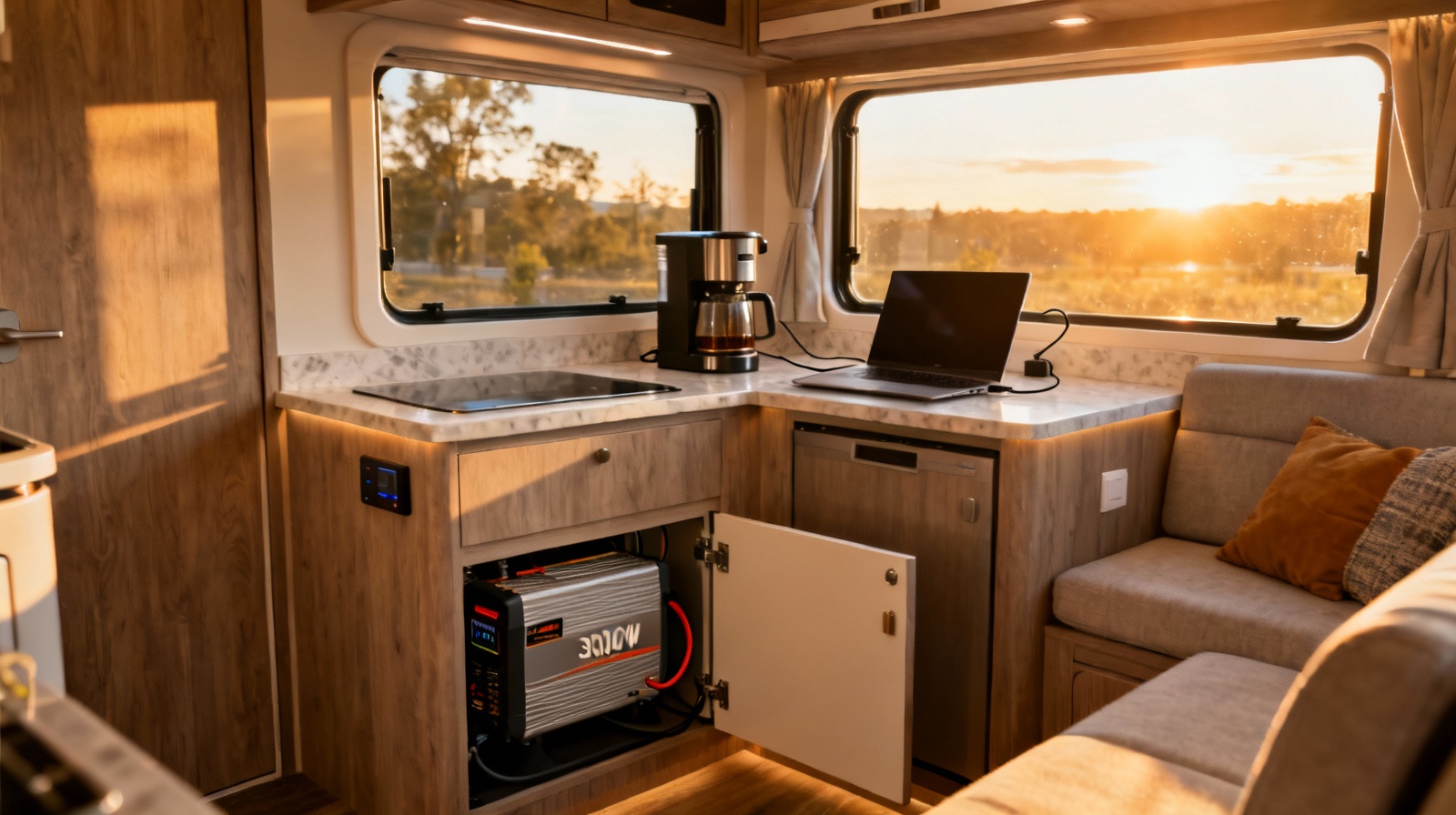
A 2000W pure sine wave inverter transforms your RV’s 12V DC battery bank into clean 120V AC power capable of running microwaves, coffee makers, air conditioners, and power tools—making it the backbone of any serious off-grid electrical system.
TL;DR — Best Picks
Best Overall: Renogy Inverter P2 2000W – High efficiency (>90%), robust build quality, and comprehensive protection features at a competitive price point.
Best Budget: GIANDEL 2000W Pure Sine Wave Inverter – Delivers reliable 2000W continuous power with dual AC outlets and USB ports under $200.
Best for Boondocking: BougeRV 2000W Pure Sine Wave Inverter – Ultra-quiet operation with intelligent cooling and low idle draw for extended dry camping.
Buyer’s Guide
Power & Sizing
Selecting the correct inverter capacity requires calculating your peak simultaneous load. A 2000W continuous rating handles most RV appliances individually—a typical microwave draws 1000–1500W, a coffee maker 800–1200W, and a 13,500 BTU air conditioner requires approximately 1500W running with a 3000–4000W startup surge.
Critical specifications to evaluate:
- Continuous power: All picks deliver 2000W sustained output
- Surge capacity: Look for 4000W minimum (2x continuous) to handle motor startup loads
- Efficiency rating: Higher percentages (90%+) mean less battery drain and heat generation
- Idle consumption: Ranges from 0.5A to 2A; lower is better for overnight operation
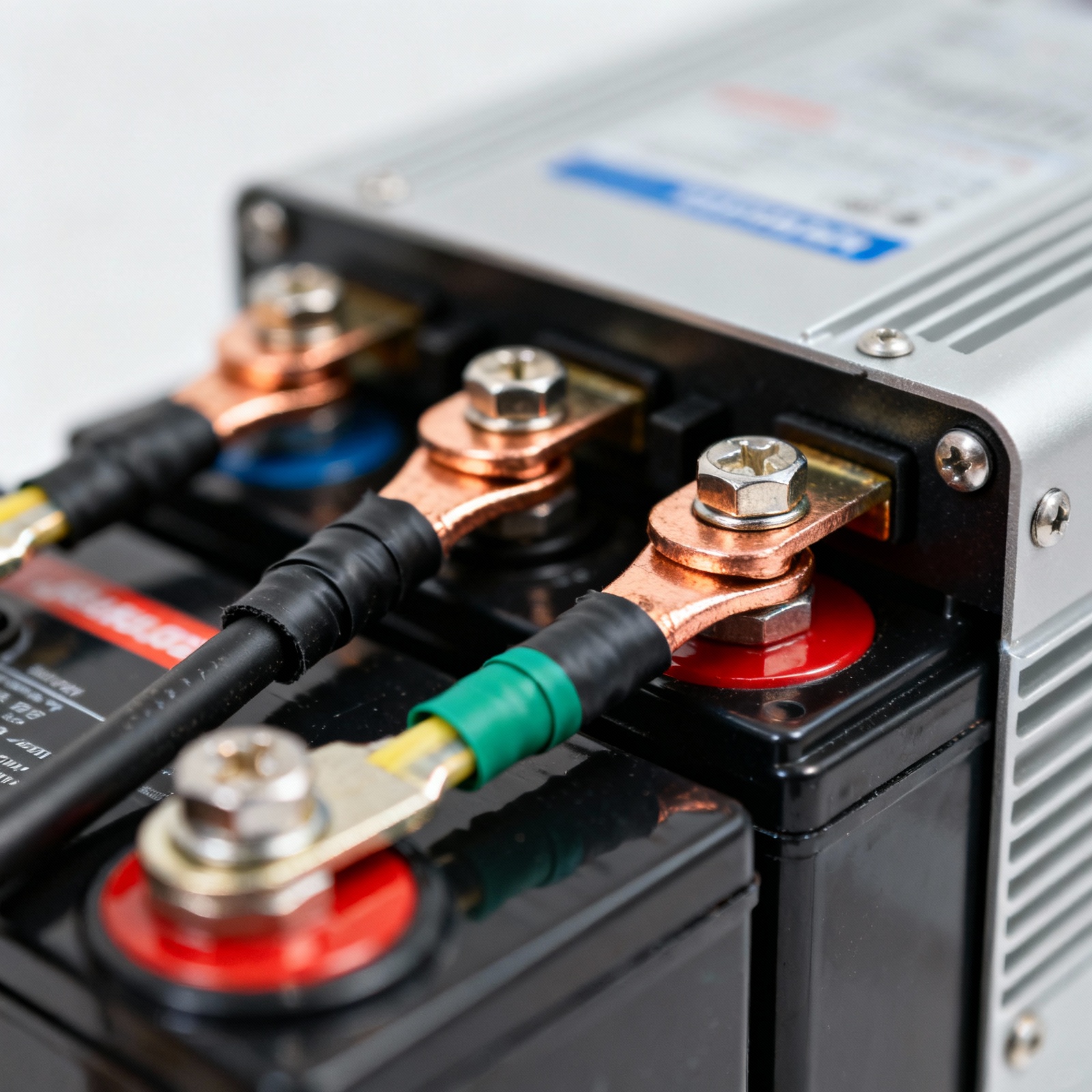
Battery bank sizing directly impacts inverter performance. At 2000W output from a 12V system, expect approximately 180–200A draw at the battery terminals. A minimum 200Ah lithium or 400Ah lead-acid bank prevents excessive voltage sag and premature low-voltage cutoff.
Waveform Quality
Pure sine wave output is non-negotiable for RV applications.
Modified sine wave inverters cost less but create problems:
- Microwave ovens produce reduced power and audible buzzing
- Variable-speed motors in fans and refrigerators run hot and fail prematurely
- Sensitive electronics (laptops, CPAP machines, battery chargers) may malfunction or sustain damage
- LED lights and dimmers flicker or produce interference
All inverters in this comparison produce true pure sine wave output with total harmonic distortion (THD) under 3%, matching or exceeding grid power quality.
Protection Features
Quality inverters include multiple protection circuits that prevent damage and extend equipment lifespan:
- Low voltage disconnect (LVD): Typically triggers at 10.5–11V to prevent deep battery discharge
- High voltage protection: Shuts down above 15–16V to prevent component damage
- Overload protection: Automatic shutdown when continuous draw exceeds rated capacity
- Over-temperature protection: Reduces output or shuts down when internal temps exceed safe limits
- Short circuit protection: Immediate shutdown with automatic reset capability
Installation Considerations
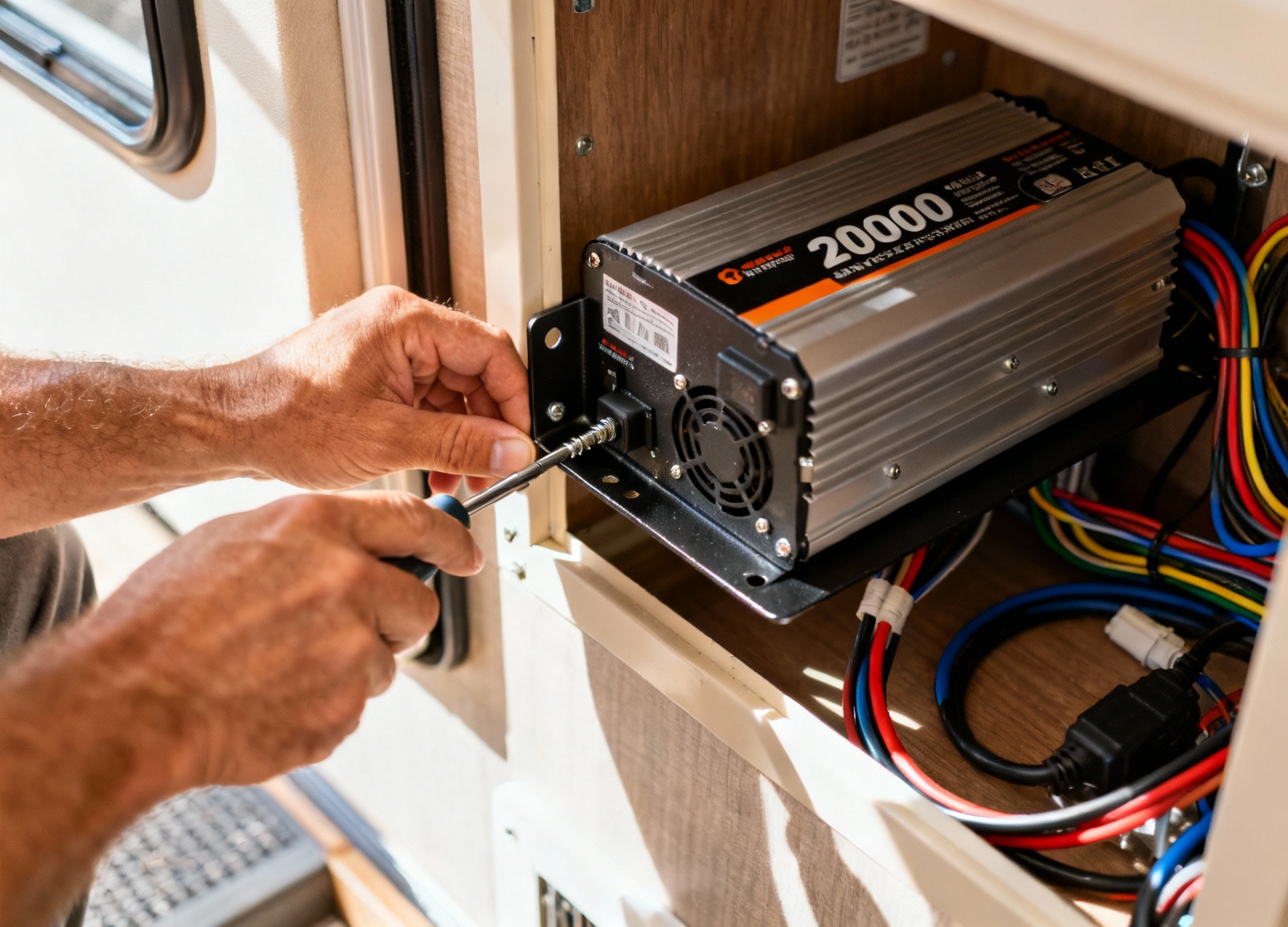
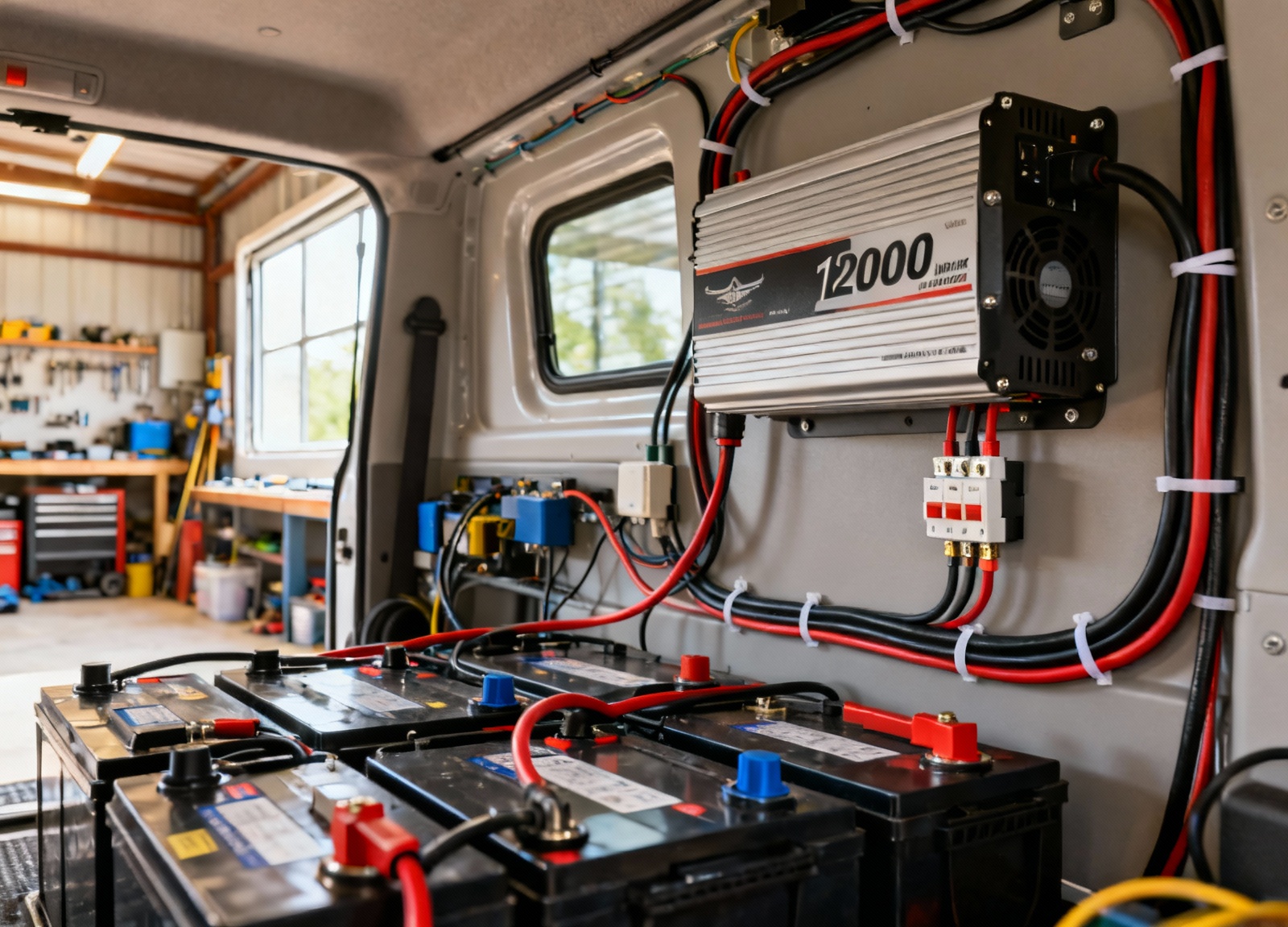
Mounting location affects both performance and longevity. Inverters generate heat proportional to load—a 2000W inverter at 90% efficiency produces approximately 200W of waste heat at full power. Ensure adequate ventilation with minimum 4-inch clearance on all sides.
Wire gauge requirements for 12V 2000W systems:
- 0–3 feet cable run: 2/0 AWG minimum
- 3–6 feet cable run: 4/0 AWG recommended
- Always use the shortest practical cable length
- Install appropriately rated fuse (typically 200–250A) within 12 inches of battery positive terminal
Product Details
Renogy Inverter P2 2000W
Key specs: 2000W continuous, 4000W surge, 12V DC input, conversion efficiency >90%.
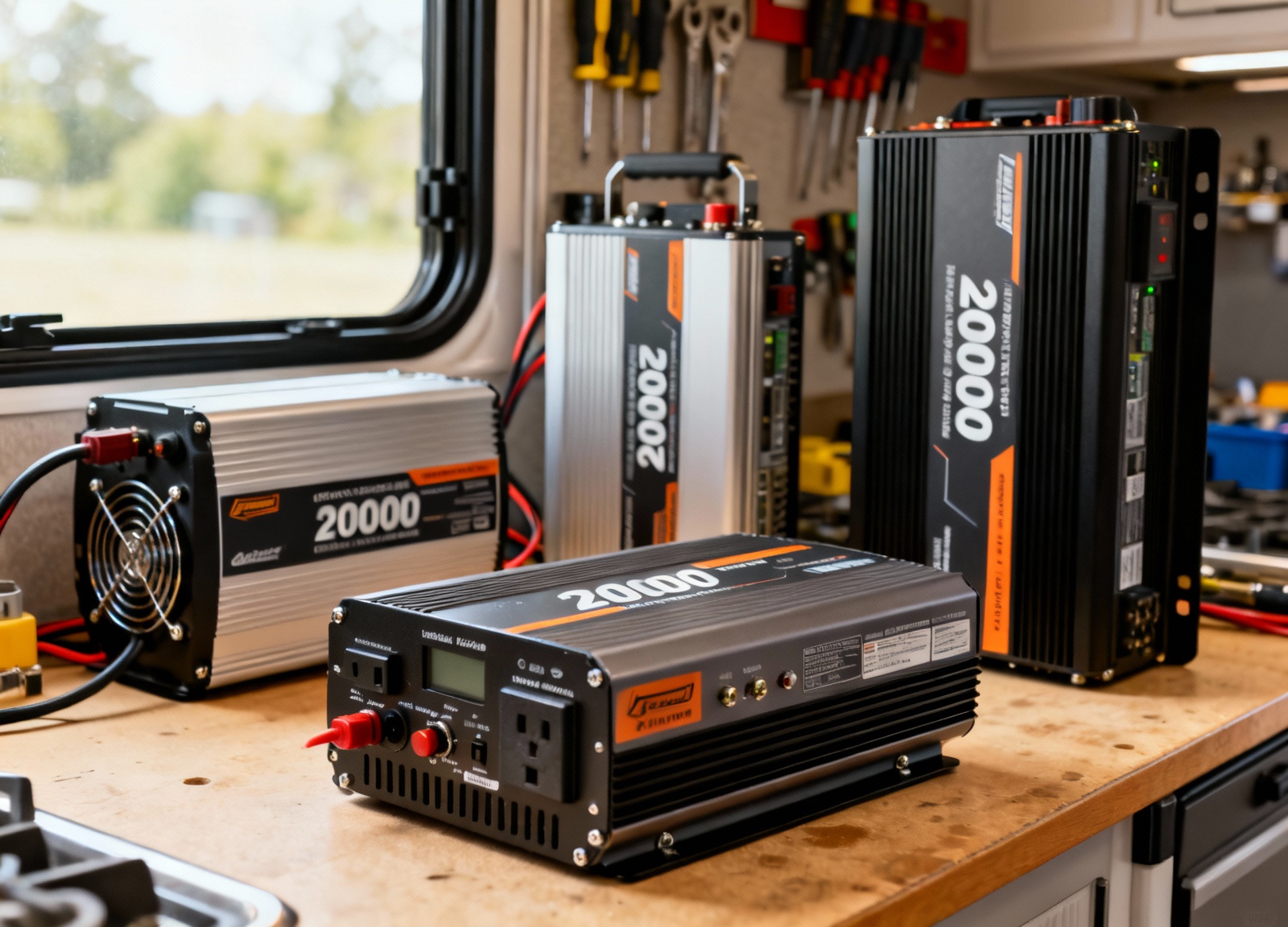
The Renogy P2 represents the current benchmark for mid-priced 2000W inverters. Its high conversion efficiency helps deliver measurably longer runtime versus lower-efficiency competitors. The aluminum housing with integrated cooling fins dissipates heat effectively, and the variable-speed fan activates only under load, maintaining quiet operation during light use. View on Amazon
- Pro: Industry-leading efficiency reduces battery drain and heat generation
- Pro: Comprehensive 8-point protection system with clear LED status indicators
- Pro: Hardwire terminal block plus standard outlets for flexible installation
- Con: Slightly larger footprint than some competitors
- Con: Wired remote control included (16.4 ft)
GIANDEL 2000W Pure Sine Wave Inverter
Key specs: 2000W continuous, 4100W surge, 12V DC input, UL Listed GFCI outlets, USB-C (36W), remote with battery monitor.
GIANDEL delivers proven reliability at an accessible price point, making it the go-to choice for budget-conscious RVers. The included remote allows convenient on/off control from the living area without accessing the inverter location. Dual AC outlets and dual USB ports (5V/2.4A each) handle typical RV charging needs without additional adapters. View on Amazon
- Pro: Sub-$200 price point with included remote control
- Pro: Hardwire terminal block enables permanent installation
- Pro: Established brand with responsive customer support
- Con: Fewer published efficiency/idle-draw specs than premium units
- Con: Cooling fan runs louder under moderate loads
BougeRV 2000W Pure Sine Wave Inverter
Key specs: 2000W output, 12V DC input, built-in Bluetooth for BougeRV app, wired remote controller.
BougeRV engineered this inverter specifically for extended off-grid use. The intelligent cooling system uses temperature-controlled variable-speed fans that remain silent during light loads—critical for overnight operation when running CPAP machines or charging devices. Low idle consumption preserves battery capacity during standby periods. View on Amazon
- Pro: Exceptionally quiet operation suits sleeping areas
- Pro: Compact, lightweight design fits tight installation spaces
- Pro: Low standby draw extends battery life during light use
- Con: Shorter warranty than some competitors
- Con: Limited availability through traditional RV dealers
Victron Phoenix 12/2000
Key specs: 2000W continuous, 4000W surge, 12V DC input, 94% peak efficiency, 14.3 lbs, 14.6 × 6.9 × 5.1 inches, 5-year warranty.
The Victron Phoenix represents the professional-grade option for RVers prioritizing long-term reliability and system integration. Built-in Bluetooth connectivity enables real-time monitoring through the VictronConnect app, displaying output power, efficiency, and fault codes. The 5-year warranty reflects Victron’s confidence in component quality and manufacturing standards.
- Pro: Highest efficiency rating (94%) minimizes battery drain
- Pro: Bluetooth monitoring and programmable settings via smartphone app
- Pro: Industry-leading 5-year warranty
- Con: Premium pricing—approximately 2–3x budget alternatives
- Con: Heavier and larger than comparable units
Krieger 2000W Pure Sine Wave Inverter
Key specs: 2000W continuous, 4000W surge, 12V DC input, ~89% efficiency, 11.8 lbs, 15.2 × 7.0 × 4.1 inches, 3-year warranty.
Krieger balances features and value with a 3-year warranty that exceeds most competitors in this price range. Three AC outlets plus USB-A and USB-C ports accommodate multiple devices simultaneously. ETL certification confirms independent safety testing, providing additional peace of mind for permanent installations.
- Pro: Extended 3-year warranty provides long-term protection
- Pro: Multiple outlet types reduce adapter requirements
- Pro: ETL safety certification
- Con: Mid-range efficiency increases operating costs slightly
- Con: Bulkier chassis requires more installation space
Comparison Table
| Model | Type | Key Specs | Best for | Pros | Cons |
|---|---|---|---|---|---|
| Renogy Inverter P2 2000W | Pure Sine Wave | 2000W continuous, 4000W surge, 12V DC input, conversion efficiency >90%, wired remote (16.4 ft) | Overall performance | High efficiency, comprehensive protections, quality construction | Premium price tier, larger footprint |
| GIANDEL 2000W Pure Sine Wave | Pure Sine Wave | 2000W continuous, 4100W surge, 12V DC input, UL Listed GFCI outlets, USB-C (36W), remote with battery monitor | Budget-conscious buyers | Affordable, includes remote switch, hardwire terminal block | Fewer published efficiency/idle specs, louder fan |
| BougeRV 2000W Pure Sine Wave | Pure Sine Wave | 2000W output, 12V DC input, built-in Bluetooth (BougeRV app), wired remote controller | Boondocking/quiet operation | Intelligent cooling, low idle consumption, compact design | Shorter warranty, limited dealer network |
| AIMS Power 2000W Pure Sine Wave | Pure Sine Wave | 2000W continuous, 4000W surge, 12V DC input, 90% efficiency, 13.2 lbs, 1-year warranty | Heavy-duty applications | Industrial-grade components, excellent surge handling | Heavier, basic warranty coverage |
| Krieger 2000W Pure Sine Wave | Pure Sine Wave | 2000W continuous, 4000W surge, 12V DC input, 3 AC outlets, USB-A/USB-C, 11.8 lbs, 3-year warranty | Multiple device charging | Extended warranty, multiple outlet options, ETL certified | Mid-range efficiency (~89%), bulkier chassis |
| Ampeak 2000W Pure Sine Wave | Pure Sine Wave | 2000W continuous, 4000W surge, 12V DC input, dual AC outlets, 2.1A USB, 10.5 lbs | Entry-level installations | Lightweight, competitive pricing, simple installation | Basic protection suite, shorter lifespan under heavy loads |
| Victron Phoenix 12/2000 | Pure Sine Wave | 2000W continuous, 4000W surge, 12V DC input, 94% efficiency, 14.3 lbs, 5-year warranty | Premium/professional builds | Industry-leading efficiency, Bluetooth monitoring, exceptional warranty | Highest price point, requires separate remote |
Which One Should You Buy?
If you prioritize efficiency and long-term value, the Renogy P2 2000W delivers the best balance of performance, build quality, and price. Its 93% efficiency rating means measurably longer runtime from your battery bank, and the comprehensive protection suite prevents costly damage from electrical faults.
Budget constraints? The GIANDEL 2000W provides reliable 2000W output with essential features at roughly half the cost of premium alternatives. The included remote control adds convenience that other budget options lack, and the hardwire terminal block enables clean permanent installations.
If you spend extended periods boondocking or need quiet overnight operation, the BougeRV 2000W excels with its intelligent cooling system and low idle draw. The near-silent operation won’t disturb sleep, and the compact footprint fits installations where space is limited.
For professional-grade systems with monitoring requirements and maximum warranty protection, the Victron Phoenix 12/2000 justifies its premium price through exceptional efficiency, Bluetooth integration, and a 5-year warranty that outlasts the competition.
Safety & Common Mistakes
- Install a correctly sized fuse (200–250A for 2000W at 12V) within 12 inches of the battery positive terminal—this is non-negotiable for fire prevention.
- Choose wire gauge for the expected current and run length; target ≤3% voltage drop using 2/0 AWG or larger for runs under 6 feet.
- Use proper battery and array disconnects; de-energize the system before any work.
- Avoid reversed polarity—double-check connections before powering on; most inverters will not survive reversed battery connections.
- Provide adequate ventilation with minimum 4-inch clearance on all sides; never install in sealed compartments.
- Torque all terminal connections to manufacturer specifications; loose connections cause resistance heating and potential fires.
Always consult a qualified electrician if you’re uncertain about any aspect of your installation.
Recommended Gear
- Victron SmartSolar MPPT 100/30 — View on Amazon
- Renogy 100W Monocrystalline Panel — View on Amazon
- Battle Born 100Ah LiFePO4 Battery — View on Amazon
FAQs
- How many solar panels do I need to run a 2000W inverter? Solar panel sizing depends on usage patterns, not inverter capacity. A 2000W inverter drawing 1000W average load for 4 hours daily requires approximately 4000Wh. With 5 peak sun hours, you’d need 800W of panels minimum—typically 600–1000W is recommended to account for efficiency losses and cloudy days.
- Can I run my RV air conditioner on a 2000W inverter? Most 13,500 BTU RV air conditioners require 1300–1500W running power but draw 2500–3500W during startup. A 2000W inverter with 4000W surge capacity can handle this, though a soft-start kit ($50–100) reduces startup surge to under 2000W for more reliable operation.
- What’s the difference between continuous and surge power ratings? Continuous power (2000W) represents sustainable output for extended periods. Surge power (typically 4000W for these units) handles brief startup loads lasting 0.1–5 seconds—critical for motors in refrigerators, air conditioners, and power tools that draw 2–3x running watts during startup.
- Do I need a transfer switch with my inverter? Yes, if you want to power existing RV outlets from both shore power and inverter power. A transfer switch prevents backfeeding and allows seamless switching between power sources. Some RVers install inverter-chargers that include automatic transfer switching.
- How long will my batteries last running a 2000W inverter? Runtime depends on actual load, not inverter capacity. At 1000W continuous draw from a 12V system: 200Ah lithium battery provides approximately 2 hours (using 80% depth of discharge); 200Ah lead-acid provides approximately 1 hour (using 50% DoD). Reduce loads or increase battery capacity for longer runtime.
- Why does my inverter shut down when I start my microwave? This typically indicates insufficient battery capacity or undersized wiring causing voltage sag below the inverter’s low-voltage cutoff (usually 10.5–11V). Solutions include upgrading to larger battery cables, adding battery capacity, or checking for corroded connections that increase resistance.
As an Amazon Associate, we earn from qualifying purchases. This helps keep SunAmpRV running.