

You’re parked at a remote campsite with no hookups, your phone is at 12%, and the LED lights in your RV are starting to dim. You don’t need a massive rooftop solar array—you just need a reliable 100-watt solar kit that can keep your essentials running without draining your house battery overnight. The problem? There are dozens of 100W RV solar kits on the market, and they vary wildly in panel quality, charge controller type, included hardware, and real-world output. After researching specifications, analyzing user feedback, and comparing what each kit actually delivers out of the box, I’ve ranked the best 100W solar kits for RVs so you can make a confident purchase.
TL;DR
- Best Overall: Renogy 100W 12V Solar Panel Starter Kit — The most complete, expandable package with proven reliability and a solid 30A PWM controller.
- Best Budget: HQST 100W Solar Panel Kit — Delivers strong real-world output at a noticeably lower price point.
- Best for Beginners: Newpowa 100W Solar Kit — Exceptionally easy installation with clear instructions and all necessary hardware included.
- Best Lightweight Option: BougeRV 100W Solar Kit — Flexible panel design ideal for curved RV roofs and weight-conscious setups.
- Best for Expansion: Rich Solar 100W Kit — Premium MPPT-compatible design built for scaling up to a multi-panel system.
Why a 100W Solar Kit Is Ideal for RV Camping
A 100-watt solar kit sits in a sweet spot for recreational vehicle owners. It’s powerful enough to maintain a 12V battery bank for basic loads, compact enough to mount on nearly any RV roof, and affordable enough that you’re not making a four-figure commitment before you know whether solar works for your travel style. For weekend warriors, seasonal campers, and minimalist boondockers, 100W is often all you need—and it’s always a smart starting point if you plan to expand later.

What Can a 100W Solar Panel Power in an RV?
Under ideal conditions—full, direct sunlight with no shading—a 100W panel produces roughly 5 to 6 amps per hour at 12V. Over a typical day with 4 to 6 peak sun hours, that translates to approximately 400–600 watt-hours of energy. In practical terms, that’s enough to run:
- LED interior lights (5–10W each) for several hours
- Phone and tablet charging (10–20W) multiple times per day
- A 12V fan (15–30W) for a few hours
- A small 12V water pump intermittently
- A laptop (60W) for a couple of hours
What it won’t comfortably run on its own: a residential refrigerator, an air conditioner, a microwave, or a hair dryer. Those appliances demand far more wattage and sustained current than a single 100W panel can deliver. However, a 100W kit can keep a 12V compressor fridge topped off if your battery bank is adequately sized and you’re getting good sun.
Monocrystalline vs. Polycrystalline: Which Is Better for RVs?
Nearly every quality 100W RV solar kit on the market today uses monocrystalline cells, and for good reason. Monocrystalline panels typically achieve 20–23% cell efficiency compared to 15–17% for polycrystalline. That higher efficiency means more power per square foot of roof space—a critical advantage when your mounting area is limited.
Monocrystalline panels also perform slightly better in low-light conditions (overcast skies, early morning, late afternoon) and tend to have a longer lifespan. The price gap between the two technologies has narrowed so much that there’s little reason to choose polycrystalline for an RV application. All five kits use monocrystalline technology.
— Renogy 100W 12V Solar Panel Starter Kit
If you ask experienced RV solar users which brand they trust most for a 100W starter kit, the answer is almost always Renogy. This kit has earned its reputation through years of consistent performance, a comprehensive package, and a brand ecosystem that makes future expansion painless.
The kit centers around Renogy’s monocrystalline 100W panel, which measures approximately 42.2 × 19.6 × 1.38 inches and weighs about 16.5 lbs. It uses high-efficiency monocrystalline cells with a rated efficiency around 21.4%, and the panel features a corrosion-resistant aluminum frame with pre-drilled holes for straightforward mounting. In real-world testing scenarios, users consistently report output in the 80–95W range under good sunlight—excellent for a 100W-rated panel, since real conditions rarely match laboratory STC (Standard Test Conditions).
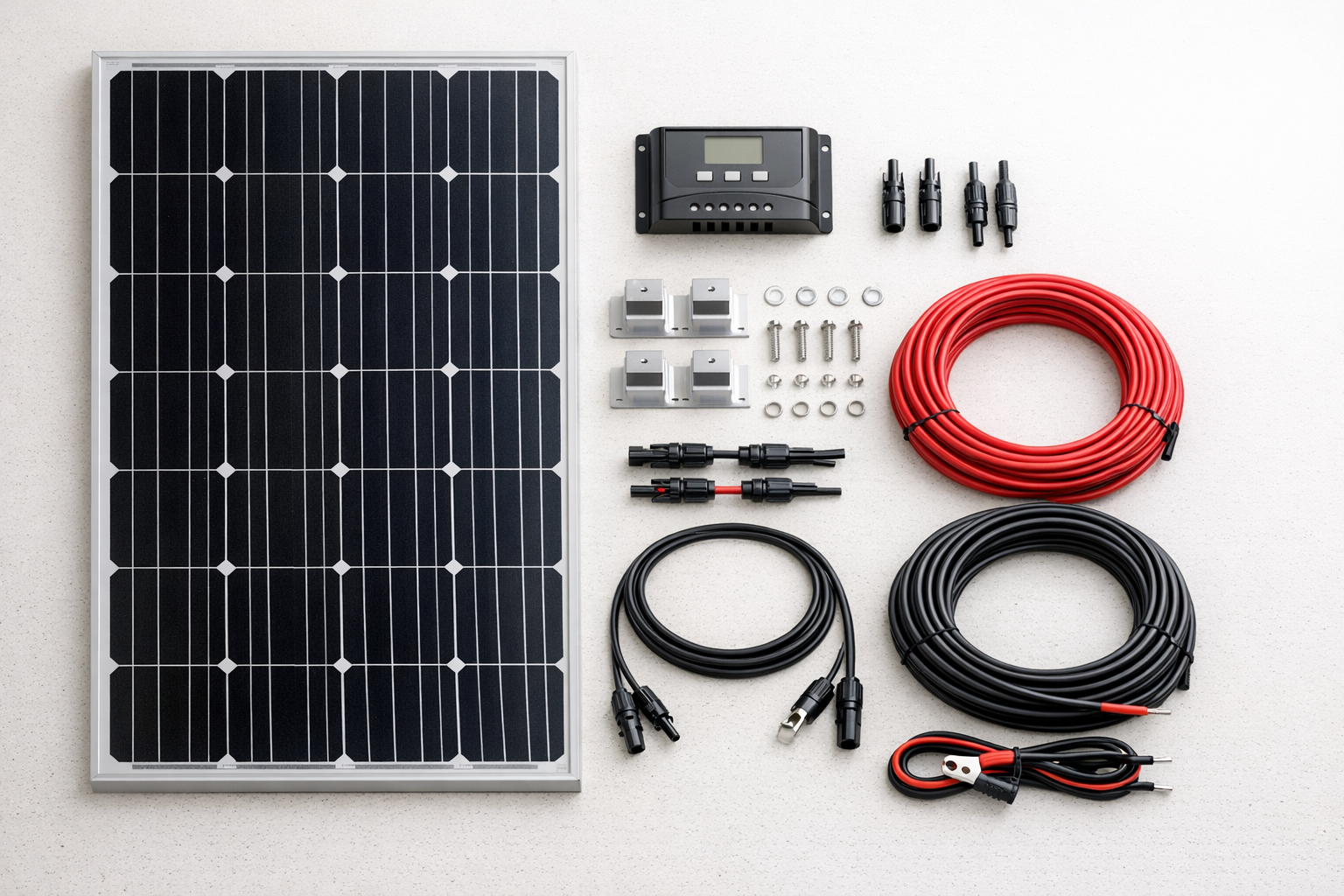
What sets this kit apart is what’s in the box. You get the panel, a Renogy Wanderer 30A PWM charge controller, Z-brackets for roof mounting, 20 feet of 10AWG tray cable, an 8-foot adapter kit with MC4 connectors, and mounting hardware. The Wanderer controller supports 12V and 24V battery systems and includes an LCD screen displaying charging current, battery voltage, and charging status. It’s not an MPPT controller—so you’re leaving some efficiency on the table—but for a single 100W panel, the difference between PWM and MPPT is modest (roughly 10–15% in most conditions), and the Wanderer keeps the kit price accessible.
The Renogy ecosystem is the real long-term advantage. When you’re ready to add a second or third panel, Renogy sells expansion kits with matching connectors, and their charge controllers handle additional panels wired in parallel. The company offers a 25-year power output warranty on the panel and a 1-year warranty on the controller and accessories.
Who it’s best for: First-time RV solar buyers who want a proven, all-in-one package from a brand with excellent support and easy expandability.
Pros: Most complete starter package; trusted brand with wide parts availability; 30A controller leaves room for expansion; solid build quality; clear installation instructions.
Cons: PWM controller (not MPPT); panel is on the heavier side at 16.5 lbs; slightly higher price than budget alternatives.
— HQST 100W Solar Panel Kit
HQST (High Quality Solar Technology) has quietly built a loyal following among budget-conscious RV owners, and their 100W kit delivers impressive value. The panel uses monocrystalline cells with efficiency ratings comparable to Renogy’s, and in side-by-side comparisons, HQST panels frequently match or come within a few watts of Renogy’s real-world output.
The HQST 100W panel measures roughly 40.2 × 19.8 × 1.38 inches—slightly more compact than the Renogy—and weighs approximately 14.3 lbs. The aluminum frame is sturdy, and the tempered glass surface is rated to withstand moderate hail and snow loads. HQST rates the panel at 21.5% maximum efficiency, and users commonly see 75–90W of actual output in favorable conditions.
The kit typically includes a 30A PWM charge controller (HQST’s own branded unit), Z-bracket mounting hardware, MC4 connectors, and wiring. The controller is functional but basic—it has LED indicators rather than an LCD screen, which means you’ll need a multimeter or a separate battery monitor to get precise voltage and current readings.
Where HQST really shines is price. This kit frequently sells for $20–$40 less than the Renogy equivalent, and the performance gap is negligible. If you’re on a tight budget and just need a reliable 100W kit to keep your batteries topped off during weekend trips, HQST is hard to beat.
Who it’s best for: Budget-minded RV owners who want strong performance without paying a premium for brand name. Also a great choice if you’re buying multiple kits for a larger system and want to minimize cost per watt.
Pros: Excellent price-to-performance ratio; lightweight panel; solid real-world output; good mounting hardware included.
Cons: Controller lacks LCD display; brand has less aftermarket support than Renogy; instructions could be more detailed.
— Newpowa 100W Solar Kit
Newpowa doesn’t get as much mainstream attention as Renogy but has earned a strong reputation in the RV and off-grid community. Their 100W kit is particularly well-suited for beginners because of its thoughtful packaging and clear, step-by-step installation guide.
The Newpowa 100W monocrystalline panel features cells rated at approximately 21% efficiency. Panel dimensions are roughly 40.5 × 19.7 × 1.18 inches, and it weighs about 15.4 lbs. Build quality is solid—the aluminum frame feels robust, and the junction box on the back is well-sealed with IP65-rated waterproofing. In real-world conditions, expect 75–90W of output during peak sun hours.
The kit comes with a 30A PWM charge controller that includes an LCD display—a nice touch at this price point. You also get Z-brackets, MC4 connectors, and tray cable. Newpowa’s controller supports 12V and 24V systems and has built-in overcharge, over-discharge, and short-circuit protection. The wiring is clearly labeled, and the included manual walks you through the entire installation process with diagrams that even a complete novice can follow.
Multiple users report responsive customer support when they’ve had questions about installation or compatibility—something that matters a lot when you’re wiring solar on your RV for the first time.
Who it’s best for: First-time solar installers who want a kit that holds their hand through the process. If you’ve never wired anything on your RV before, Newpowa’s documentation and support make the learning curve much less intimidating.
Pros: Excellent installation documentation; LCD-equipped controller; good build quality; responsive customer support; competitive pricing.
Cons: Slightly less brand recognition (harder to find expansion accessories); PWM controller only; panel is marginally heavier than HQST.
— BougeRV 100W Solar Kit
BougeRV takes a different approach by focusing on a flexible panel design. If your RV has a curved roof—common on fiberglass trailers, Airstreams, and many camper vans—a rigid panel either won’t sit flush or requires custom mounting solutions. BougeRV’s flexible 100W panel can bend up to a 258-degree arc (roughly 30 degrees of flex), allowing it to conform to curved surfaces and maintain a low profile.
The flexible panel is dramatically lighter than rigid alternatives, weighing only about 4.4 lbs compared to 14–17 lbs for a standard framed panel. It’s also much thinner—roughly 0.1 inches—which means it adds virtually no aerodynamic drag. The panel uses monocrystalline PERC cells with an efficiency rating around 22%, and real-world output typically falls in the 70–85W range. That’s slightly lower than the best rigid panels, partly because flexible panels can’t dissipate heat as effectively when mounted flush against a roof surface.
The kit includes the flexible panel, a 30A PWM charge controller, MC4 connectors, and wiring. Mounting is typically done with industrial-strength adhesive (VHB tape or Dicor lap sealant) rather than brackets, which means no drilling holes in your roof. This is a significant advantage for RV owners who are nervous about creating potential leak points.
The trade-off? Flexible panels generally don’t last as long as rigid ones. While a quality rigid panel can deliver 80%+ of its rated output for 25 years, flexible panels tend to degrade faster—expect a useful lifespan of 5–10 years depending on conditions and how well the panel is protected from foot traffic and debris. The lamination can also delaminate over time in extreme heat.
Who it’s best for: RV owners with curved roofs, weight-sensitive builds (like camper vans or pop-up trailers), or anyone who absolutely doesn’t want to drill into their roof.
Pros: Ultra-lightweight (4.4 lbs); conforms to curved surfaces; no-drill installation; low profile; high cell efficiency rating.
Cons: Shorter lifespan than rigid panels; slightly lower real-world output due to heat buildup; can’t be tilted for optimal angle; adhesive mounting is semi-permanent.
— Rich Solar 100W Kit
Rich Solar positions itself as a premium option in the 100W space, and their kit reflects that with higher-grade components and a design philosophy centered on future expansion. The Rich Solar 100W monocrystalline panel uses Grade-A cells with an efficiency rating around 21.8%, and the panel construction feels noticeably robust—the frame is thicker gauge aluminum, and the tempered glass has a textured anti-reflective coating that improves light absorption at oblique angles.
The panel measures approximately 40.6 × 20.1 × 1.38 inches and weighs about 15.6 lbs. Real-world output is competitive, with users reporting 80–92W under good conditions. The junction box is IP68-rated (a step above the IP65 rating on most competitors), providing better protection against water intrusion during heavy rain or when washing your RV roof.
Where Rich Solar differentiates itself is in the charge controller. Some configurations of this kit include an MPPT controller rather than a PWM unit, which can harvest 10–30% more energy from the same panel—especially in conditions where the panel voltage is significantly higher than the battery voltage (cold weather, partially shaded conditions). An MPPT controller also makes expansion much more efficient, since it can handle higher input voltages from panels wired in series.
The kit includes mounting Z-brackets, MC4 connectors, and appropriately gauged wiring. Rich Solar also sells a wide range of compatible panels, batteries, and inverters, so building out a complete system within their ecosystem is straightforward.
Who it’s best for: RV owners who know they’ll eventually expand beyond 100W and want to invest in premium components from the start. Starting with Rich Solar’s MPPT-equipped kit saves you from replacing the controller later.
Pros: Premium build quality; MPPT controller option; IP68 junction box; excellent expansion potential; anti-reflective glass coating.
Cons: Higher price point; MPPT controller adds cost that’s arguably overkill for a single 100W panel; slightly less widespread availability than Renogy.
Rigid vs. Flexible vs. Portable 100W Panels for RVs
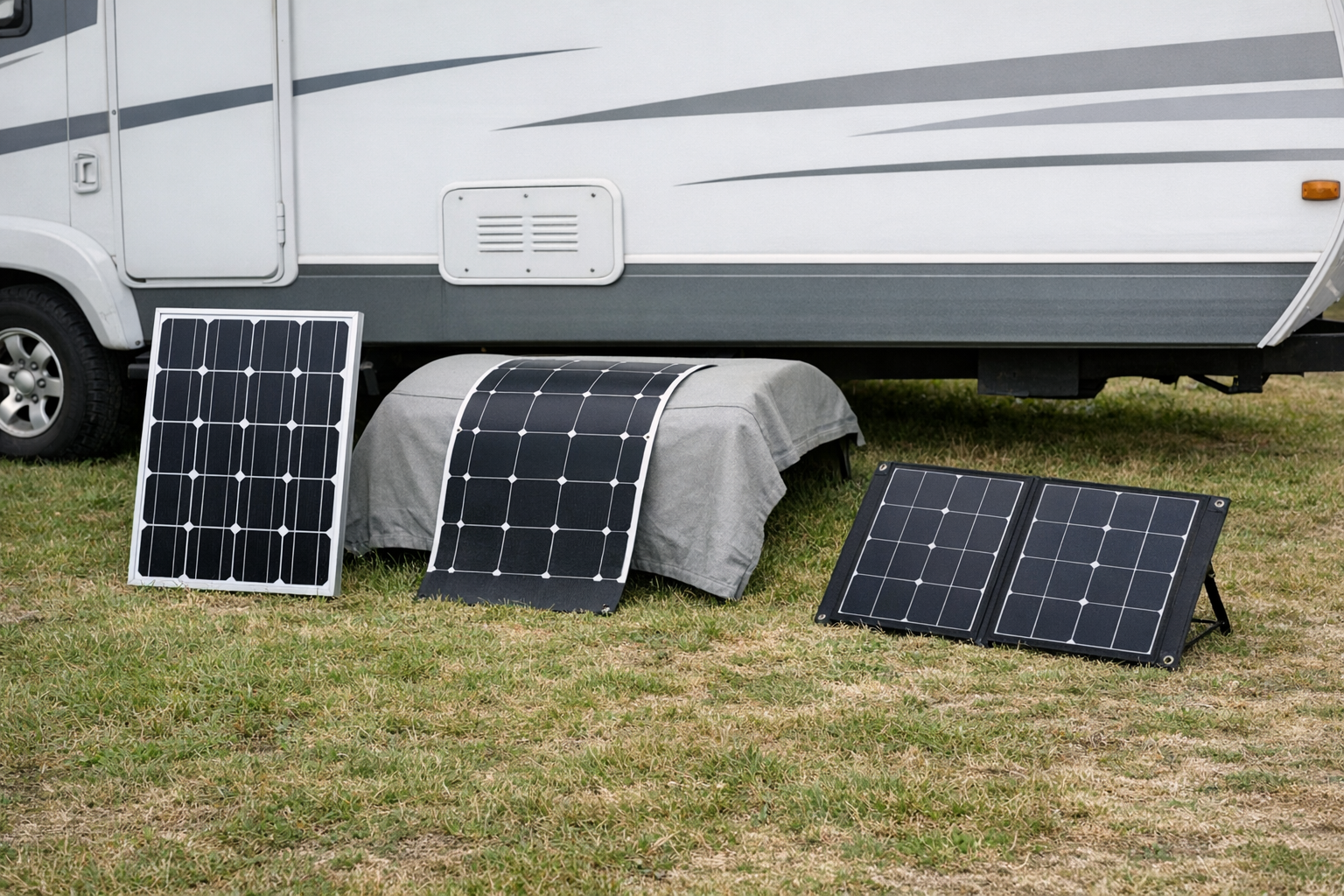
Rigid panels are the default choice for most RV installations. They’re mounted on aluminum Z-brackets or tilt mounts, leaving an air gap between the panel and the roof that helps with heat dissipation. They’re durable, efficient, and can last 25+ years. The downside: they add 2–3 inches of height, they require drilling into your roof (creating potential leak points if not sealed properly), and they weigh 14–17 lbs for a 100W panel.
Flexible panels weigh a fraction of rigid panels (often under 5 lbs) and can conform to curved surfaces. They’re ideal for camper vans, Airstreams, and pop-up trailers where weight and aerodynamics matter. However, they run hotter because there’s no air gap, which reduces output by 5–10%. They also have shorter lifespans—typically 5–10 years versus 25+ for rigid panels—and they can’t be tilted toward the sun.
Comparison Table
| Model | Type | Key Specs | Best for | Pros | Cons | Where to buy |
|---|---|---|---|---|---|---|
| Renogy 100W 12V Starter Kit | Rigid Monocrystalline | 100W; 21.4% eff.; 30A PWM; 16.5 lbs; 42.2 × 19.6 in | Best overall / first-time buyers | Complete package; expandable ecosystem; 25-yr panel warranty | PWM only; heavier panel; slightly pricier | Amazon ↗ |
| HQST 100W Solar Panel Kit | Rigid Monocrystalline | 100W; 21.5% eff.; 30A PWM; 14.3 lbs; 40.2 × 19.8 in | Best budget pick | Low price; lightweight; strong output | Basic controller (no LCD); less brand support | Amazon ↗ |
| Newpowa 100W Solar Kit | Rigid Monocrystalline | 100W; 21% eff.; 30A PWM w/ LCD; 15.4 lbs; 40.5 × 19.7 in | Best for beginners | Clear instructions; LCD controller; good support | Less expansion ecosystem; PWM only | Amazon ↗ |
| BougeRV 100W Flexible Kit | Flexible Monocrystalline | 100W; 22% eff.; 30A PWM; 4.4 lbs; ultra-thin | Best lightweight / curved roofs | 4.4 lbs; no-drill install; low profile | Shorter lifespan; lower real-world output; can’t tilt | Amazon ↗ |
| Rich Solar 100W Kit | Rigid Monocrystalline | 100W; 21.8% eff.; MPPT option; 15.6 lbs; IP68 junction box | Best for future expansion | MPPT controller; premium build; IP68 rated | Higher cost; MPPT overkill for single panel | Amazon ↗ |
| All Kits (Avg.) | Monocrystalline | 100W; 21–22% eff.; 30A controller; 4.4–16.5 lbs | General RV use | Maintain 12V battery; compact; affordable entry | Single panel won’t run high-draw appliances | Amazon ↗ |
Safety & Common Mistakes
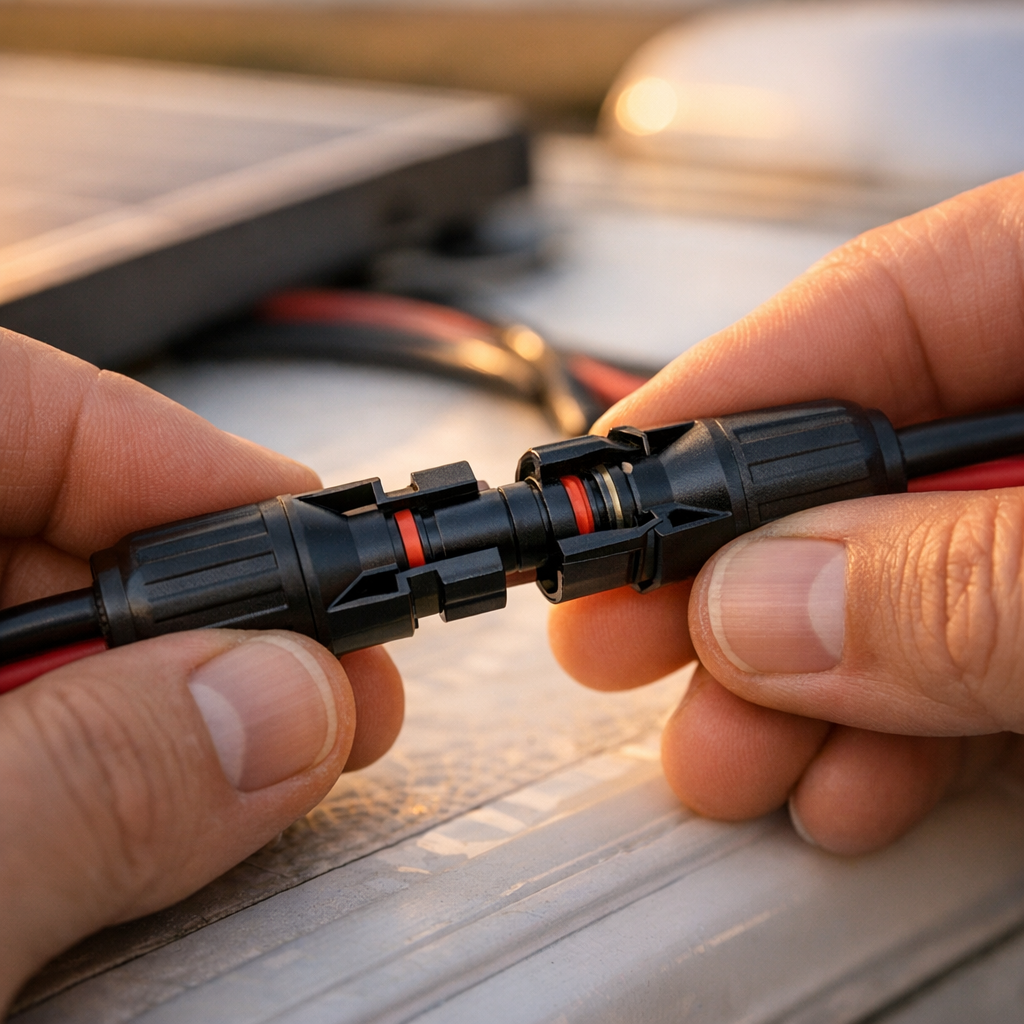
- Disconnect the battery before beginning any wiring work. Always connect the battery to the charge controller before connecting the solar panel to the controller—reversing this order can damage some controllers.
- Use appropriately rated fuses. Install a 15A fuse between the charge controller and the battery on a 100W / 12V system to protect against short circuits.
- Seal all roof penetrations. Use self-leveling Dicor sealant on every bolt hole and cable entry plate to prevent water intrusion and roof damage.
- Never work on a wet roof. RV roofs are slippery when damp, and water near electrical connections creates shock hazards.
- Verify polarity before every connection. Reversed polarity can destroy charge controllers and damage batteries. Use a multimeter to confirm positive and negative leads.
Disclaimer: If you are not comfortable working with electrical wiring, hire a qualified RV technician to perform the installation.
Recommended Gear
- Victron SmartSolar MPPT 100/30 — View on Amazon
- Renogy 100W Monocrystalline Panel — View on Amazon
- Battle Born 100Ah LiFePO4 Battery — View on Amazon
FAQs
- How many watts do I need for full-time RV living? Most full-timers find 400–600W sufficient with 200–400Ah lithium.
- Can I mix different wattage panels? Yes. Wire identical panels in series first, then parallel the strings.
- Should I disconnect solar when plugged into shore power? Good controllers stop charging automatically; ensure profiles are compatible.
- Will solar panels survive hail? Tier-1 panels are tested with 1-inch hail at ~50 mph and typically pass.
As an Amazon Associate, we earn from qualifying purchases. This helps keep SunAmpRV running.