
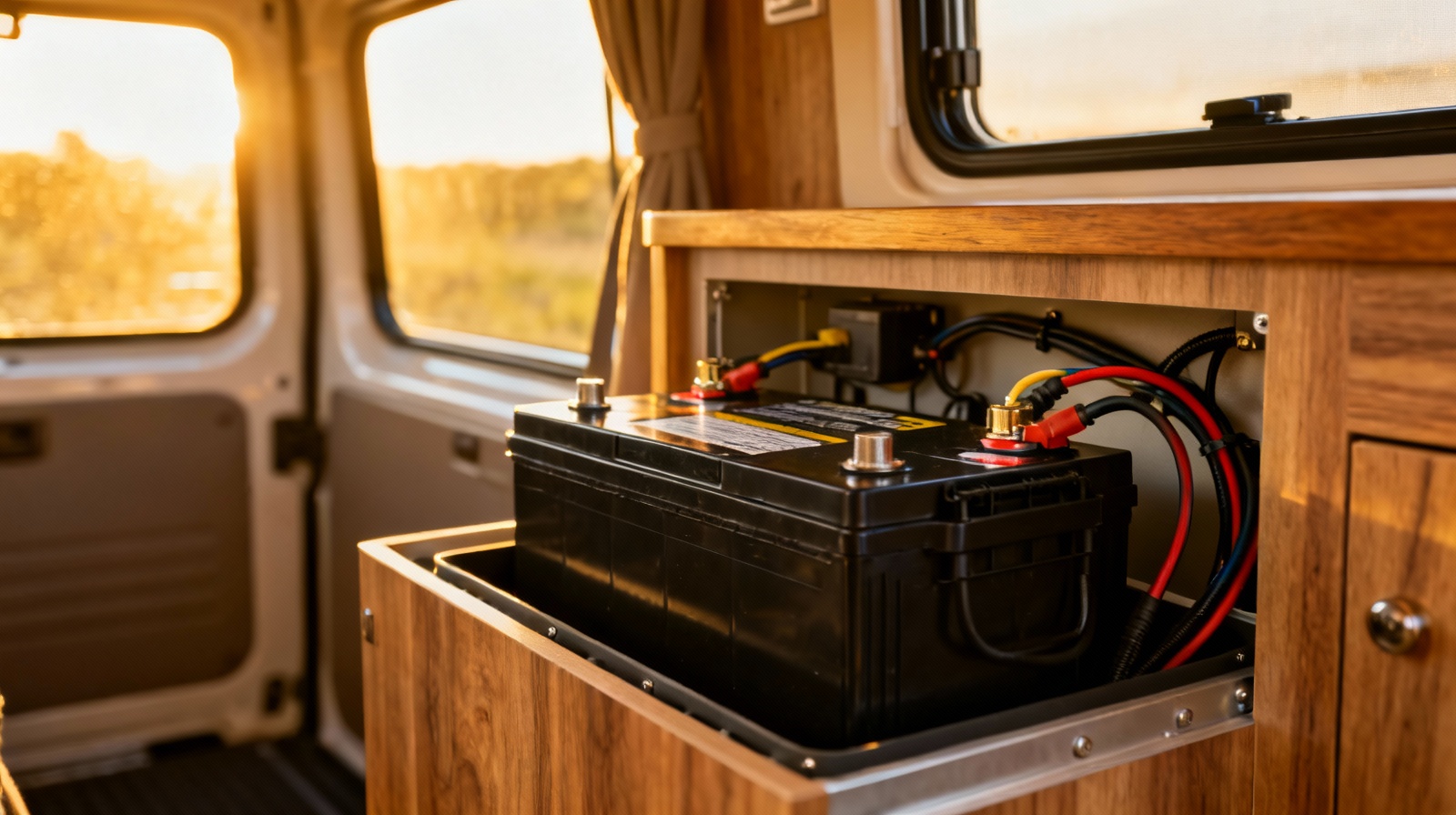
Choosing the right 100Ah LiFePO4 battery for your RV isn’t just about capacity—it’s about matching the battery to how you actually camp. A weekend warrior at developed campgrounds has vastly different needs than a boondocker chasing solitude in the desert for weeks at a time. This guide cuts through the spec sheets and organizes recommendations around real-world scenarios so you can invest confidently.
TL;DR — Best Picks
Best Overall: Battle Born 100Ah 12V LiFePO4 – Industry-leading warranty, proven reliability, and exceptional customer support make it the gold standard for serious RVers.
Best Budget: LiTime 12V 100Ah LiFePO4 – Delivers solid performance and a built-in BMS at roughly half the price of premium competitors.
Best for Cold Weather: Dakota Lithium 12V 100Ah Heated – Integrated heating system allows safe charging down to -20°F, perfect for four-season adventurers.
Best by Use-Case
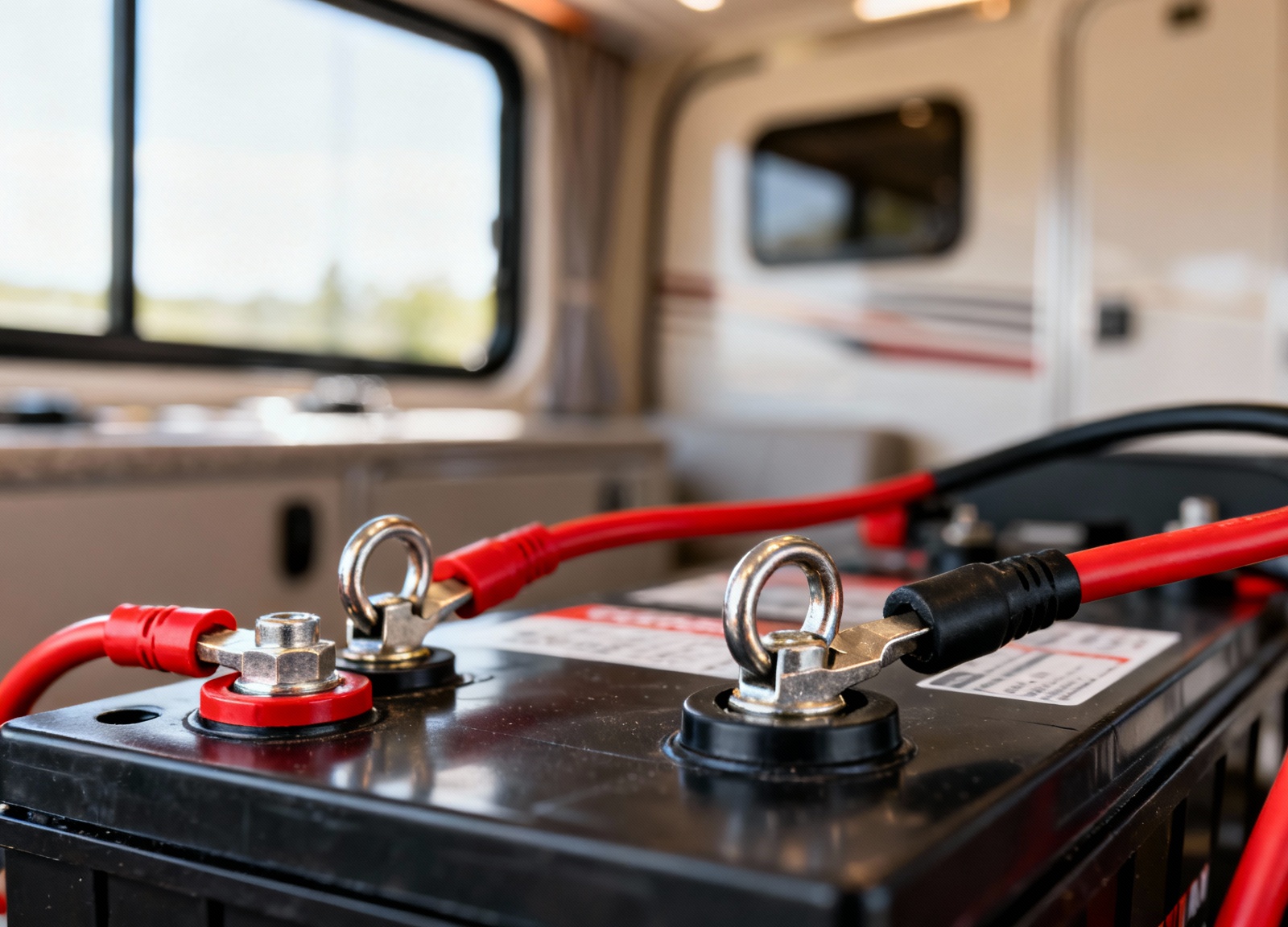
Boondocking & Off-Grid
If you’re a boondocker who measures success by how many days you can stay off-grid without firing up a generator, battery reliability isn’t optional—it’s everything. You need a cell that handles deep discharge cycles gracefully, communicates well with your solar charge controller, and won’t leave you stranded when the nearest town is 50 miles of washboard road away.
Recommended: Battle Born 100Ah 12V LiFePO4
Key specs: 100Ah usable capacity, 100A continuous discharge, 31 lbs, 10-year warranty. View on Amazon
- Pro: 3,000–5,000 cycle lifespan means years of daily cycling without capacity fade
- Pro: Exceptional BMS with cell balancing, over-temperature, and short-circuit protection
- Pro: US-based customer support with responsive technical assistance
- Con: Premium price point—expect to pay $800–$950 per battery
For extended boondocking, consider pairing two Battle Borns in parallel. While some RVers debate whether two 100Ah batteries or one 200Ah unit is better, the parallel configuration offers redundancy—if one battery’s BMS trips, you still have power. Battle Born explicitly supports up to four batteries in parallel without communication cables, simplifying expansion.
Also Consider: Victron Energy Smart LiFePO4 100Ah
Key specs: 100Ah, Bluetooth monitoring via app, 1,280Wh. View on Amazon
- Pro: Bluetooth connectivity lets you monitor state of charge, voltage, and temperature from your phone
- Pro: Integrates seamlessly with Victron charge controllers and inverters
- Con: Even pricier than Battle Born; best suited for those already in the Victron ecosystem
Budget Weekender
If you’re a weekend warrior who camps at developed sites with occasional shore power, you don’t need to spend $900 on a battery. You need something reliable enough to run your fridge overnight, charge devices, and maybe power some LED lights—without draining your wallet before you even hit the road.
Recommended: LiTime 12V 100Ah LiFePO4
Key specs: 100Ah, 100A BMS, 1,280Wh, about 22 lbs, 5-year warranty. View on Amazon
- Pro: Priced around $300–$400, making lithium accessible to budget-conscious campers
- Pro: Lightweight design at just over 22 lbs—easy to install or swap
- Pro: Built-in BMS handles overcharge, over-discharge, and short-circuit protection
- Con: Warranty and support don’t match premium brands; some users report inconsistent quality control
- Con: Lower cold-weather tolerance—charging cuts off around 32°F
For context on runtime: a typical 12V compressor fridge draws 30–50W. On a 100Ah lithium battery (roughly 1,280Wh usable), you can expect 25–40 hours of fridge operation before needing a recharge—plenty for a weekend trip with modest solar input.
Also Consider: Ampere Time 12V 100Ah LiFePO4
Key specs: 100Ah, 100A continuous discharge, 4,000+ cycles, 24.25 lbs.
- Pro: Competitive pricing similar to LiTime with solid user reviews
- Pro: Supports up to 4 batteries in series or parallel for system expansion
- Con: Customer service can be slow; warranty claims may require patience
Winter Camper
If you chase powder in the mountains or prefer the solitude of off-season camping, standard lithium batteries become a liability. LiFePO4 cells cannot safely accept a charge below freezing—the lithium plates onto the anode, permanently damaging capacity. You need either a heated battery or a robust low-temperature cutoff paired with an external heating solution.
Recommended: Dakota Lithium 12V 100Ah Heated
Key specs: 100Ah, integrated heating system, charges safely to -20°F, 280A max discharge, 29 lbs, 11-year warranty.
- Pro: Self-heating technology automatically warms cells before accepting charge in freezing conditions
- Pro: Industry-leading 11-year warranty demonstrates manufacturer confidence
- Pro: 280A peak discharge handles high-draw appliances like coffee makers or hair dryers
- Con: Heating element draws power—expect some capacity loss in extreme cold
- Con: Premium pricing around $700–$800
The heating system is automatic: when the battery senses temperatures below 32°F and detects incoming charge current, it diverts power to internal heating pads until cells reach safe charging temperature. This eliminates the need for external battery blankets or manual monitoring.
Also Consider: Battle Born 100Ah with External Heating Pad
If you already own Battle Born batteries, adding an aftermarket heating pad and thermostat controller costs $50–$100 and provides similar protection. However, this DIY approach requires more installation effort and monitoring.
Lightweight / Minimalist
If you’re a van lifer in a Sprinter or Promaster, or you’ve converted a small trailer where every pound matters, battery weight directly impacts fuel economy and payload capacity. You want maximum energy density in the smallest, lightest package possible.
Recommended: Renogy 12V 100Ah Smart LiFePO4
Key specs: 100Ah, 100A BMS, Bluetooth monitoring (optional BT-2 module), 26 lbs, 5-year warranty. View on Amazon
- Pro: Compact dimensions fit tight van installations
- Pro: Bluetooth app provides real-time monitoring (optional BT-2 module)
- Pro: Renogy ecosystem compatibility with their panels and controllers
- Con: Some users report Bluetooth connectivity issues requiring app restarts
- Con: Mid-tier pricing—not the cheapest, not the most premium
For ultra-minimalists, consider that any 100Ah LiFePO4 battery weighs roughly 24–31 lbs—about one-third the weight of an equivalent lead-acid battery. The weight savings alone often justify the upgrade, freeing payload for water, gear, or passengers.
Also Consider: Wistek 12V 100Ah LiFePO4
Key specs: 100Ah, 100A continuous, 24 lbs, compact form factor.
- Pro: Among the lightest 100Ah options available
- Pro: Positive user reviews for value and reliability
- Con: Smaller brand with less established track record
Buyer’s Notes
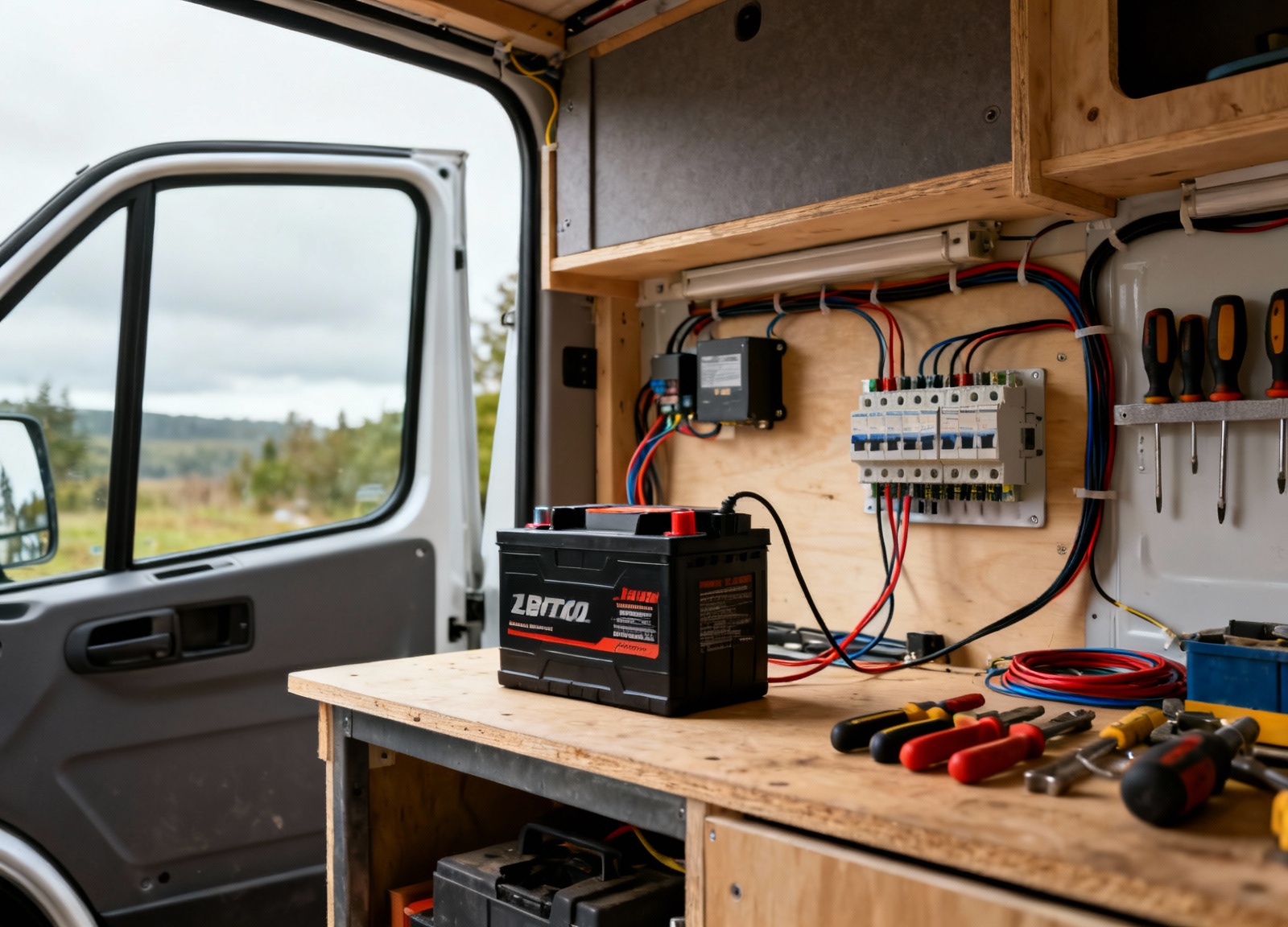
Warranty matters more than you think. A 10-year warranty from Battle Born or 11-year from Dakota Lithium isn’t just marketing—it reflects confidence in cycle life. Budget batteries with 5-year warranties may cost less upfront but could need replacement sooner, especially with daily cycling.
BMS quality varies significantly. The Battery Management System protects against overcharge, over-discharge, short circuits, and temperature extremes. Premium brands use higher-quality MOSFETs and more sophisticated cell balancing. Cheap BMS units may cut out prematurely under high loads or fail to balance cells properly over time.
Check your charging sources. Most RV converters and alternators are designed for lead-acid charging profiles. LiFePO4 batteries prefer a flat 14.2–14.6V charge with no float stage. You may need a DC-DC charger for alternator charging or a lithium-compatible converter. Verify compatibility before installation.
Parallel vs. series configurations. For 12V systems, wire batteries in parallel to increase capacity while maintaining voltage. Most manufacturers support 2–4 batteries in parallel. Going beyond that may require communication cables or careful matching of battery age and state of charge.
Comparison Table
| Model | Capacity | Weight | Warranty | Best For | Price Range |
|---|---|---|---|---|---|
| Battle Born 100Ah | 100Ah / 1,280Wh | 31 lbs | 10 years | Boondocking, reliability-focused | $800–$950 |
| Victron Smart 100Ah | 100Ah / 1,280Wh | 31 lbs | 5 years | Tech-savvy users, Victron systems | $900–$1,100 |
| LiTime 100Ah | 100Ah / 1,280Wh | 22.2 lbs | 5 years | Budget weekenders | $300–$400 |
| Ampere Time 100Ah | 100Ah / 1,280Wh | 24.25 lbs | 5 years | Budget-conscious, expandable systems | $280–$380 |
| Dakota Lithium Heated 100Ah | 100Ah / 1,280Wh | 29 lbs | 11 years | Winter camping, cold climates | $700–$800 |
| Renogy Smart 100Ah | 100Ah / 1,280Wh | 26 lbs | 5 years | Van lifers, Renogy ecosystem | $400–$500 |
| Wistek 100Ah | 100Ah / 1,280Wh | 24 lbs | 5 years | Weight-conscious minimalists | $350–$450 |
Which One Should You Buy?
Your ideal battery depends entirely on how you camp. If you’re a boondocker who needs maximum independence and values peace of mind, invest in the Battle Born 100Ah—its warranty, support, and proven track record justify the premium. Weekend warriors on a budget should grab the LiTime 100Ah; it covers the basics without overspending, and the weight savings over lead-acid alone make it worthwhile.
Cold-weather campers shouldn’t gamble with standard lithium in freezing temps. The Dakota Lithium Heated 100Ah eliminates the risk of cold-charging damage with its integrated heating system—set it and forget it.
Van lifers and minimalists prioritizing space and weight will appreciate the Renogy Smart 100Ah or Wistek 100Ah for their compact footprints and Bluetooth monitoring.
Remember: the “best” battery is the one that matches your actual usage patterns, not the one with the most impressive spec sheet.
Safety & Common Mistakes
- Install a correctly sized fuse close to the battery positive terminal—typically a Class T or ANL fuse rated for your battery’s max discharge current.
- Choose wire gauge for the expected current and run length; target ≤3% voltage drop. For 100A loads, use 2/0 AWG for runs over 6 feet.
- Double-check polarity before connecting—reversing positive and negative can destroy the BMS instantly.
- Never charge LiFePO4 batteries below 32°F unless using a heated battery or external heating solution.
- Secure all cables with strain relief and protect exposed runs with UV-resistant conduit or loom.
Always de-energize your system before performing any electrical work. When in doubt, consult a qualified RV electrician.
Recommended Gear
- Victron SmartSolar MPPT 100/30 — View on Amazon
- Renogy 100W Monocrystalline Panel — View on Amazon
- Battle Born 100Ah LiFePO4 Battery — View on Amazon
FAQs
- Is it better to have 2 100Ah batteries or 1 200Ah battery? Two 100Ah batteries in parallel offer redundancy—if one BMS trips, you still have power. A single 200Ah battery is simpler to wire and may fit tighter spaces. For most RVers, two 100Ah units provide better flexibility and easier replacement if one fails.
- How long will a 12V fridge run on a 100Ah lithium battery? A typical 12V compressor fridge draws 30–50W average. With 1,280Wh of usable capacity, expect 25–40 hours of runtime before the battery needs recharging. Actual results vary based on ambient temperature, fridge efficiency, and how often you open the door.
- Can I replace my lead-acid batteries with LiFePO4 directly? Physically, yes—most 100Ah LiFePO4 batteries use Group 31 dimensions. Electrically, you’ll likely need to adjust your charging sources. RV converters and alternators designed for lead-acid may overcharge lithium or fail to fully charge it. Consider a lithium-compatible converter or DC-DC charger.
- Do I need a special charger for LiFePO4 batteries? LiFePO4 batteries prefer a constant-current, constant-voltage charge profile at 14.2–14.6V with no float stage. Many modern smart chargers have a lithium setting. Avoid chargers with desulfation modes or equalization cycles—these can damage lithium cells.
- What happens if my LiFePO4 battery gets too cold? The BMS will prevent charging below its low-temperature cutoff (typically 32°F). Discharging in cold weather is generally safe, though capacity may temporarily decrease. If you camp in freezing conditions regularly, a heated battery like the Dakota Lithium eliminates this concern.
- How do I monitor my battery’s state of charge? Options include Bluetooth-enabled batteries with smartphone apps, standalone battery monitors like the Victron BMV-712, or simple voltage meters. For accurate state-of-charge readings, a shunt-based monitor that tracks amp-hours in and out is most reliable.
As an Amazon Associate, we earn from qualifying purchases. This helps keep SunAmpRV running.