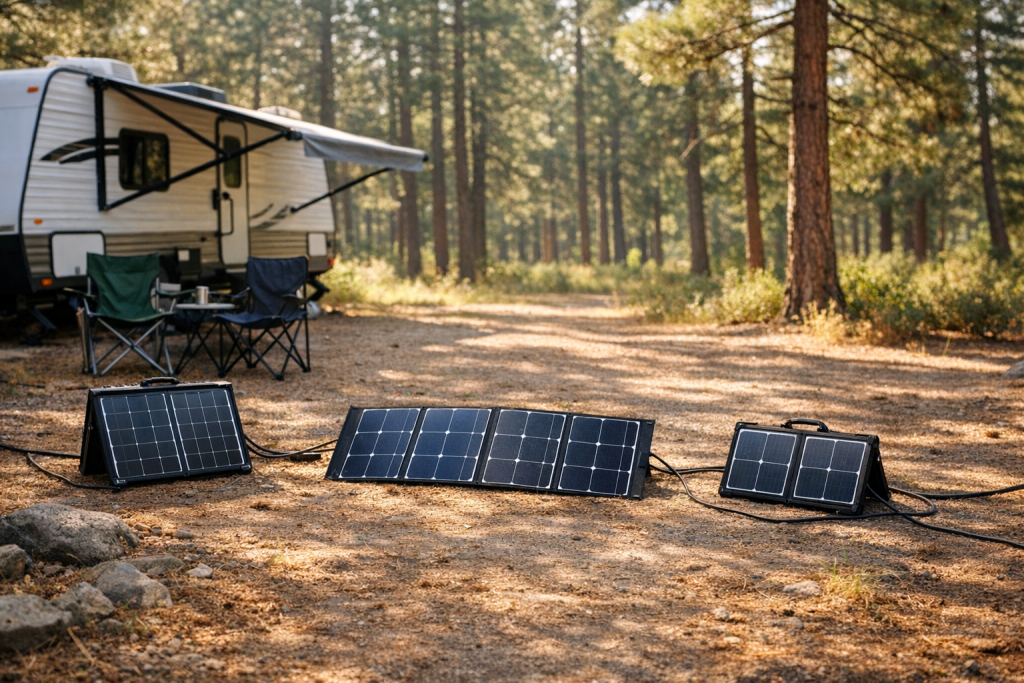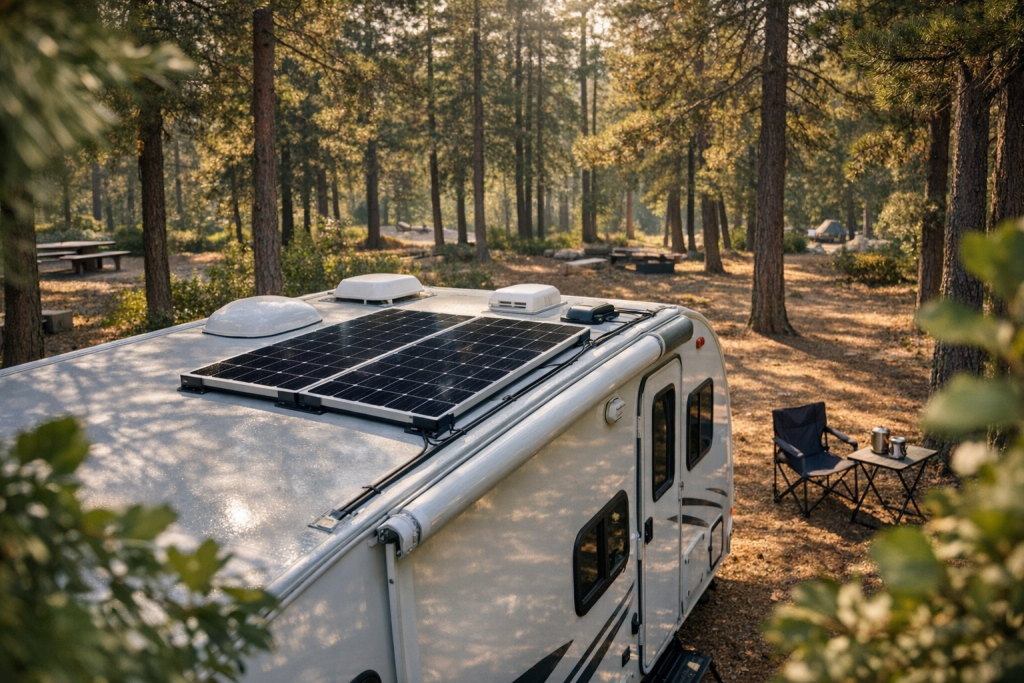
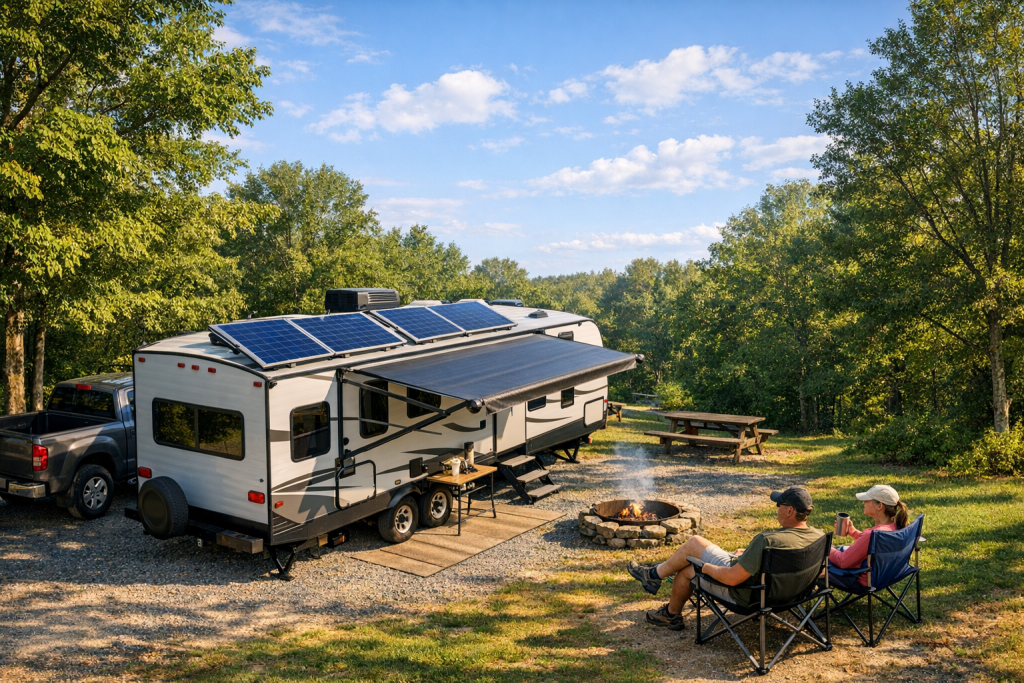
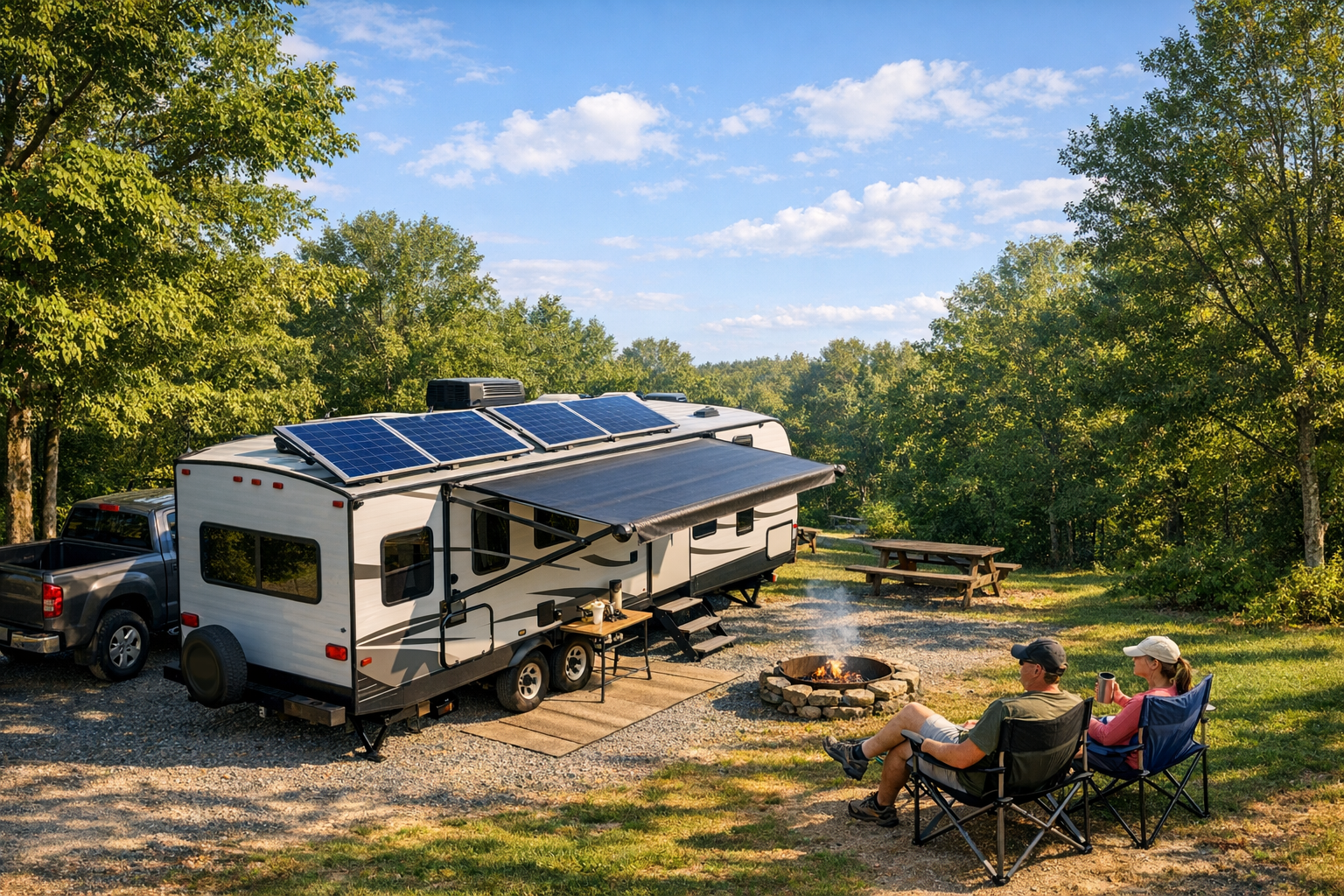
You’re parked at a gorgeous dispersed campsite with no hookups in sight, your phone is at 12%, the fridge is warming up, and that single 100-watt panel on your roof clearly isn’t cutting it. Figuring out how many watts of solar you need for your RV is the single most important decision in building a reliable off-grid power system — get it wrong and you’ll either overspend on panels you don’t need or run out of juice when it matters most. This covers the real-world math, ranks the best RV solar panel kits by wattage tier, and helps you match the right system to your camping style, battery bank, and budget.
TL;DR
- Best Overall: Renogy 400W Premium Solar Kit — Covers moderate-to-heavy RV use with an MPPT controller and expandability for full-time travelers.
- Best Budget: HQST 200W Polycrystalline Solar Kit — Affordable entry point that handles weekend camping basics without breaking the bank.
- Best for Full-Time Boondocking: Rich Solar 800W 12V Kit — Serious wattage for off-grid living with enough capacity to run a residential fridge and multiple devices all day.
- Best Compact Option: BougeRV 200W CIGS Thin-Film Panel — Ultra-thin, flexible, and lightweight for RVs with limited or curved roof space.
- Best Starter Kit: Newpowa 100W Monocrystalline Kit — Perfect “dip your toes in” setup for minimalist campers who just need lights and phone charging.
Why Solar Power Matters for RV Living
Solar power has shifted from a niche hobby to a near-essential RV upgrade. Panels give you energy independence — no more idling a generator at 6 a.m. to make coffee, no more hunting for campsites with electrical hookups, and no more worrying about draining your house batteries overnight.
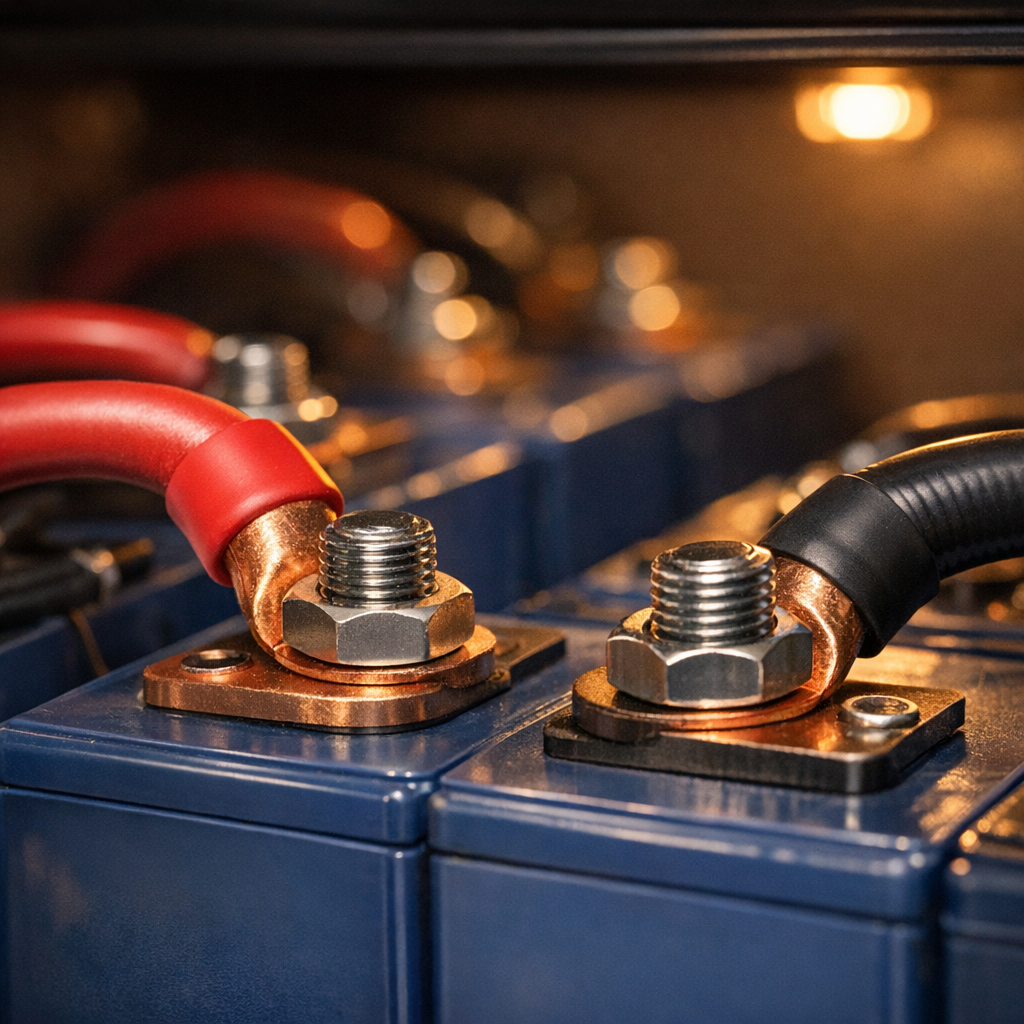
The real question isn’t whether you should add solar — it’s how much. The answer depends on what you plan to run, how long you camp without hookups, and where you travel. A couple who charges phones and runs LED lights needs a fundamentally different system than a family running a residential refrigerator, a coffee maker, and a laptop workstation.
List Your Appliances and Their Wattage
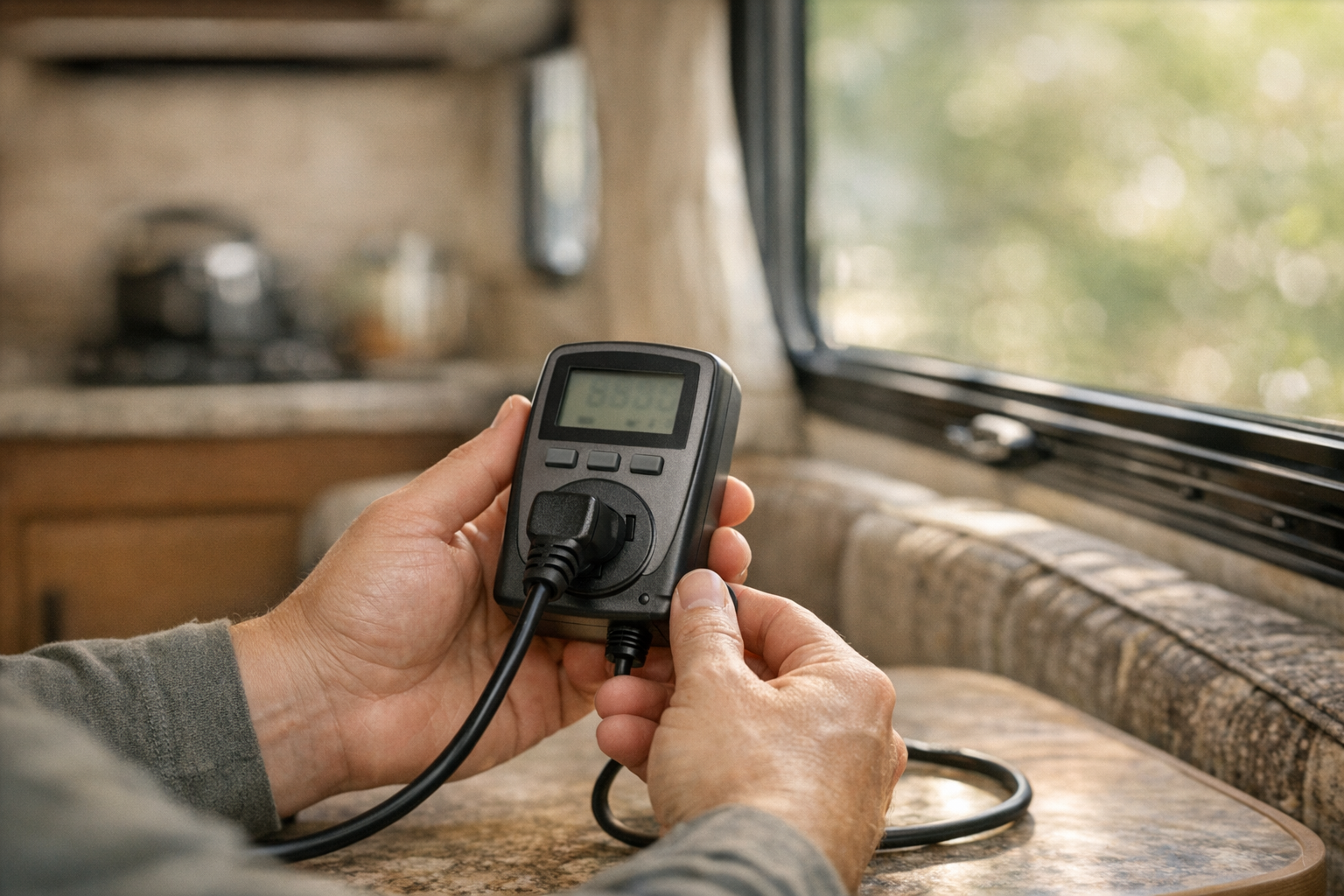
Start by listing every electrical device you use in your RV. Check the label on each appliance for its wattage rating, or look it up in the owner’s manual. Common examples:
- LED lights (per bulb): 5–15W
- Phone charger: 10–25W
- Laptop charger: 50–100W
- 12V compressor fridge: 40–60W (runs intermittently, roughly 8–12 hours/day)
- Vent fan (MaxxAir, Fantastic Fan): 20–40W
- TV (32-inch LED): 30–60W
- Coffee maker: 600–1,200W
- Microwave: 900–1,500W
- RV air conditioner: 1,200–2,400W
Estimate Daily Watt-Hours of Consumption
Multiply each appliance’s wattage by the number of hours you use it per day. The result is watt-hours (Wh). A 12V fridge drawing 50W for 10 hours per day uses 500Wh. A vent fan at 30W running 6 hours uses 180Wh. Add everything up for your total daily energy consumption.
A light-use camper might consume 500–1,000Wh per day. A moderate user lands around 1,500–2,500Wh. A heavy user running a residential fridge, multiple devices, and occasional high-draw appliances can easily hit 3,000–5,000Wh or more.
Factor in Sun Hours for Your Location
Solar panels don’t produce their rated wattage all day. You need to think in terms of “peak sun hours” — the number of hours per day when sunlight intensity equals roughly 1,000W per square meter. In the sunny Southwest U.S. (Arizona, New Mexico), you might get 6–7 peak sun hours. In the Pacific Northwest or during winter months, expect only 3–4.
The formula is straightforward:
Daily Wh needed ÷ peak sun hours = minimum solar wattage
If you need 2,000Wh per day and get 5 peak sun hours, you need at least 400W of solar panels. But real-world losses from heat, wiring, charge controller efficiency, and panel angle mean you should add a 20–25% buffer. That 400W minimum becomes roughly 500W in practice.
— Renogy 400W Premium Solar Kit (Best Overall)
If you could only recommend one system to the broadest range of RV owners, the Renogy 400W kit is it. This package includes four 100W monocrystalline panels, a 40A MPPT charge controller guide (the Rover 40A), mounting hardware, and all necessary wiring. At 400W, it sits in the sweet spot for extended-trip campers who run a 12V fridge, charge multiple devices, use LED lighting, and occasionally watch TV or run a vent fan.
In 5 peak sun hours, this system generates roughly 1,600–1,800Wh per day after real-world losses — enough for most couples or small families who aren’t running air conditioning or heavy resistive loads. The MPPT controller squeezes up to 30% more energy from your panels compared to PWM units, especially in cooler temperatures or partial shade. Renogy’s ecosystem also makes expansion straightforward; you can add panels as your needs grow.
Who it’s best for: RV owners who take week-long trips, want to boondock comfortably, and value a complete, well-matched kit from a trusted brand.
— Rich Solar 800W 12V Complete Kit (Best for Full-Time Boondocking)
Full-time boondockers need serious wattage. This system pairs eight 100W monocrystalline panels (or four 200W panels, depending on configuration) with a 60A MPPT charge controller guide. At 800W, you’re looking at 3,200–3,600Wh of daily production in good sun — enough to run a residential fridge, a laptop workstation, LED lights, vent fans, a TV, and still have headroom for a coffee maker used briefly.
The key advantage is margin. Full-timers can’t afford to run their batteries to zero on a cloudy day. With 800W on the roof, you have buffer for overcast weather, shorter winter days, dusty panels, tree shadows, and imperfect parking orientation. Paired with a 400Ah lithium battery bank, this system can keep a full-time RVer comfortable almost anywhere in the continental U.S.
Who it’s best for: Full-time RVers, digital nomads working from the road, and anyone who refuses to compromise on comfort while living off-grid.
— HQST 200W Polycrystalline Solar Kit (Best Budget)
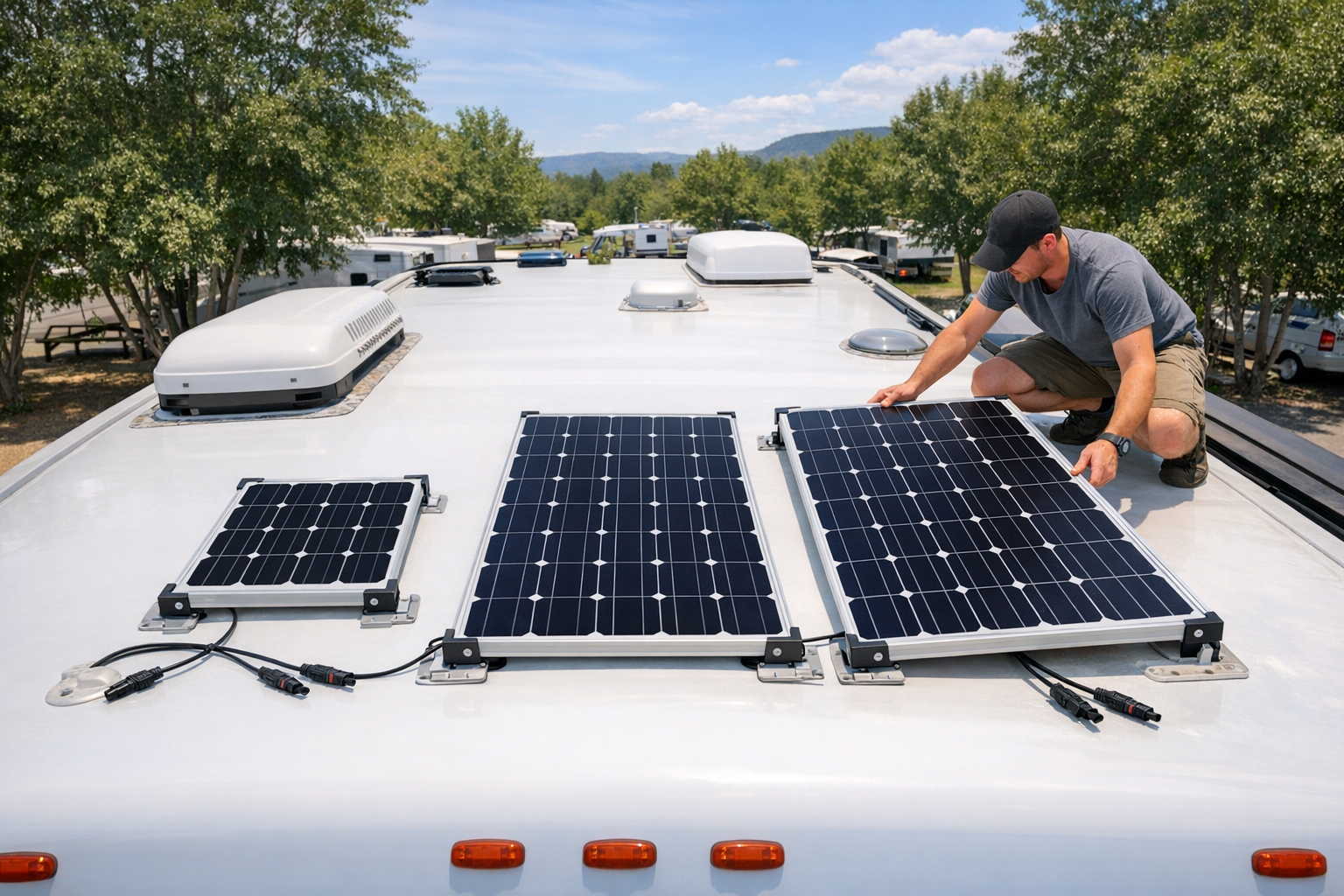
Not everyone needs — or can afford — a 400W+ system right away. The HQST 200W kit includes two 100W polycrystalline panels, a 20A PWM charge controller, mounting brackets, and cables. At roughly half the price of premium kits, it gets you into solar without a major financial commitment.
With 200W, expect roughly 700–900Wh per day in 5 peak sun hours. That’s enough to keep LED lights on, charge phones and tablets, run a vent fan, and power a small 12V compressor fridge — the essentials for a comfortable weekend or even a week-long trip if you’re mindful about consumption. The polycrystalline panels are slightly less efficient than monocrystalline in low-light conditions, and the PWM controller leaves some energy on the table, but for the price, it’s hard to argue.
Who it’s best for: Weekend campers, budget-conscious RVers, and anyone who wants to test solar before committing to a larger system.
— BougeRV 200W CIGS Thin-Film Panel (Best Compact Option)
Roof space is a real constraint on smaller RVs, campervans, and trailers with rooftop AC units, vents, and antennas eating up real estate. The BougeRV 200W CIGS thin-film panel solves this elegantly. At just 0.08 inches thick and roughly 9 pounds, it conforms to curved surfaces and fits where rigid panels simply can’t.
CIGS (Copper Indium Gallium Selenide) technology performs better in partial shade and high temperatures than traditional silicon panels — a real advantage for RVers who can’t always park in full sun. The trade-off is a higher cost per watt and lower peak efficiency compared to monocrystalline. But if your roof is small, curved, or crowded, this panel lets you harvest energy that would otherwise be impossible to capture.
Who it’s best for: Campervan owners, pop-up trailer users, and anyone with limited or irregularly shaped roof space.
— Newpowa 100W Monocrystalline Starter Kit (Best Starter Kit)
Sometimes you just need the absolute basics. The Newpowa 100W kit includes a single monocrystalline panel, a 10A PWM charge controller, and mounting hardware.
At 100W, you’ll generate roughly 350–450Wh per day — enough for LED lights, phone charging, and a small fan. It won’t run a fridge reliably, and you’ll need to be conservative with energy use. But for the minimalist camper who just wants to keep the lights on and their phone alive during a weekend trip, it’s all you need. You can always add a second or third panel later.
Who it’s best for: Ultra-minimalist RVers and anyone who wants to learn about solar on a tiny budget before scaling up.
— Renogy 600W Monocrystalline Kit (Best Mid-Range Upgrade)
Sitting between the 400W “moderate use” tier and the 800W “full-time” tier, the Renogy 600W kit is ideal for RVers who find 400W almost-but-not-quite enough. It includes six 100W monocrystalline panels and a 40A MPPT controller. At 600W, you’re producing roughly 2,400–2,700Wh per day in good conditions — enough to comfortably run a residential fridge, multiple devices, a TV, and still have margin for cloudy days.
Who it’s best for: Extended-trip boondockers, remote workers, and RVers who’ve outgrown a 200–400W system and want reliable daily power without going all-in on a massive array.
— Go Power! 190W Overlanding Solar Kit (Best for Overlanders)
Go Power! has been a trusted name in RV solar for years, and their 190W overlanding kit is built for rugged use. It features a single high-efficiency 190W monocrystalline panel with a heavy-duty aluminum frame, a 30A PWM controller, and robust wiring designed to handle vibration and rough roads.
At 190W, the output is similar to a 200W system — around 650–850Wh per day. What sets it apart is build quality. If you’re driving forest service roads, crossing deserts, or generally putting your rig through its paces, this kit is designed to survive the abuse.
Who it’s best for: Overland vehicle owners, truck campers, and RVers who prioritize durability over maximum wattage per dollar.
— WindyNation 400W Complete Off-Grid Kit (Best Value 400W Kit)
The WindyNation 400W kit offers a compelling alternative to the Renogy 400W at a lower price point. It includes four 100W polycrystalline panels, a 30A PWM charge controller, wiring, and mounting hardware. You sacrifice some efficiency compared to monocrystalline panels and MPPT controllers, but you get 400W of capacity for significantly less money.
In practice, the PWM controller and polycrystalline panels mean roughly 1,400–1,600Wh per day in 5 peak sun hours — about 10–15% less than a comparable monocrystalline/MPPT setup. For many RVers camping in sunny climates, that difference is negligible.
Who it’s best for: Budget-minded RVers who want 400W of capacity without paying premium prices, especially those camping primarily in sunny southern states.
Light Use (100–200W): Weekend Camping
If you camp mostly at sites with hookups and only occasionally boondock for a night or two, 100–200W of solar is likely sufficient. This tier covers LED lighting, phone and tablet charging, a vent fan, and maybe a small 12V fridge on sunny days. You’ll generate roughly 350–900Wh per day depending on exact wattage and sun conditions.
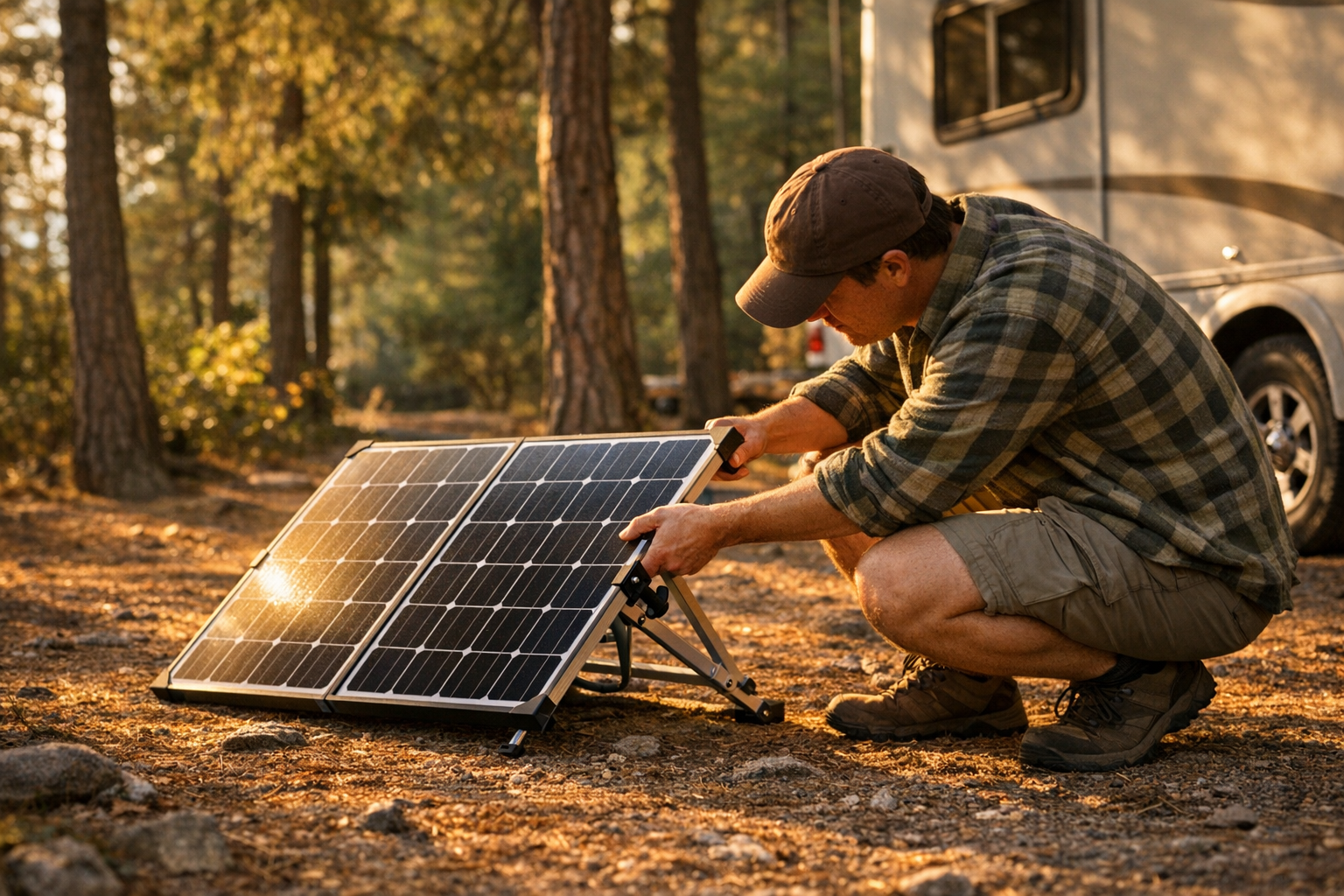
The key limitation: almost no buffer. A cloudy day can cut production in half, and running anything beyond the basics will drain your batteries faster than the panels can replenish them. Think of this tier as “maintenance charging.”
Moderate Use (300–400W): Extended Trips
This is where most RVers land. With 300–400W, you can comfortably run a 12V compressor fridge 24/7, charge multiple devices, use LED lights freely, run a vent fan, and watch TV for a couple of hours in the evening. Daily production ranges from 1,200–1,800Wh, covering the needs of most couples or small families on week-long boondocking trips.
At this tier, you gain meaningful resilience against cloudy days. Even at 50% production, a 400W system still generates 800–900Wh — enough to keep the fridge running and the lights on.
Heavy Use (600W+): Full-Time Boondocking
Full-timers, remote workers, and families running multiple devices simultaneously should look at 600W or more. At 600–800W, you’re generating 2,400–3,600Wh per day — enough for a residential fridge, a laptop workstation running 8+ hours, LED lights, vent fans, a TV, and brief use of high-draw appliances like a coffee maker or hair dryer (through an inverter).
Going above 800W makes sense in northern climates, forested areas with shade, or for particularly power-hungry setups. Some full-timers install 1,000–1,200W or more to minimize generator use across all seasons.
Is 200 Watts of Solar Enough for an RV?
It depends on your expectations. A 200W setup handles basic needs — LED lights, phone charging, a vent fan, and a small 12V fridge on sunny days. For a weekend camper who spends most of their time outdoors and uses the RV mainly for sleeping, 200W can feel like plenty.
But 200W has real limitations. You’ll produce roughly 700–900Wh per day in good sun, and a 12V fridge alone can consume 500–600Wh. That leaves very little margin, and a single cloudy day puts you in a deficit. If you plan to boondock for more than 2–3 days, run a laptop, or use any 120V appliances through an inverter, 200W will feel frustrating.
Bottom line: 200W is enough for minimalist weekend camping. For anything more, plan to upgrade.
Is 400W Solar Enough for an RV?
For the majority of RV owners, 400W is the sweet spot. It provides enough daily energy (1,600–1,800Wh in good sun) to run a 12V fridge around the clock, charge all your devices, use LED lights and fans freely, and still have headroom for a TV or laptop. Most couples and small families who boondock for a week at a time find 400W perfectly adequate.
Where 400W falls short: you won’t run an air conditioner (that requires 2,000W+ of panels and a massive battery bank). You’ll also struggle running a residential fridge, a desktop computer, and multiple high-draw appliances simultaneously. In winter or cloudy climates, 400W may not fully recharge a large battery bank each day.
If you’re on the fence between 400W and 600W, consider your travel patterns. Sunny Southwest? 400W is probably fine. Pacific Northwest in winter? Go bigger.
RV Solar Sizing Quick-Reference Chart
| Camping Style | Typical Daily Use (Wh) | Recommended Solar (W) | Recommended Battery (Ah, 12V Lithium) | Common Appliances |
|---|---|---|---|---|
| Minimalist Weekend | 300–600Wh | 100–200W | 100Ah | LED lights, phone charging, vent fan |
| Comfortable Weekend | 800–1,200Wh | 200–300W | 100–200Ah | Above + 12V fridge, tablet |
| Extended Boondocking | 1,500–2,500Wh | 400–600W | 200–300Ah | Above + laptop, TV, coffee maker (brief) |
| Full-Time Off-Grid | 2,500–4,000Wh | 600–1,000W | 300–400Ah | Above + residential fridge, workstation, multiple devices |
| Heavy Full-Time (with AC supplement) | 4,000–6,000Wh+ | 1,000–1,500W+ | 400–600Ah+ | Everything above + occasional AC, microwave, hair dryer |
Comparison Table
| Model | Type | Key Specs | Best for | Pros | Cons | Where to buy |
|---|---|---|---|---|---|---|
| Renogy 400W Premium Kit | Monocrystalline, MPPT | 4×100W panels, 40A MPPT controller, ~1,600–1,800Wh/day | Extended trips, moderate-to-heavy use | MPPT efficiency, expandable, trusted brand | Higher upfront cost, needs decent roof space | Amazon ↗ |
| Rich Solar 800W 12V Kit | Monocrystalline, MPPT | 800W total, 60A MPPT controller, ~3,200–3,600Wh/day | Full-time boondocking | Massive daily output, great cloudy-day buffer | Requires large roof, significant investment | Amazon ↗ |
| HQST 200W Polycrystalline Kit | Polycrystalline, PWM | 2×100W panels, 20A PWM controller, ~700–900Wh/day | Weekend camping, budget builds | Very affordable, easy install, good starter | Lower efficiency, PWM controller limits output | Amazon ↗ |
| BougeRV 200W CIGS Thin-Film | CIGS thin-film, flexible | 200W single panel, 0.08″ thick, ~9 lbs | Small/curved roofs, campervans | Ultra-thin, lightweight, good shade performance | Higher cost per watt, needs separate controller | Amazon ↗ |
| Newpowa 100W Monocrystalline Kit | Monocrystalline, PWM | 1×100W panel, 10A PWM controller, ~350–450Wh/day | Minimalist camping, learning solar | Cheapest entry point, simple install | Very limited output, won’t run a fridge | Amazon ↗ |
| Renogy 600W Monocrystalline Kit | Monocrystalline, MPPT | 6×100W panels, 40A MPPT controller, ~2,400–2,700Wh/day | Remote workers, extended boondocking | Strong daily output, MPPT efficiency, expandable | Needs significant roof space, mid-high cost | Amazon ↗ |
| Go Power! 190W Overlanding Kit | Monocrystalline, PWM | 1×190W panel, 30A PWM controller, heavy-duty frame | Overlanders, truck campers | Extremely durable, vibration-resistant | Lower wattage for the price, PWM controller | Amazon ↗ |
| WindyNation 400W Off-Grid Kit | Polycrystalline, PWM | 4×100W panels, 30A PWM controller, ~1,400–1,600Wh/day | Budget 400W builds | Low price for 400W, complete kit | Poly panels less efficient, PWM controller | Amazon ↗ |
Recommended Gear
- Victron SmartSolar MPPT 100/30 — View on Amazon
- Renogy 100W Monocrystalline Panel — View on Amazon
- Battle Born 100Ah LiFePO4 Battery — View on Amazon
FAQs
- How many watts do I need for full-time RV living? Most full-timers find 400–600W sufficient with 200–400Ah lithium.
- Can I mix different wattage panels? Yes. Wire identical panels in series first, then parallel the strings.
- Should I disconnect solar when plugged into shore power? Good controllers stop charging automatically; ensure profiles are compatible.
- Will solar panels survive hail? Tier-1 panels are tested with 1-inch hail at ~50 mph and typically pass.
As an Amazon Associate, we earn from qualifying purchases. This helps keep SunAmpRV running.