

Four 100-watt solar panels on an RV roof, 20 feet of wire to a charge controller, and the battery monitor reads barely 320 watts instead of the rated 400. The culprit is voltage drop caused by a wiring configuration that doesn’t match the setup. Choosing between series, parallel, or a hybrid approach is the single biggest decision that determines how much solar energy actually reaches your battery bank. This guide ranks the best charge controllers, wiring components, and panel configurations for minimizing voltage drop on RV solar systems, then walks through the science so you can make the right call for your rig.
TL;DR
- Best Overall: Victron SmartSolar MPPT 100/30 — Handles high series voltage with Bluetooth monitoring, ideal for series-wired RV arrays up to 440W.
- Best Budget: Renogy Rover 40A MPPT — Solid MPPT tracking at a lower price, supports series strings up to 100V for effective voltage-drop reduction.
- Best for Large Arrays: Victron SmartSolar MPPT 150/35 — 150V input handles long series strings or series-parallel combos on rigs with 600W+ arrays.
- Best for Shade-Heavy Parking: Renogy 100W Panel + Parallel Branch Connectors Kit — Parallel-ready setup that keeps individual panels producing even under partial shade.
- Best Wiring Accessory: 10 AWG Solar Extension Cable (One-Pair, 30 ft) — Pre-terminated MC4 cables sized for parallel runs under 20 feet with manageable voltage drop.
Quick Refresher on Voltage, Amperage, and Watts
Every solar panel has three key electrical ratings: open-circuit voltage (Voc), short-circuit current (Isc), and maximum power (Pmax in watts). Watts equal volts times amps (W = V × A). A typical 100W RV panel is rated at roughly 22V Voc and 5.8A Isc, with a maximum power point around 18V and 5.56A.
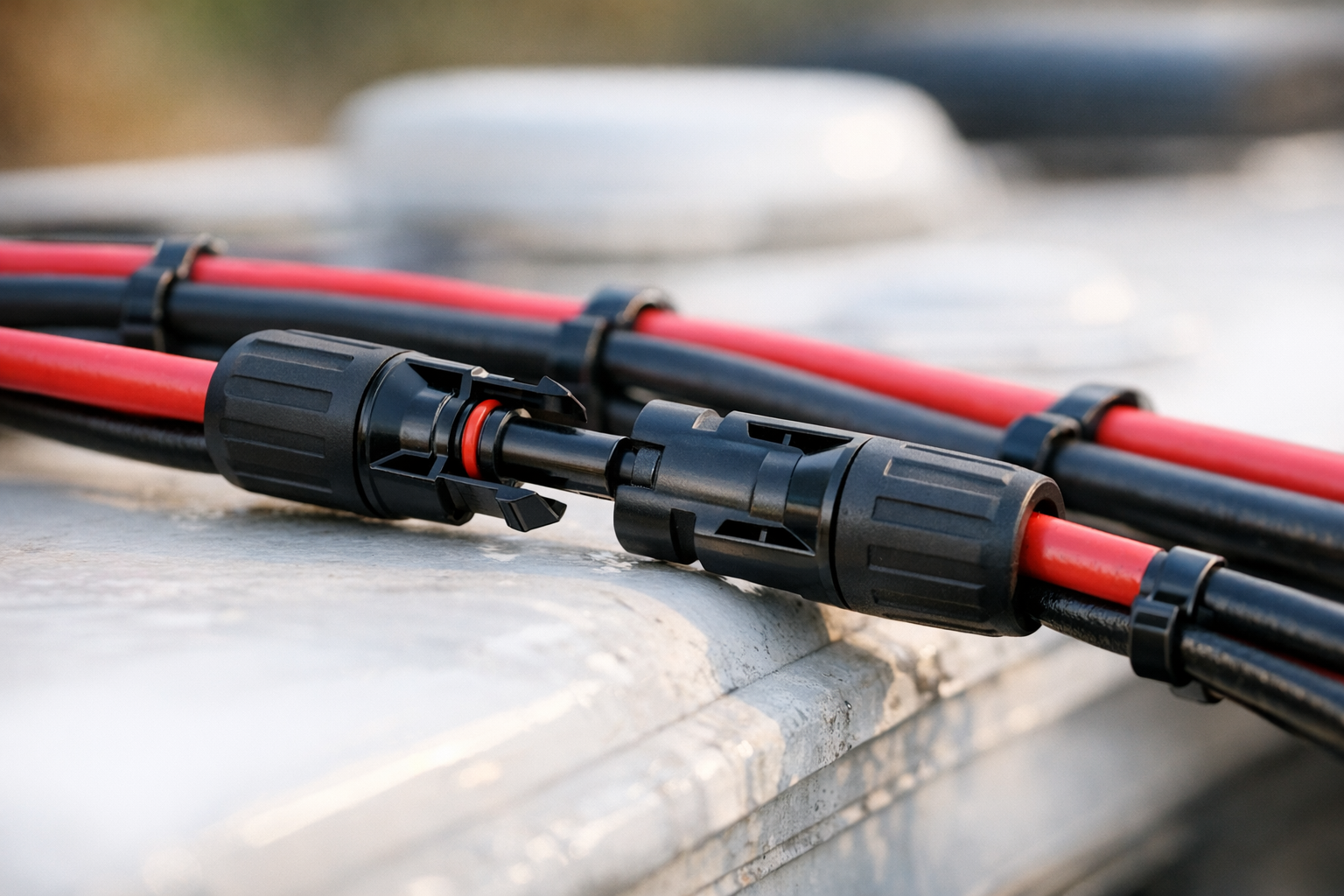
The way you connect panels changes the total voltage and total amperage your system sees. Those two numbers directly determine how much energy you lose in the wire between your roof and your charge controller.
What Happens When You Wire Panels in Series
Series wiring connects the positive terminal of one panel to the negative terminal of the next, daisy-chain style. Voltages add up; amperage stays the same as a single panel. Two 100W panels in series produce roughly 44V at 5.56A. Four panels produce about 88V at 5.56A. The current flowing through your wires stays low — and low current is the key to reducing voltage drop.
What Happens When You Wire Panels in Parallel
Parallel wiring connects all positive terminals together and all negative terminals together, usually through branch connectors or a combiner box. Amperage adds up; voltage stays the same as a single panel. Two 100W panels in parallel produce roughly 22V at 11.12A. Four panels produce 22V at 22.24A. That high current is the enemy of efficiency over distance.
How Wire Length and Gauge Affect Voltage Drop
Voltage drop is energy lost as heat in wire resistance. It increases with higher current, longer wire runs, and thinner (higher gauge number) wire.
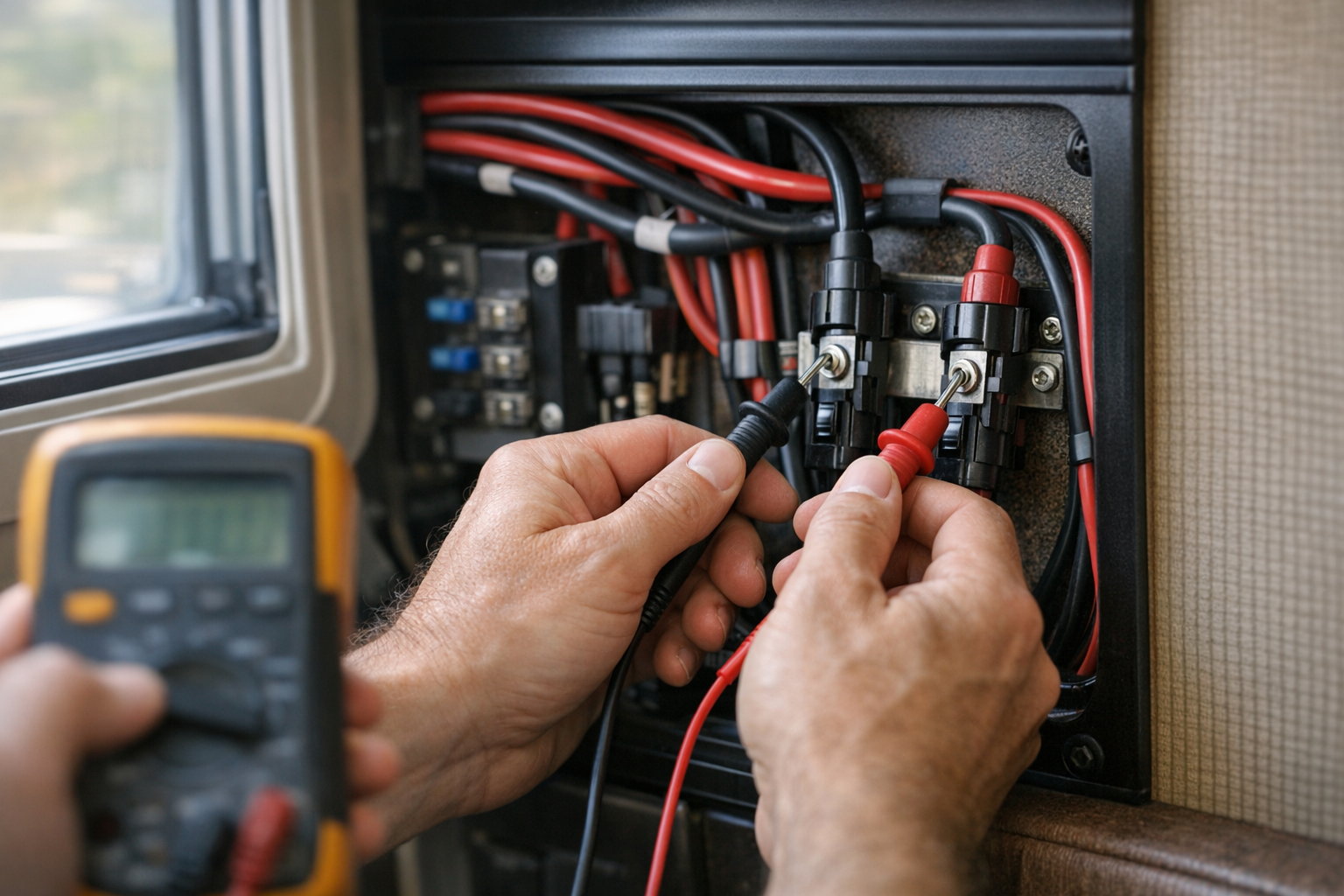
On an RV, wire runs from rooftop panels to a charge controller near the batteries can easily be 15–30 feet round-trip. At 22A (four panels in parallel) through 30 feet of 10 AWG wire, you lose over 2V — nearly 10% of your 22V system voltage gone before it reaches the controller. The same four panels wired in series push only 5.56A through that wire. Voltage drop shrinks to about 0.5V — less than 1% of the now-88V system voltage. The real-world difference can be 30–50W on a 400W array, adding up to meaningful amp-hours over a full day of boondocking.
Calculating Voltage Drop for Your RV Setup
The standard formula: Voltage Drop = Current (A) × Wire Resistance (Ω/ft) × Round-Trip Length (ft). For 10 AWG copper wire, resistance is approximately 0.00102 Ω per foot.
Example with a 30-foot round-trip at 22A (parallel): 22 × 0.00102 × 30 = 0.67V. At a 22V system voltage, that’s a 3.1% drop — right at the commonly recommended 3% maximum. The same run at 5.56A (series): 5.56 × 0.00102 × 30 = 0.17V, or just 0.19% of 88V. Series wins the voltage-drop battle decisively.
Higher Voltage Means Less Current and Less Drop
By keeping amperage low, series wiring lets you use thinner, lighter, cheaper wire while staying well under the 3% voltage-drop threshold. For most RV owners running two to four panels with wire runs over 10 feet, series is the default recommendation — provided you have an MPPT charge controller guide that can step the higher voltage down to your 12V or 24V battery bank.
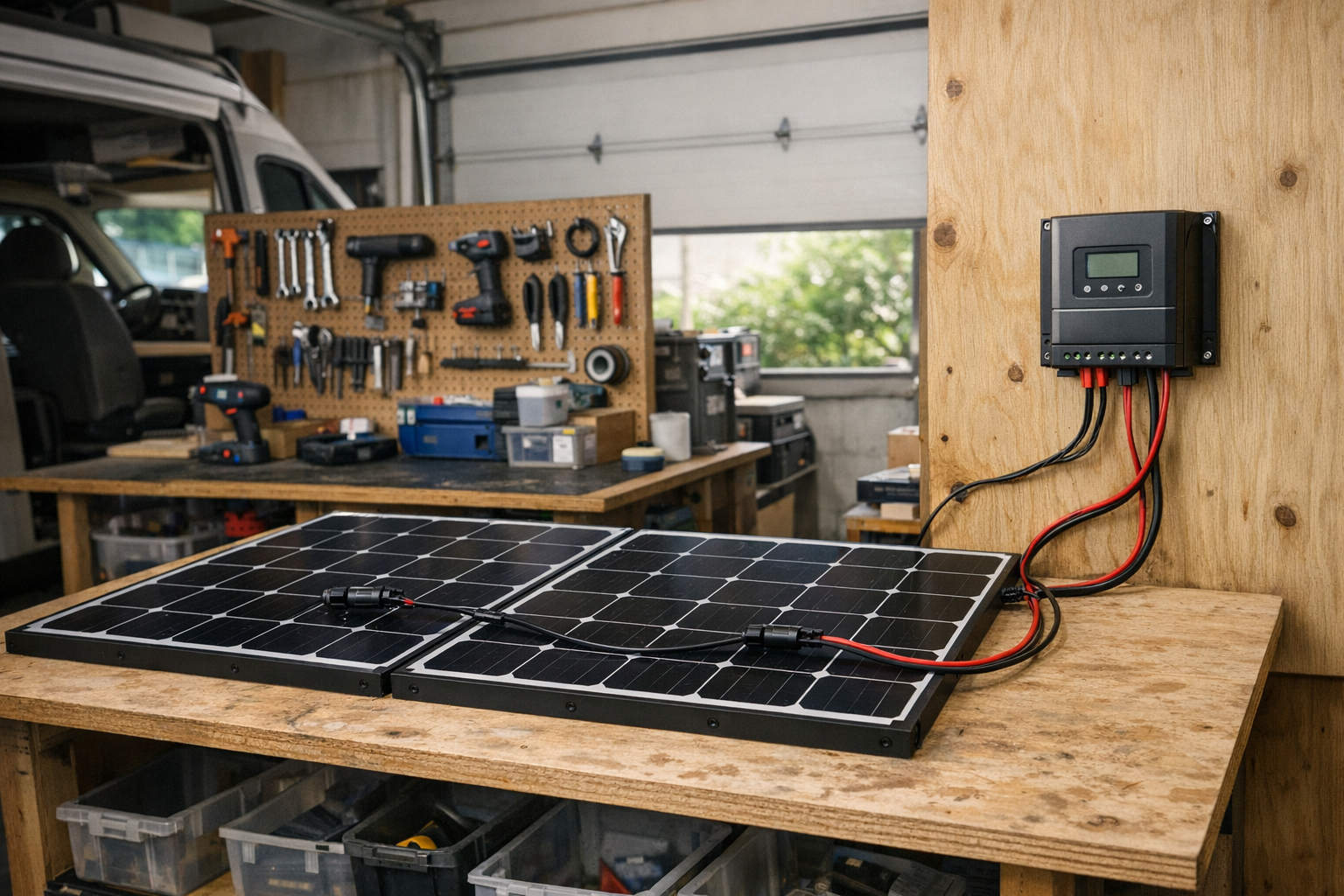
Series wiring also simplifies rooftop connections: one positive and one negative wire down through the roof, no branch connectors or combiner boxes needed.
The Shade Problem With Series Wiring
In a series string, current is limited by the weakest link. If one panel is partially shaded — by an AC unit, antenna, or tree shadow — its reduced current drags down every other panel in the string. Modern panels include bypass diodes that mitigate this by routing current around shaded cell groups, but they don’t eliminate the problem entirely. In heavy shade, a series string can lose 50–80% of its output, while a parallel array might only lose the output of the affected panel (25% in a four-panel system).
Shade Tolerance and Individual Panel Performance
Parallel wiring shines when shade is unavoidable. Each panel operates at its own current independently. If one panel drops to 2A because of a shadow, the other three still contribute their full 5.56A each. Total output: about 18.7A instead of the 2A the entire series string might be limited to. For RVers who frequently park under trees or have rooftop obstructions, parallel wiring can deliver significantly more daily energy despite its higher voltage drop.
Higher Amperage and the Need for Thicker Wire
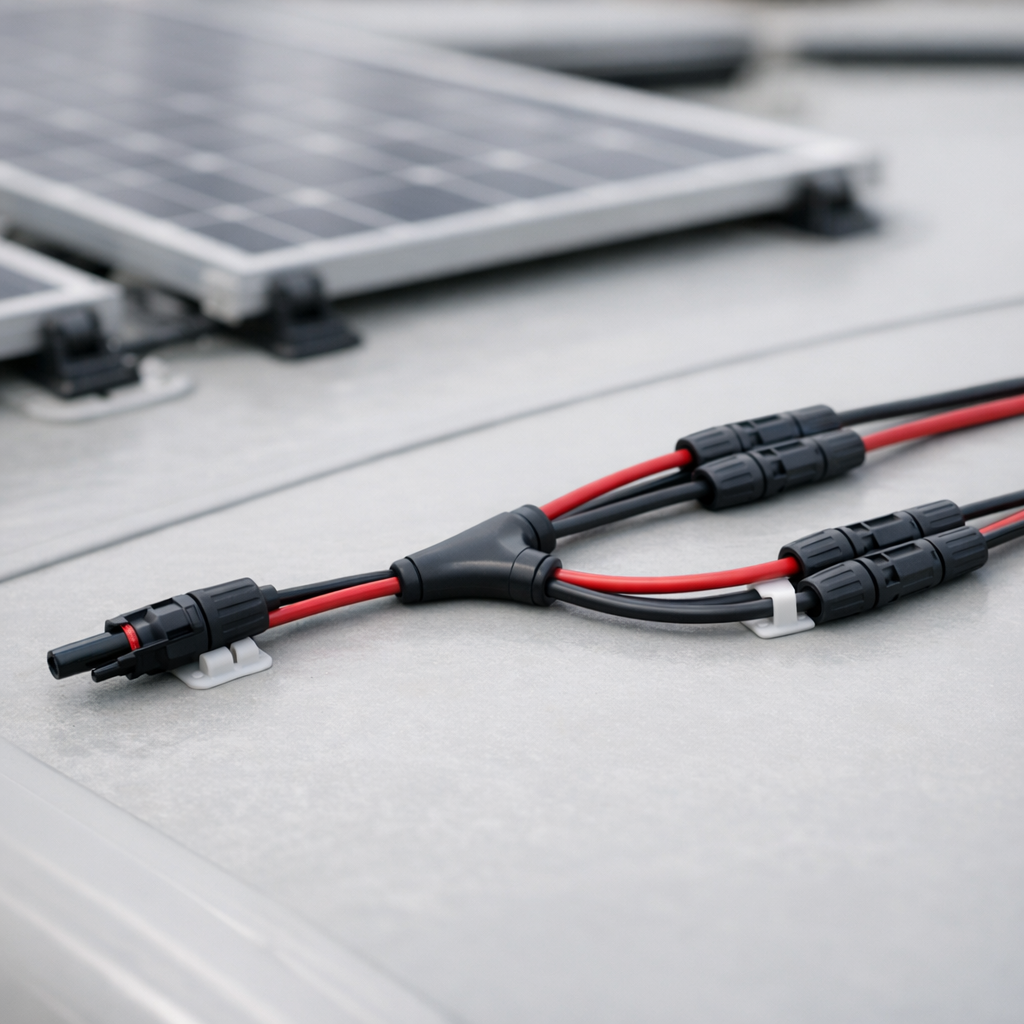
To keep voltage drop under 3% with four parallel panels (22A) over a 30-foot round-trip, you need at least 8 AWG wire — and 6 AWG is safer for longer runs. Thicker wire is heavier, harder to route through RV conduit, and more expensive. You also need MC4 branch connectors or a combiner box on the roof, adding connection points that can corrode or fail over time.
Parallel wiring is compatible with simpler PWM charge controllers since panel voltage stays close to battery voltage, but PWM controllers waste excess voltage as heat rather than converting it to useful current. For most RV owners, the savings on a PWM controller are quickly eaten up by the cost of thicker wire and lost efficiency.
When and Why to Combine Both Configurations
With four or more panels, a series-parallel hybrid offers the a good balance. The most common approach: wire panels into pairs in series (doubling voltage), then connect those pairs in parallel (doubling current). Four 100W panels configured as 2S2P produce roughly 44V at 11.12A — half the current of full parallel, double the voltage, and some shade resilience since each series string operates independently.
This configuration is ideal for larger RV arrays (600W+) where full series would push voltage beyond the charge controller’s input limit (often 100V or 150V), and full parallel would require impractically thick wire. It’s the go-to for serious boondockers with Class A motorhomes or fifth wheels sporting six to eight panels.
How Controller Type Influences Your Wiring Decision
A PWM (Pulse Width Modulation) controller essentially connects panels directly to batteries, so panel voltage must be close to battery voltage — typically 18–22V for a 12V system. This means PWM only works with parallel wiring or a single panel. It’s cheap but inefficient, wasting 20–30% of potential power.
An MPPT (Maximum Power Point Tracking) controller converts higher panel voltage into lower battery voltage at 95–99% efficiency. This unlocks series wiring: you can feed 88V from a four-panel series string into an MPPT controller, and it steps that down to 14.4V for your batteries while boosting current proportionally. The result is dramatically less voltage drop in the wires AND more efficient power conversion. For any RV system with two or more panels, MPPT is the right choice — and it’s essential for series wiring.
Victron SmartSolar MPPT 100/30 — Best Overall for RV Series Wiring
The Victron SmartSolar MPPT 100/30 is our top pick for RV solar charge controllers because of how well it handles series-wired panels to minimize voltage drop. With a 100V maximum input voltage, it comfortably accepts up to four typical 100W panels in series (roughly 88V Voc) or three higher-voltage 200W panels. The 30A output rating supports systems up to about 440W on a 12V battery bank.
Its ultra-fast MPPT tracking algorithm adjusts in under 5 seconds to changing conditions — critical when clouds pass or you pull into a shaded campsite. Built-in Bluetooth lets you monitor real-time voltage, current, and daily yield from your phone via the VictronConnect app.
Build quality is exceptional: fully potted electronics resist vibration and humidity, which matters in an RV bouncing down forest roads. It supports 12V and 24V battery banks automatically and works with lithium, AGM, gel, and flooded batteries. The only real downside is price — it costs more than competitors — but the reliability and efficiency justify the premium for full-time RVers.
Best for: RV owners with 200–440W arrays who want the lowest possible voltage drop via series wiring, with premium build quality and app-based monitoring.
Renogy Rover 40A MPPT charge controller guide — Best Budget MPPT for Series Setups
The Renogy Rover 40A MPPT delivers about 90% of the Victron’s performance at roughly 60% of the price. It accepts up to 100V input, handles the same four-panel series strings, and its 40A output rating supports up to about 520W on a 12V system — giving you room to grow. MPPT efficiency is rated at 99%, and real-world testing shows it consistently tracks within 1–2% of the Victron.
The Rover includes a small LCD screen displaying input voltage, charging current, battery voltage, and daily energy harvested. It supports four battery types (sealed, gel, flooded, lithium) and includes temperature compensation via an optional sensor.
Build quality is good but not quite Victron-level — the plastic housing feels less robust, and some users report the LCD failing after a couple of years in hot climates. For the price, it’s an outstanding value that makes MPPT-enabled series wiring accessible to budget-conscious RVers.
Best for: Budget-minded RV owners who want MPPT efficiency for series wiring without paying the Victron premium.
Victron SmartSolar MPPT 150/35 — Best for Large Series-Parallel Arrays
When your RV array grows beyond 400W, you need a controller with higher voltage headroom. The Victron 150/35 accepts up to 150V input, meaning you can wire five or six standard panels in series, or create series-parallel configurations with long strings. For a 600W system (six 100W panels in a 3S2P configuration), you’d see roughly 66V at 11.12A — extremely manageable voltage drop even with 30+ foot wire runs using just 10 AWG cable.
The 35A output rating supports up to about 500W on 12V or 1000W on 24V, making it future-proof for battery bank upgrades. It shares all the SmartSolar features: Bluetooth, fast MPPT tracking, potted electronics, and multi-chemistry battery support. The 150V input ceiling gives you flexibility to optimize wiring for minimal voltage drop regardless of how many panels you add.
Best for: RV owners with 500W+ arrays or those planning to expand, who need voltage headroom for long series strings or series-parallel combos.
Renogy 100W Monocrystalline Panel + MC4 Parallel Branch Connectors — Best Parallel-Ready Kit for Shade-Heavy Sites
If you frequently camp under tree cover or have significant rooftop obstructions, parallel wiring may deliver more daily energy despite higher voltage drop. Renogy’s 100W monocrystalline panels are compact (42.2 × 19.6 inches), efficient (21%+ cell efficiency), and come with pre-attached MC4 connectors that make parallel wiring straightforward.
Paired with Renogy’s MC4 branch connectors (Y-connectors), you can combine two, three, or four panels in parallel on the roof with minimal fuss. Each panel operates independently, so a shadow on one panel doesn’t affect the others. The trade-off: you’ll need thicker wire (8 AWG minimum for four panels over 20 feet) and should budget for a combiner box for a clean, maintainable installation.
These panels include three bypass diodes each, which also help in series configurations, but their real strength here is as the building block of a shade-tolerant parallel array. At roughly $100 per panel, they’re affordable enough to buy extras to compensate for the slightly lower system efficiency of parallel wiring.
Best for: RVers who park in partial shade regularly and need each panel to produce independently.
10 AWG MC4 Solar Extension Cable (30 ft, One Pair) — Best Wiring for Small Parallel Systems
For RV owners running two panels in parallel (about 11A), a quality 10 AWG MC4 extension cable keeps voltage drop manageable over typical wire runs. At 30 feet round-trip and 11A, 10 AWG copper gives you about 0.34V of drop — roughly 1.5% at 22V, well within the 3% guideline. Pre-terminated MC4 connectors ensure weatherproof, low-resistance connections.
Safety & Common Mistakes
- Exceeding your charge controller’s maximum input voltage. Voc increases in cold weather — panels can produce 10–15% above rated Voc on a cold morning. Four panels in series at 88V nominal could push past 100V in cold conditions, exceeding a 100V controller’s limit. Always leave at least a 10% safety margin.
- Using undersized wire for parallel arrays. Running four panels in parallel through 14 AWG wire is a fire hazard. At 22A, 14 AWG wire can overheat. Always size wire for the maximum current your array can produce.
- Skipping individual panel fuses in parallel arrays. Without fuses, a failed or shaded panel can draw reverse current from the other panels, overheating wiring and damaging panels. Fuse each parallel string at 1.56× the panel’s Isc rating.
- Mixing panels of different specifications in series. The panel with the lowest current limits the entire string. Mixing a 100W panel (5.56A) with a 200W panel (10A) throttles the 200W panel to 5.56A. Only series-wire panels with matching current ratings.
- Forgetting to account for round-trip wire length. A 15-foot run from roof to controller is actually 30 feet of wire (positive and negative conductors). Many RV owners calculate voltage drop using one-way distance and end up with twice the expected drop.
Disclaimer: Always follow NEC guidelines and local electrical codes. If you are unsure about any wiring decision, consult a licensed electrician.
Comparison Table
| Model | Type | Key Specs | Best for | Pros | Cons | Where to buy |
|---|---|---|---|---|---|---|
| Victron SmartSolar MPPT 100/30 | MPPT charge controller guide | 100V max input, 30A output, Bluetooth, 12/24V | Series wiring up to 440W | Fast MPPT tracking, app monitoring, potted electronics | Higher price, 30A limits larger arrays | Amazon ↗ |
| Renogy Rover 40A MPPT | MPPT charge controller guide | 100V max input, 40A output, LCD, 12/24V | Budget series setups up to 520W | Great value, 40A output, 4 battery types | Plastic housing, LCD longevity concerns | Amazon ↗ |
| Victron SmartSolar MPPT 150/35 | MPPT charge controller guide | 150V max input, 35A output, Bluetooth, 12/24/48V | Large series-parallel arrays 500W+ | 150V headroom, future-proof, premium build | Expensive, overkill for small systems | Amazon ↗ |
| Renogy 100W Mono Panel + Branch Connectors | Solar Panel + Parallel Wiring | 100W, 22V Voc, 5.8A Isc, MC4, bypass diodes | Shade-heavy parallel arrays | Independent panel output, affordable, compact | Needs thicker wire for 3+ panels, lower system voltage | Amazon ↗ |
| 10 AWG MC4 Solar Extension Cable (30 ft) | Solar Wiring | 10 AWG, tinned copper, MC4, UV-resistant, 30 ft pair | 2-panel parallel or series home runs | Pre-terminated, weatherproof, good for ≤15A | Too thin for 4+ panel parallel arrays | Amazon ↗ |
| 6 AWG Solar Battery Cable (per foot) | Heavy-Gauge Wiring | 6 AWG, copper, double-insulated, sold per foot | 4+ panel parallel arrays | Very low resistance, handles 30A+, future-proof | Bulky, hard to route, expensive | Amazon ↗ |
| MPPT Fuse and Breaker Kit | Safety / Overcurrent Protection | Inline fuse holders, breakers, panel fuses | All RV solar configurations | Essential safety, prevents reverse current, NEC-compliant | Must be sized correctly for your system | Amazon ↗ |
Recommended Gear
- Victron SmartSolar MPPT 100/30 — View on Amazon
- Renogy 100W Monocrystalline Panel — View on Amazon
- Battle Born 100Ah LiFePO4 Battery — View on Amazon
FAQs
- Is series or parallel wiring better for most RV solar setups? Series is better for the majority of RV installations. It keeps amperage low, which dramatically reduces voltage drop over the 15–30 foot wire runs typical on RVs. As long as you use an MPPT charge controller guide (required for series wiring), you’ll convert the higher panel voltage to battery voltage at 95–99% efficiency. The main exception is when you deal with frequent, heavy shade — in that case, parallel wiring preserves output from unshaded panels.
- Do I need lithium-compatible settings? Ensure your controller supports LiFePO4 profiles and proper voltages.
- What gauge wire should I use for solar? Match wire gauge to amperage and run length; 10 AWG handles 30 A up to about 15 ft.
- Can I install solar panels myself? Yes, with basic tools and safety precautions. Always disconnect batteries first.
As an Amazon Associate, we earn from qualifying purchases. This helps keep SunAmpRV running.