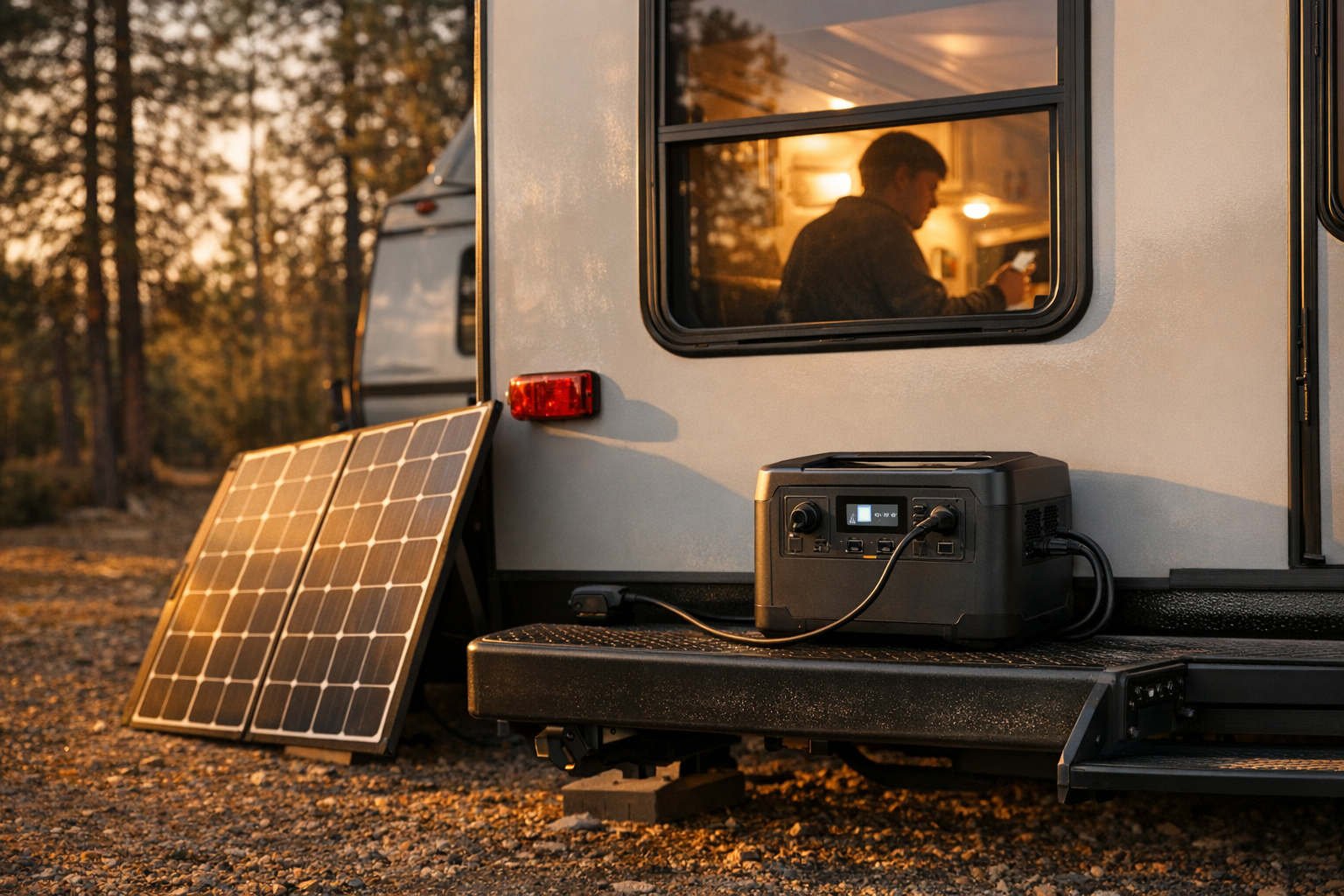
You’ve just pulled into a quiet, off-grid campsite after a long drive, and the moment you switch off the engine you realize there’s no hookup in sight. Your fridge needs power, your phones are dying, and your partner wants to brew coffee. This is the exact scenario where a portable power station earns its keep—but choosing the wrong one means either hauling dead weight or running out of juice before sunrise.
Below, we break down the best portable power stations for RV camping by the real-world situations you’ll actually face on the road.
TL;DR
- Best Overall: EcoFlow DELTA 2 Max — 2,048 Wh LiFePO4 capacity with 2,400 W output covers nearly every RV appliance without breaking the bank.
- Best Budget: Jackery Explorer 1000 Plus — Solid 1,264 Wh LiFePO4 unit at a competitive price for weekend warriors.
- Best for Large RVs & High-Draw Appliances: Bluetti AC200MAX — 2,048 Wh expandable to 8,192 Wh, with a 2,200 W inverter that handles air conditioners and microwaves.
- Best for Solar Pairing: Goal Zero Yeti 3000X — 3,032 Wh capacity with robust MPPT controller and up to 600 W solar input for extended boondocking.
- Best Compact & Lightweight: Anker SOLIX C800 Plus — 768 Wh in a 24 lb package, perfect for small rigs and short trips.
Battery Capacity and Wattage Output
Capacity, measured in watt-hours (Wh), tells you how much total energy the unit stores. Wattage output, measured in watts (W), tells you how much it can deliver at any given moment. For RV camping, these two numbers work in tandem: a 2,000 Wh station with a 2,400 W inverter can run a 1,200 W microwave for roughly 1.4 hours after accounting for inverter efficiency losses (typically 10–15%). A station with the same capacity but only a 1,000 W inverter simply can’t start that microwave at all.
Most RV campers need at least 1,000–2,000 Wh for basic overnight use—lights, phone charging, a CPAP machine, and a 12 V fridge. If you plan to run an air conditioner, electric kettle, or microwave, look for 2,400 W continuous output or higher and at least 2,000–3,000 Wh of capacity.
Battery Chemistry: LiFePO4 vs. Li-Ion
This is one of the most consequential decisions you’ll make. Standard lithium-ion (NMC) batteries are lighter per watt-hour and often cheaper upfront, but they typically last only 500–800 charge cycles before degrading to 80% capacity. LiFePO4 (lithium iron phosphate) batteries routinely deliver 3,000–3,500 cycles—some manufacturers rate them at 6,000+. They also handle heat better and carry a lower risk of thermal runaway, which matters when your power station sits in a sun-baked RV compartment.
For RV camping, where the unit endures temperature extremes and frequent cycling, LiFePO4 is the clear winner for long-term value. The weight penalty is modest—roughly 10–20% heavier for the same capacity—and prices have dropped significantly over the past two years.
Weight, Portability, and Size Constraints
A 60 lb power station is manageable if it lives in a basement storage bay, but it’s a different story if you need to carry it up a ladder into a truck camper. Consider where the unit will physically sit in your rig. Measure the space, check the weight rating of the shelf or compartment, and remember that you may need to move it for charging or ventilation.
Units under 30 lb are genuinely portable. Anything over 50 lb is more “semi-permanent installation” territory.
Solar Charging Compatibility
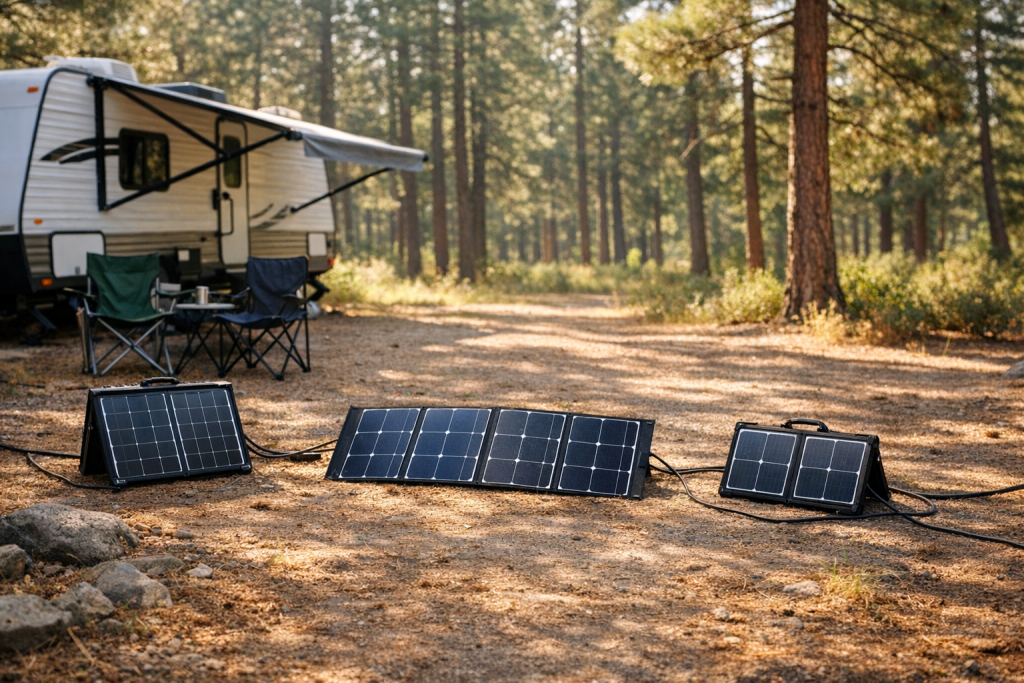
Most quality portable power stations accept solar input via an MC4 or Anderson connector, but the maximum solar input wattage varies wildly—from 100 W on budget models to 1,200 W on flagship units. Higher solar input means faster recharging. For practical boondocking, pairing a 200–400 W portable solar panel array with a station that has a built-in MPPT charge controller guide gives you the best efficiency. Check the station’s voltage input range to ensure compatibility with your chosen panels.
Outlet Types and Port Selection
RV-specific features to look for:
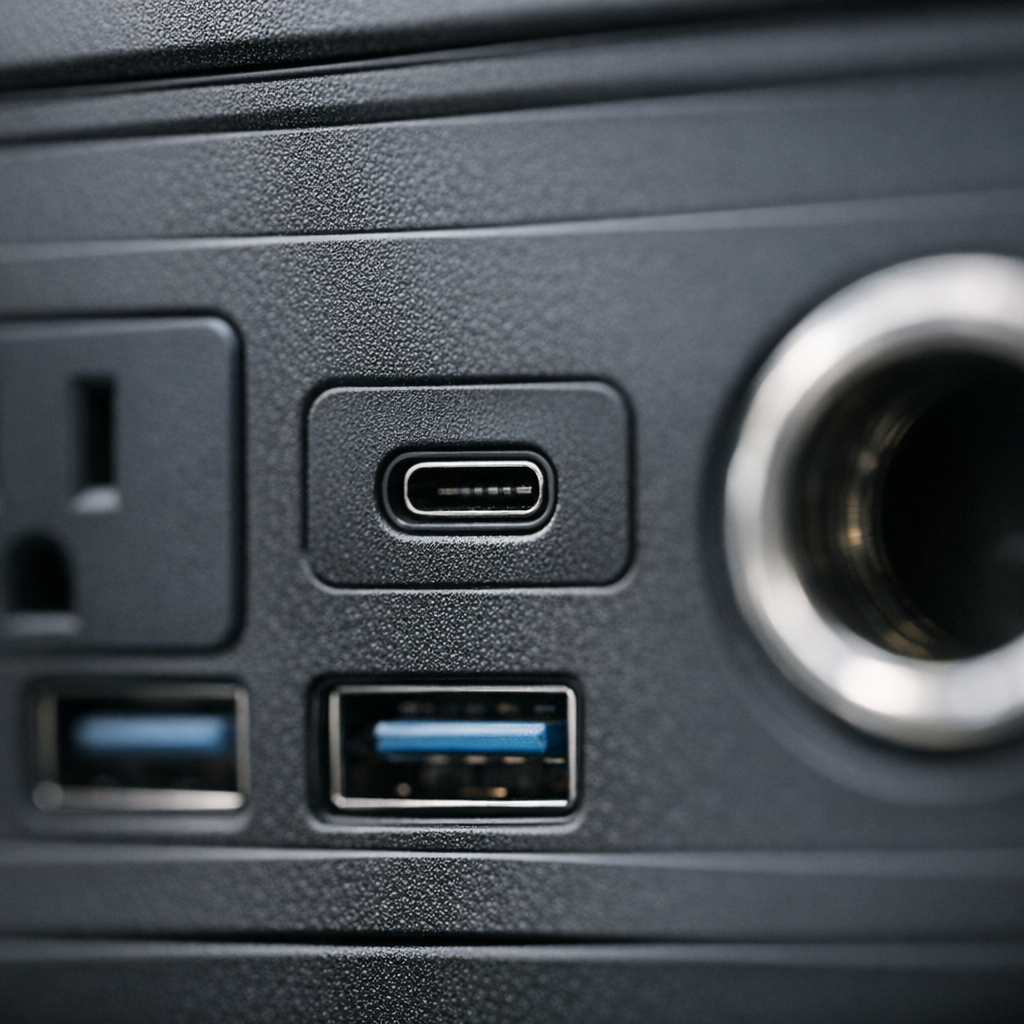
- A dedicated 30 A TT-30 RV plug (or at least a standard 20 A AC outlet you can adapt)
- USB-A and USB-C ports for devices
- A regulated 12 V DC output (cigarette-lighter style) for running 12 V appliances directly
- Anderson Power Pole connectors for hardwired accessories
Some high-end units also offer a 240 V outlet via a bonding cable between two units—useful for 50 A RVs.
Weekend Warriors: 1–3 Night Trips With Basic Appliances
If your RV camping style involves short getaways where you’re running LED lights, charging phones and laptops, powering a CPAP machine, and keeping a 12 V compressor fridge humming, you don’t need a massive unit. A station in the 1,000–1,500 Wh range with 1,500–2,000 W output handles this load comfortably for two to three nights without recharging.
Top pick: Jackery Explorer 1000 Plus. This LiFePO4 unit packs 1,264 Wh and delivers 2,000 W continuous (4,000 W surge). At roughly 31 lb, it’s light enough to move between your RV and a picnic table. It charges from a wall outlet in about 1.7 hours and accepts up to 800 W of solar input. The expandable battery ecosystem lets you add a 1,264 Wh expansion pack later if your needs grow. For weekend trips, it’s the sweet spot of price, weight, and capability.
Runner-up: Anker SOLIX C800 Plus. At just 768 Wh and 24 lb, this is the pick for solo travelers or couples in small vans and truck campers. Its 1,200 W output (1,600 W with SurgePad boost) won’t run a microwave, but it handles everything else a minimalist camper needs. The built-in LED light panel is a surprisingly useful bonus for campsite illumination.
Extended Boondocking: 5+ Days Off-Grid With Solar
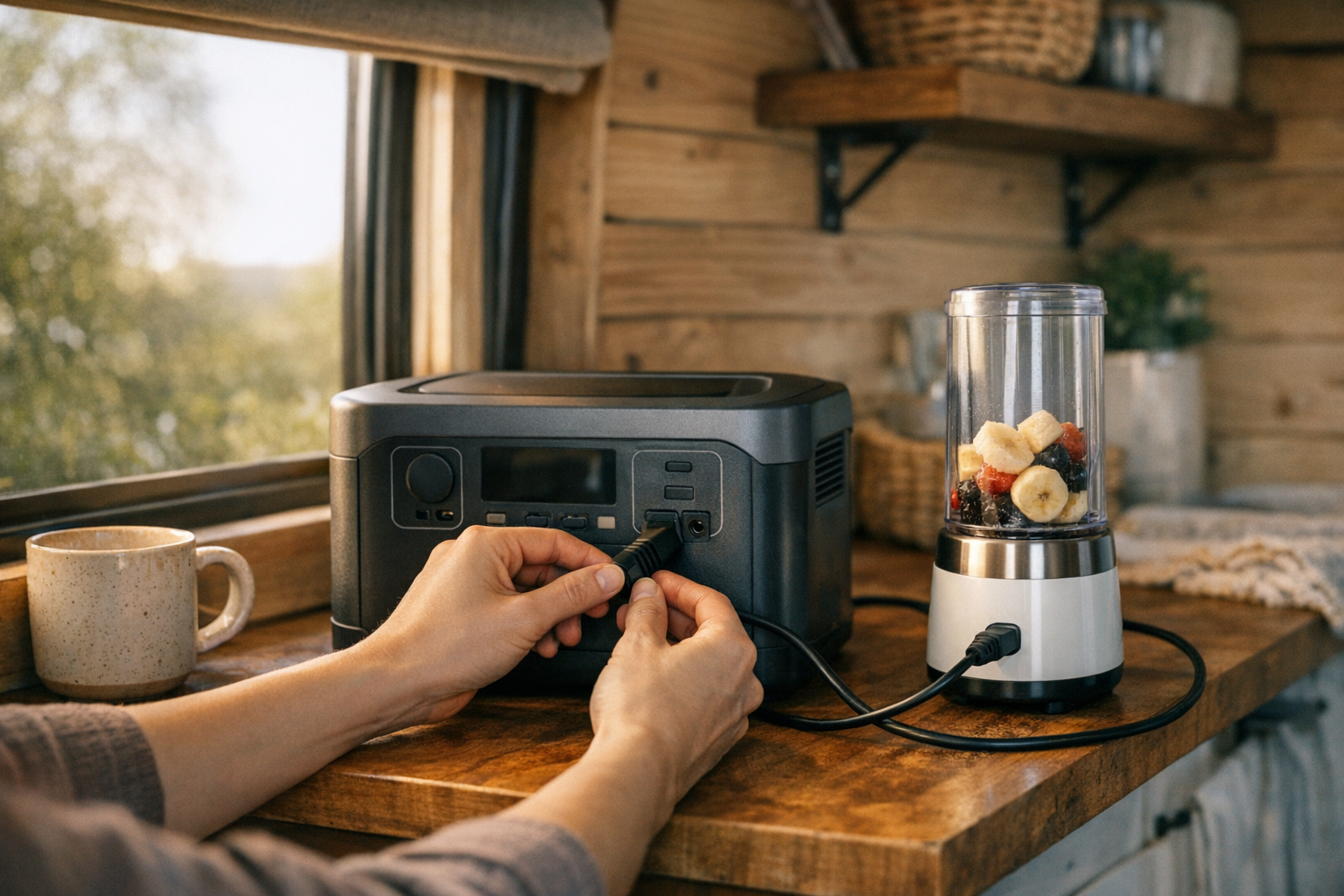
Boondocking on BLM land or in national forests means no hookups and no timeline for leaving. You need a large battery bank, efficient solar charging, and the discipline to manage your loads. The ideal station here has at least 2,000 Wh of capacity, high solar input, and an MPPT controller for maximum panel efficiency.
Top pick: Goal Zero Yeti 3000X. With 3,032 Wh of capacity and up to 600 W of solar input through its MPPT controller, the Yeti 3000X is built for extended off-grid stays. Its 2,000 W inverter (3,500 W surge) runs most RV appliances short of a large air conditioner. The unit uses Li-NMC chemistry rather than LiFePO4, which is a trade-off—it’s rated for roughly 500 cycles to 80%—but the sheer capacity and proven solar ecosystem (Goal Zero’s Nomad and Boulder panels integrate seamlessly) make it a boondocking favorite. At 70 lb, plan on giving it a permanent home in your rig.
Runner-up: Bluetti AC200MAX. This 2,048 Wh LiFePO4 station accepts up to 900 W of solar input and can expand to 8,192 Wh with two B300 expansion batteries. If you’re building a serious off-grid system over time, the modular approach is compelling. The 2,200 W inverter handles heavy loads, and the LiFePO4 chemistry means 3,500+ cycle longevity.
Full-Comfort RV Living: Running AC, Microwaves, and High-Draw Appliances
Running a rooftop RV air conditioner is the hardest test for a portable power station. A typical 13,500 BTU RV AC unit draws 1,200–1,500 W while running but can spike to 2,800–3,500 W on startup. You need a station with both high continuous wattage and a robust surge rating, plus enough capacity to make the runtime worthwhile.
Top pick: EcoFlow DELTA 2 Max. This is our best overall pick for a reason. Its 2,048 Wh LiFePO4 battery delivers 2,400 W continuous with a 4,800 W surge—enough to start and run most RV air conditioners. EcoFlow’s X-Boost technology can push compatible appliances up to 3,400 W by intelligently reducing voltage. The unit charges from 0–80% in 43 minutes via a wall outlet and accepts up to 1,000 W of solar input. At 51 lb, it’s heavy but manageable. You can expand to 6,144 Wh with two DELTA 2 Max Smart Extra Batteries for multi-hour AC runtime.
Runner-up: Bluetti AC300 + B300 system. Bluetti AC300 + B300 system. The AC300 is an inverter-only unit (no internal battery) that pairs with B300 expansion batteries and starts at 3,072 Wh with one B300, expanding as high as 12,288 Wh with four packs. Its 3,000 W pure sine wave inverter (6,000 W surge) handles virtually any RV appliance. The tradeoff is weight: the AC300 itself is about 47.6 lb and each B300 battery is about 79.6 lb. It also supports 240 V output when paired with a second AC300 via a fusion box—ideal for 50 A RV setups.
Budget-Conscious Campers: Maximum Value Without Compromise
Not everyone needs—or wants to pay for—a 2,000+ Wh flagship. If you’re supplementing an existing RV battery system or simply want backup power for essentials, a well-chosen mid-range station delivers excellent value.
Top pick: Jackery Explorer 1000 Plus (also our weekend warrior pick). Its combination of LiFePO4 longevity, 2,000 W output, expandability, and competitive pricing makes it the best value in the category right now.
Alternative: EcoFlow RIVER 2 Pro. At 768 Wh with an 800 W inverter (1,600 W with X-Boost), this compact LiFePO4 unit is one of the most affordable name-brand options. It won’t run heavy appliances, but for charging devices, running a fan, and powering a CPAP, it’s more than sufficient—and it weighs just 17.4 lb.
How to Size a Power Station for Your RV Needs
Sizing a portable power station correctly prevents two equally frustrating outcomes: buying too small and running out of power, or buying too large and hauling unnecessary weight. Here’s a practical method:
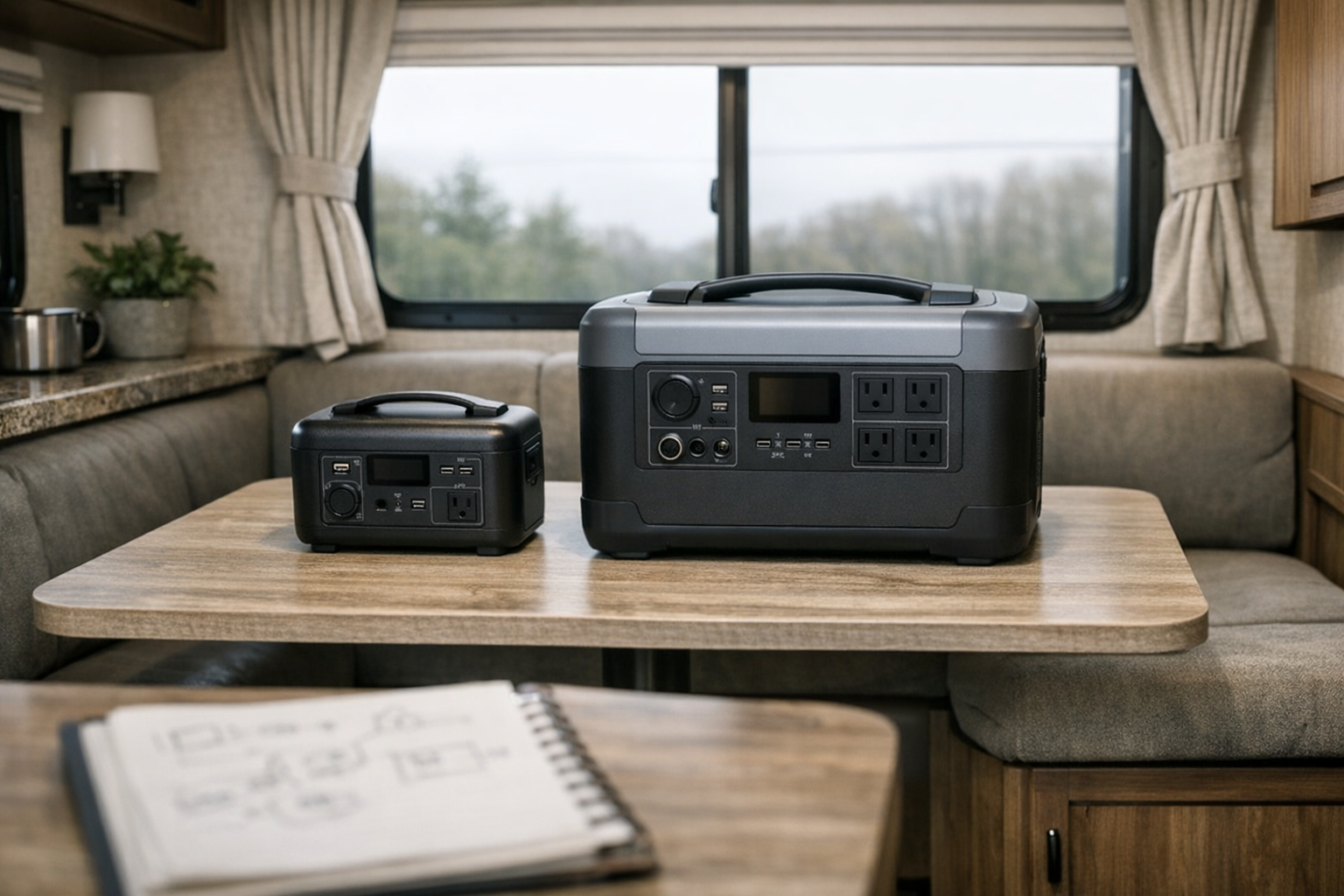
- List every device you’ll run. Write down each appliance and its wattage. Check the label or manual—look for “running watts,” not just “rated watts.” Common RV loads: LED lights (5–15 W each), 12 V compressor fridge (40–60 W running, 120–180 W startup), laptop (50–65 W), CPAP machine (30–60 W), phone charger (10–20 W), coffee maker (600–1,200 W), microwave (900–1,500 W), RV air conditioner (1,200–1,500 W running, up to 3,500 W startup).
- Estimate daily usage in watt-hours. Multiply each device’s wattage by the hours you’ll use it per day. A 60 W fridge running 24 hours (with compressor cycling roughly 40% of the time) uses about 576 Wh. A CPAP at 40 W for 8 hours uses 320 Wh. Add everything up for your total daily consumption.
- Add a 15–20% buffer for inverter losses. No inverter is 100% efficient. If your daily total is 1,000 Wh, plan for needing about 1,150–1,200 Wh of battery capacity per day.
- Multiply by the number of days between charges. If you’re boondocking for three days with no solar, you need three times your daily figure. With solar panels, you can offset a significant portion—but factor in cloudy days and partial shade.
- Check peak wattage. Your station’s continuous output must exceed the highest single load you’ll run, and its surge rating must handle startup spikes. If you want to run a microwave (1,200 W) and a fridge (60 W) simultaneously, you need at least 1,260 W continuous.
For most RV campers running basic loads (fridge, lights, devices, CPAP), 1,000–2,000 Wh is the practical sweet spot. Add an air conditioner or microwave, and you’re looking at 2,000–3,000+ Wh—or a smaller station paired with solar panels for daily replenishment.
Portable Power Station vs. Built-In RV Generator
| Factor | Portable Power Station | Built-In RV Generator |
|---|---|---|
| Noise | Zero—completely silent operation | 50–70 dB; audible from neighboring campsites |
| Emissions | None | Produces CO, CO₂, and other exhaust gases |
| Fuel | Electricity (wall, solar, vehicle alternator) | Gasoline, diesel, or propane |
| Runtime | Limited by battery capacity; typically 4–20 hours depending on load | Limited by fuel tank; can run for days with refueling |
| Maintenance | Virtually none | Oil changes, spark plugs, fuel stabilizer, winterization |
| Output | Typically 1,000–3,000 W continuous | 2,000–7,000+ W continuous |
| Campground rules | Allowed everywhere; no quiet-hour restrictions | Often prohibited during quiet hours (typically 10 PM–7 AM) |
| Upfront cost | $500–$3,500 for most RV-suitable units | $2,000–$5,000+ installed |
Can You Charge a Portable Power Station With Solar Panels?
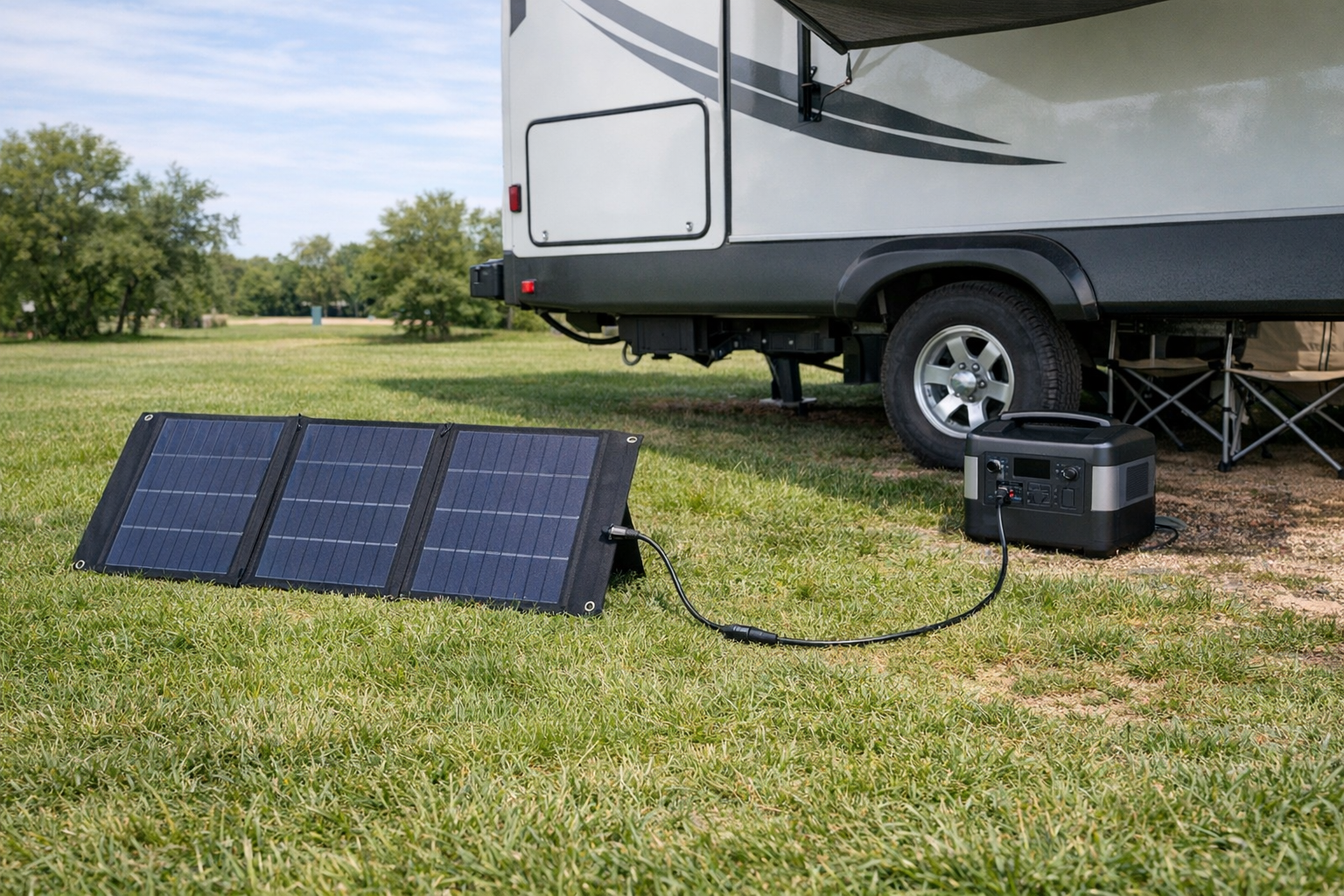
- Position panels perpendicular to the sun and adjust every 2–3 hours for maximum exposure.
- Keep panels cool—elevating them off the ground on a stand allows airflow underneath, improving efficiency by up to 5–10%.
- Use shorter, thicker cables between panels and the station to minimize voltage drop.
- Check your station’s input voltage range before buying panels; mismatched voltage can prevent charging or damage the controller.
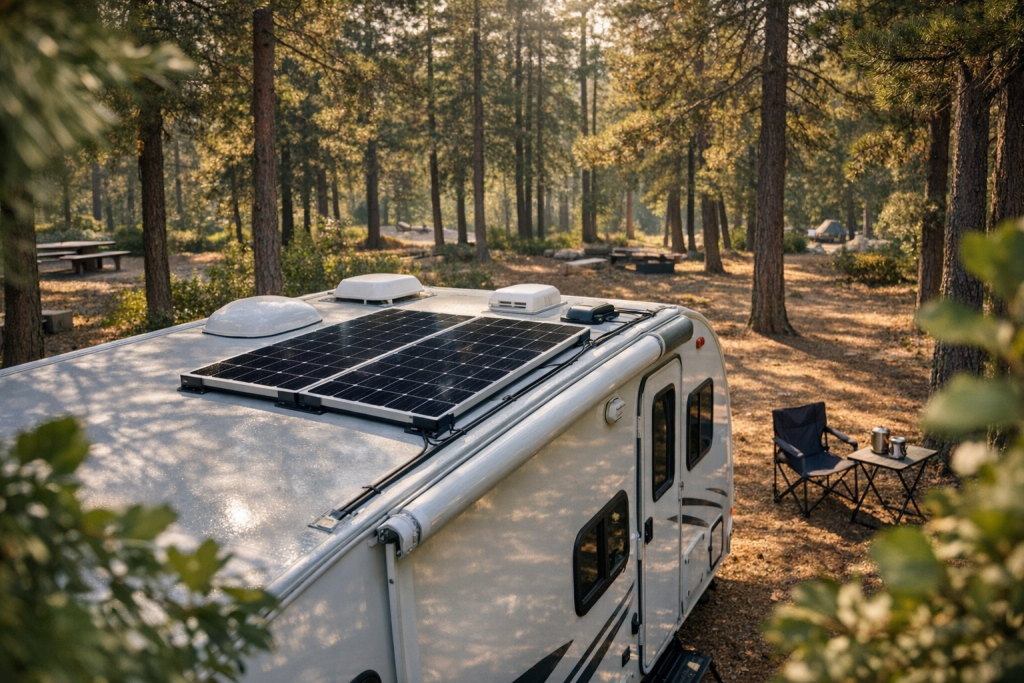
- Portable folding panels (100–200 W) are convenient but less efficient per dollar than rigid panels mounted on your RV roof. Consider a hybrid approach: roof-mounted rigids for passive daily charging and a portable folding panel you can position in direct sun.
Comparison Table
| Model | Type | Key Specs | Best for | Pros | Cons | Where to buy |
|---|---|---|---|---|---|---|
| EcoFlow DELTA 2 Max | LiFePO4 portable power station | 2,048 Wh · 2,400 W (4,800 W surge) · 51 lb · 1,000 W solar input | Full-comfort RV living; best overall | Fast wall charging (0–80% in 43 min); X-Boost to 3,400 W; expandable to 6,144 Wh; 3,000+ cycle LiFePO4 | 51 lb is heavy for one person; premium price; fan can be audible under heavy load | Amazon ↗ |
| Bluetti AC200MAX | LiFePO4 portable power station | 2,048 Wh · 2,200 W (4,800 W surge) · 61.9 lb · 900 W solar input | Large RVs; expandable off-grid systems | Expandable to 8,192 Wh with B300 packs; 3,500+ cycle LiFePO4; dual charging (solar + AC simultaneously); wireless charging pad | Heavy at 62 lb; slower wall charging (~5 hrs without dual input); bulky for frequent moving | Amazon ↗ |
| Goal Zero Yeti 3000X | Li-NMC portable power station | 3,032 Wh · 2,000 W (3,500 W surge) · 70 lb · 600 W solar input | Extended boondocking with solar | Massive capacity; excellent MPPT solar controller; proven ecosystem with Goal Zero panels; regulated 12 V outputs | Li-NMC chemistry (~500 cycles); 70 lb; high price per Wh; slower solar input vs. competitors | Amazon ↗ |
| Jackery Explorer 1000 Plus | LiFePO4 portable power station | 1,264 Wh · 2,000 W (4,000 W surge) · 31.5 lb · 800 W solar input | Weekend trips; best budget option | Excellent price-to-performance; LiFePO4 (4,000 cycles); expandable with add-on battery; lightweight; fast solar charging | 1,264 Wh may be tight for multi-day trips; no built-in 30 A RV outlet; expansion battery sold separately | Amazon ↗ |
| Anker SOLIX C800 Plus | LiFePO4 portable power station | 768 Wh · 1,200 W (1,600 W SurgePad) · 24 lb · 300 W solar input | Compact rigs; solo travelers; van life | Very light at 24 lb; built-in LED light; LiFePO4 longevity; intuitive app control; quiet operation | 768 Wh limits runtime; 1,200 W won’t run AC or microwave; 300 W max solar input is modest | Amazon ↗ |
| Bluetti AC300 + B300 | LiFePO4 modular power station | 3,072 Wh · 3,000 W (6,000 W surge) · AC300 47.6 lb + B300 79.6 lb · 2,400 W solar input | 50 A RVs; heavy appliance loads; modular builds | 3,000 W pure sine wave; 240 V split-phase option; 2,400 W solar input; 3,500+ cycles; expandable modular system | Requires separate B300 battery (added cost); total system is expensive; complex setup vs. all-in-one units | Amazon ↗ |
| EcoFlow RIVER 2 Pro | LiFePO4 portable power station | 768 Wh · 800 W (1,600 W X-Boost) · 17.4 lb · 220 W solar input | Ultra-budget; device charging; CPAP backup | Extremely light; fast AC charging (70 min); LiFePO4; affordable; compact footprint | 768 Wh is limited; 800 W native output restricts appliance use; not expandable; small solar input | Amazon ↗ |
Safety & Common Mistakes
- Ventilation: Power stations generate heat under load. Never operate one in a sealed compartment; ensure at least 6 inches of clearance around all vents.
- Temperature limits: Most units are rated for charging between 32–113 °F (0–45 °C). Avoid charging in direct sun inside a closed vehicle where interior temps can exceed 140 °F.
- Water exposure: Portable power stations are not waterproof. Keep them away from open windows, leaky roofs, and condensation-prone areas.
- Secure during transit: A 50+ lb power station becomes a dangerous projectile in a sudden stop. Strap it down with ratchet ties or store it in a compartment with a positive latch.
- No indoor generator use: While power stations themselves produce no emissions, never run a gas generator inside or near an RV to charge one—carbon monoxide poisoning is a leading cause of camping fatalities.
Recommended Gear
- Victron SmartSolar MPPT 100/30 — View on Amazon
- Renogy 100W Monocrystalline Panel — View on Amazon
- Battle Born 100Ah LiFePO4 Battery — View on Amazon
FAQs
- How many watts do I need for full-time RV living? Most full-timers find 400–600W sufficient with 200–400Ah lithium.
- Can I mix different wattage panels? Yes. Wire identical panels in series first, then parallel the strings.
- Should I disconnect solar when plugged into shore power? Good controllers stop charging automatically; ensure profiles are compatible.
- Will solar panels survive hail? Tier-1 panels are tested with 1-inch hail at ~50 mph and typically pass.
As an Amazon Associate, we earn from qualifying purchases. This helps keep SunAmpRV running.