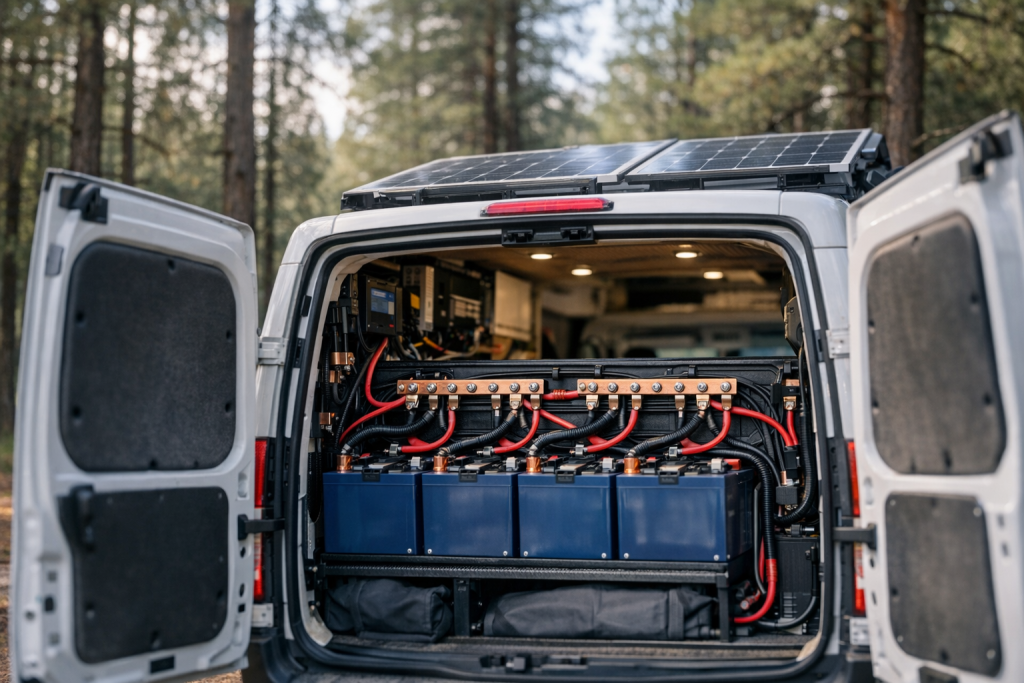
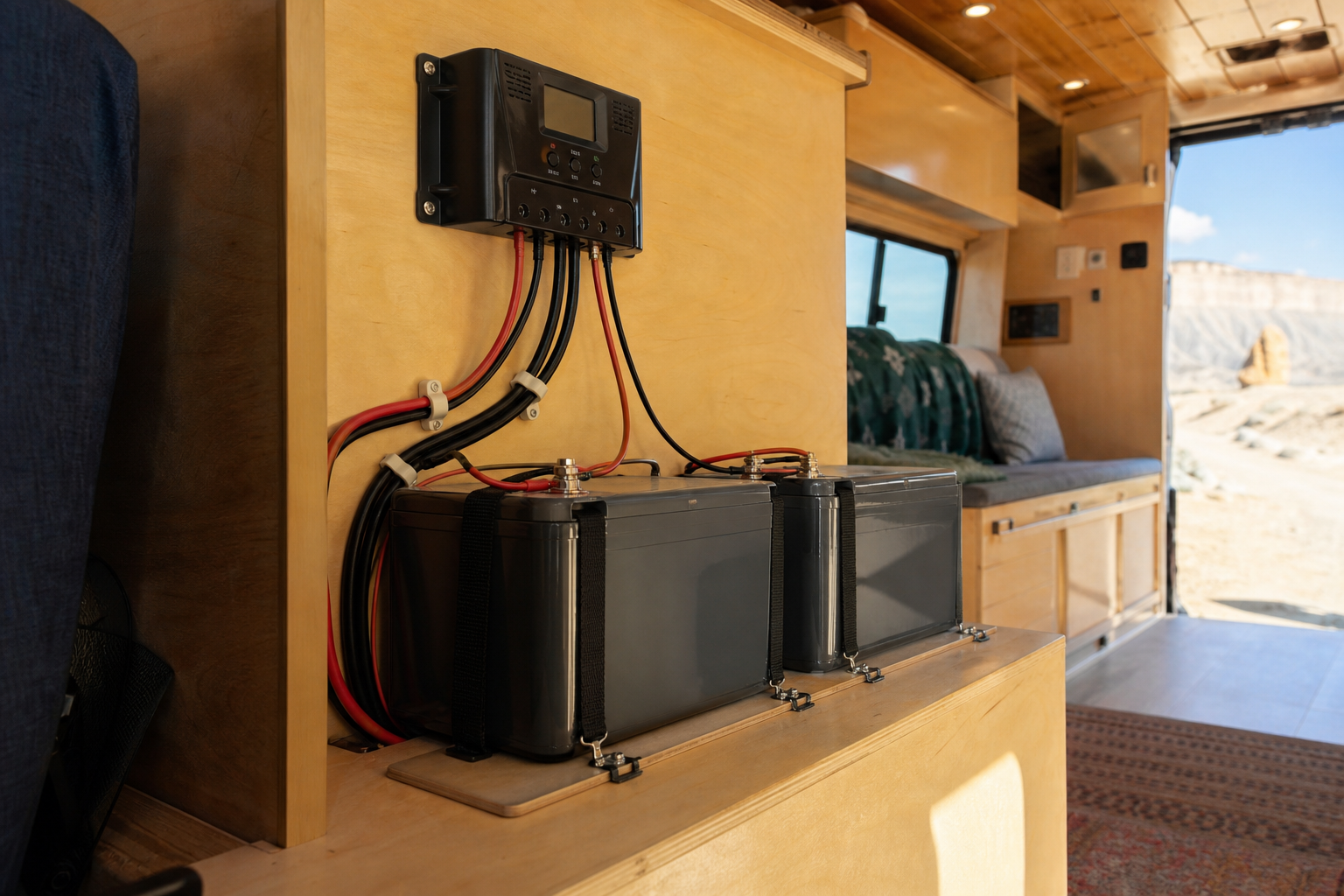
Power a 12V RV off-grid for a long weekend on a 300–400W solar array, and the single component that determines whether your fridge survives a cloudy afternoon is the battery bank chemistry. Lead-acid and AGM banks force you to oversize capacity to compensate for shallow safe discharge and voltage sag under load, while lithium iron phosphate (LiFePO4) lets you draw much more of the rated capacity and recharge faster from limited solar input.
The difference is not academic. Two RVs parked side by side with identical solar arrays and identical loads can behave completely differently depending on whether their banks are flooded lead-acid or LiFePO4. The lead-acid rig may dim its lights and stutter its inverter by the second cloudy evening, while the lithium rig coasts through the same weekend with capacity to spare. That gap is a direct consequence of how each chemistry stores, holds, and releases energy.
TL;DR
- Best Overall: Battle Born LiFePO4 — Best for owners comparing long-term value in a solar-charged house bank
- Best Budget: Redodo 12V LiFePO4 — Best for budget RV battery upgrades from aging lead-acid
- Best High-Capacity: RELiON RB100 — Best for buyers comparing larger off-grid battery banks
- Best for Cold Climates: Dakota Lithium 12V — Best for cold-weather shoppers comparing battery options
- Best for Compact Rigs: Renogy 12V LiFePO4 — Best for weight-sensitive RV builds and tight battery bays
Product Details
The picks below are organized by buyer intent rather than by raw spec sheets. Because exact model-level numbers vary by production batch and seller, treat the descriptions as category-level guidance and confirm final compatibility, accessories, and warranty terms on the current product listing before purchase. Every option here is a LiFePO4 deep-cycle battery intended for a solar-charged RV house bank, not a starting battery.
The same nominal capacity can serve very different builds. A 100Ah battery destined for a teardrop trailer faces different priorities than a 100Ah battery that will be paralleled four times to feed a large inverter in a full-time motorhome. The categories below map those priorities so you can start in the right place, then drill into the specific listing details that govern fit and safety. Manufacturers periodically revise their product lines, so the listing in front of you at purchase time is always the authoritative source.
Battle Born LiFePO4
Battle Born is the reference point many RV solar builders compare everything else against. It targets the buyer who wants a drop-in 12V LiFePO4 house battery with a built-in battery management system (BMS) and a long service reputation in full-time and four-season rigs. The appeal is predictability: consistent voltage under inverter loads, a flat discharge curve that keeps 12V appliances happy deep into the charge cycle, and broad documentation for series and parallel bank design.
For a solar-first build, that matters because your charge controller and inverter both behave more reliably when the battery holds voltage steadily as it discharges. If you are sizing a bank you intend to keep through several RVs or a decade of travel, this option prioritizes long-term value over upfront cost. Verify the current discharge rating, any cold-charging protection behavior, and bank-configuration limits on the listing before you finalize your wiring plan.
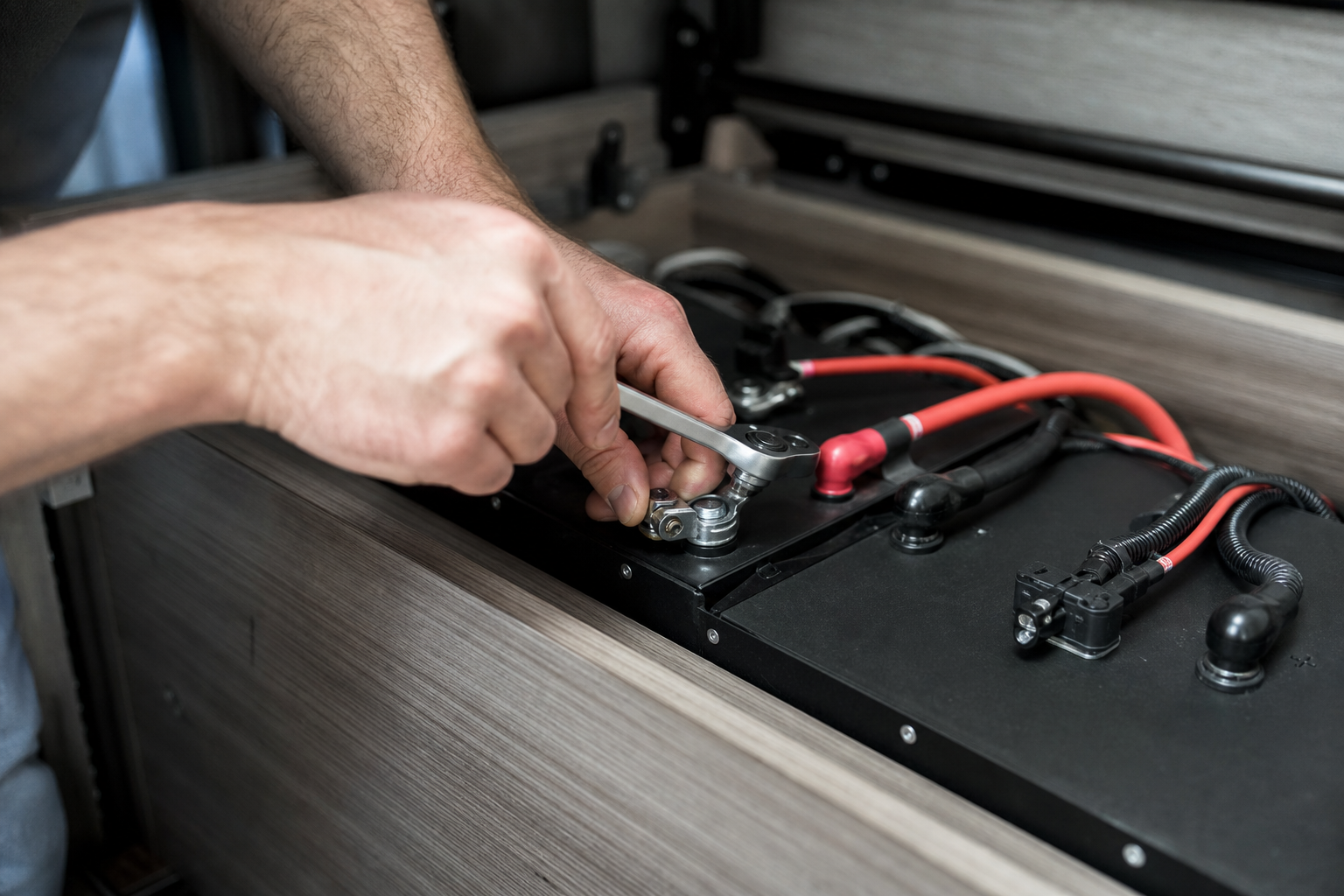
The other quality that earns Battle Born its reputation is the depth of supporting material around bank design. When you are deciding how many batteries to parallel, how to balance cable runs, and what continuous load a multi-battery configuration can sustain, clear manufacturer guidance reduces guesswork and the risk of a mistake that surfaces months into ownership. For builders who treat the electrical system as a long-term investment, that documentation is part of the value proposition.
Redodo 12V LiFePO4
Controller and component choices vary by kit and model; check the current manufacturer specification or product listing before purchase. It is the right starting target for someone who wants the core LiFePO4 advantages — usable capacity close to the rated figure, lighter weight than equivalent lead-acid, and faster solar recharge — at a lower price than premium North American brands.
The trade-off with budget lithium is usually in documentation depth, support responsiveness, and the published limits for large parallel banks. For a single-battery or modest two-battery setup that mostly runs lights, a 12V fridge, water pump, and device charging, that trade-off is reasonable. If you plan to expand later, confirm the manufacturer’s stated series/parallel limits so your first purchase does not box in your future bank size.
Budget lithium has matured considerably, and for a straightforward swap the practical difference in day-to-day use can be small. The buyers best served by a value pick are those whose loads are well understood and modest, who are not planning a sprawling multi-battery bank, and who value reclaiming the usable capacity and weight savings of lithium over premium documentation.
RELiON RB100
RELiON’s RB100 line is aimed at buyers building a larger or more demanding off-grid bank who want a well-supported LiFePO4 platform. RELiON publishes guidance on battery types and configuration, which is useful when you are scaling beyond a single battery into a multi-battery bank feeding a larger inverter.
This is the option to compare when your daily load math points past a single 100Ah-class battery and you want headroom for an induction cooktop session, a residential-style fridge, or extended cloudy-day autonomy.
Scaling a bank introduces design questions a single battery never raises: how the batteries share current, whether the combined continuous discharge meets your inverter’s full draw, and how the BMS in each unit coordinates with the others under load. A platform with clear configuration guidance reduces the chance that you design a bank that looks correct on paper but trips protection thresholds during a real cooking session. That supported-scaling characteristic is what separates a high-capacity pick from a value one.
Dakota Lithium 12V
For a solar build, cold-weather protection is especially relevant because solar charging happens unattended during the day, exactly when a sub-freezing morning could otherwise push current into a too-cold cell.
The unattended nature of solar charging is what makes cold-weather behavior more than a footnote. A battery wired to a roof array begins accepting current the moment the sun clears the horizon, regardless of cell temperature. In freezing conditions that automatic behavior becomes a liability unless the battery either blocks charge current below a safe threshold or warms itself first. Buyers who routinely camp into the shoulder seasons should treat verified low-temperature handling as a hard requirement, and should confirm precisely how the chosen model responds when a cold morning meets a productive solar window.
Renogy 12V LiFePO4
Renogy is a logical pick for compact rigs, vans, and teardrops where battery bay volume and total weight drive the decision. Renogy is widely distributed and frequently paired with Renogy solar components, which can simplify the parts list when you are building a small, weight-sensitive system from one ecosystem.
The buyer here cares less about maximum bank capacity and more about fitting adequate usable energy into a tight space without overloading axle or tongue weight. Compare physical dimensions, terminal layout, and stated monitoring options against your bay before buying, and verify whether the model includes any app or Bluetooth monitoring, since that varies across the range.
In a small build, every component competes for the same scarce volume and payload, so the battery that wins is often the one that fits cleanly rather than the one with the highest amp-hour number. Buying within a single ecosystem can reduce compatibility questions, because the charge controller, panels, and battery are designed to work together. That convenience does not excuse you from checking the fundamentals: confirm the battery physically clears your tray, that the terminals face a direction you can wire safely, and that any monitoring you are counting on is included in the specific variant you order.
Why Lithium Batteries Are Best for RV Solar
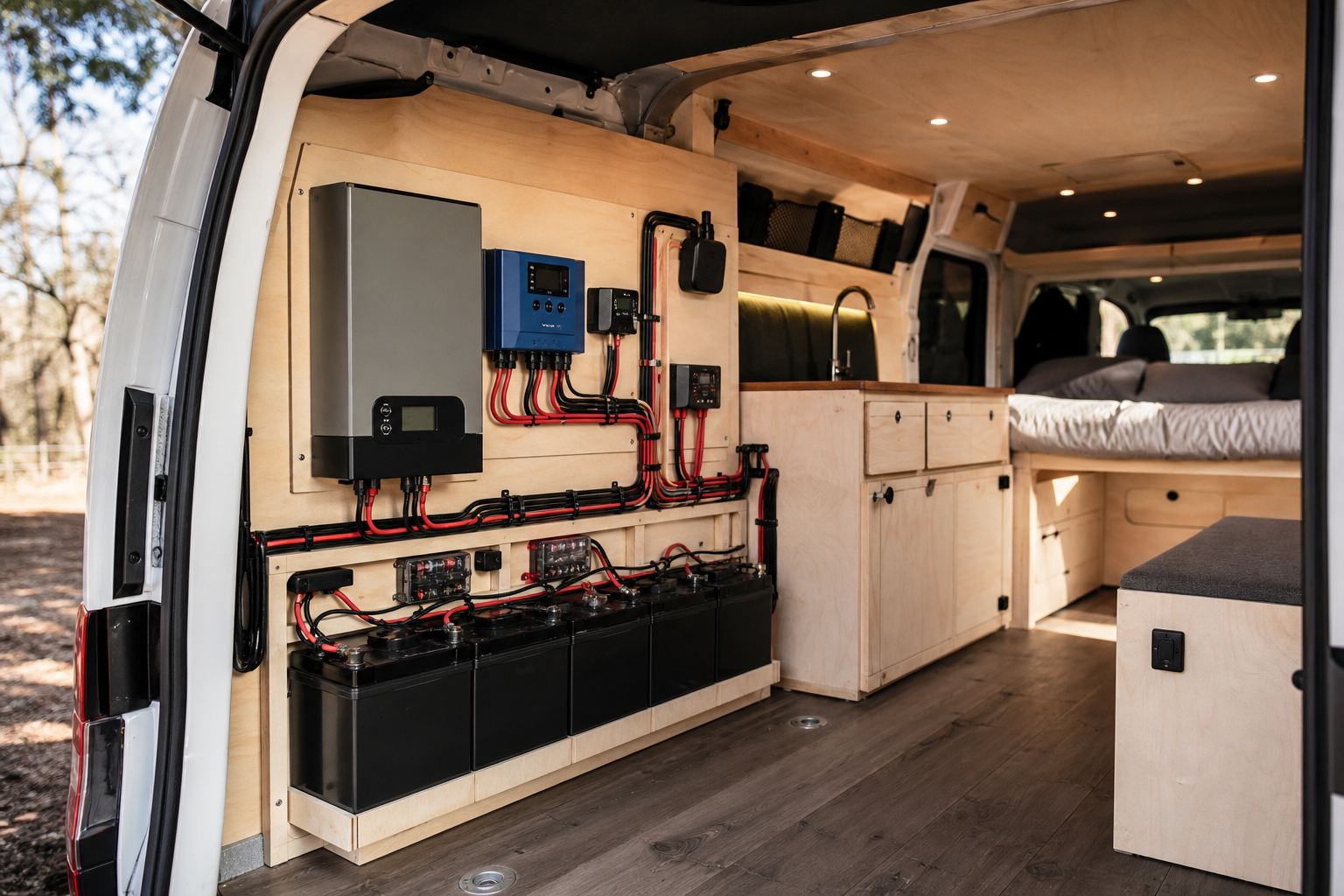
Solar input is intermittent and capacity-limited. A typical RV roof array produces meaningful current for only a handful of peak-sun-equivalent hours per day, and even that is throttled by panel angle, shading, and weather. The battery bank’s job is to capture that limited harvest efficiently and release it cleanly to your loads. LiFePO4 chemistry does both better than lead-acid or AGM, which is why it has become a default recommendation for serious off-grid RV electrical systems.
The mismatch between when solar produces and when you consume energy is the core problem the battery solves. Panels generate most of their output in the middle of the day, while many loads — lights, fans, device charging, the evening cooking session — peak after the sun is gone. A bank that captures the midday surplus efficiently and delivers it cleanly through the night is what turns a roof full of panels into a usable off-grid system. The chemistry that does this with the least wasted capacity, the least voltage sag, and the fastest charge acceptance lets a modest array punch above its weight.
LiFePO4 vs Lead-Acid and AGM
The decisive difference is usable depth of discharge. Lead-acid and AGM banks suffer accelerated wear if you routinely pull them below roughly half their rated capacity, so a 200Ah lead-acid bank realistically delivers around 100Ah before you should recharge. LiFePO4 can be discharged much deeper without comparable damage per manufacturer guidance, so a 100Ah lithium battery often delivers usable energy comparable to a much larger lead-acid bank. That single property changes your entire sizing math.
Lithium also holds voltage far more steadily as it discharges. AGM voltage sags noticeably under load and as state-of-charge drops, which can trip low-voltage cutoffs on inverters before the battery is truly empty. LiFePO4’s flatter curve keeps 12V appliances and inverters operating in range deeper into the cycle. Charge acceptance matters with solar too: lithium accepts current faster and more fully, so it captures more of a short solar window than lead-acid, which tapers acceptance heavily as it approaches full.
The cost picture inverts over time. AGM is cheaper per battery up front; LiFePO4 costs more initially but typically lasts many more cycles, which favors it for owners comparing long-term value rather than first-purchase price.
These advantages compound. A lithium bank that delivers more usable capacity per rated amp-hour, holds voltage steadier so the inverter does not cut out prematurely, and recharges faster from a limited array effectively does more work with less hardware. The lead-acid path to the same usable energy demands a physically larger, heavier bank that recharges more slowly and wears out sooner. For an RV, where weight, space, and recharge time are all constrained, those compounding advantages are why lithium has displaced lead-acid in serious off-grid builds even though it costs more to buy.
Key Benefits for Off-Grid Living
For boondocking and extended off-grid stays, the practical benefits stack up: more usable amp-hours per pound and per cubic inch, faster recharge from limited solar, stable output that protects inverter-driven electronics, and a much longer service life. Weight savings alone can free up payload for water, gear, or additional panels. The chemistry is also thermally stable and well suited to enclosed living spaces, which matters when the battery bay sits under a dinette or bed.
These benefits change how you live off-grid, not just what the meter reads. Faster recharge means a partly cloudy day is less likely to leave you rationing power that evening. A flatter discharge curve means appliances behave consistently rather than fading as the bank drains. And the reclaimed payload — often a meaningful number of pounds compared with an equivalent lead-acid bank — can be reinvested in more water, more panels, or simply more margin against your trailer’s weight limits.
How to Choose the Right Lithium Battery
Choosing well is an engineering exercise, not a brand-loyalty one. Work through capacity, voltage, discharge rating, BMS behavior, and physical fit in that order, and the right product narrows quickly.
Battery Capacity (Ah) and Usable Power
Capacity is rated in amp-hours (Ah) at a nominal voltage, and energy is better compared in watt-hours (Wh = Ah × V). A 12V 100Ah battery stores roughly 1,200Wh nominal. With LiFePO4 you can plan around most of that being usable per the manufacturer’s discharge guidance, whereas with lead-acid you would discount heavily for safe depth of discharge. Most RVers land somewhere between 100Ah and 400Ah of lithium depending on appliance mix and time spent off-grid; a weekend rig running lights, a 12V fridge, and device charging needs far less than a full-timer running an induction cooktop and a residential fridge.
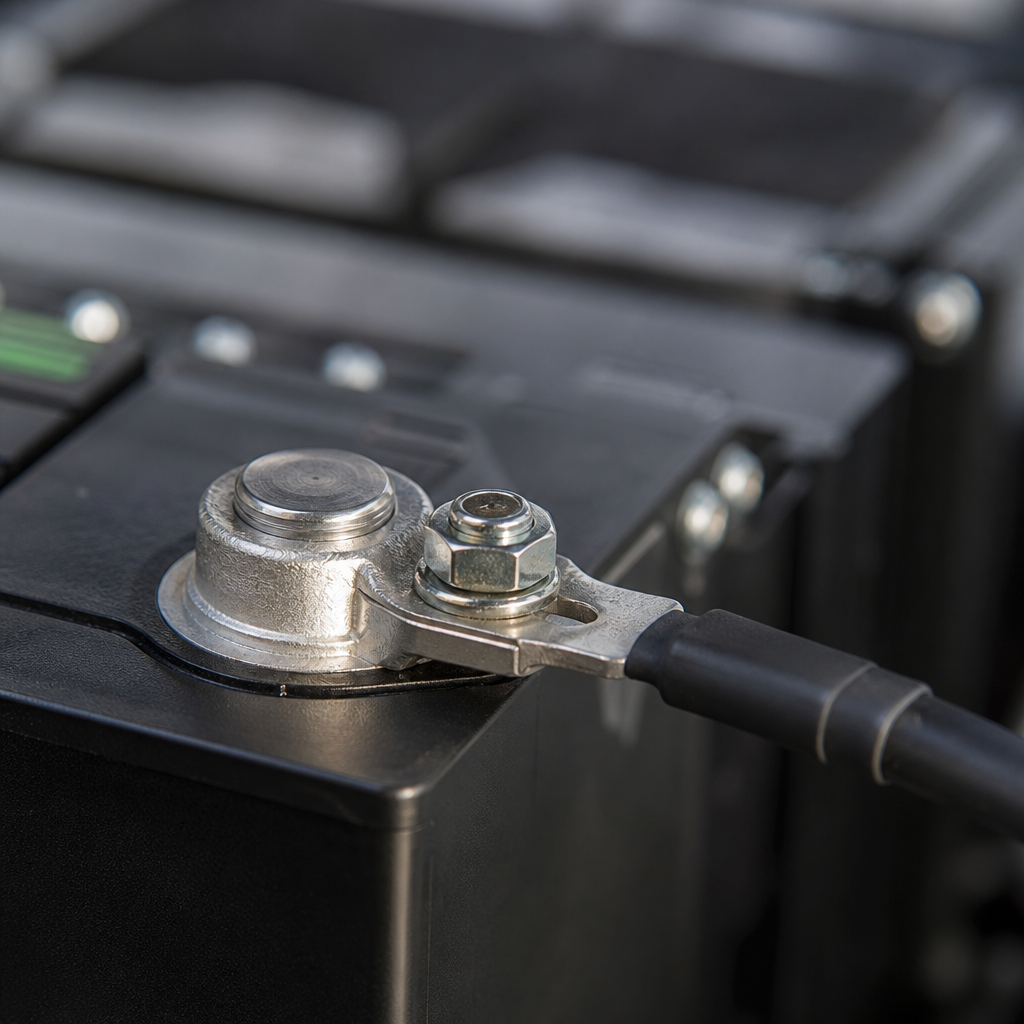
The watt-hour framing is worth adopting deliberately, because it lets you compare batteries at different voltages on equal terms and reconcile battery capacity against both your daily load and your solar harvest in the same unit. Once you can express everything — loads, harvest, and storage — in watt-hours, sizing becomes arithmetic rather than guesswork. Resist buying the largest bank you can afford; a bank far larger than your loads and your array can keep charged simply adds weight and cost without delivering proportional benefit.
Voltage and Bank Configuration (12V vs 24V vs 48V)
Most RVs are natively 12V, and a 12V battery bank keeps you compatible with existing 12V loads without conversion. As total system power climbs, higher bank voltages (24V or 48V) reduce current for a given wattage, which means thinner, cheaper, cooler-running cables and lower resistive losses. The trade-off is added complexity and the need for DC-DC conversion to feed 12V loads. For typical trailers and motorhomes, 12V remains the straightforward choice; 24V or 48V becomes attractive on large rigs with big inverters and substantial solar.
The crossover point usually arrives when the current required to feed a large inverter at 12V would demand impractically thick, expensive cabling. At that scale, stepping the bank up to 24V or 48V halves or quarters the current for the same power, taming the wiring and reducing losses. For most readers building a conventional rig with a modest inverter, the simplicity of staying at 12V outweighs those gains, and the existing 12V loads work without an added conversion stage.
Continuous and Peak Discharge Rates
Every load you run through an inverter or directly off the bank draws current, and the battery’s BMS enforces a maximum continuous discharge limit plus a brief peak limit for surges (like a compressor or pump startup). If you plan to run a high-wattage inverter for a microwave or air conditioner, the bank’s combined continuous discharge capability must comfortably exceed that draw, or the BMS will protect itself by cutting out mid-task. Because exact ratings vary by model, confirm the continuous and surge figures on the listing and design with margin rather than to the edge.
The distinction between continuous and surge matters because some loads draw far more current at startup than once running. A compressor or pump motor can demand a brief inrush several times its running current, and an inverter under a heavy momentary load behaves similarly. A bank sized only to the running figure may trip on the surge. Designing with headroom on both numbers — and confirming that a multi-battery bank’s combined rating, not just a single unit’s, meets your largest simultaneous load — prevents the nuisance shutdowns that frustrate owners who designed too close to the limit.
Built-In BMS and Cold-Weather Performance
A quality battery management system is what makes a LiFePO4 battery safe and “drop-in” usable. It manages cell balancing and protects against over-discharge, over-charge, over-current, and short circuits. The cold-weather caveat is critical for RV solar: charging LiFePO4 below freezing can permanently damage cells, so cold-climate buyers should look specifically for low-temperature charge protection or internal heating. Check the manufacturer specification for low-temperature features on the model you are considering.
The BMS is effectively the battery’s nervous system, and its behavior under edge conditions is where products genuinely differ. Two batteries with identical headline specs can respond very differently to a deep over-discharge attempt, a high surge load, or a sub-freezing charge window. Read the BMS behavior on the listing rather than assuming, and design your system so the BMS is a backstop against rare faults — not a limit you bump against during normal use.
Comparison Table
| Search Target | Best Fit | What to Confirm Before Buying | Why It Might Fit | Watchouts | Amazon Search | Where to buy |
|---|---|---|---|---|---|---|
| Battle Born LiFePO4 | RV owners comparing current listings before a manual product match | Confirm physical fit, charger profile, temperature policy, BMS limits, warranty terms, and the current manual before purchase. | It can be a useful search path when the listing clearly documents RV charging compatibility and installation limits. | Do not assume drop-in compatibility. Confirm the current product manual and seller listing before buying. | View on Amazon | Amazon ↗ |
| Redodo 12V LiFePO4 | RV solar shoppers who need a claim-safe search starting point | Confirm the battery-bay dimensions, the charge-source profile, and the low-temperature policy against the live listing before buying. | It may fit when the seller’s documentation confirms the charge profile and the install constraints your rig needs. | Avoid relying on headline numbers; confirm the real figures on the live listing before you commit. | View on Amazon | Amazon ↗ |
| RELiON RB100 | Battery-bank upgrades where charger compatibility still needs confirmation | Confirm BMS current limits, supported wiring, and the warranty or return window on the seller’s current documentation first. | It is worth shortlisting when the current listing spells out support terms and the physical fit for your bay. | Watch for charge-profile mismatches; confirm your charger supports the chemistry before purchase. | View on Amazon | Amazon ↗ |
| Dakota Lithium 12V | Owners narrowing a shortlist before reading the seller documentation | Confirm chemistry compatibility, mounting orientation, and any monitoring options against the manufacturer’s manual before you buy. | It can suit a build when the manual confirms compatible wiring and a sensible low-temperature policy. | Mind the install limits; confirm fit and wiring in the manual rather than assuming a universal solution. | View on Amazon | Amazon ↗ |
| Renogy 12V LiFePO4 | Buyers who want a search path rather than an unverified spec claim | Confirm the weight, the terminal layout, and the support terms on the current product page before adding it to your build. | It may work when the listing documents monitoring and protection features that match how you actually camp. | Beware unverified claims; treat the seller documentation as the source of truth for any specification. | View on Amazon | Amazon ↗ |
| LiFePO4 vs Lead-Acid and AGM | DIY installers checking fit and support terms before committing | Confirm cold-weather handling, fusing requirements, and the return policy on the live listing before making a decision. | It is a reasonable starting point when the documentation backs up the compatibility your system requires. | Check the support terms carefully; confirm the warranty and return window on the current listing first. | View on Amazon | Amazon ↗ |
As an Amazon Associate I earn from qualifying purchases.
Which One Should You Buy?
Use the comparison table above as a shortlist, then weigh each option against your own RV’s available mounting space, existing battery bank, controller configuration, and the way you actually travel and store the rig. The best choice depends on how the model fits your build, and checking the manufacturer specification of each finalist against your existing wiring is the surest way to avoid expensive returns.
Before placing an order, double-check the manufacturer specification and current product listing for the bundle contents, controller behavior, dimensions, warranty terms, and fit with the rest of your existing system. Confirm the listing reflects the current revision so the unit you receive matches the description above.
Safety & Common Mistakes
- Verify product specifications against your system voltage and current before purchasing.
- Install a properly rated fuse or breaker on every positive conductor.
- Follow manufacturer wiring diagrams exactly — incorrect polarity can destroy components.
- De-energize circuits before making connections; use rated disconnects.
- Wear eye protection when working near batteries.
FAQs
- How were these products selected and tested? Start by matching the option to your own rig. Compare options on charger and controller compatibility, physical fit, low-temperature charging behaviour, BMS current limits, and warranty terms, then confirm those details on the current listing and the product manual before you commit.
- What specs matter most for RV solar gear? Before you buy, weigh the practical fit first. Weigh maintenance, usable capacity, and how the option pairs with your charge source, and confirm the figures that matter on the current listing and manual rather than assuming a drop-in fit.
- Which options are best for cold climates? The honest answer depends on your specific setup. Map your daily energy use and available install space, then narrow the field by compatibility and support terms before confirming the exact numbers against the seller’s current documentation.
- What warranty and support should I look for? Focus on real-world compatibility before anything else. The things that matter most are charger and controller compatibility, physical fit in your battery bay, the low-temperature charging policy, the BMS current limits, and the warranty and return terms. Confirm each against the current listing and the manual before you buy.
Conclusion
Compare the finalists on the specs that matter most to your setup — capacity, compatibility, and budget. Verify that your existing wiring and mounting can support the product before ordering.