How Many Amp Hours Do I Need for RV Boondocking?
On this page
TL;DR
- Audit daily Wh: Sum each load’s wattage × hours per day to find your total daily energy need.
- Apply DoD: Divide by usable depth of discharge — 50% for lead-acid, 80–90% for LiFePO4.
- Add autonomy days: Multiply by the number of days you want to go without charging.
Introduction to Battery Bank Sizing
A typical boondocking RV consumes between 75 and 200 amp-hours per day at 12V, yet undersized battery banks remain the most common off-grid failure point. Correctly sizing your bank demands an honest energy audit, the right depth-of-discharge limit for your chemistry, and a realistic autonomy target. This guide walks through every step with formulas and worked examples.
Daily Energy Audit
Every reliable battery bank starts with a daily energy audit. List every electrical load in your RV, record its wattage, estimate how many hours per day it runs, and multiply watts by hours to get watt-hours per day. Sum the entire column and you have your baseline daily energy requirement. Skip this step and you are guessing — a habit that leads to either an oversized, overpriced bank or one that leaves you in the dark on night two.

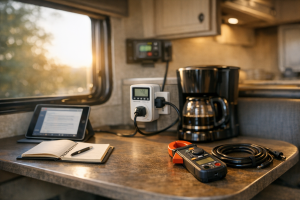
Be ruthless about accuracy. A residential refrigerator’s compressor does not run 24 hours a day; its duty cycle is typically 30–40 percent, meaning roughly 8–10 hours of actual compressor runtime in a 24-hour period. LED lights draw far less than the incandescent fixtures they may have replaced, but a water pump’s draw is bursty and easy to undercount. If you own a clamp meter or a plug-in watt meter, measure each appliance directly rather than relying on nameplate ratings, which often reflect peak or surge draw rather than continuous consumption.
Scroll sideways to see every column.
| Appliance | Watts | Hours/Day | Wh/Day |
|---|---|---|---|
| LED Lighting (all fixtures) | 30 | 5 | 150 |
| 12V Compressor Refrigerator | 50 | 10 | 500 |
| Water Pump | 60 | 0.5 | 30 |
| Furnace Fan | 35 | 4 | 140 |
| Laptop Charger (via inverter) | 65 | 3 | 195 |
| Phone/Tablet Charging | 15 | 3 | 45 |
| Vent Fan (MaxxAir-style) | 25 | 8 | 200 |
| TV/Streaming Device | 40 | 3 | 120 |
Summing the Wh/Day column gives us 1,380 Wh/day. This is a moderate-use scenario — a couple traveling in a well-equipped travel trailer with no air conditioning or microwave running off the battery bank. A minimalist weekend camper using only lights, a 12V fridge, and phone charging might tally as little as 500–700 Wh/day, while a full-timer running a residential fridge, an inverter-fed coffee maker, and a CPAP machine could easily exceed 2,500 Wh/day.
Accounting for Inverter Losses
Any load that runs through an inverter (laptop charger, TV, CPAP) incurs a conversion penalty. Most quality pure-sine inverters operate at 85–92 percent efficiency. For planning purposes, divide the AC load’s watt-hours by 0.85 to account for worst-case inverter overhead. In the table above, the laptop charger’s 195 Wh at the outlet actually pulls roughly 229 Wh from the battery bank when you factor in a 15 percent inverter loss.
After adjusting for inverter efficiency on the three AC loads (laptop, phone/tablet charger, TV), the corrected daily total rises to approximately 1,460 Wh/day. We will use this adjusted figure going forward.
Usable Capacity and Depth of Discharge
A battery’s nameplate amp-hour rating is not the amount of energy you can safely extract from it. Every chemistry has a recommended maximum depth of discharge (DoD) — the percentage of total capacity you should draw before recharging. Exceeding this limit accelerates degradation, shortens cycle life, and in the case of lead-acid batteries, can cause irreversible sulfation damage.
Lead-acid batteries — including flooded, AGM, and gel variants — should not be discharged beyond roughly 50 percent of their rated capacity on a regular basis. A 200 Ah AGM battery therefore offers only about 100 Ah of usable capacity. Many experienced boondockers target an even more conservative 40 percent DoD for lead-acid to maximize longevity, which means only 80 Ah of usable energy from that same 200 Ah battery.
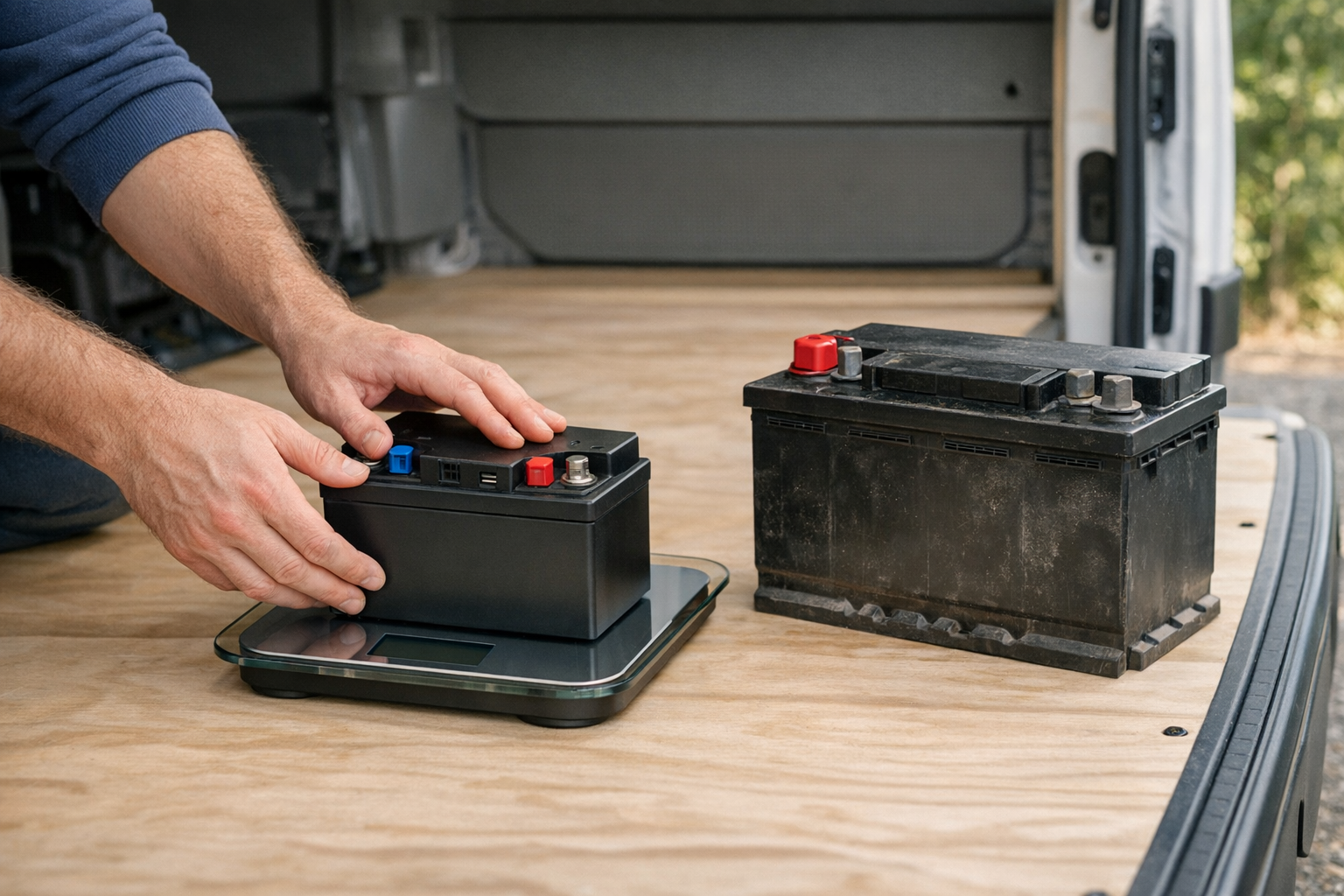
LiFePO4 (lithium iron phosphate) batteries change the equation significantly. Their recommended DoD ranges from 80 to 90 percent, with most manufacturers warranting the battery at 80 percent DoD for 2,000–5,000 cycles. A 200 Ah LiFePO4 battery at 80 percent DoD delivers 160 Ah of usable capacity — 60 percent more usable energy from the same nameplate rating. At 90 percent DoD, which some premium cells support, you get 180 Ah.
This single difference is why lithium batteries often result in a physically smaller, lighter bank for the same usable energy.
Scroll sideways to see every column.
| Chemistry | Rated Capacity (Ah) | Recommended DoD | Usable Ah | Approx. Cycle Life at Rated DoD |
|---|---|---|---|---|
| Flooded Lead-Acid | 200 | 50% | 100 | 300–500 |
| AGM | 200 | 50% | 100 | 400–800 |
| Gel | 200 | 50% | 100 | 500–1,000 |
| LiFePO4 | 200 | 80–90% | 160–180 | 2,000–5,000 |
Always use the usable capacity — not the nameplate rating — when sizing your bank. Failing to account for DoD is the single most common mistake in RV battery sizing and the primary reason new boondockers run out of power on their first trip.
Worked Examples
Example 1: Weekend Camper (12V Lead-Acid)
Sarah and Tom use their Class C motorhome for two- to three-night weekend trips at dispersed campsites. Their loads are modest:
Scroll sideways to see every column.
| Appliance | Watts | Hours/Day | Wh/Day |
|---|---|---|---|
| LED Lights | 20 | 4 | 80 |
| 12V Compressor Fridge | 45 | 10 | 450 |
| Water Pump | 60 | 0.3 | 18 |
| Phone Charging | 12 | 2 | 24 |
| Vent Fan | 20 | 6 | 120 |
Total daily draw: 692 Wh/day. The phone charger is the only AC load; adjusting for inverter losses at 85 percent efficiency raises the phone charging draw from 24 Wh to about 28 Wh, bringing the adjusted total to roughly 696 Wh/day.
Step 1 — Daily Ah draw: 696 Wh ÷ 12V = 58 Ah/day.
Step 2 — Autonomy multiplier: 58 Ah × 2 days = 116 Ah of actual energy needed.
Step 3 — Adjust for DoD: 116 Ah ÷ 0.50 = 232 Ah nameplate capacity.
Two Group 31 AGM batteries rated at 100–110 Ah each, wired in parallel, would give them 200–220 Ah — close but slightly under the target. Adding a third battery (300–330 Ah total) provides a comfortable margin and allows them to stay conservative at 40 percent DoD. Alternatively, two 130 Ah AGM batteries in parallel (260 Ah) would meet the requirement with a small buffer.
Example 2: Full-Timer (12V LiFePO4)
Mike lives full-time in a fifth wheel and boondocks for weeks at a stretch in the desert Southwest. He has solar panels but wants enough battery capacity to ride out three consecutive cloudy days without a generator. His loads are heavier:
Scroll sideways to see every column.
| Appliance | Watts | Hours/Day | Wh/Day |
|---|---|---|---|
| LED Lighting | 40 | 6 | 240 |
| Residential Fridge | 120 | 8 | 960 |
| Water Pump | 60 | 0.75 | 45 |
| Laptop + Monitor | 90 | 6 | 540 |
| CPAP Machine | 50 | 8 | 400 |
| Vent Fan | 25 | 10 | 250 |
| Cell Booster + Router | 20 | 24 | 480 |
| Misc (blender, charging) | 100 | 0.5 | 50 |
Raw total: 2,965 Wh/day. The residential fridge, laptop/monitor, CPAP, and blender all run through the inverter. Those loads sum to 1,950 Wh at the outlet. Adjusting for 88 percent inverter efficiency: 1,950 ÷ 0.88 = 2,216 Wh from the battery. The remaining DC loads total 1,015 Wh. Adjusted grand total: 3,231 Wh/day.
Step 1 — Daily Ah draw: 3,231 Wh ÷ 12V = 269 Ah/day.
Step 2 — Autonomy multiplier: 269 Ah × 3 days = 808 Ah of actual energy needed.
Step 3 — Adjust for DoD: 808 Ah ÷ 0.80 = 1,010 Ah nameplate capacity.
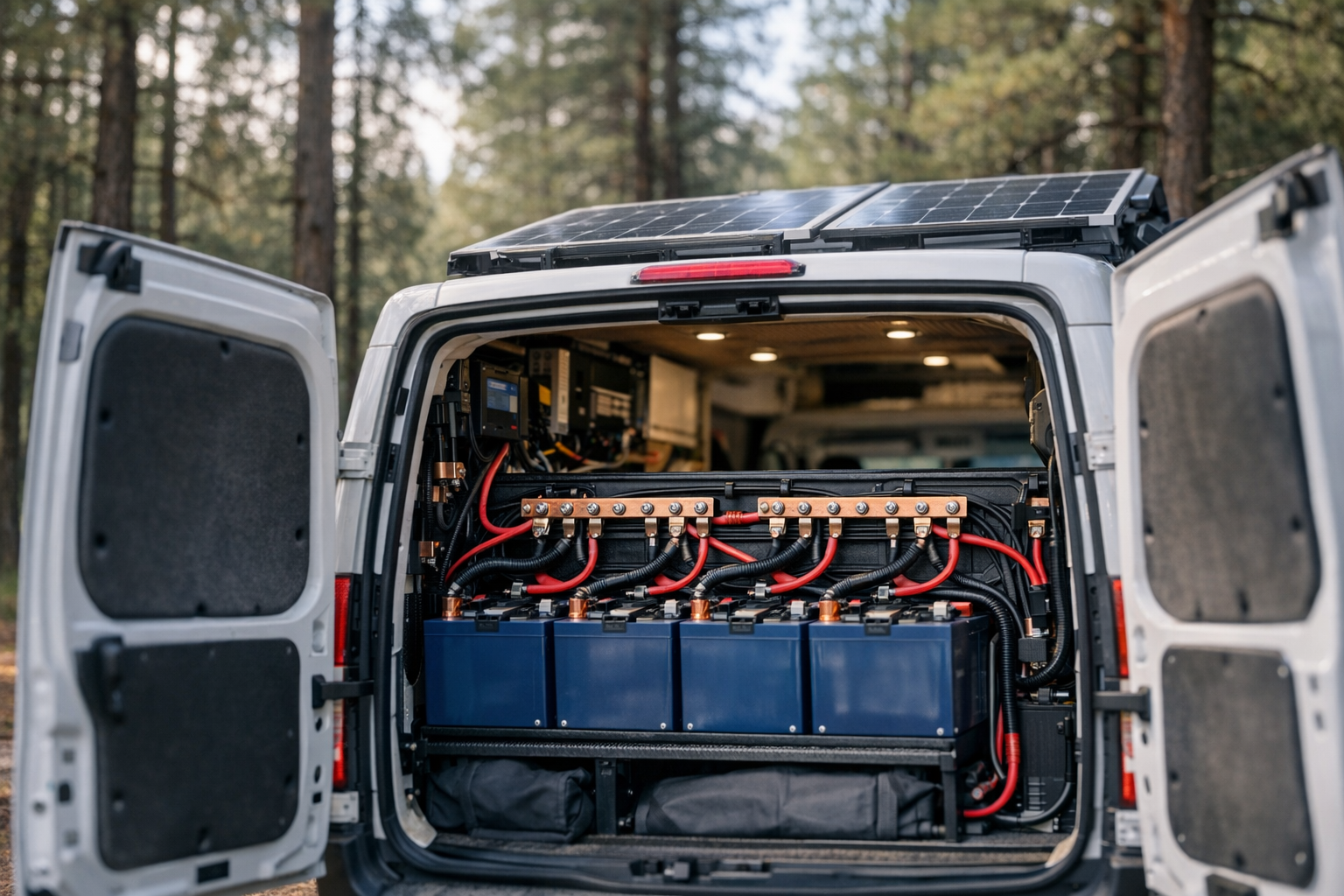
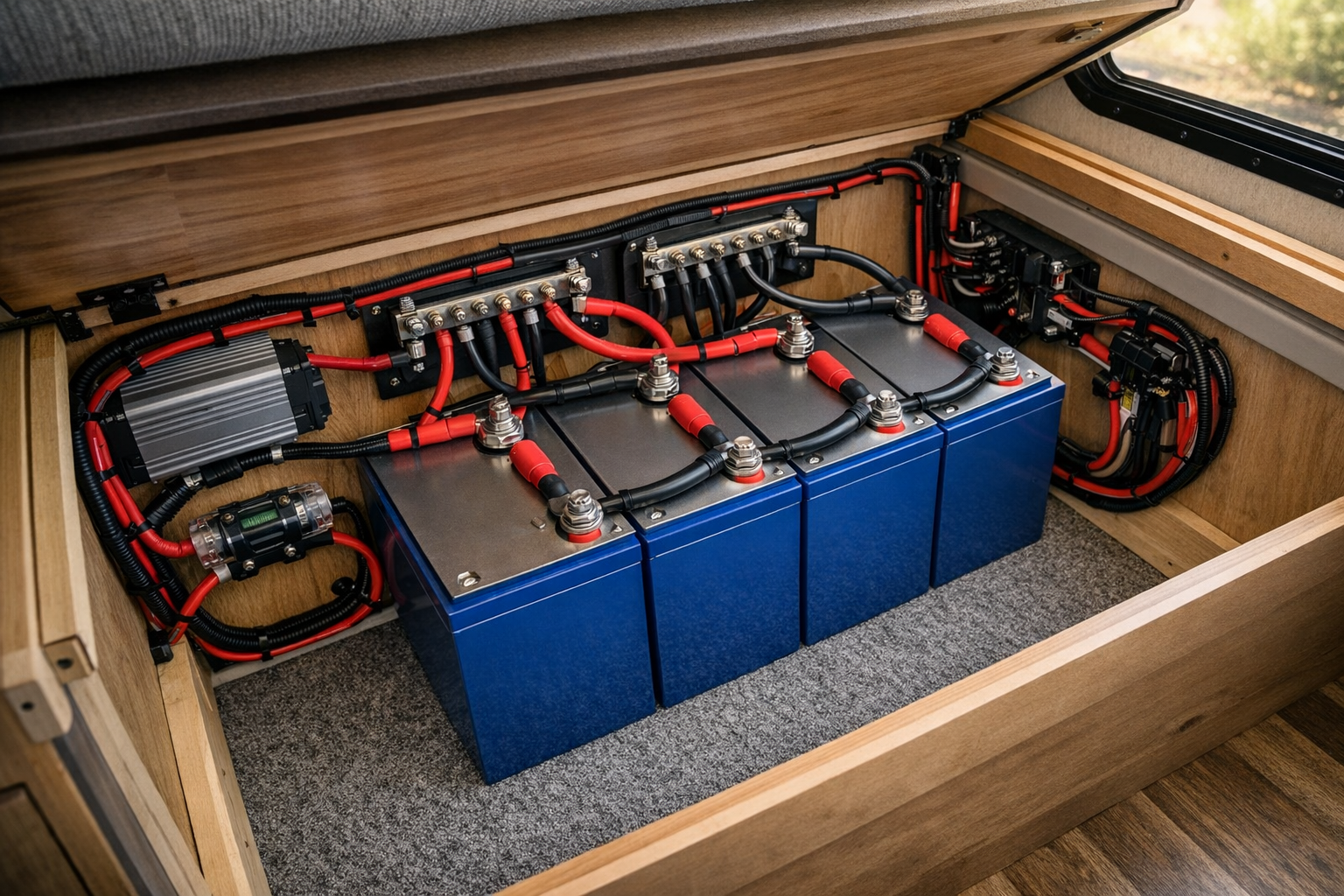
Mike needs roughly 1,000 Ah of LiFePO4 at 12V. That is a substantial bank — typically four 12V 300 Ah batteries wired in parallel (1,200 Ah total, providing a healthy margin) or an equivalent configuration using 200 Ah units. If he had chosen AGM at 50 percent DoD, the required nameplate capacity would balloon to 1,616 Ah, requiring eight or more heavy Group 31 batteries and adding several hundred pounds of weight.
This example illustrates why full-timers with high loads almost universally choose LiFePO4. The weight savings alone — roughly 60 percent lighter per usable amp-hour — can be the difference between staying within your RV’s cargo carrying capacity and exceeding it.
12V vs. 24V Battery Banks
Most RVs ship with a 12V electrical system, and the vast majority of RV-specific appliances, charge controllers, and inverter-chargers are designed for 12V. However, as battery banks grow beyond roughly 400–600 Ah at 12V, the current flowing through cables and components becomes substantial, and a 24V system starts to offer meaningful advantages.
Ohm’s law explains why. For the same power delivery, doubling the voltage halves the current. Mike’s 3,231 Wh/day system at 12V draws a continuous average of roughly 11A, but peak loads (residential fridge compressor startup, blender) can spike to 100A or more. At 24V, those peaks are cut in half. Lower current means smaller cable cross-sections, reduced voltage drop over long runs, less heat generation at connections, and smaller (often cheaper) fuses and disconnects.
The trade-off is compatibility. Most RV furnaces, water heaters, slide-out motors, and factory-installed lighting circuits expect 12V. Running a 24V bank typically requires a 24V-to-12V DC-DC converter to power those native 12V loads, adding cost and a small efficiency penalty (usually 92–97 percent). Your inverter, solar charge controller, and battery charger must all be 24V-rated models.
Scroll sideways to see every column.
| Factor | 12V System | 24V System |
|---|---|---|
| Current for 3,000 W load | 250A | 125A |
| Cable size (for same voltage drop) | Larger (e.g., 4/0 AWG) | Smaller (e.g., 2 AWG) |
| RV appliance compatibility | Native — no converter needed | Requires DC-DC converter for 12V loads |
| Component availability | Widest selection | Growing but more limited |
| Best suited for | Banks under ~600 Ah | Large banks, high-draw systems |
For most RV owners — including the majority of boondockers — a 12V system remains the practical choice. Consider 24V only if your bank exceeds 600 Ah, you are building a custom electrical system from scratch, or you are running sustained high-draw loads like a large inverter-fed air conditioner.
Safety and Common Mistakes
- Fuse each parallel string independently. When batteries are wired in parallel, a short circuit in one battery can draw catastrophic current from every other battery in the bank. Install a Class T or ANL fuse on the positive cable of each individual battery, rated for the maximum expected current of that string. For a single 12V 200 Ah LiFePO4 battery with a 200A continuous BMS, a 250A or 300A fuse is typical. Without individual fuses, a single cell failure can cause a thermal event across the entire bank.
- Never mix battery chemistries or ages. Combining a new AGM battery with a two-year-old flooded battery creates an imbalanced bank. The weaker battery limits performance and gets overworked, accelerating its failure and potentially damaging the newer battery. When expanding a bank, replace all batteries at once or add a completely separate, independently fused parallel string of identical batteries of the same age and brand.
- LiFePO4 requires a compatible BMS and charger profile. Every lithium battery must have a battery management system (BMS) — either internal or external — that monitors individual cell voltages, prevents overcharge above approximately 14.6V (for 12V packs), prevents over-discharge below roughly 10V, and provides over-current and over-temperature protection. Your converter/charger, solar charge controller, and alternator charging system must all be set to a lithium charge profile. Using a lead-acid charge profile on LiFePO4 batteries risks overcharging, which the BMS will interrupt by disconnecting the battery — potentially leaving you without power at an inconvenient moment.
- Ventilate lead-acid batteries. Flooded lead-acid batteries release hydrogen gas during charging, particularly during the absorption and equalization phases. Hydrogen is explosive at concentrations above 4 percent in air. Battery compartments must have ventilation to the exterior of the RV — never into the living space. AGM and gel batteries produce far less gas under normal conditions but can still vent if overcharged, so ventilation remains a best practice for all lead-acid types.
- Size cables for the actual current, not the battery rating. Undersized cables cause voltage drop, heat buildup, and in extreme cases, fire. Use a voltage drop calculator and target no more than 3 percent drop between the battery bank and the main distribution panel. For a 12V system pulling 200A through a 6-foot cable run, you need 4/0 AWG copper cable.
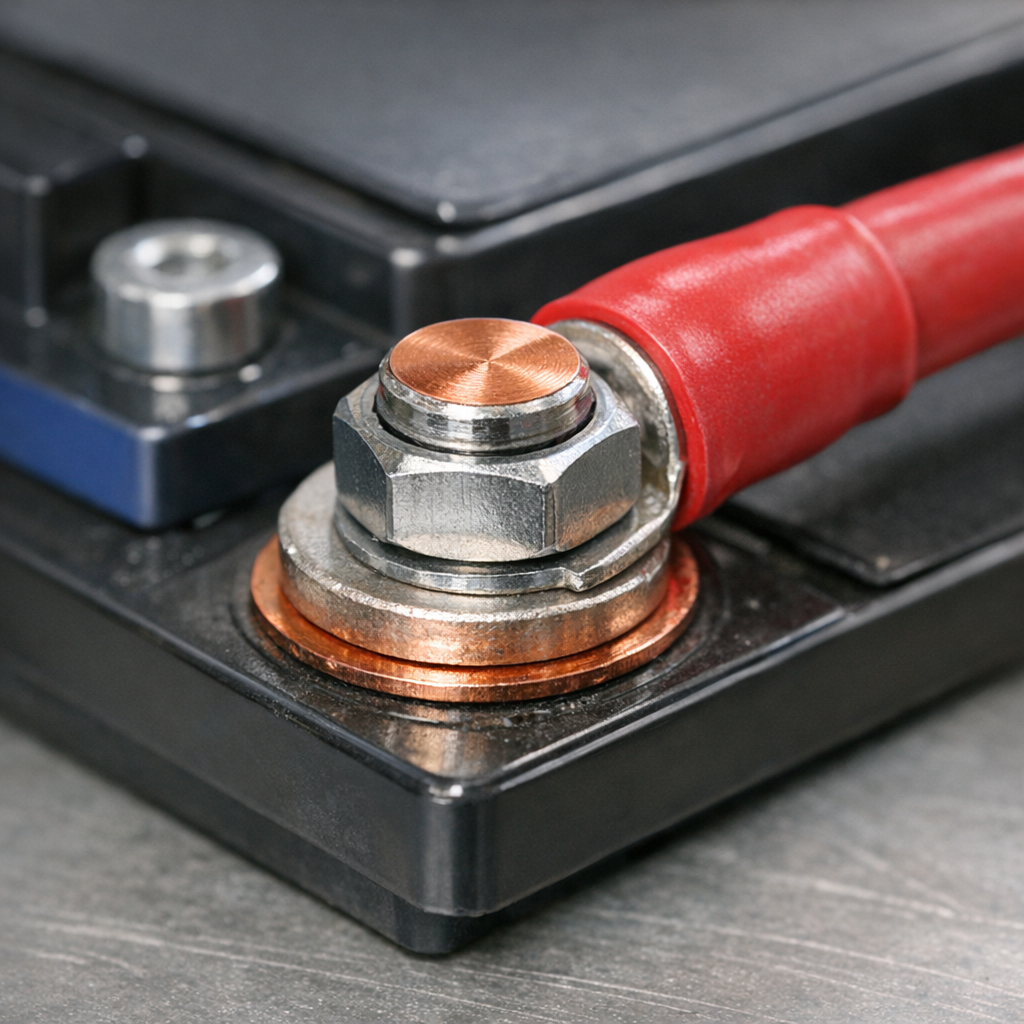
- Torque all connections to specification. Loose battery terminal connections are a leading cause of RV electrical fires. Use a torque wrench on all terminal bolts and bus bar connections. Check torque values every six months, as vibration from road travel loosens connections over time. Apply a thin coat of dielectric grease or anti-corrosion spray to terminals after torquing.
FAQs
- How many amp-hours do I need for boondocking? Most moderate-use RV boondockers consume 75–150 Ah per day at 12V. A couple running a 12V fridge, LED lights, vent fans, and device charging typically lands around 80–120 Ah of actual daily draw. Apply the sizing formula — dividing by your chemistry’s DoD and multiplying by desired autonomy days — to determine the nameplate bank size. A common starting point for weekend boondocking with AGM is 200–300 Ah; for full-timing with LiFePO4, 400–600 Ah covers most needs.
- Can I mix lead-acid and lithium batteries in the same bank? No. Lead-acid and LiFePO4 have fundamentally different charge voltage profiles, internal resistances, and discharge curves. Connecting them in parallel causes the lithium battery to absorb a disproportionate share of charge current and deliver a disproportionate share of discharge current, stressing both chemistries and creating a genuine safety hazard. The BMS on the lithium battery may disconnect unpredictably, dumping the full load onto the lead-acid battery. Always use a single chemistry per bank.
- Do I need a battery monitor, or can I rely on voltage readings? A coulomb-counting battery monitor (such as a Victron BMV or Renogy shunt monitor) is far more accurate than voltage alone. Resting voltage can indicate approximate state of charge for lead-acid batteries, but only after the battery has rested for several hours with no load or charge current — impractical during active use. LiFePO4 voltage is nearly flat between 20 and 80 percent state of charge, making voltage readings almost useless for gauging remaining capacity. A shunt-based monitor tracks every amp in and out and gives you a reliable percentage readout in real time.
- How does temperature affect battery capacity? Cold temperatures reduce available capacity for all chemistries. Lead-acid batteries lose roughly 10–15 percent of their capacity at 32°F (0°C) and up to 40 percent at 0°F (−18°C). LiFePO4 batteries should not be charged below 32°F without a built-in heating system, as lithium plating can occur on the anode and permanently damage cells. Many quality LiFePO4 batteries now include internal heaters that activate automatically, but this heating draws additional energy from the bank. If you camp in cold climates, add a 10–20 percent capacity buffer to your sizing calculation.
- Is it better to add more batteries or reduce my loads? Reducing loads is almost always more cost-effective than adding battery capacity. Replacing a residential fridge with an efficient 12V compressor fridge can save 500–1,000 Wh per day — the equivalent of adding 80–170 Ah of usable LiFePO4 capacity. Switching from incandescent to LED lighting, using a DC-native CPAP machine instead of an AC model through an inverter, and running a 12V kettle instead of an inverter-fed electric kettle all reduce your daily draw and let a smaller, lighter, cheaper bank do the job.
Conclusion
Sizing an RV battery bank is a four-step process grounded in measured data. First, conduct a thorough daily energy audit — list every load, account for inverter losses at 85–92 percent efficiency, and arrive at an honest daily watt-hour total. Second, convert that total to amp-hours at your system voltage (typically 12V) and divide by the appropriate DoD fraction: 0.50 for lead-acid or 0.80 for LiFePO4. Third, multiply by your desired days of autonomy — one to two days for solar-equipped weekend campers, two to three days for full-timers with generator backup. Fourth, validate that your charging infrastructure (solar, DC-DC charger, generator) can replenish the bank within a reasonable window.
For the moderate-use example (1,460 Wh/day adjusted), a 12V LiFePO4 bank of 300–400 Ah covers two days of autonomy with margin. The same scenario with AGM demands 480–600 Ah of nameplate capacity at nearly triple the weight. Choose the chemistry that fits your budget, weight limits, and camping frequency — then let the formula, not a forum post, determine the number on the battery label.
Spot an error or an outdated detail in this guide?
Report it