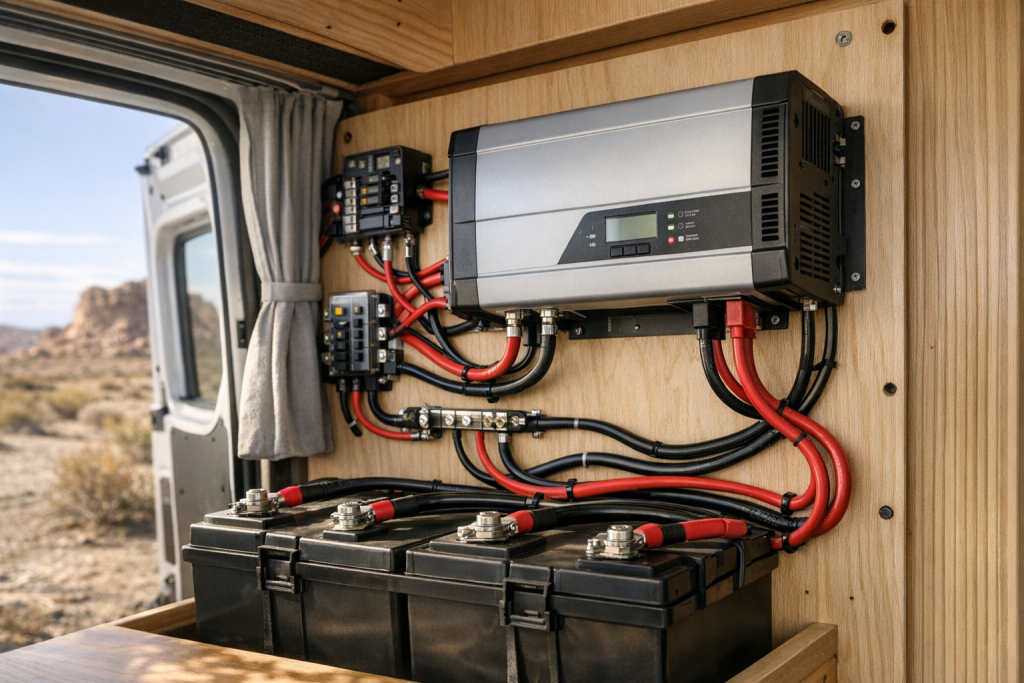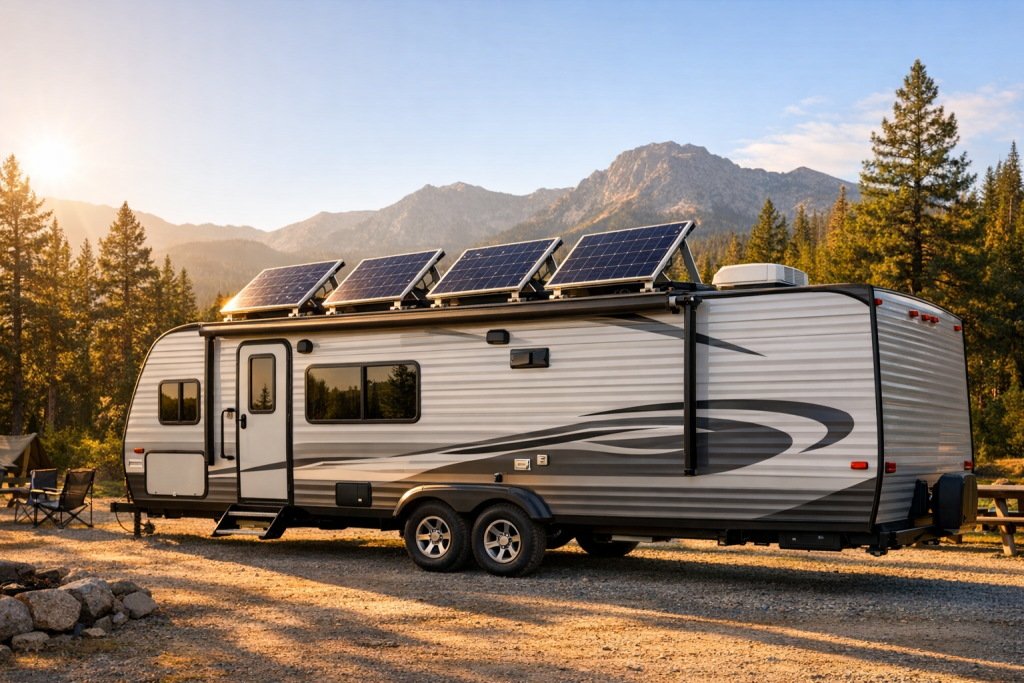
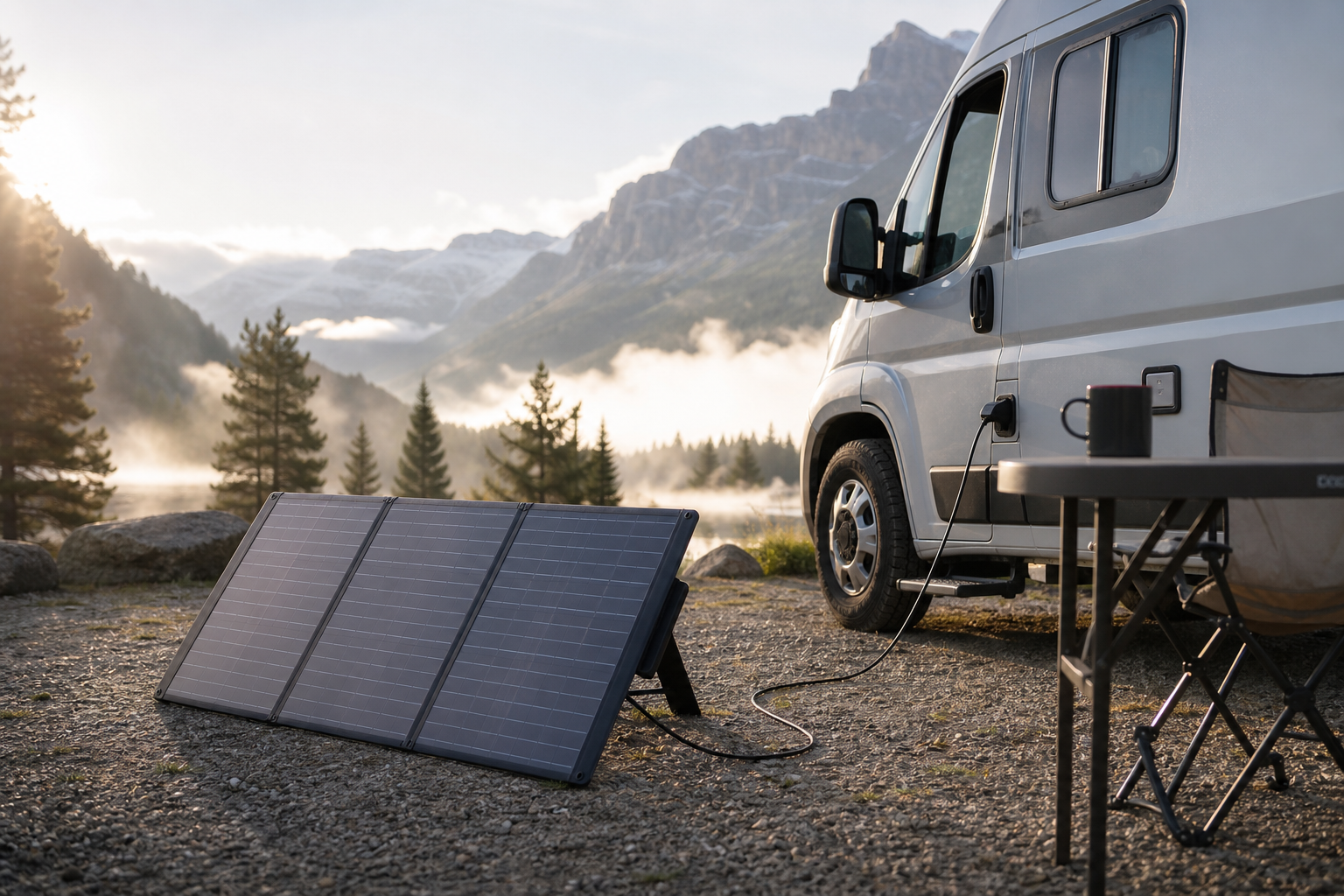
Picture this: you’ve parked your rig in a shaded canyon campsite with no hookups for the next five days, and the roof of your RV is sitting under a juniper tree. This is exactly where portable solar panels earn their keep — you can drag them out into a sunny patch while your rig stays cool in the shade. Unlike fixed rooftop arrays, portable panels give you control over angle, position, and timing, which means you can squeeze more usable energy out of a campsite that would otherwise leave you running the generator. They also serve as a supplement to a rooftop system, which is why many experienced boondockers eventually own both.
The portable solar market has matured considerably. What used to be a niche dominated by rigid framed panels and DIY wiring has become a polished consumer segment, with foldable suitcase designs, integrated charge controllers, weatherproof connectors, and ecosystem-matched power stations. That maturity means fewer compatibility headaches — but also more options to wade through. The goal here is to anchor each recommendation to a specific camping pattern rather than abstract spec-sheet comparisons.
TL;DR
- Best Overall: Renogy 200W Foldable Suitcase — versatile wattage with a built-in controller for weekend and extended boondockers.
- Best Budget: Rockpals 100W Foldable Panel — light, simple, and enough to top off a small battery bank on weekend trips.
- Best for Full-Timers: Jackery SolarSaga 200W Foldable — durable build and broad ecosystem compatibility for daily off-grid use.
- Best High-Wattage: BLUETTI PV350 Foldable Panel — high output for big battery banks and shorter charge windows.
- Best for Vans/Small RVs: Goal Zero Boulder 100 Briefcase — compact suitcase format that stores easily in tight gear bays.
Best Portable RV Solar Panels — Picks
Each panel below targets a specific scenario: weekend boondocking, full-time off-grid living, fast top-ups, or van-life storage constraints. None require permanent roof modifications, and all can be repositioned to chase the sun. The picks are limited to designs with a track record in RV forums and owner reviews, which matters more than headline wattage when you’re relying on a panel as your primary energy source for days at a time.
A quick note on terminology: “suitcase” panels are typically two rigid framed panels hinged together with kickstands and a handle, while “foldable” panels are usually fabric-backed tri-fold or quad-fold designs that are lighter but less rigid. Suitcase designs tend to be more durable over years of repeated deployment; tri-fold fabric panels pack flatter and weigh less.
Renogy 200W Foldable Suitcase — Best Overall for Weekend Boondockers
If you camp off-grid four to ten days at a stretch and run a typical 100Ah lead-acid or LiFePO4 battery bank, a 200W-class suitcase hits a useful sweet spot. RVers commonly recommend the 200W class because it can realistically offset daily draw from lights, a vent fan, a water pump, and modest electronics during long summer days. The suitcase form factor means you unfold it, prop it on its kickstands, clip it to the battery, and walk away — no permanent wiring, no roof penetration.
The integrated charge controller is the reason this kind of suitcase is so beginner-friendly. Monocrystalline cells generally outperform older polycrystalline designs in low light, which matters when the sun gets low or clouds drift in. The trade-off is weight: a 200W folding panel is not something you’ll want to carry 200 ft from the rig, so plan a setup spot within an extension cable’s reach. Most owners report that the included alligator clips work well for direct battery connection, though if you want to plug into a solar-ready port on the side of your RV you may need an adapter cable with the appropriate SAE or Anderson connector.
One practical advantage: because the controller sits on the panel side rather than inside the RV, you can see at a glance whether the panel is producing power. The downside of that same design is that the controller sits outside in the weather, so look for adequate IP-rated weatherproofing if you camp where afternoon storms are common.
Jackery SolarSaga 200W Foldable — Best for Full-Timers and Power Station Owners
Full-timers tend to live within an ecosystem — a portable power station plus the panels that plug into it — and Jackery’s SolarSaga line is built around that workflow. If you already own a Jackery Explorer power station, the SolarSaga plugs in directly with no separate charge controller setup. For full-timers running laptops, CPAP machines, and small fridges, matched components reduce troubleshooting time. When a charge issue arises, you have one manufacturer to contact rather than three different vendors pointing fingers.
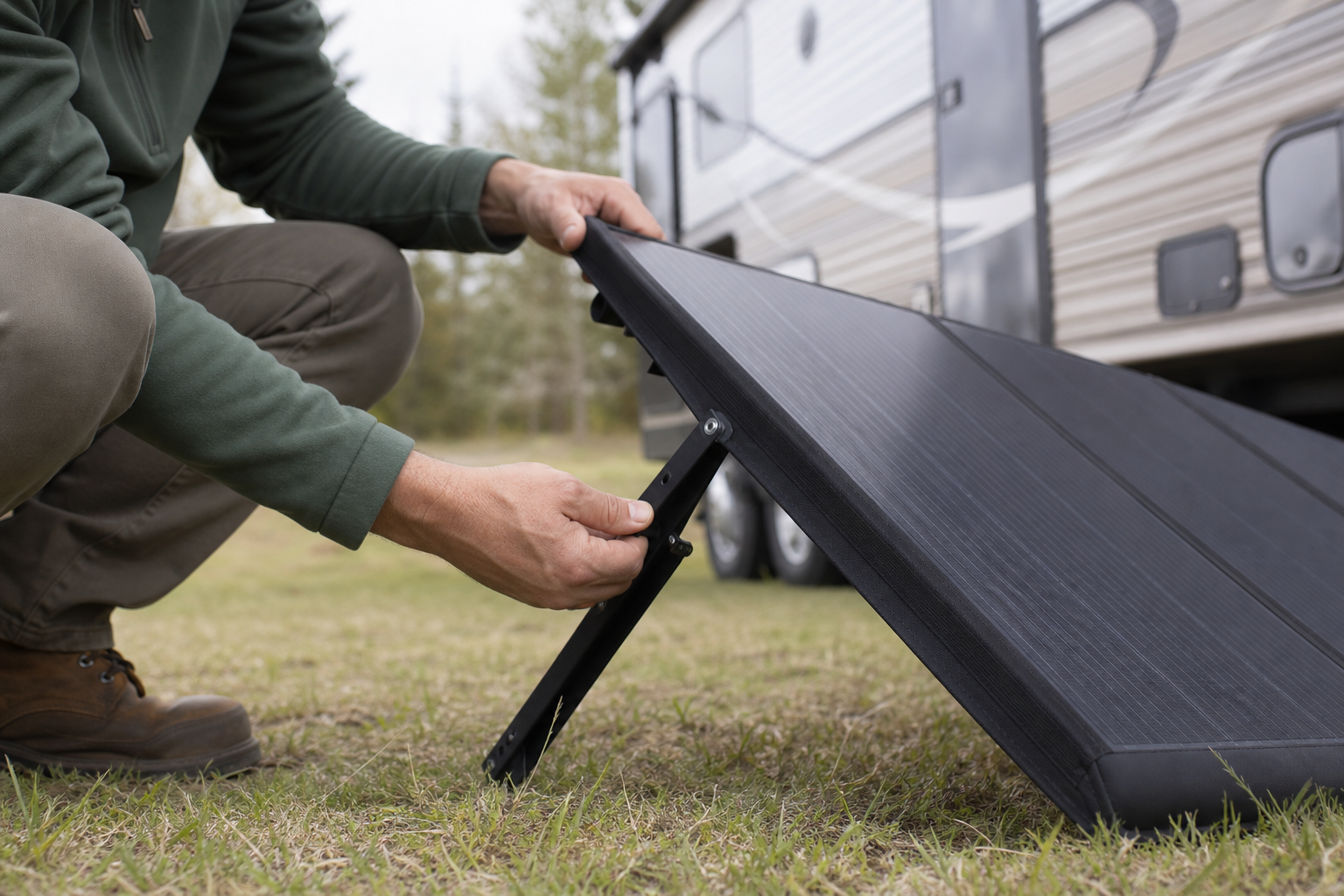
Build quality on Jackery’s larger panels is generally more weather-resistant than entry-level options, which matters when a panel sits in the same campsite for a week and a thunderstorm rolls through. The downside: this design is most useful if you’ve bought into the Jackery ecosystem. Adapter cables exist that let you bridge between proprietary connectors and standard MC4 or alligator clips, but every adapter is one more potential failure point and a small efficiency loss.
For full-timers, the bigger question is whether to rely on a power station at all or wire panels into a traditional house battery bank. Power stations win on convenience and portability. House banks win on capacity per dollar and integration with the rest of the 12V system. Many full-timers run both — the house bank for chassis loads, the power station for laptops and other sensitive electronics.
BLUETTI PV350 Foldable Panel — Best High-Wattage for Big Battery Banks
For RVers with 200Ah+ lithium banks, big inverters, or anyone trying to recharge a large power station in a single day, a single 100W or 200W panel won’t cut it. A high-wattage foldable in the 300W-plus class shortens charge windows considerably. Actual recharge time depends on sun angle, temperature, controller efficiency, and battery chemistry — check manufacturer guidance for your specific battery before relying on a single-day estimate. In the desert Southwest in summer, a 350W panel aimed properly can produce close to its rated output for several hours a day; in the Pacific Northwest in October, the same panel may produce less than half that.
The trade-off with high-wattage foldables is size: when deployed, they’re long. You need a campsite with a clear sunny stretch where they won’t get stepped on. Storage inside the RV also takes more thought. Cargo trailers and fifth wheels usually have the room; Class B van owners may not. Measure folded dimensions against your storage bay before ordering — it’s a common return reason among van-lifers who assumed a 350W panel would fit where a 200W did.
High-wattage panels also bring higher open-circuit voltages, which means your charge controller needs to handle the input. Most modern MPPT controllers can, but cheap PWM units may not. If you’re pairing a 350W panel with a power station, the input is already matched. If you’re wiring into a house bank, double-check the controller’s maximum input voltage and current ratings against the panel’s specs before connecting.
Rockpals 100W Foldable Panel — Best Budget Pick for Weekend Trips
If you only boondock occasionally — two or three weekends a month in warmer months — you don’t need 300W of solar. A 100W foldable is enough to keep a single 100Ah battery topped off when loads are modest: LED lights, phone charging, a vent fan, maybe a small inverter for a laptop charger. Rockpals has been a long-time budget favorite in RV forums for keeping costs reasonable without dipping into junk territory. The build is plainer than premium brands, but the cells perform adequately for the wattage.
At this tier, you’ll typically supply your own charge controller (or use one built into your power station). Output in cloudy weather drops significantly — plan on a fraction of the rated wattage on overcast days. The math is simple: a 100Ah battery at 12V holds roughly 1200 watt-hours, and modest daily use might draw 300–500 watt-hours, so even partial sun on a 100W panel can meaningfully offset that draw — though actual usable capacity depends on your battery chemistry and the manufacturer’s recommended depth of discharge.
One caveat: at the budget tier, expect modest construction in the connectors, hinges, and carrying case. Treat the panel gently, store it dry, and don’t pile heavy gear on top of it in transit. If solar is a critical part of your power plan rather than a nice-to-have, consider stepping up to a mid-tier brand for better long-term durability.
Goal Zero Boulder 100 Briefcase — Best for Vans and Small RVs
Storage space is the binding constraint in a Class B van or teardrop trailer. The Boulder 100 Briefcase folds in half with a built-in handle and kickstand, slipping into the same gear bay where you’d store a folding chair. For van-lifers running a modest 12V system or a Goal Zero Yeti power station, the matched ecosystem is convenient. Setup takes under a minute: unfold, position, plug in.
This isn’t the panel for someone trying to power a residential fridge and a rooftop AC — it’s a panel for keeping the lights on, the fans running, and the phones charged in a minimalist setup. The tempered-glass build is more durable than thin-film foldables but also heavier, so factor that into your storage plan. Compared to a fabric tri-fold of the same wattage, the Boulder is what you’d choose if you expect rougher handling.
Van-lifers often pair a panel like this with a smaller power station (in the 500–1000 Wh range) and use it as a flexible charging source they can take outside the van — to a hammock setup, a beach chair, or a friend’s campsite.
EcoFlow 220W Bifacial Portable Panel — Best for Variable Sun Conditions
Bifacial panels capture light on both sides — the back face picks up reflected light from light-colored ground, snow, or a white RV wall. For shoulder-season campers in the desert Southwest in spring, or anyone parked next to reflective surfaces, this can squeeze more daily watt-hours from the same footprint. EcoFlow’s bifacial design pairs naturally with its Delta and River power stations. The connector is keyed for the EcoFlow ecosystem, though adapters allow use with other systems.
The catch: bifacial gains are real but typically modest in campsites with dirt or grass underneath. If you camp mostly on dark forest floors, you won’t see much benefit from the rear face. Bifacial panels also tend to cost more per rated watt than equivalent single-sided designs, so value depends on how often you camp in environments where the rear face actually contributes.
Bifacial designs work best when angled rather than laid flat, because tilting raises the panel above the ground and lets light reflect onto the back side. Most bifacial portable panels include kickstands that account for this. A bifacial panel lying flat on the dirt is essentially performing as a single-sided panel.
Comparison Table
| Model | Type | Key Specs | Best for | Pros | Cons |
|---|---|---|---|---|---|
| Renogy 200W Foldable Suitcase | Suitcase, monocrystalline | 200W class; built-in controller | Weekend boondockers | Plug-and-play; broad battery compatibility | Heavier than tri-fold designs |
| Jackery SolarSaga 200W | Foldable, monocrystalline | 200W class; ecosystem connector | Full-timers with power stations | Durable build; easy pairing | Best within Jackery ecosystem |
| BLUETTI PV350 | Foldable, monocrystalline | High-wattage class | Big battery banks; fast charging | Short recharge windows; high output | Large deployed footprint |
| Rockpals 100W Foldable | Foldable, monocrystalline | 100W class | Occasional weekend campers | Affordable; light; compact | Lower output; controller often separate |
| Goal Zero Boulder 100 Briefcase | Briefcase, rigid glass | 100W class | Vans and small RVs | Compact storage; rugged frame | Heavy for its wattage |
| EcoFlow 220W Bifacial | Foldable bifacial, monocrystalline | 220W class; dual-sided cells | Reflective environments | Extra rear-face yield; ecosystem fit | Bifacial gains depend on ground |
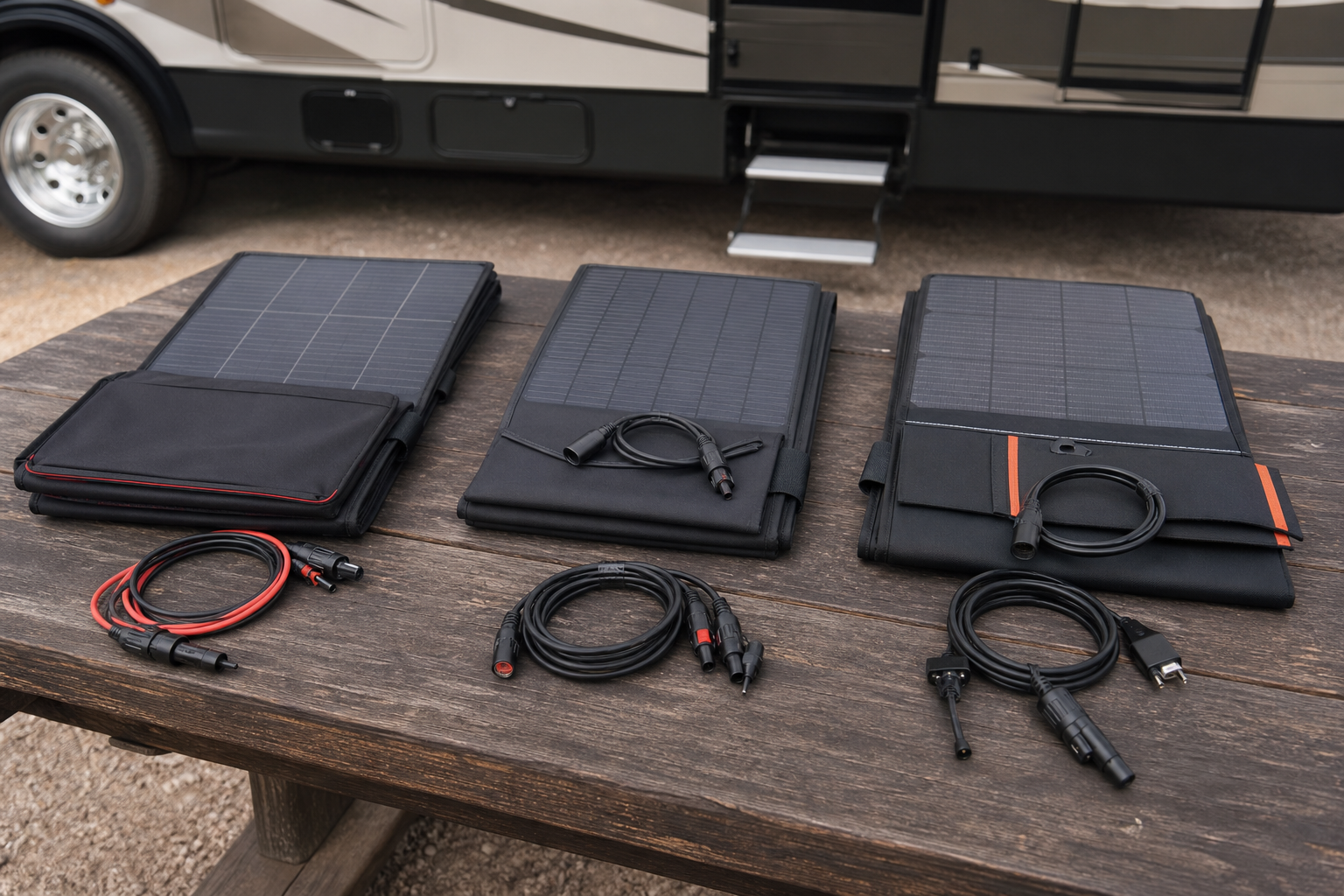
Which One Should You Buy?
Weekend Trips → If you boondock two or three weekends a month with a single 100Ah battery and modest loads (lights, fans, phones, no inverter-heavy appliances), the Rockpals 100W is enough panel to extend battery life without spending big. Pair it with a basic PWM or MPPT charge controller if your setup doesn’t already include one. For a typical Friday-evening-to-Sunday-afternoon trip, a 100W panel deployed in good sun on Saturday can replace most of the energy used overnight Friday.
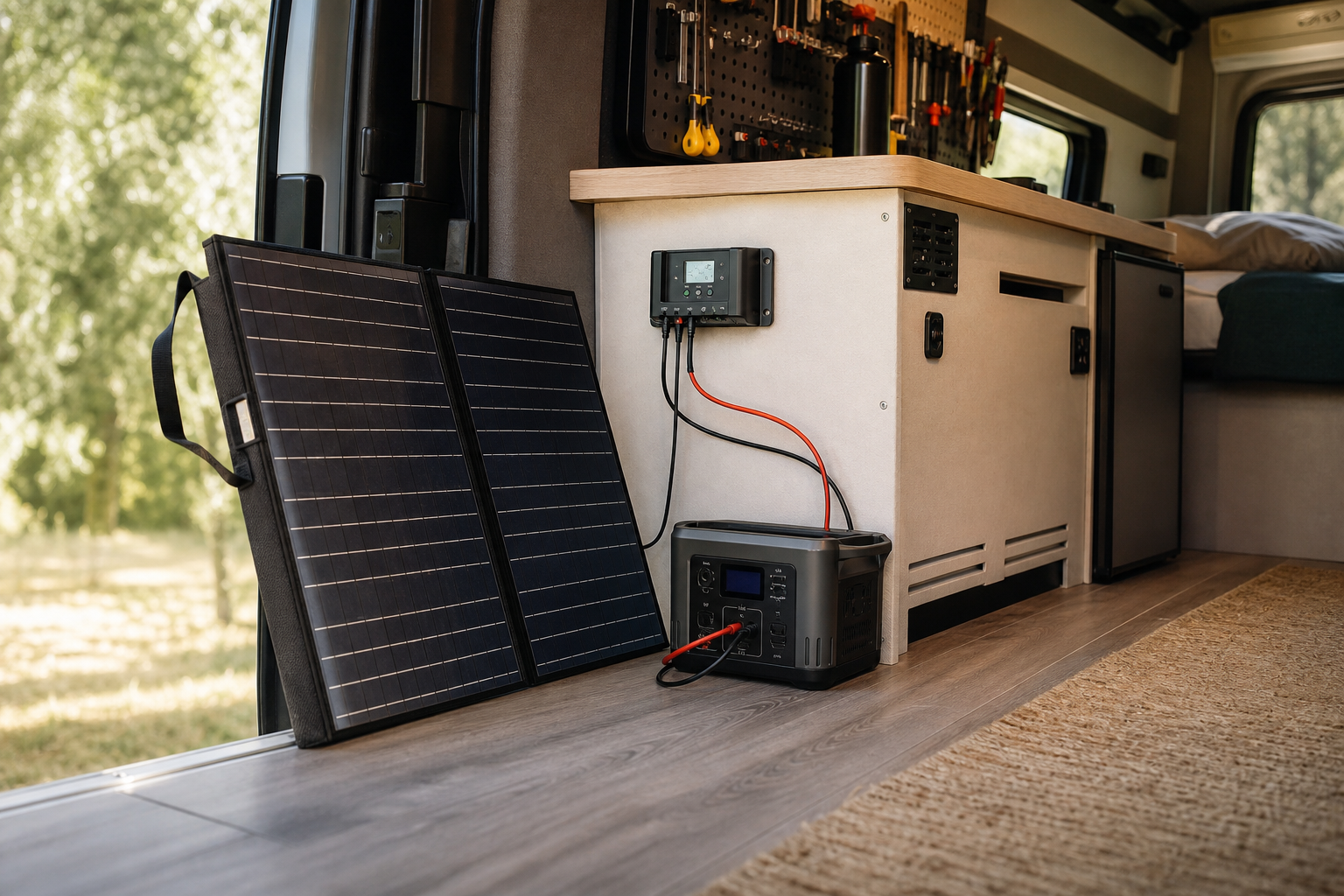
Extended Boondocking (1–2 weeks) → Step up to the Renogy 200W suitcase. The 200W class is the most commonly recommended size for typical RVers because it can cover daily consumption from a 100Ah bank in most summer conditions, and the integrated controller eliminates a wiring project. It also scales reasonably: if you later decide you need more, you can buy a second 200W suitcase and run them in parallel rather than replacing the first.
Full-Time Off-Grid Living → Match your panel to your power-station ecosystem. If you’ve already invested in a Jackery, Bluetti, EcoFlow, or Goal Zero power station, buy a matched panel from the same brand. Connectors line up, charge profiles are tuned, and you avoid adapter cables that can drop efficiency. Full-timers also benefit from redundancy: two medium panels mean a single failure or shade event doesn’t cripple your charging capacity for the day.
Big Battery Banks → If you run a 200Ah+ lithium bank with an inverter for a residential fridge or coffee maker, a single 100W or 200W panel won’t keep up. Go with a high-wattage foldable like the BLUETTI PV350, or run two suitcase panels in parallel. Verify your charge controller can handle the combined current before wiring.
Vans and Tight Storage → The Goal Zero Boulder 100 Briefcase wins on storage footprint. A van or teardrop trailer usually doesn’t have a basement bay big enough for a sprawling tri-fold panel, and a briefcase design slips into the same nooks where folding chairs live.
Key considerations across all picks: Monocrystalline is now the default for quality portable panels. A built-in charge controller saves a setup step but limits flexibility if you upgrade batteries later. Weight matters more than you’d think — you’ll be moving these panels around to chase the sun. Cable length also matters: most panels come with cables in the 8–12 ft range, which is rarely enough to reach a shaded rig from a sunny spot, so plan to buy an appropriate-gauge extension.
Safety & Common Mistakes
- Skipping the charge controller: Connecting a solar panel directly to a battery without a controller can overcharge and damage it. Suitcase panels usually include one; bare foldables often do not.
- Mismatched battery chemistry settings: A controller set to “lead-acid” charging a LiFePO4 battery (or vice versa) will undercharge or overcharge. Set the controller’s battery profile to match your battery’s chemistry and follow the manufacturer’s recommended voltages.
- Leaving panels flat: A panel lying flat on the ground produces far less than one tilted toward the sun. Use the kickstands and reposition two or three times a day.
- Ignoring shade on a single cell: A leaf or shadow across one cell can dramatically reduce output from the whole panel. Keep the surface clear.
- Overheating the controller: Charge controllers throttle output when they get hot. Don’t bury the controller under a blanket or set it on hot asphalt — keep it shaded and ventilated.
- Underestimating cable loss: Long extension cables between panel and battery drop voltage, especially on 12V systems. Keep runs short and use appropriate wire gauge (AWG) for the current.
- Leaving panels unsecured in wind: A folded suitcase panel propped on kickstands can catch a gust and tip over. Stake it down or weight the base in exposed campsites.
- Reverse polarity at the battery clips: Connecting alligator clips backward can blow a fuse in the controller or damage internal components. Confirm red-to-positive, black-to-negative every time.
This is general guidance. Always follow the manufacturer’s instructions for your specific panel, controller, and battery.
FAQs
- What are the best portable solar panels for RV use? The check the manufacturer datasheet for the current spec suitcase class — like the Renogy check the manufacturer datasheet for the current spec — is the most commonly recommended starting point because it balances output, portability, and a built-in charge controller. Full-timers with power stations should match their panel to the same brand.
- How long will it take a 400W solar array to charge a 100Ah battery? Under strong direct sun, a 400W array can typically recharge a 100Ah battery from a moderate state of discharge in several hours, but real-world time varies significantly with sun angle, temperature, controller efficiency, and battery chemistry. Follow your battery manufacturer’s recommended charge profile rather than a fixed time estimate.
- Are portable solar panels better than rooftop panels for RVs? They’re better in two scenarios: when you park in the shade to keep the rig cool, and when you want to aim the panel directly at the sun for maximum output. Rooftop panels are better for set-and-forget convenience. Many RVers eventually run both.
- Do portable solar panels work on cloudy days? Yes, but output drops significantly — typically to a fraction of rated wattage on heavily overcast days. Monocrystalline panels generally handle low light better than older polycrystalline designs.
- Can I connect multiple portable panels together? Yes — most panels support series or parallel wiring to increase voltage or current respectively. Verify your charge controller can handle the combined input before connecting, and use matched panels for best results.
Conclusion
Portable RV solar panels solve a problem rooftop systems can’t: you can park your rig in the shade while your panels sit in the sun. The right pick depends on how you actually camp. Weekend campers with modest loads do fine with a 100W foldable; extended boondockers should plan around the 200W suitcase class; full-timers running power stations should buy within their ecosystem; and anyone with a big lithium bank should look at high-wattage foldables or run multiple panels in parallel. Match the panel to your real-world load and storage constraints first, and the rest of the spec sheet becomes much easier to read.