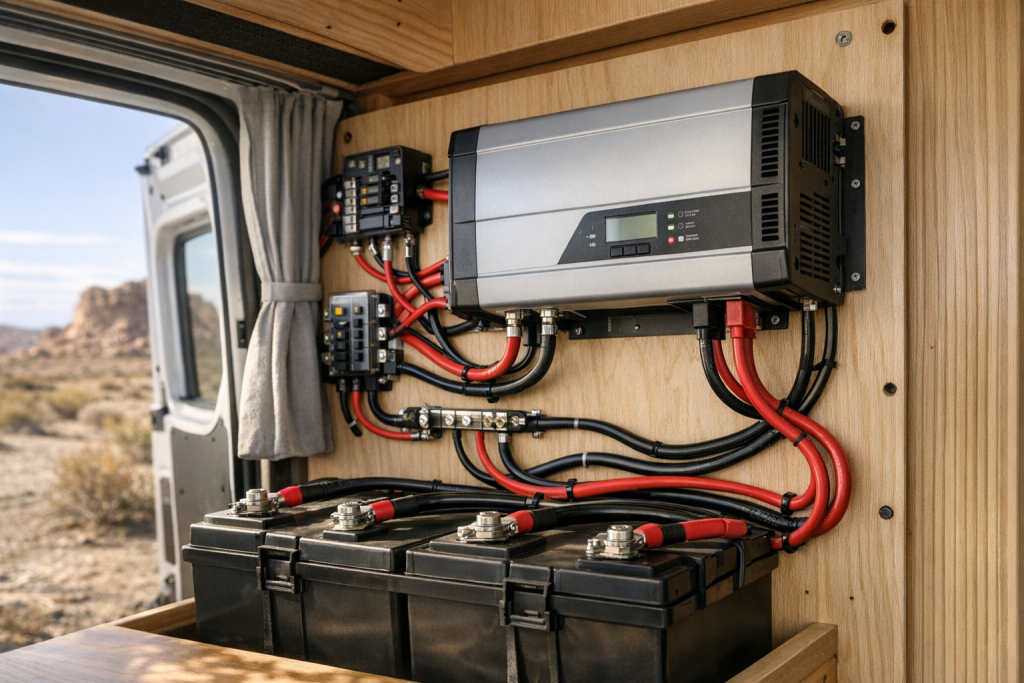
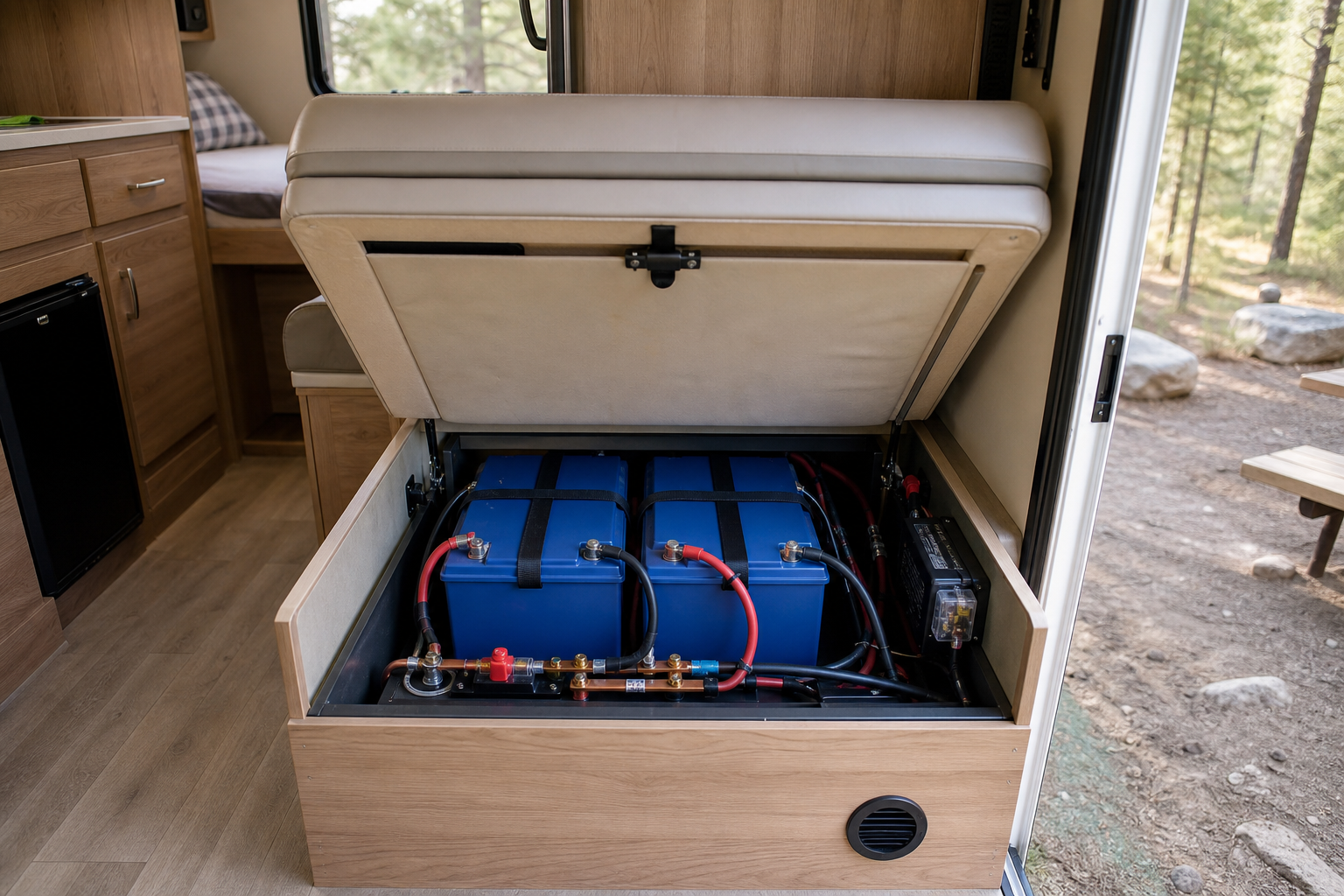
Powering a modern RV solar setup means matching battery chemistry to a charge profile that lead-acid can’t keep up with: high charge acceptance, deep cyclic discharge, and minimal voltage sag under inverter load. For most RV solar builds, that comes down to selecting the right 12V (or 24V/48V) LiFePO4 bank sized to daily watt-hour demand and matched to a lithium-aware solar charge controller. The shift from lead-acid to lithium iron phosphate has reshaped how RV electrical systems are designed: panels can be smaller for the same usable energy, inverters can be larger without overwhelming the bank, and the battery compartment no longer has to be the heaviest object in the rig.
TL;DR
- Best Overall: Battle Born 100Ah LiFePO4 — long support history and a proven track record in full-time RV solar use.
- Best Budget: LiTime 100Ah 12V LiFePO4 — strong cost-per-Ah for weekend and seasonal RVers.
- Best for Large Banks: SOK 206Ah 12V LiFePO4 — higher per-unit capacity reduces parallel connections in big solar banks.
- Best for Cold Weather: RELiON RB100-HP — built for harsher operating conditions; verify low-temp specs on the current listing.
- Best Drop-In Replacement: Renogy 12V Smart LiFePO4 — straightforward swap-in for existing 12V lead-acid wiring.
Why Lithium Is the Best Battery for RV Solar
RV solar systems are defined by two constraints: limited roof area for panels, and limited bay space for batteries. Lithium iron phosphate (LiFePO4) addresses both by storing substantially more usable energy per pound than AGM, while accepting a higher charge current from MPPT controllers. More of the solar harvest actually lands in the battery instead of being wasted as absorption-stage taper.
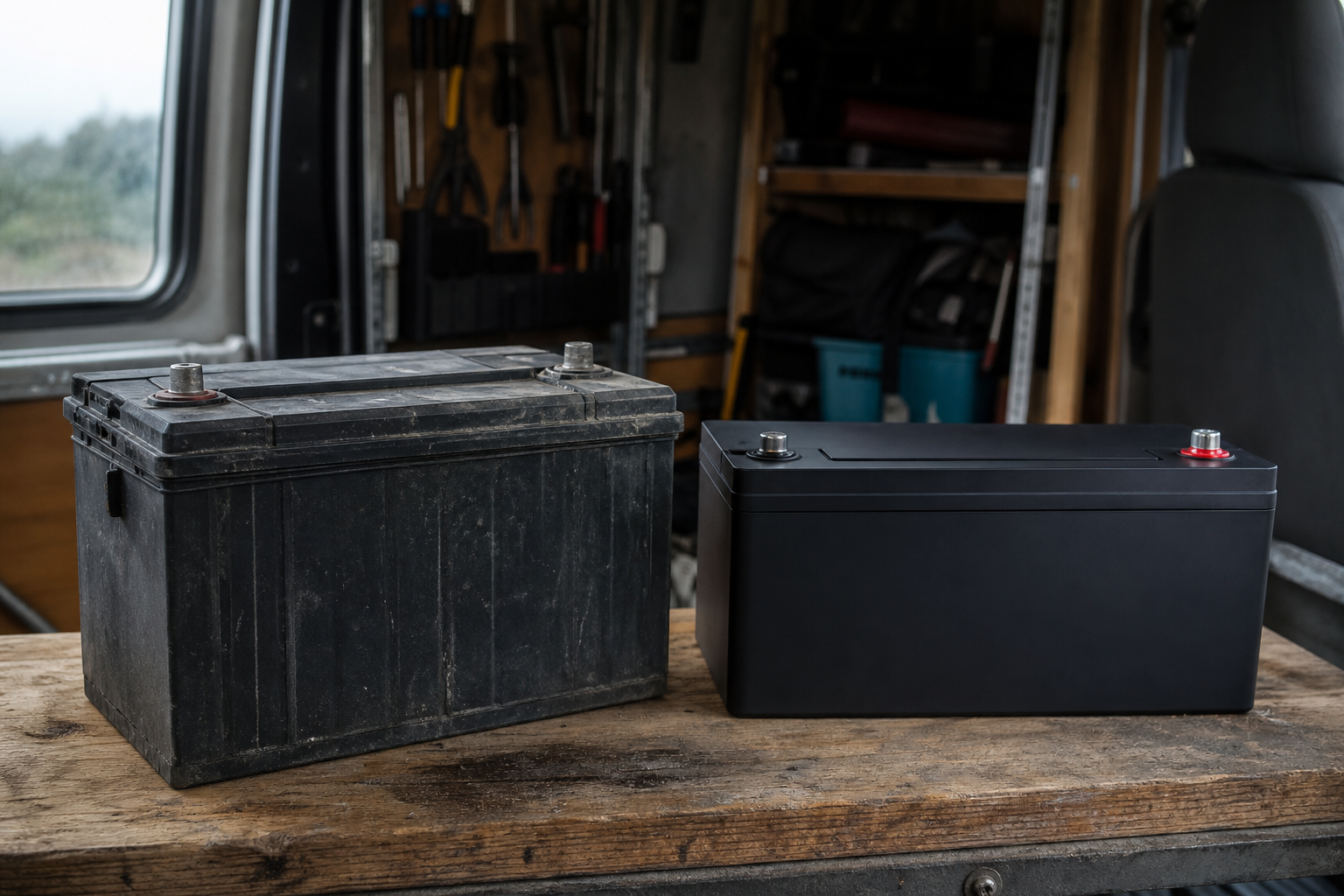
With a lead-acid bank, the absorption phase can stretch for hours as the battery’s internal resistance climbs and accepts only a trickle near full charge — meanwhile, the sun is moving and panel output is falling. LiFePO4 cells accept near-full rated current up to roughly 90% state of charge, which compresses the recharge window and lets a modestly sized array do the work that previously required oversizing.
There is also a behavioral benefit. RVers using a threshold that varies by manufacturer and model (check the datasheet) state of charge shortens battery life noticeably. Lithium lets users stop calculating and simply use the system, because the usable window is wider and occasional deep discharge is acceptable within the manufacturer’s published cycle envelope.
Our Top Picks
LiFePO4 vs Lithium-Ion vs AGM
“Lithium-ion” is a broad family that includes NMC, LCO, and LiFePO4 chemistries. For RV solar, LiFePO4 is the dominant choice because of its thermal stability, flatter discharge curve, and long cycle life. NMC cells (common in EVs and power tools) have higher energy density but trade off thermal safety and longevity — not an attractive tradeoff in a sealed RV battery bay.
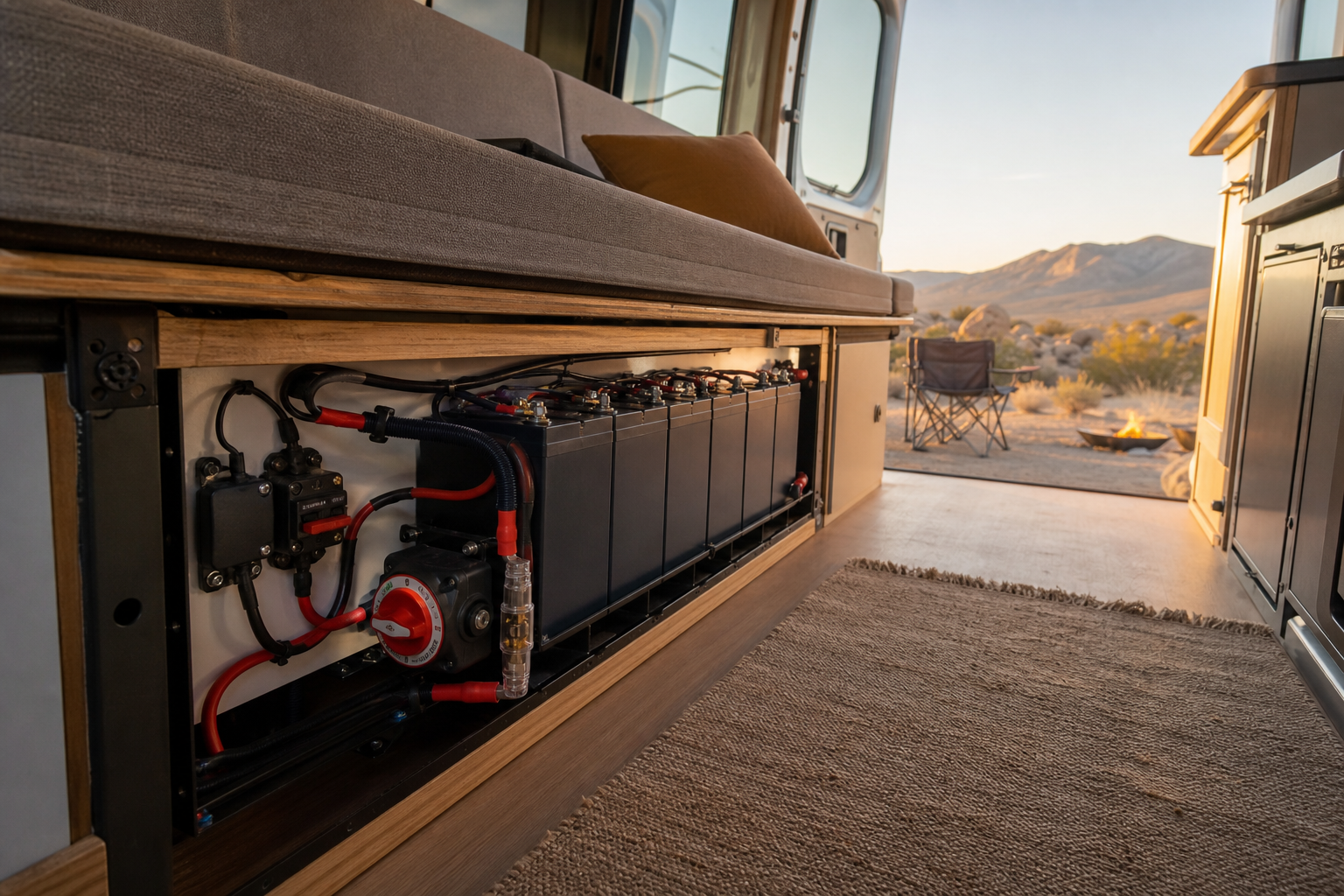
- Greater usable depth-of-discharge per cycle, subject to the manufacturer’s published cycle-life curves.
- Cycle life in the thousands rather than hundreds.
- Higher charge acceptance, which matters when solar input is variable.
- A flatter voltage curve, so inverters see a more stable bus voltage well into the discharge before low-voltage cutoff.
The flat discharge curve deserves emphasis. An AGM bank’s voltage drops steadily as it discharges, meaning inverter efficiency falls and DC loads see progressively lower voltage. A LiFePO4 bank holds in the 13.0–13.3V range for most of its discharge cycle, then drops sharply near empty. Inverters, LED lighting, and 12V appliances perform more consistently across the cycle, and inverter low-voltage shutdown becomes a near-binary event at the end rather than a slow brownout.
Key Benefits: Weight, Lifespan, Depth of Discharge
A 100Ah LiFePO4 battery generally weighs a fraction of an equivalent flooded lead-acid bank — a meaningful gain on tongue weight and cargo capacity. Lifespan claims from reputable manufacturers commonly fall in the 3,000–5,000+ cycle range at moderate depth of discharge per the manufacturer’s spec sheet. For a part-time RVer cycling once per weekend, that’s a decade-plus of service if cells are kept within operating temperature limits.
The weight savings matter beyond pure payload. Travel trailers and fifth wheels with marginal tongue weight ratings benefit from reducing battery mass over the axles; truck campers gain rear-suspension headroom; Controller and component choices vary by kit and model; check the current manufacturer specification or product listing before purchase.
How to Choose a Lithium Battery for RV Solar
Capacity (Ah) and Voltage (12V vs 24V vs 48V)
Capacity is straightforward: total amp-hours × nominal voltage = watt-hours. The voltage decision is more nuanced. A 12V bank is the default for legacy RV wiring, fuse panels, and 12V appliances. 24V and 48V banks become attractive once total stored energy grows large, because higher bus voltage reduces conductor size, fuse cost, and I²R losses on long inverter runs.
Check the manufacturer datasheet for the current electrical rating before using this product in an RV solar system. Below that, a 12V system is wire-able with reasonable copper sizes and standard Class T fuses; above it, the current draw at full inverter load pushes past 300A on the DC side, where cables, lugs, and fuses become bulky and expensive. Stepping up to 24V halves the current for the same power; 48V quarters it. The tradeoff is that 24V and 48V appliances and converters are less common in the RV aftermarket, so most builders accept a DC-DC converter to feed the existing 12V house loads while running the inverter at higher voltage.
BMS,, and
Every LiFePO4 RV battery worth installing has an integrated battery management system (BMS) handling cell balancing, over/under-voltage cutoff, over-current, and temperature protection. Specific BMS amperage, balancing strategy, and low-temperature cutoff thresholds vary by product — check the current manufacturer specification for the model you’re considering. Bluetooth monitoring and integrated low-temperature charging cutoffs are common premium features; treat each as a model-specific claim to verify on the listing.
BMS continuous current rating is the spec most often overlooked. Check the manufacturer datasheet for the current electrical rating before using this product in an RV solar system. Check the manufacturer datasheet for the current electrical rating before using this product in an RV solar system. Paralleling two batteries effectively doubles the available BMS current, which is one reason multi-battery banks are common even when watt-hour requirements could be met by a single larger unit.
Solar Charge Controller Compatibility
Lithium needs a charge controller (MPPT preferred for RV solar) with a lithium or LiFePO4 charge profile — typically a bulk/absorption stage in the manufacturer-specified range for a 12V bank, with minimal or zero float. PWM controllers will technically work but waste a meaningful fraction of panel output. Confirm that your converter/charger on the shore-power side also has a lithium profile, otherwise you’ll undercharge the bank on hookups.
Required accessories vary by panel and battery; check the manufacturer specification for the model you are considering. Each must be set to a lithium profile, and each must agree on absorption voltage and the absence of a long float stage. A common mistake is upgrading the batteries and the solar controller while leaving an old WFCO or Progressive Dynamics converter on its default lead-acid setting; the result is a bank that never reaches full charge on shore power, masking itself as a solar shortfall.
Product Details
Battle Born 100Ah 12V LiFePO4
Battle Born is one of the most widely deployed LiFePO4 brands in North American RV solar builds. The 100Ah 12V model is a known quantity in the community: documented integration with major inverter/charger brands, and a long support history. Exact BMS current limits, dimensions, and warranty terms should be confirmed on the current listing.
The brand’s reputation for North American support and consistent quality control is the main reason it earns the overall pick for full-time RV solar. For users who plan to keep an RV for many years and want a battery brand likely to still answer the phone in year eight, Battle Born is a defensible default.
LiTime 100Ah 12V LiFePO4
LiTime (formerly Ampere Time) targets the value end of the LiFePO4 RV market. The 100Ah 12V drop-in is one of the most common budget choices for first-time lithium upgrades and modest solar banks. Performance, BMS specs, and warranty are competitive for the price tier — verify current numbers on the listing before buying, since the brand iterates on hardware revisions.
The cost-per-amp-hour advantage is significant enough that some builders deliberately specify LiTime in parallel pairs to get more total capacity for less money than a single premium-brand unit, accepting that brand support and longevity warranties may be less generous.

SOK 206Ah 12V LiFePO4
For larger RV solar battery banks, SOK’s 206Ah class reduces the number of parallel connections needed to hit a target capacity — fewer batteries means fewer interconnects, fewer fuses, and simpler balancing across the bank. SOK is well-regarded among DIY off-grid and RV solar builders for serviceable construction. Check the manufacturer specification for current BMS rating, terminal layout, and case dimensions before designing a battery box around it.
Single-unit 206Ah batteries are heavy enough that installation logistics matter; plan a path that doesn’t require lifting the unit overhead, and verify the floor or platform can carry the concentrated weight.
RELiON RB100-HP
RELiON’s HP line targets higher-output and more demanding deployments than its baseline RB100. For cold-weather RV solar users, look closely at the current product page for low-temperature charging behavior and operating temperature range — these are model-specific and worth verifying rather than assuming. RELiON’s industrial roots show up in build quality and documentation, which can be a meaningful advantage for users who want detailed engineering data rather than consumer marketing copy.
Renogy 12V Smart LiFePO4
Renogy is a familiar name to RV solar buyers because they sell panels, controllers, and batteries as a system. The Smart LiFePO4 line is designed as a drop-in replacement for 12V lead-acid wiring, with monitoring features that vary by model — check the current listing for confirmation of what’s actually integrated on the SKU you’re buying. The ecosystem story is real: a Renogy battery, controller, and monitor combination shares a communication protocol that simplifies system-level visibility.
Dakota Lithium 100Ah Plus
Dakota Lithium emphasizes long warranty coverage and cold-tolerant operation in its marketing. For RV solar use, the 100Ah Plus is a solid mid-tier option between budget imports and top-shelf North American brands. Verify exact warranty length, BMS amperage, and temperature limits on the current product page. The brand has a strong following in marine and ice-fishing communities, which translates well to RV applications in cold climates where battery temperature management is a real operational concern.
Match Capacity to Daily Watt-Hour Load
If your measured load is under roughly 1,000 Wh/day (lights, water pump, vent fan, phone/laptop charging, occasional inverter use), a single 100Ah 12V LiFePO4 is generally sufficient — that’s about 1,280 Wh nominal, with usable capacity defined by the manufacturer’s depth-of-discharge guidance. The LiTime 100Ah is a defensible budget choice here; Battle Born is the upgrade for full-timers who want long-term support.
For loads between roughly 2,000–4,000 Wh/day (residential fridge, larger inverter loads, frequent boondocking), two 100Ah units in parallel — or one 206Ah unit like the SOK — makes more sense for fewer interconnects. Above 4,000 Wh/day, the system starts looking more like a small off-grid cabin than a traditional RV, and the conversation shifts toward 24V or 48V architecture and three or more battery units.
Voltage Architecture: 12V vs 24V/48V
If your inverter is around 2,000W or smaller and the existing RV wiring is 12V, stay on 12V. Check the manufacturer datasheet for the current electrical rating before using this product in an RV solar system.
Higher-voltage banks reduce copper cost and inverter current significantly, but they also limit you to inverter/chargers and accessories that match. Retrofitting a 24V or 48V bank into an existing 12V RV requires a DC-DC converter to feed the legacy 12V loads, which adds cost and one more component to maintain.
Climate and Use Case
If you camp in freezing temperatures, the low-temperature charging behavior of the specific battery you’re considering matters more than the brand. LiFePO4 cells should not be charged below 0°C (32°F) without an internal heater or external low-temp cutoff. Review the current product listing for whether that protection is built in; if it isn’t, the controller and converter should be configured to halt charging at low temperatures.
Hot climates introduce a different concern: sustained operation above roughly 45°C (113°F) accelerates calendar aging even when the BMS isn’t actively cutting off charge. Battery compartments in dark-colored RVs parked in summer sun routinely exceed those temperatures, so ventilation or relocation of the bank into a conditioned interior compartment can extend service life materially.
Comparison Table
| Model | Type | Key Specs | Best for | Pros | Cons | Where to buy |
|---|---|---|---|---|---|---|
| Battle Born 100Ah | Check the manufacturer specification. | Check manufacturer specification | Full-time RV solar | Strong support; proven integration | Premium price | Amazon ↗ |
| LiTime 100Ah | Check the manufacturer specification. | Check current listing | Budget builds | Strong cost-per-Ah | Newer brand; verify revision | Amazon ↗ |
| SOK 206Ah | Check the manufacturer specification. | Check manufacturer specification | Large banks | Fewer parallel units needed | Heavy single unit | Amazon ↗ |
| RELiON RB100-HP | Check the manufacturer specification. | Check current listing | Harsh conditions | Industrial build | Higher cost tier | Amazon ↗ |
| Renogy 12V Smart LiFePO4 | Check the manufacturer specification. | Check current listing | AGM drop-in swap | Ecosystem compatibility | Feature set varies by SKU | Amazon ↗ |
| Dakota Lithium 100Ah Plus | Check the manufacturer specification. | Check manufacturer specification | Cold-tolerant mid-tier | Long warranty marketing | Verify exact terms | Amazon ↗ |
As an Amazon Associate I earn from qualifying purchases.
Which One Should You Buy?
The biggest determinant isn’t brand — it’s how many watt-hours per day you actually consume and how aggressively you boondock. A measured load profile gathered over a representative week is worth more than any spec-sheet comparison, because it tells you both the total energy demand and the peak instantaneous draw that the BMS and inverter must handle.
Safety & Common Mistakes
- Wrong charge profile: Leaving the converter or solar charge controller on a lead-acid AGM profile undercharges LiFePO4 and can push excessive float voltage. Set a lithium profile on every charging source — solar MPPT, shore-power converter, and DC-DC charger from the alternator.
- Undersized cabling and fusing: LiFePO4 delivers its rated current without sagging, so a fuse or cable that “worked fine” with AGM may now run hot. Resize to the actual current capability of the bank and inverter.
- Charging below freezing: Without a heated battery or low-temp cutoff BMS, charging a cold LiFePO4 cell causes lithium plating and permanent capacity loss. Verify low-temp behavior on the specific model.
- Mixing old and new batteries in parallel: Paralleling a new battery with an aged one creates circulating currents and uneven aging. Build a bank with matched units installed at the same time.
- Ignoring the alternator path: Running a stock RV alternator straight into a lithium house bank can overload the alternator because lithium accepts current aggressively. Use a properly configured DC-DC charger.
- Skipping a battery monitor: LiFePO4’s flat voltage curve makes voltage-based state-of-charge estimates unreliable. A shunt-based monitor is essential for accurate SoC tracking.
This article is general information, not installation guidance. Follow each manufacturer’s documentation and consult a qualified installer for your specific RV.
FAQs
- Which is better for RVs, lithium-ion or LiFePO4? LiFePO4 is preferred for RV solar because of its thermal stability, longer cycle life, and tolerance for deep discharge. Other lithium-ion formulations like NMC have higher energy density but trade off safety and longevity.
- How many solar panels do I need for a 100Ah lithium battery? Roughly 200W of solar is a common baseline to fully recharge a 100Ah LiFePO4 in a good solar day. Increase that if you camp in shaded sites, run loads during the day, or expect winter sun angles.
- Can I drop a LiFePO4 directly in place of my AGM? Most 12V LiFePO4 batteries are mechanically drop-in, but reconfigure the converter and solar charge controller to a lithium charge profile and verify cable and fuse sizing for the higher available current.
- How long do lithium RV batteries last? Quality LiFePO4 batteries are commonly rated for several thousand cycles at moderate depth of discharge, which translates to roughly a decade or more in typical RV use, subject to the manufacturer’s published cycle-life curve.
- Do lithium RV batteries work in freezing temperatures? They discharge fine in the cold, but charging below 32°F (0°C) damages the cells unless the battery has an internal heater or a BMS with a low-temperature charge cutoff. Verify on the specific model.
Conclusion
Charge-controller type and pairing varies by kit; check the manufacturer specification for the model you are considering. Battle Born remains the safest overall pick for full-timers who value support, while LiTime offers the best cost-per-amp-hour for weekenders and seasonal users. Whichever battery you choose, measure your actual loads before sizing, verify every charging source is on a lithium profile, and confirm low-temperature behavior matches your climate — those three steps separate systems that quietly run for a decade from those that disappoint in their second season.