Best RV Inverter Charger for Boondocking: Top Picks
On this page
You’re parked on a mesa two hours from the nearest hookup, the coffee maker needs household power at 6 a.m., and your battery bank has to last three more days before you see a pedestal. An inverter charger handles both halves of that problem: it turns battery power into 120V AC for the coffee maker, then recharges the bank and passes power through the moment a generator or shore cord is connected. The seven picks below are compared on what matters for boondocking: how fast they recharge from a generator, how they share a small generator with your appliances, what they draw while idling, and how much shore power they can pass through.
TL;DR
- Best overall: Victron MultiPlus-II 12/3000/120, with 120 A charging, PowerAssist for small generators and a 13 W idle draw.
- Best budget: Renogy 2000W Inverter Charger, with a remote in the box and up to 65 A of charging, but only a 16 A transfer switch.
- Best for fast generator charging: Xantrex Freedom XC PRO 3000, with a 150 A charger and 3,000 W at 104°F in an 18.6 lb case.
- Best for Magnum-equipped rigs: Magnum MS2812, with a power-factor-corrected 125 A charger that’s easier on a generator.
- Best for hard-starting loads: AIMS 3000W Inverter Charger, rated for 9,000 W for 20 seconds, at the cost of a 55 W idle draw.
- Best for 50-amp RVs: Go Power GP-IC2000-12, which passes both legs of a 50 A service through its transfer switch.
- Best for shore power plus a generator: Samlex EVO-2212, with a separate AC input for each.
- Check the battery side: a 3,000 W load means roughly 275 A of DC current at 12.8 V.
Best RV Inverter Chargers Compared
These seven are compared from their makers’ spec sheets and manuals, not from bench tests we ran ourselves, and each one earns its place for a different reason. All are 12V units for US 120V power; weight, idle draw, surge ratings and the accessories you’ll need are in the reviews below.
As an Amazon Associate I earn from qualifying purchases.
Scroll sideways to see every column.
| Model | Continuous Output | Max Charging Current | Shore-Power Handling | Best For | Where to Buy |
|---|---|---|---|---|---|
| Victron MultiPlus-II 12/3000/120 | 2,400 W | 120 A | 50 A transfer, PowerAssist | Small generators, Victron systems | Amazon ↗ |
| Renogy 2000W Inverter Charger | 2,000 W | 65 A | 16 A transfer | Budget builds with light AC loads | Amazon ↗ |
| Xantrex Freedom XC PRO 3000 | 3,000 W | 150 A | 40 A transfer, Power Share | Fast charging, tight bays | Amazon ↗ |
| Magnum MS2812 | 2,800 W | 125 A | Two 30 A transfer legs | Replacing a Magnum | Amazon ↗ |
| AIMS 3000W Inverter Charger | 3,000 W | 100 A | 30 A bypass | Hard-starting loads | Amazon ↗ |
| Go Power GP-IC2000-12 | 2,000 W | 100 A | Two 50 A transfer legs | 50-amp RVs | Amazon ↗ |
| Samlex EVO-2212 | 2,200 W | 100 A | Separate shore and generator inputs, 40 A | Shore power plus a generator | Amazon ↗ |
Our Picks in Detail
Victron MultiPlus-II 12/3000/120: Best Overall
The MultiPlus-II is built around the problem boondockers actually have: a small generator that can’t carry the charger and the appliances at once. PowerControl caps how much current the unit takes from the generator and trims charging when your loads rise, and PowerAssist goes further, adding battery power on top of the generator when a load exceeds what the generator can supply. It also has the lowest published idle draw here, 13 W, or 3 W in search mode, and its 120 A charger refills a bank quickly once the generator runs.
- Key specs: 2,400 W continuous at 77°F (2,200 W at 104°F), 5,500 W peak, 120 A charger, 50 A transfer switch, 13 W idle (9 W in AES mode, 3 W in search mode), about 42 lb, 22.7 × 10.9 × 5.8 in.
- Choose it for: rigs that charge from a small portable generator, and systems that already run Victron solar controllers or battery monitors.
- Know before you buy: “3000” is its VA rating; plan on 2,400 W of continuous power. To set its charge voltages for your battery, budget for Victron’s MK3-USB interface and a computer. A VE.Bus Smart dongle, Digital Multi Control or GX device adds remote control and monitoring; the unit itself has an on/off/charger-only switch. This 120V model passes one 120 V line; a 50-amp RV needs Victron’s 2x120V version or a separate setup for the second leg.
Check the Victron MultiPlus-II 12/3000/120 on Amazon
Renogy 2000W Inverter Charger: Best Budget Pick
Renogy’s 2000W unit puts a pure sine inverter, a charger and an automatic transfer switch in one box at a budget price, with a wired remote included. The charger is adjustable from 5 to 65 A in 5 A steps, so you can turn it down to suit a small generator, and it has a lithium setting. Its idle draw is under 20 W, or under 15 W in power-saving mode.
- Key specs: 2,000 W continuous, 6,000 W surge for 1 second, 5 to 65 A charger, 16 A transfer switch, under 20 W idle, about 51 lb, 20.1 × 11.2 × 7.6 in.
- Choose it for: a first off-grid build that runs a coffee maker, a microwave or power tools one at a time.
- Know before you buy: the 16 A transfer switch is well below a 30-amp shore service, so use the inverter’s output to supply a subpanel of selected circuits rather than routing the whole RV’s shore feed through it. At 65 A, putting 200 Ah back from a generator takes over three hours. At about 51 lb, it’s heavy for a 2,000 W unit.
Check the Renogy 2000W Inverter Charger on Amazon
Xantrex Freedom XC PRO 3000: Best for Fast Generator Charging
Generator hours are what boondockers pay for, and the Freedom XC PRO cuts them with a 150 A charger, the highest here. It also delivers its full 3,000 W at 104°F rather than at room temperature, surges to 6,000 W for up to 5 seconds, and weighs 18.6 lb, about half as much as the next-lightest pick. Its Power Share feature trims the charging current to keep the total draw under the input breaker’s limit, and it has settings for lithium batteries.
- Key specs: 3,000 W continuous at 104°F, 6,000 W surge for up to 5 seconds, 150 A charger (up to 25 A AC input at full charge), transfer relay rated 40 A continuous (50 A surge), RV-C and J1939 communication, 18.6 lb, 16 × 12 × 4.9 in including mounting flanges.
- Choose it for: the shortest charging runs from a generator that can supply about 3,000 W continuously, plus whatever your appliances draw while it charges, and tight bays where a 50 lb unit won’t fit or can’t be lifted into place.
- Know before you buy: with a smaller generator, lower the input limit or charge rate, since the full 150 A takes up to 25 A of AC. The LFP battery setting is only for Xantrex’s own lithium batteries; for other LiFePO4 batteries, Xantrex’s manual says to use the Custom battery type with the battery maker’s settings. The Bluetooth app works only with the optional Bluetooth remote panel (808-0817-02), sold separately. Xantrex doesn’t publish an idle draw, and the transfer relay suits a 30-amp service, not both legs of a 50-amp one.
Check the Xantrex Freedom XC PRO 3000 on Amazon
Magnum MS2812: Best for Magnum-Equipped Rigs
Many fifth-wheels and motorhomes left the factory with a Magnum inverter, and the MS2812-L-U keeps those rigs in Magnum’s family of remotes and accessories, with a transformer-based design rated to hold 3,000 W for 30 minutes. Its 125 A charger uses power-factor correction, which Magnum says draws 25 to 30 percent less AC current than a standard charger, so it asks less of a generator for the same charge rate.
- Key specs: 2,800 W continuous, 3,900 W for 5 seconds and 3,000 W for 30 minutes, 125 A charger (about 18 A of AC input at full output), two 30 A transfer legs, 30 W idle (7 W in search mode, per Magnum’s MS spec sheet), about 55 lb.
- Choose it for: replacing a Magnum in a rig already wired for one, and long heavy loads that would outlast a shorter surge rating.
- Know before you buy: battery setup runs through an optional Magnum remote. The LFP lithium preset needs a compatible ME-RC or ME-MR; with other remotes, enter your battery maker’s values in a custom profile. If you’re replacing an older Magnum, check your existing remote’s version before counting on it.
Check the Magnum MS2812 on Amazon
AIMS 3000W Inverter Charger: Best for Hard-Starting Loads
The AIMS (model PICOGLF30W12V120VR) is a low-frequency, transformer-based unit with a surge rating the others can’t touch: 9,000 W for up to 20 seconds, enough headroom for well pumps, air compressors and other motors that are slow to come up to speed. It pairs that with a 100 A charger, seven battery settings including LiFePO4, and an automatic generator-start feature.
- Key specs: 3,000 W continuous, 9,000 W surge for 20 seconds, 100 A charger, 30 A bypass breaker, 55 W idle (21.7 W in power-saver mode), about 56 lb.
- Choose it for: heavy motor loads and rigs that run AC power for long stretches, where its surge reserve matters more than its idle draw.
- Know before you buy: 55 W around the clock is 1,320 Wh a day, a real cost if the inverter stays on. AIMS’s manual calls for a generator of at least 4,500 W with this model, so it isn’t the pick to pair with a small suitcase generator. Its lithium setting charges and floats at 14.4 V, so check that against your battery maker’s float voltage. The 20-second surge is available only through the hardwired terminal block, not the AC outlets. The remote is optional, and at about 56 lb it needs a solid mounting surface.
Check the AIMS 3000W Inverter Charger on Amazon
Go Power GP-IC2000-12: Best for 50-Amp RVs
Most inverter chargers pass through a single 120 V line, which leaves half of a 50-amp RV’s service outside the transfer switch. The Go Power IC2000 has two 50 A transfer legs, so both sides of a 50-amp, 120/240 V shore connection pass through it, and its power-share feature can top up a generator with up to 2,000 W of battery power on the first output leg (OUT1). This package includes the ICR-50 remote and a battery temperature sensor.
- Key specs: 2,000 W continuous up to 104°F, 3,400 W for 5 seconds, 100 A charger (15 A of AC input), two 50 A transfer legs, 25 W idle (5 W in sleep mode), about 38.7 lb, 13.7 × 12.6 × 8.1 in.
- Choose it for: 50-amp fifth-wheels and motorhomes that want shore and generator power passed straight through, with inverter power for the essentials.
- Know before you buy: 2,000 W runs a microwave or a coffee maker, but not an air conditioner alongside them. For lithium, use the included ICR-50 remote’s Custom battery profile, enter the battery maker’s charging values and leave equalization disabled.
Check the Go Power GP-IC2000-12 on Amazon
Samlex EVO-2212: Best for Shore Power Plus a Generator
The EVO-2212 has two separate AC inputs, one for shore power and one for a generator, so both can stay connected and you don’t need a separate transfer switch to choose between them. Its input current limit is adjustable from 5 to 40 A, which lets you match it to a small generator, and it offers charging profiles for lead-acid and lithium batteries.
- Key specs: 2,200 W continuous, 3,300 W for 5 seconds, a 100 A charger and a 40 A transfer relay, 5 to 40 A adjustable input limit, 30 W idle (under 8 W in power-saving mode), about 59 lb, 12.8 × 16.8 × 8.2 in.
- Choose it for: rigs with a built-in generator and a shore cord, and long stays that alternate between the two.
- Know before you buy: settings and monitoring need the EVO-RC remote, sold separately. At about 59 lb it’s the heaviest pick here, and its 40 A relay suits a 30-amp hookup; it can’t pass both sides of a 50-amp service.
How to Choose an Inverter Charger for Boondocking
Check the Battery Side First
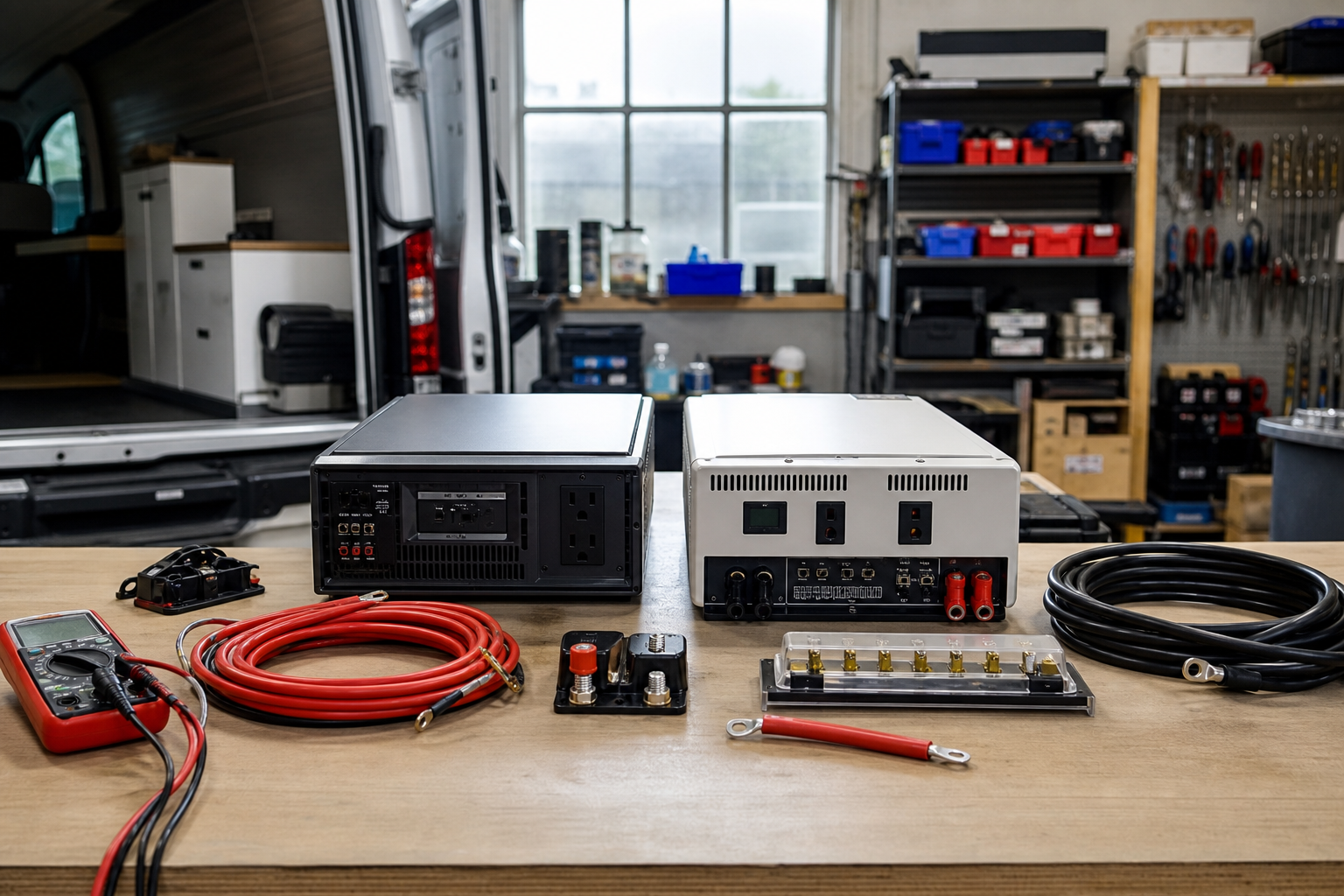
An inverter’s wattage is only as useful as the current your battery can deliver. At 3,000 W and 85 percent inverter efficiency, the inverter pulls about 275 A from a 12.8 V lithium bank, and close to 295 A as the voltage sags toward 12 V. Amp-hours don’t decide whether that works: a 320 Ah battery with a 200 A BMS can’t supply it, however much energy it holds. Size the bank’s continuous current, its fuse and its cables for the inverter’s full draw; our lithium battery guide compares BMS ratings, and our amp-hour guide sizes the bank for runtime.
A large bank behind a smaller inverter isn’t wasted, either. If your loads are moderate, it simply gives you more hours between charges.
Charging From a Generator
The charger’s amp rating sets your generator time. Putting 200 Ah back into a bank takes about two hours at 100 A and a little over three hours at 65 A, before the charger tapers near full and before your other loads take their share.
That charging power comes out of the generator. At full output, Magnum’s 125 A charger draws about 18 A from a 120V input and the Xantrex’s 150 A charger as much as 25 A, both more than a typical 2,000 W portable generator supplies on its own, and your coffee maker still wants its share. Three features handle this differently:
- Input current limit: you set the most the unit may draw, and it trims charging when your appliances need more. Victron calls this PowerControl; Xantrex calls it Power Share, and Samlex lets you set 5 to 40 A.
- Battery support: when your loads alone exceed the limit, the inverter tops up the generator with battery power. Victron calls this PowerAssist; Go Power’s power-share feature, despite its name, does the same on its OUT1 leg.
- Adjustable charge rate: on units without either feature, turn the charger down by hand so charging and appliances together stay within the generator’s rating.
Idle Draw Adds Up
An inverter that stays on all day uses power even with nothing plugged in. Over 24 hours, Victron’s 13 W comes to about 310 Wh, while the AIMS’s 55 W comes to 1,320 Wh, three-quarters of the 1,750 Wh a day that our RV energy audit example couple uses. Search and power-saving modes cut that sharply, but they wake only when a load is big enough to detect, so a phone charger or a fridge’s control board may not wake the inverter. Switch it off when you don’t need AC.
Shore Power and Transfer Switching
Match the transfer rating to what you plug into. A 30-amp RV needs a transfer switch rated for 30 A to pass the whole service, and a 50-amp RV has two 120 V legs: a built-in transfer switch on a single-120 V unit handles only one of them. That’s where the Go Power’s two 50 A legs, or Victron’s 2x120V version, earn their place. With a smaller transfer rating, like the Renogy’s 16 A, the inverter feeds a subpanel of selected circuits instead of the whole rig.
Installation Basics
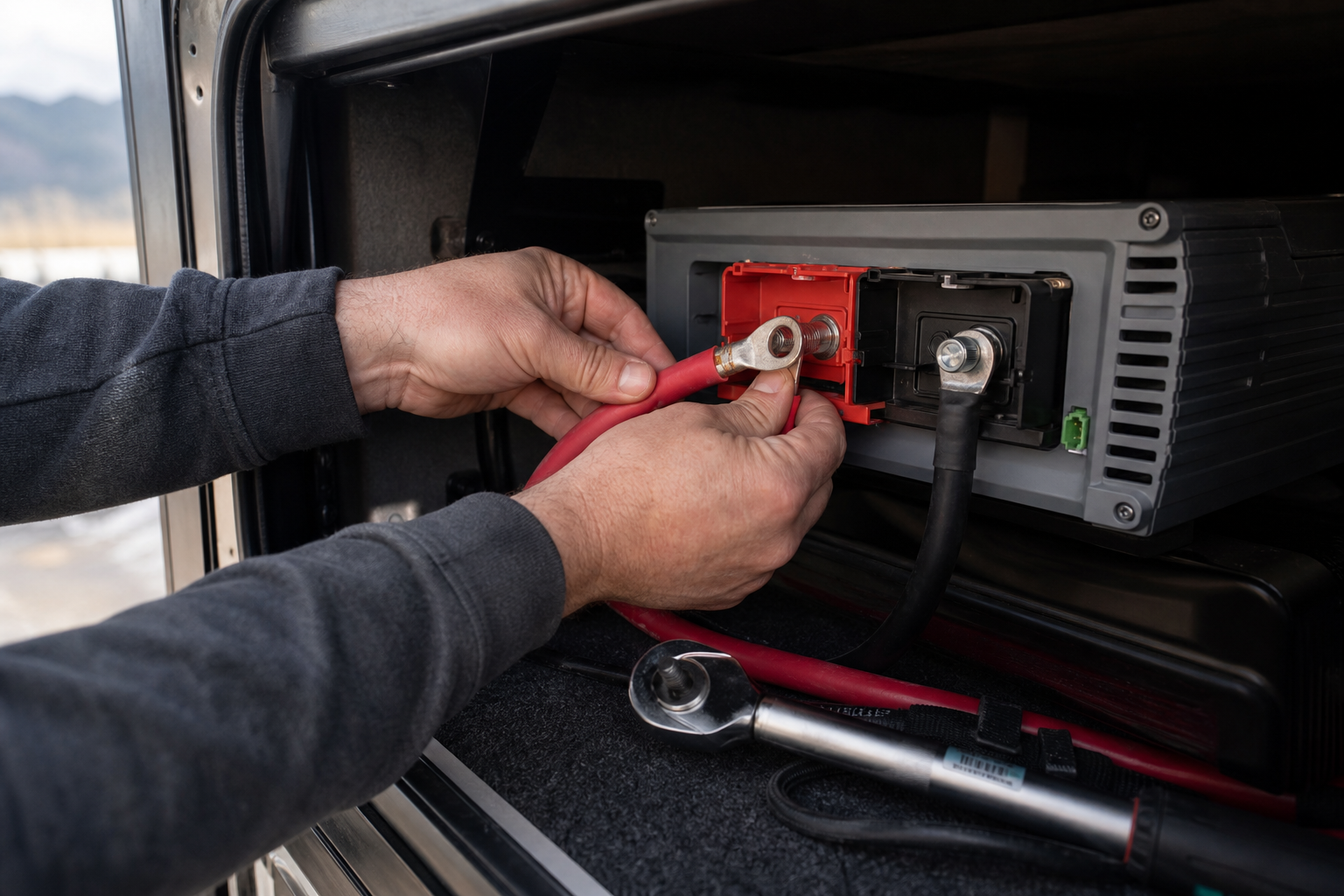
- Cables and fuse: size the DC cables and the battery fuse for the inverter’s full current, mount the fuse as near the battery as practical, and follow the manual’s ventilation clearances and grounding instructions for that model. The full steps are in our RV inverter wiring guide.
- The RV’s converter: if the existing converter stays, make sure the inverter doesn’t power it. Otherwise the converter charges the battery from the inverter, which runs from the same battery, and burns energy in a loop.
- Other charge sources: solar charges through its own controller and the alternator through a DC-DC charger, straight to the battery. The inverter charger’s charger works only from shore or generator power.
- Battery settings: set the charge voltages and current to your battery maker’s figures, and never run an equalize charge on a LiFePO4 battery.
FAQs
- What size inverter charger do I need for boondocking? Add up the AC loads you run at the same time, such as a microwave plus a coffee maker, and pick a continuous rating above that total. For a microwave, use its electrical input wattage, not its cooking-power rating. Then check that your battery can deliver the current: 2,000 W draws about 185 A from a 12.8 V bank, and 3,000 W about 275 A.
- Can an inverter charger run my RV’s air conditioner? Yes, with enough battery behind it. Starting the compressor and keeping it running are separate problems: a soft-start kit tames the startup surge, but it doesn’t give the battery more energy. With 300 Ah at 12.8 V, 80 percent of it usable and an 85 percent efficient inverter, a rooftop unit drawing a steady 1,500 W gets about 1.7 hours of compressor time before other loads.
- How big a battery bank does a 3,000 W inverter charger need? Big enough in both current and energy. At full output, a 3,000 W unit pulls roughly 275 to 300 A from a 12V bank, depending on battery voltage. Size the bank’s continuous discharge rating, cables and fuse to the inverter maker’s requirements, with room for the RV’s other DC loads. For runtime, cover your daily watt-hours times the days between recharges, plus a reserve you leave unused.
- Do I still need my RV’s converter? Usually not for charging, since the inverter charger takes over when you’re plugged in. If the converter stays, keep it off the inverter’s output so the two don’t charge the battery in a loop.
- How do I keep my batteries charged while boondocking? Layer the sources: solar through its charge controller every day, the alternator via a DC-DC charger while you drive, and a generator through the inverter charger for cloudy stretches. Our guide to sizing a DC-DC charger covers the alternator side.
- What’s the difference between an inverter and an inverter charger? A plain inverter only turns battery power into AC. An inverter charger adds a battery charger and an automatic transfer switch, so it recharges the bank from shore or generator power and passes that power through to your outlets. If you never plug in, a stand-alone unit from our pure sine wave inverter guide can be enough.
Conclusion
For most boondockers, the Victron MultiPlus-II 12/3000/120 is the best all-round choice: PowerAssist makes a small generator go further, and its 13 W idle draw is easy on the battery. If generator time is what you want to cut and your generator can keep up, the Xantrex Freedom XC PRO 3000 charges at 150 A in an 18.6 lb package. The Renogy keeps costs down for light loads, the Magnum MS2812 keeps a Magnum-equipped rig on Magnum gear, and the AIMS starts the hardest motors if you can live with its idle draw. For a 50-amp RV, the Go Power passes both legs through, and the Samlex EVO-2212 keeps shore power and a generator on separate inputs. Whichever you choose, check the battery’s current rating against the inverter’s full draw first.
Spot an error or an outdated detail in this guide?
Report it