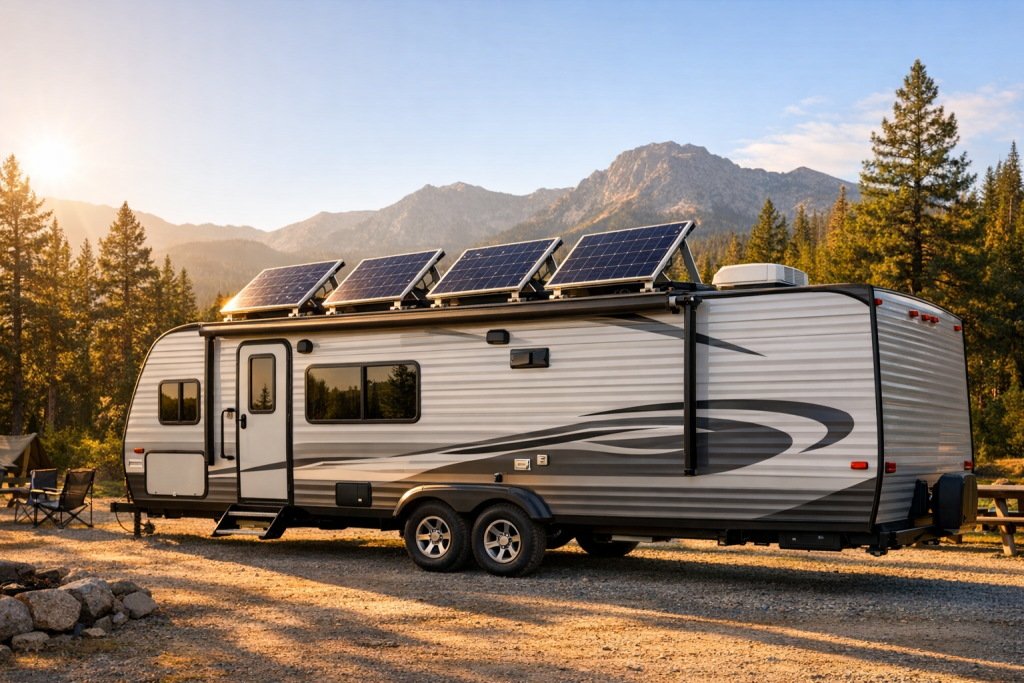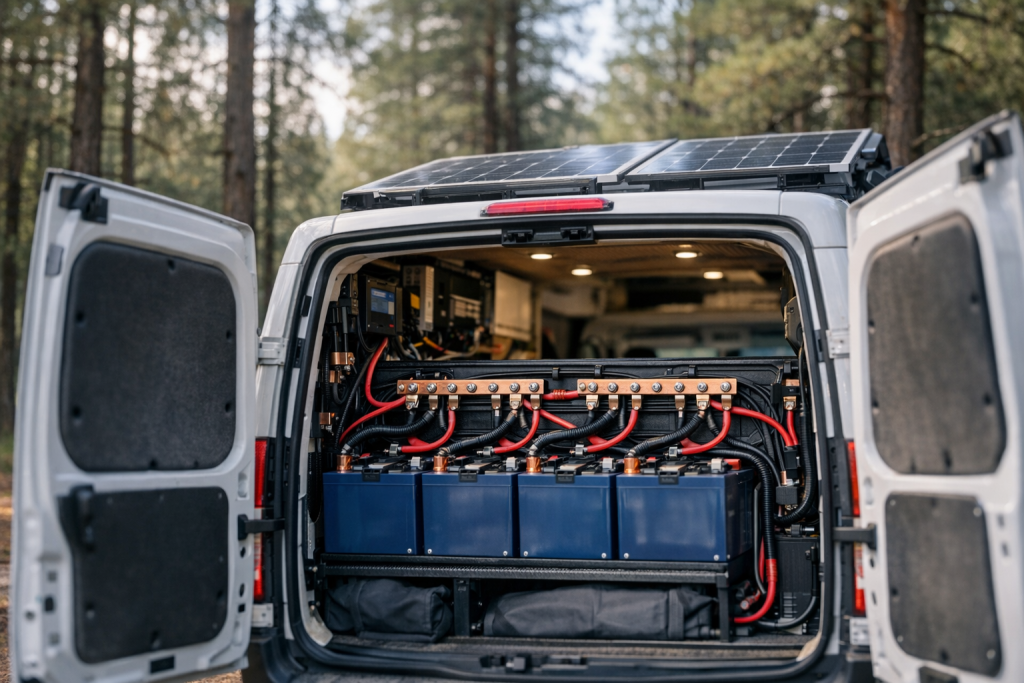
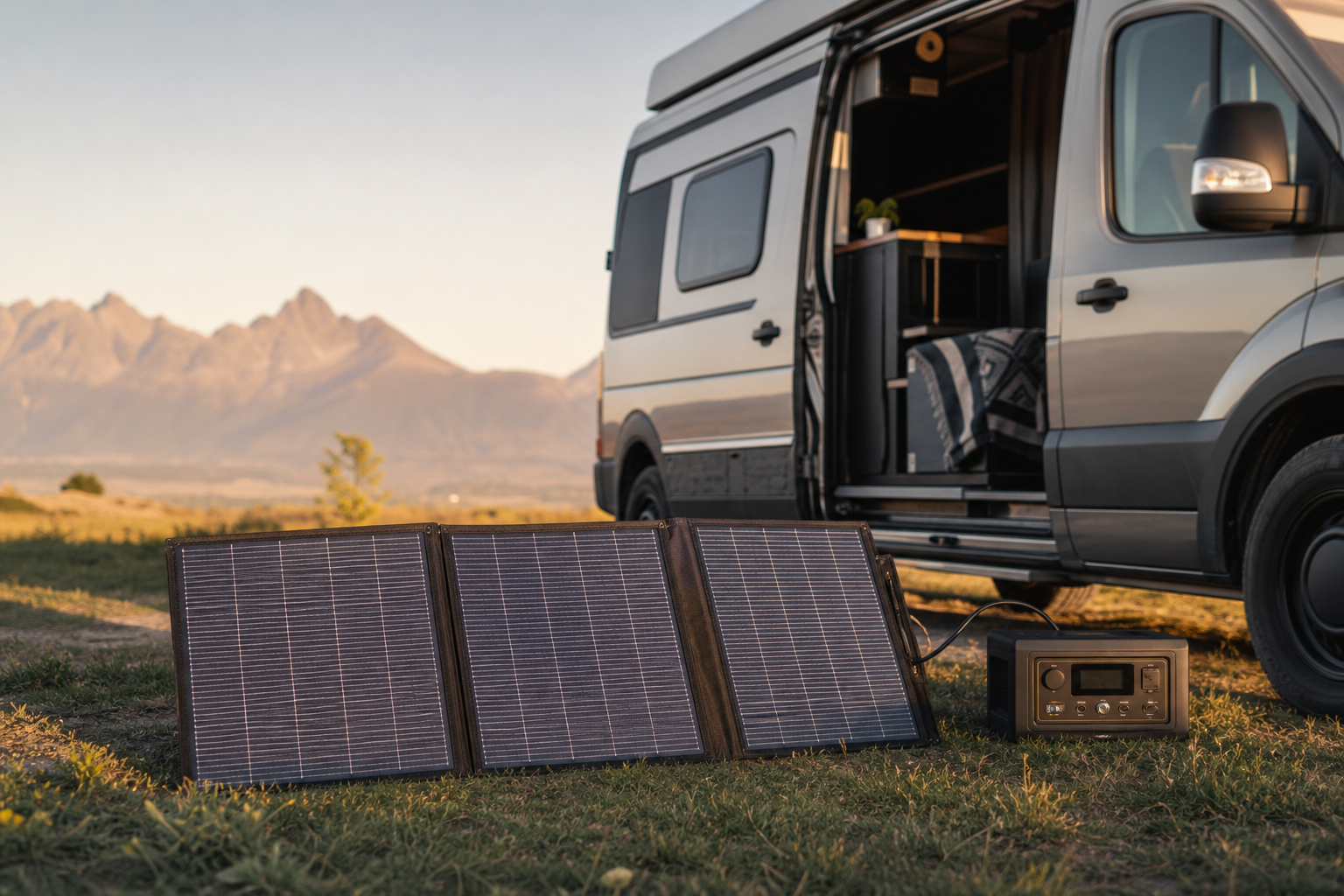
If you’re parked in a shady forest site one weekend and a wide-open desert pullout the next, a portable RV solar panel lets you chase the sun instead of being stuck with whatever angle your roof happens to face. This guide organizes the best portable RV solar panels by the way real RVers actually use them — weekend trips, serious boondocking, weight-sensitive builds, and high-output off-grid setups. The core advantage of a portable panel is freedom of placement: a rooftop array is locked to the orientation of your rig, but a portable unit can be carried to wherever the light is best and tilted to follow the sun across the sky. That single difference can mean the gap between a battery bank that limps through a cloudy weekend and one that comfortably banks a surplus by mid-afternoon.
Before the specific picks, it helps to know the broad categories you’ll encounter. Folding “suitcase” panels are rigid, hinged units that open like a book and stand on built-in legs. Foldable fabric-backed panels roll or fold into a slim package and are prized for their light weight. Both can be paired with a charge controller to feed a battery directly, or plugged into a portable power station that handles its own regulation. The right choice depends less on brand prestige and more on how often you camp, how much power you draw each day, and how much storage and carrying capacity you have to spare.
TL;DR
- Best Overall: Renogy Portable Solar Suitcase — Best for buyers who want a flexible, ground-deployable kit for general RV charging
- Best Budget: ECO-WORTHY Portable Solar Kit — Best for budget-minded weekend campers topping off a battery
- Best for Boondocking: Rich Solar Portable Suitcase — Best for off-grid stays where you need to reposition panels through the day
- Best Lightweight: Jackery SolarSaga Foldable Panel — Best for weight-sensitive builds and easy storage
- Best High-Wattage Kit: BougeRV Foldable Solar Panel — Best for owners comparing larger off-grid charging arrays
Best Portable RV Solar Panel Picks
Below are five portable solar panel options grouped by the use-case each one fits best. Because exact model specs vary by production batch and seller, this guide stays focused on category-level trade-offs — what each style of panel does well, who it suits, and how to plan your setup. Confirm final compatibility, included accessories, and warranty terms on the current product listing before purchase.
A use-case framework beats a simple ranking. A panel that is perfect for a van dweller carrying gear by hand may be a poor fit for a full-timer running a residential refrigerator, and the budget kit that suits an occasional weekender could frustrate someone who relies on solar every single day. Rather than crown a single “best” panel in the abstract, the sections below describe the camper each format serves, so you can place yourself in the right category first and then shop within it.
Best Overall: Renogy Portable Solar Suitcase
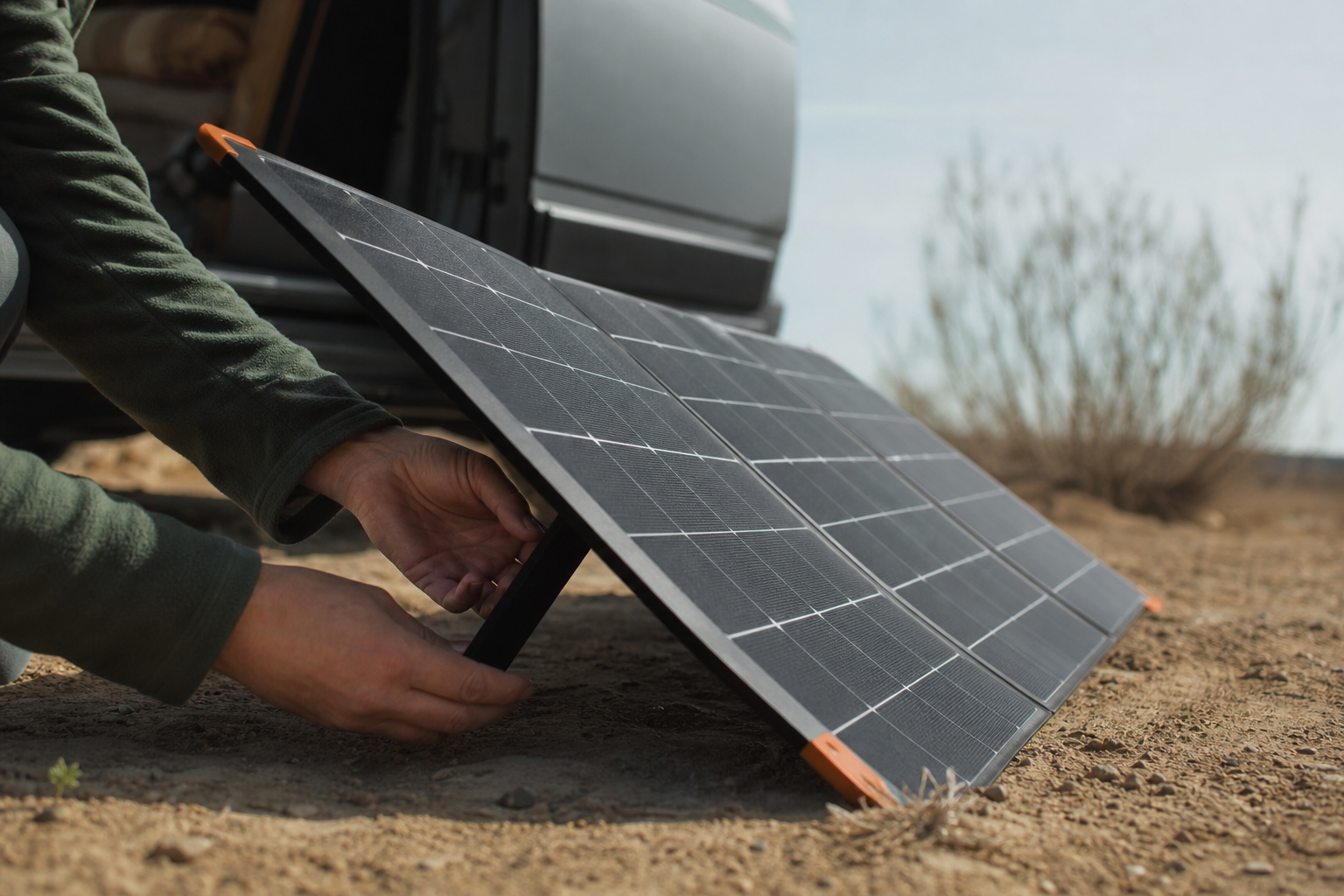
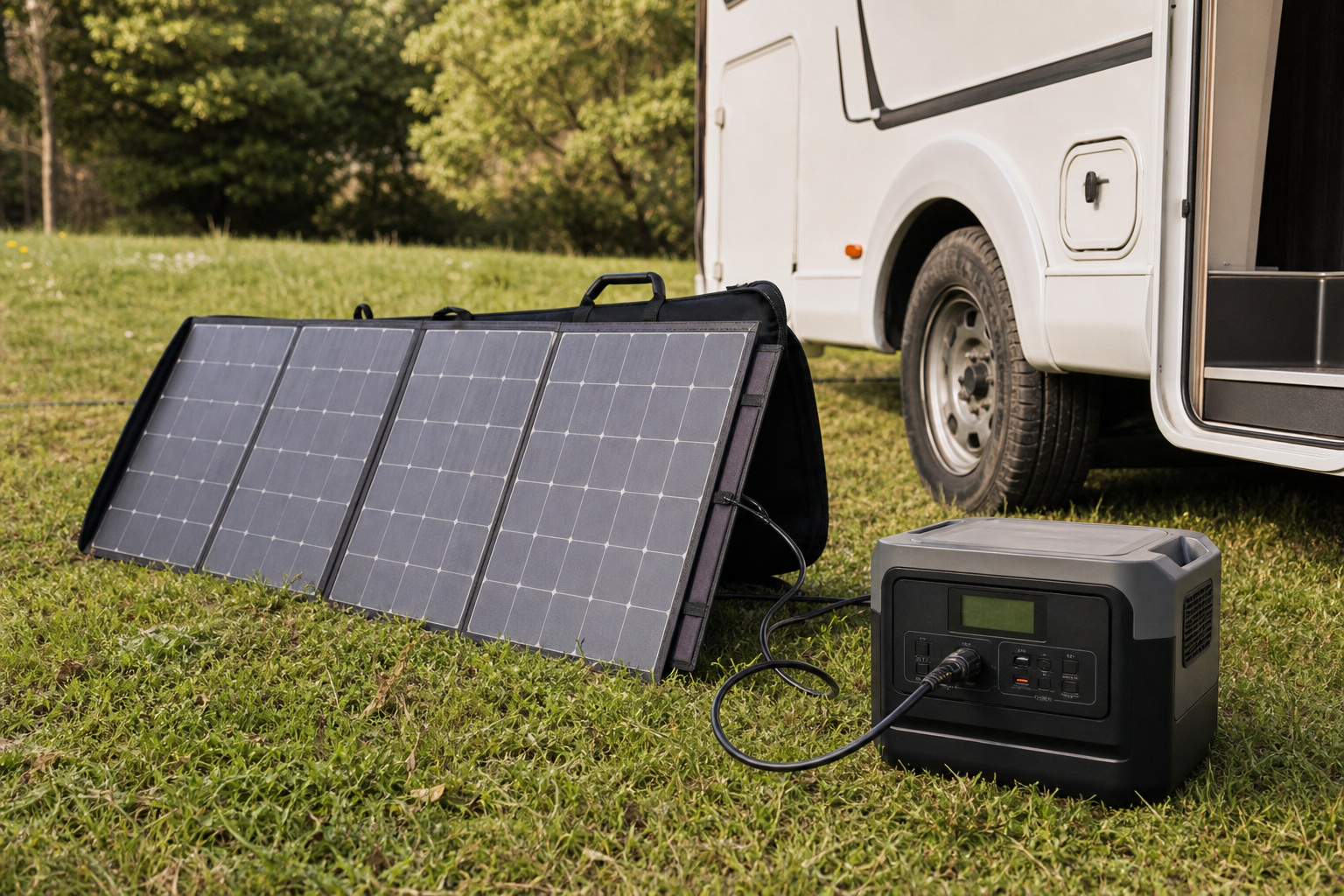
For most RVers shopping for their first portable kit, a folding “suitcase” style panel hits the sweet spot between output, portability, and ease of use. Renogy is one of the most widely referenced brands in the RV solar space, and its portable suitcase format is built around one simple idea: set the panel on the ground, angle it toward the sun, and run a cable back to your battery or power station.
This style serves the weekend-to-long-weekend RVer who parks in mixed shade and sun. Because you can carry the panel to a sunny patch even when your rig sits in the trees, a portable suitcase often out-produces a comparable rooftop panel in real-world boondocking conditions. The folding clamshell design also protects the cells during transport and stows flat in a storage bay.
The reason this format earns the “best overall” label is its balance. It is rugged enough to handle being carried and repositioned repeatedly, generates meaningful wattage in a single deployable unit, and folds shut to protect the glass and cells when you move on to the next site. The integrated legs let you set a usable tilt angle in seconds without improvising stands from rocks or camp chairs, which matters more than it sounds when you’re trying to squeeze every usable hour out of a short winter day.
Plan your setup around how you’ll regulate the charge. Required accessories vary by panel and battery; check the manufacturer specification for the model you are considering. Confirm the connector type and controller arrangement on the listing so your charging path is safe and complete. For a first kit, either will work, but knowing which one is bundled helps you set realistic expectations for harvest.
Best Budget: ECO-WORTHY Portable Solar Kit
If your goal is simply to keep a single house battery topped off over a weekend — running lights, a water pump, and charging phones — you don’t need a premium high-output array. Budget portable kits like those from ECO-WORTHY are aimed squarely at the value shopper who wants meaningful charging without a big spend.
The trade-off at this price tier usually shows up in build refinement, hardware quality, and bundled accessories. That’s fine for occasional campers who store the panel carefully and deploy it only on trips. For a buyer who wants to learn how portable solar behaves before investing in a larger system, an entry-level kit is a sensible on-ramp.
Think of a budget kit as a low-risk way to discover your real-world habits. Many first-time buyers overestimate how much solar they need, or underestimate how often they’ll bother to reposition a panel. If you find yourself reaching for the panel every trip and wishing for more output, you’ll know exactly what to upgrade to — and the budget kit can remain a useful secondary panel or a backup.
A panel that won’t hold its angle in a breeze, or whose lead cable is too short to reach a shady-parked rig, undercuts the whole point of going portable. Verify those practical details against your typical campsite layout. It’s also worth checking the latching mechanism and the hinge: on the most basic kits these are the parts most likely to feel flimsy, and a hinge that flexes too much can stress the cells over repeated open-and-close cycles. None of this is disqualifying at the budget tier, but going in with clear expectations prevents disappointment.
Best for Boondocking: Rich Solar Portable Suitcase
Boondocking — camping off-grid with no hookups — is where portable panels truly shine, because your daily power comes entirely from what you can harvest. Rich Solar appears regularly in RV solar roundups, and its portable suitcase format is geared toward the dispersed-camping crowd that moves the panel two or three times a day to track the sun.
For multi-day off-grid stays, the ability to reposition is worth more than a few extra watts of fixed capacity. A panel you can walk into full sun at 8 a.m. and reangle at noon will beat a roof panel shaded by an awning or a nearby tree. Durable corner protection and a sturdy folding frame matter here, since the panel gets handled constantly.
Repositioning is not just about morning versus afternoon. As the sun climbs and drops, its angle relative to a fixed panel changes constantly, and a panel that is even moderately off-axis can lose a noticeable share of its output. The boondocker who steps outside two or three times a day to nudge the panel toward the sun will consistently harvest more than someone who sets it once and walks away. Over a four- or five-day off-grid stretch, that difference compounds into the margin between a fully charged bank and a slow, anxious decline.
When boondocking, size your solar to your battery bank and your daily draw, not the other way around. A common starting point is roughly 200–400 watts of portable solar for typical RV appliance and battery-charging needs. Pair that with adequate battery capacity so you can bank energy on sunny afternoons and coast through cloudy mornings. The battery is what carries you through the night and through stretches of marginal weather, so a larger panel paired with an undersized bank still leaves you short. Treat the panel and battery as two halves of one system, sized together.
Best Lightweight: Jackery SolarSaga Foldable Panel
For van builds, smaller trailers, and anyone who hauls the panel by hand from a storage bay to a sunny spot, weight and packed size dominate the decision. Jackery’s foldable SolarSaga panels are popular with the power-station crowd and prioritize a slim, carry-friendly form factor over maximum raw output.
This use-case suits the minimalist camper who already owns a portable power station or who wants the lightest possible solution to keep a modest battery charged. Foldable fabric-backed panels typically stow into a thinner profile than rigid suitcases — a real advantage when storage space is tight.
The integration with a portable power station is the heart of this format’s appeal. Rather than wiring a controller, fuses, and battery terminals, you simply plug the panel into the station’s solar input and let its internal electronics manage the rest. That plug-and-play simplicity lowers the barrier to entry for newcomers and keeps the whole system tidy in a small vehicle. Many of these panels also include built-in kickstands and a carry handle, so deployment is genuinely a one-person, one-minute task.
The catch with ultralight foldables is that you trade some durability and per-panel wattage for portability. They’re excellent companions to a power station, but plan your charge path carefully if you intend to feed an RV house battery directly. Confirm you have appropriate charge regulation in place rather than assuming the panel handles it. Fabric-backed panels also reward gentle handling — the flexible substrate can be creased or punctured more easily than rigid glass, so a dedicated storage sleeve and a habit of folding along the original seams will extend their life considerably.
Best High-Wattage Kit: BougeRV Foldable Solar Panel
Full-timers, families, and anyone running larger loads off-grid often want more harvest than a single small suitcase provides. Larger foldable panels and higher-wattage portable kits from brands like BougeRV target the buyer who needs to bank serious amp-hours during limited sun windows.
This tier fits the heavy user who runs a residential fridge, charges multiple devices, and wants to recover a depleted battery bank in a single sunny day. More wattage also helps on marginal-sun days, when even a partial harvest from a big panel keeps essentials running.
The math behind buying extra capacity is straightforward: a larger panel doesn’t just charge faster on perfect days, it also reaches a useful charging threshold sooner in the morning and keeps producing later into the afternoon. On an overcast day when a small panel might barely trickle, a high-wattage unit can still deliver enough to cover refrigeration and lighting. For households that simply cannot afford to run out of power — because food spoilage or medical devices are on the line — that headroom is a baseline requirement, not a luxury.
Higher output brings two planning considerations: your charge controller must be rated to handle the panel’s current, and the panel itself gets heavier and bulkier to deploy. Make sure your storage bay and your back can manage the size, and that your charging components are matched to the array you choose. There is a practical ceiling to how large a single portable panel one person can comfortably carry and angle; beyond a certain point, two smaller panels can be easier to handle and position than one oversized unit, and they let you split them between sun pockets if your site is partly shaded.
Comparison Table
| Search Target | Best Fit | What to Confirm Before Buying | Why It Might Fit | Watchouts | Where to buy |
|---|---|---|---|---|---|
| Best Overall: Renogy Portable Solar Suitcase | Best for shoppers weighing a recognizable option against their rig, power needs, and budget | Check fit, wiring, and charge-or-power compatibility before you order. | Worth a look if its size and capability line up with your daily power use and available space. | Do not assume a universal fit — match it to your rig first. | Amazon ↗ |
| Best Budget: ECO-WORTHY Portable Solar Kit | A practical starting point for owners comparing fit and features before they decide | Make sure it suits your loads, your space, and your install plan first. | A reasonable match when its feature set fits the way you travel and the loads you run. | Headline numbers can mislead; weigh real-world fit and support. | Amazon ↗ |
| Best for Boondocking: Rich Solar Portable Suitcase | Suits buyers narrowing a shortlist around how they actually camp and travel | Match its capability and protection limits to your setup before buying. | Earns a spot on your shortlist when the install effort suits your skills and your rig. | Watch for compatibility gaps with your existing charge-or-power setup. | Amazon ↗ |
| Best Lightweight: Jackery SolarSaga Foldable Panel | Good for upgrades where space, wiring, and compatibility still need a closer look | Look over mounting, connections, and support terms for your rig. | Fits builds where compatibility with your existing charge-or-power setup checks out. | Mind the install effort and the space the unit actually needs. | Amazon ↗ |
| Best High-Wattage Kit: BougeRV Foldable Solar Panel | Aimed at DIY installers matching capability and fit to their existing setup | Be sure the size, fit, and warranty terms work for your build. | Appeals to owners who want dependable performance without paying for capability they will not use. | Treat unverified marketing claims with caution and compare the essentials. | Amazon ↗ |
| Portable RV solar suitcase | A sensible candidate for owners balancing capability, install effort, and price | Double-check compatibility and install constraints against your rig. | Makes sense when its capability and support reputation match what your setup demands. | Make sure the warranty and support terms genuinely cover your use. | Amazon ↗ |
As an Amazon Associate I earn from qualifying purchases.
Use the table as a shortlist filter rather than a final verdict. The “What to The “Watchouts” column is not a list of dealbreakers but a set of trade-offs that are entirely manageable once you know to expect them. Read across a row for the format you’re leaning toward, and you’ll have a compact checklist of what to look for.
Which One Should You Buy?
Best for weekend trips → a budget portable kit or a mid-size suitcase. If you camp a handful of weekends a year and mostly need to keep a single battery healthy while running lights, a pump, and device charging, you don’t need a large array. A budget kit or a standard folding suitcase covers the basics, and the suitcase format leaves room to grow into longer trips later. The occasional camper benefits most from simplicity and low cost, since a panel that sits in storage most of the year doesn’t justify a premium price. Start here, learn your habits, and upgrade only if your usage clearly outgrows the kit.
Best for serious boondocking → a rugged portable suitcase you can reposition. When all of your power comes from the sun, the ability to move the panel into full light beats a slightly higher fixed wattage stuck in the shade. Prioritize a sturdy frame, protected corners, and a lead cable long enough to reach your rig from an open patch of sun. Size your panels to your daily draw and battery bank — roughly 200–400 watts is a common, sensible range for typical RV needs. Build quality earns its keep here because the panel is handled daily; a flimsy hinge or a corner that cracks on the second trip will leave you stranded at the worst possible time.
Best for weight-sensitive builds → an ultralight foldable. Van dwellers and small-trailer owners who carry the panel by hand should weigh packed size and weight heavily. Foldable panels pair naturally with portable power stations and tuck into tight storage. In a build where every cubic foot counts and you’re moving gear in and out by hand, the convenience of a slim, light panel can be worth more than raw wattage — a panel you actually deploy beats a heavier one that stays buried in a bin.
Best for full-timers and heavy loads → a high-wattage foldable or larger kit. If you run a fridge and recover a depleted bank in one day, buy more harvest capacity and make sure your charge controller is rated for the current. Full-time living turns solar from a convenience into infrastructure, and the cost of being underpowered — spoiled food, dead devices, a recurring scramble for shore power — quickly outweighs the price difference of buying enough capacity from the start.
Across all of these, the two compatibility checks that matter most are: (1) how the panel regulates charge — directly to a battery through a controller, or into a power station’s own input — and (2) whether the connectors match your existing gear. Get those right, and almost any quality panel in your wattage range will serve you well. Everything else — brand, color, marginal differences in stated efficiency — is secondary to getting a safe, complete charging path that physically plugs into what you already own.
Safety & Common Mistakes
- Skipping the charge controller. Connecting a panel directly to a battery without proper regulation can overcharge and damage it. Always route through an appropriate charge controller unless you’re feeding a device that regulates input itself. An overcharged battery can degrade rapidly, vent, or in extreme cases become a hazard, so this is the single most important step to get right.
- Undersizing for your real draw. Buyers often pick wattage by guess. Add up your daily consumption and match panel and battery capacity to it rather than hoping a small panel keeps up. A short worksheet listing each device, its draw, and the hours you run it removes the guesswork and tends to reveal that a few high-draw appliances dominate your total.
- Expecting a portable kit to run an air conditioner. RV air conditioners demand large wattage and substantial battery capacity. Most portable solar kits cannot run an AC on their own — plan for that load separately. Treating cooling as its own power-planning problem, rather than assuming solar will cover it, prevents an expensive disappointment.
- Leaving panels flat or in the shade. The whole advantage of portable solar is angle and repositioning. A panel left lying flat in partial shade gives up a big share of its potential output. Even partial shading across a few cells can disproportionately cut a panel’s output, so keep the entire surface in clear sun whenever possible.
- Ignoring weather and storage. Most panels are weather-resistant, not built for prolonged heavy rain or standing water. Store them dry and bring them in during severe weather. Wind is an underrated threat as well — a lightweight panel on its stand can be tipped or blown over by a gust, so weight or secure the legs when conditions are blustery.
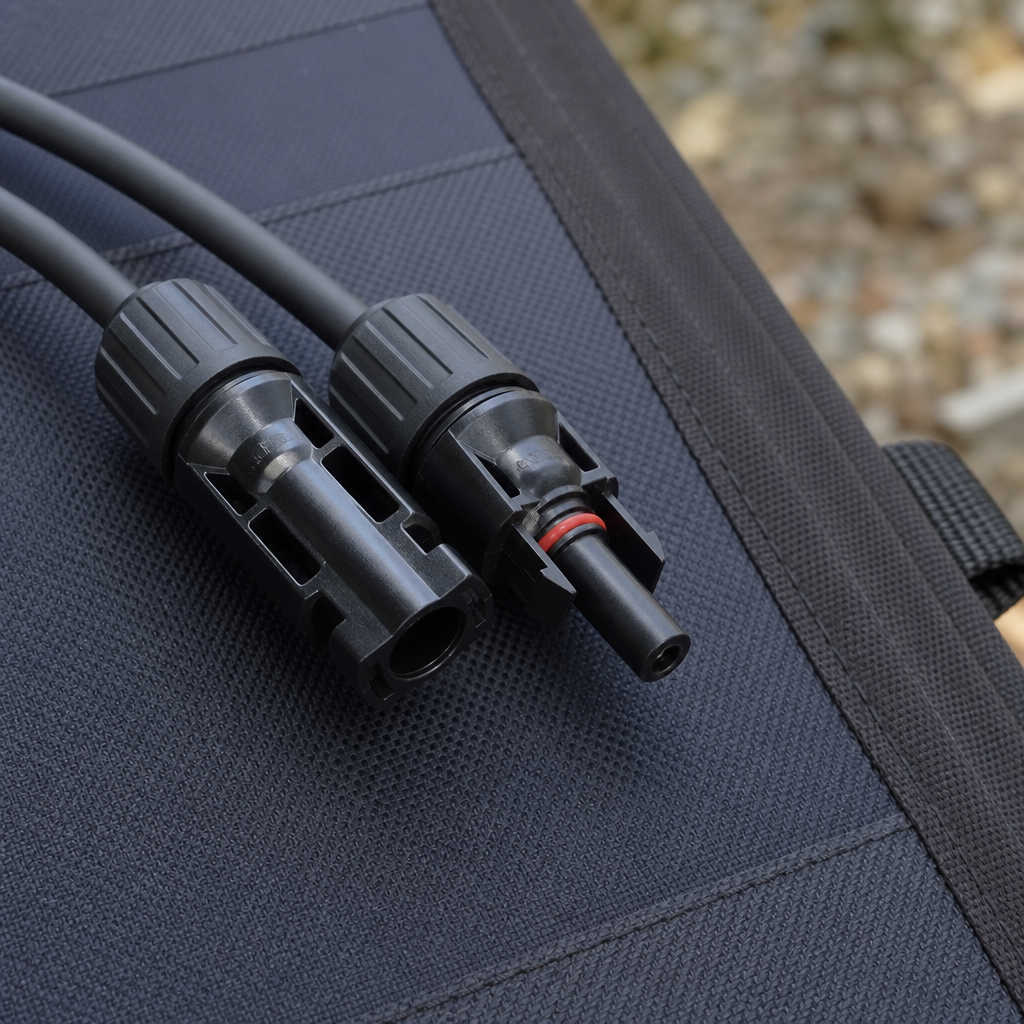
- Mismatched connectors. A panel you can’t plug into your battery or power station is useless at the campsite. Verify connector types before you rely on the kit. Adapters exist for most common standards, but confirming compatibility before you leave home is far easier than improvising a connection in the field.
Treat this as general guidance — follow each manufacturer’s instructions for your specific panel, controller, and battery chemistry. Different battery chemistries have different charging requirements, and a controller configured for the wrong type can either undercharge or overstress the bank. When in doubt, the documentation that ships with your specific components takes precedence over any general advice.
FAQs
- How were these products selected and tested? Start by matching the option to your own rig. Compare options on charger and controller compatibility, physical fit, low-temperature charging behaviour, BMS current limits, and warranty terms, then confirm those details on the current listing and the product manual before you commit.
- What specs matter most for RV solar gear? Before you buy, weigh the practical fit first. Weigh maintenance, usable capacity, and how the option pairs with your charge source, and confirm the figures that matter on the current listing and manual rather than assuming a drop-in fit.
Conclusion
Choosing the right portable RV solar panel comes down to matching real use to the right fit rather than chasing headline numbers. Start by shortlisting options such as Best Overall: Renogy Portable Solar Suitcase, Best Budget: ECO-WORTHY Portable Solar Kit and Best for Boondocking: Rich Solar Portable Suitcase, then weigh each against how you actually camp — daily power needs, available space, and the budget you are working with. The comparison table and the ‘Which One Should You Buy?’ section are there to narrow that shortlist quickly.
Use the safety notes to plan a clean, protected install, and treat the current product listing as the final word on the details that matter to your rig. Pick the option that fits your setup today and you will get dependable power without overspending.