Best Lithium Batteries for RV Solar Setups
On this page
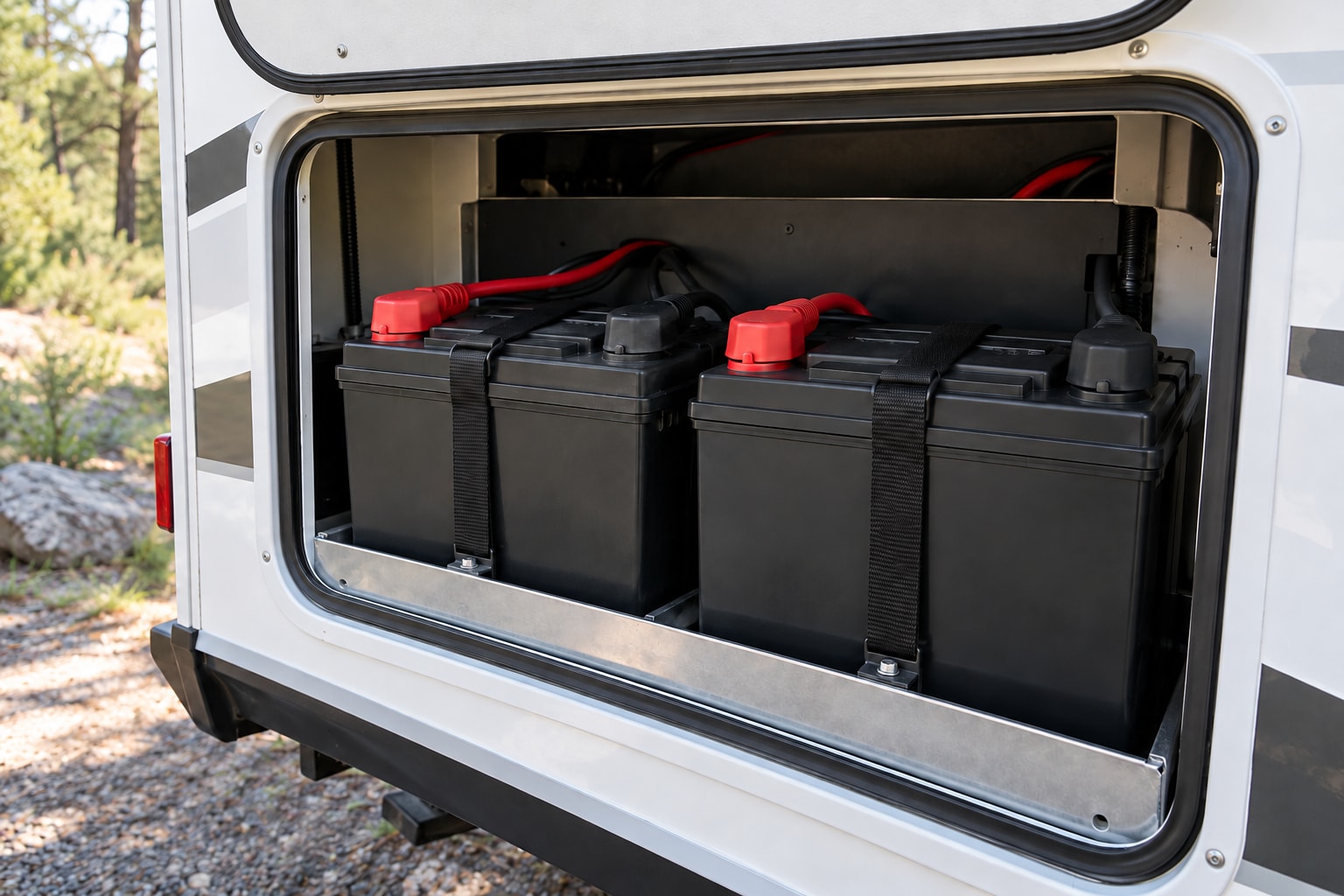
A full 100 Ah lithium battery can still cut out the moment a 1,500 W microwave starts, and one in an outside bay may refuse to charge on a frosty morning. Neither problem shows on the amp-hour label, so we picked these five for how they handle big loads and freezing nights.
TL;DR
- Best value and compact: Redodo 12V 100Ah Ultra-Mini, a full 1,280 Wh in a Group 22NF case under 20 lb, with Bluetooth and a low-temperature charge cutoff.
- Best for cold weather: Renogy Pro 12V 100Ah, which warms its own cells before it charges.
- Best Group 31 option: LiTime 12V 200Ah Xtra Mini, with 2,560 Wh and 200 A continuous in a Group 31 case.
- Best for longer boondocking: LiTime 12V 320Ah Mini, with 4,096 Wh in a single case.
- Best for Victron setups: SOK 12V 314Ah, with self-heating and a CAN link to a Victron GX device.
- Check current, not just amp-hours: a battery with a 100 A BMS tops out around 1,000 W of inverter load.
Best Lithium Batteries for RV Solar Compared
The numbers in this table come from the makers’ published specs and manuals, not from our own lab test. Each battery wins a different job, so start with the row that matches your rig.
As an Amazon Associate I earn from qualifying purchases.
Scroll sideways to see every column.
| Battery | Nominal Energy | Continuous Current | Below Freezing | Best For | Where to Buy |
|---|---|---|---|---|---|
| Redodo 12V 100Ah Ultra-Mini | 1,280 Wh | 100 A | Stops charging below 32°F | Most rigs, especially tight bays and weight-sensitive builds | Amazon ↗ |
| Renogy Pro 12V 100Ah | 1,280 Wh | 100 A | Heats its cells, then charges | Outside compartments and winter trips | Amazon ↗ |
| LiTime 12V 200Ah Xtra Mini | 2,560 Wh | 200 A | Stops charging below 32°F | Microwaves and 2,000 W inverters in a Group 31 tray | Amazon ↗ |
| LiTime 12V 320Ah Mini | 4,096 Wh | 200 A | Stops charging below 32°F | Longer stays between charges | Amazon ↗ |
| SOK 12V 314Ah | 4,019 Wh | 200 A | Heats its cells, then charges | Victron GX systems and cold bays | Amazon ↗ |
Our Picks in Detail
Redodo 12V 100Ah Ultra-Mini: Best Value and Compact
Redodo squeezes the 1,280 Wh and 100 A BMS of a typical Group 24 lithium battery into a smaller, lighter Group 22NF case. That leaves room to spare in a van, a teardrop or a cramped bay. It adds Bluetooth monitoring and a BMS that stops charging below 32°F and starts again above 41°F, and it usually costs no more than a basic Group 24 battery without either feature.
- Key specs: 1,280 Wh, 100 A continuous, 100 A maximum charge current, 9.0 × 5.4 × 8.2 in, 19.8 lb, up to four in series and four in parallel, 5-year warranty.
- Choose it for: most RVs with room for a 100 Ah battery, and especially vans, small trailers and tight compartments where every inch and pound counts.
- Know before you buy: the cutoff protects the cells but doesn’t warm them. In a Group 24 or Group 31 tray it’s smaller than the battery it replaces, so add a spacer or adjust the hold-down to keep it from sliding. Redodo wants every battery in a bank to be the same model, bought within about a month of the others.
Check the Redodo 12V 100Ah Ultra-Mini on Amazon
Renogy Pro 12V 100Ah: Best for Cold Weather
On a trailer tongue or in an outside compartment, a charge cutoff alone can leave you with no charging on a frosty morning. Renogy’s Pro battery heats its own cells instead: below 41°F it warms them with current from the charger, as long as the charger supplies more than 4 A per battery, and it stops heating at 50°F. Bluetooth is built in, so the Renogy app shows the charge level on your phone without an extra module.
- Key specs: 1,280 Wh, 100 A continuous (245 A for 30 seconds), 100 A maximum charge current, IP67, about 10.6 × 7.6 × 8.1 in, about 27 lb, 7-year prorated warranty.
- Choose it for: winter camping and any battery that lives outside the heated space.
- Know before you buy: no charger, no heat. Plugged into shore power, it can warm the battery overnight; with nothing charging, it can’t. It connects in parallel only, up to eight batteries, so it won’t build a 24V bank.
Check the Renogy Pro 12V 100Ah on Amazon
LiTime 12V 200Ah Xtra Mini: Best Group 31 Option
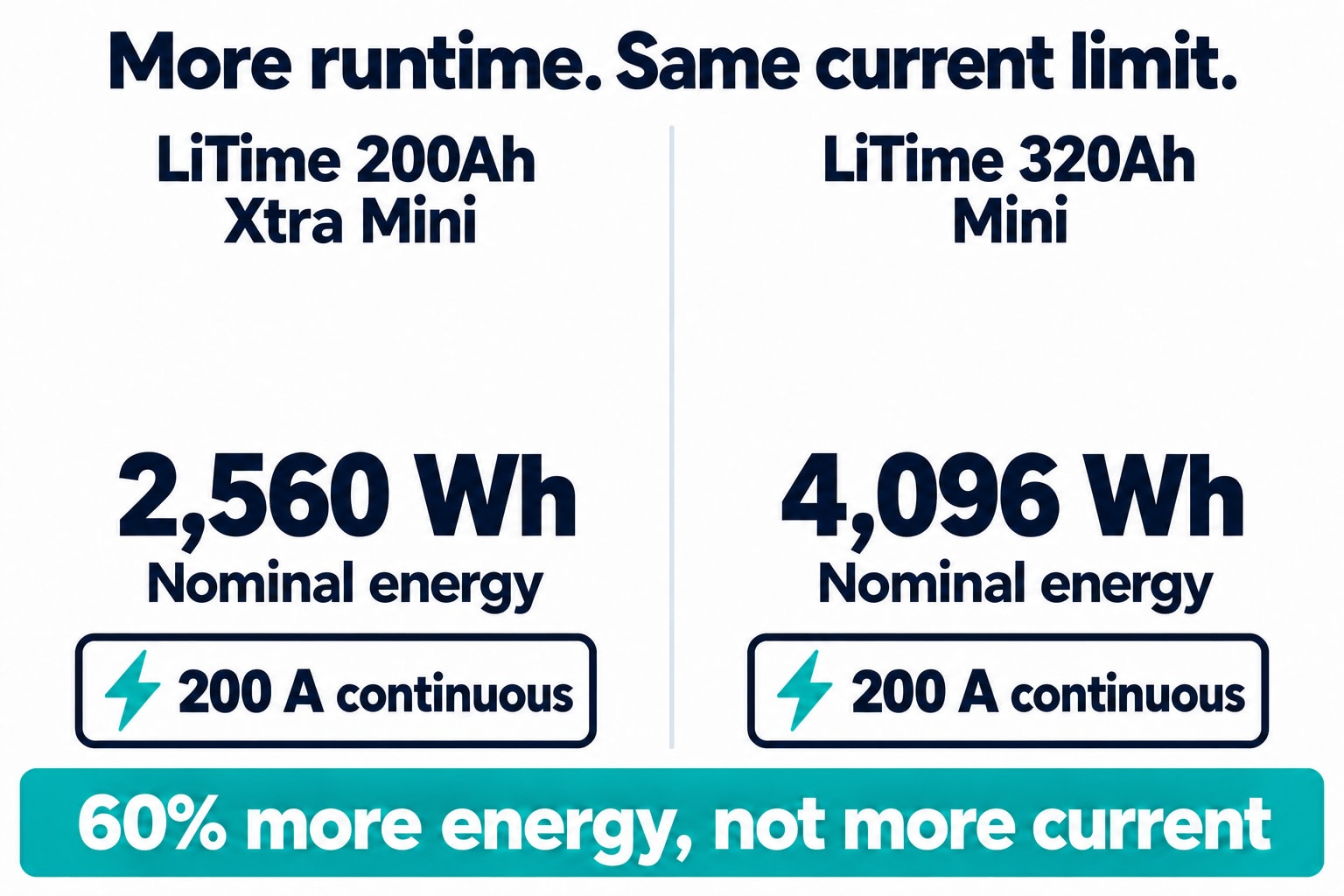
A 100 A BMS runs out of current long before the battery runs out of energy once a microwave comes on. The 200Ah Xtra Mini doubles both numbers: 2,560 Wh and a 200 A BMS, in a case that fits most Group 31 trays. That’s enough current to run a 1,500 W microwave through the inverter from a single battery, and it brings Bluetooth monitoring and a low-temperature charge cutoff along.
- Key specs: 2,560 Wh, 200 A continuous (1,000 A for 1 second), 200 A maximum charge current, 13.1 × 6.9 × 9.5 in, 44.5 lb, up to four in series and four in parallel, 5-year warranty.
- Choose it for: microwaves and coffee makers on an inverter, and anyone who wants 200 Ah and 200 A in a standard Group 31 tray without wiring two batteries together.
- Know before you buy: at 44.5 lb, it’s a heavy lift into a high bay. Size the cables and fuse for the inverter’s full draw, which can approach 200 A.
Check the LiTime 12V 200Ah Xtra Mini on Amazon
LiTime 12V 320Ah Mini: Best for Longer Boondocking
When you want more nights between charges rather than more power at once, the 320Ah Mini puts 4,096 Wh in a single case, 60 percent more than the 200Ah Xtra Mini. Counting 80 percent as usable, that’s about 3,280 Wh: a day and a half without charging for a rig using 1,750 Wh a day, reserve included. It shares the 200Ah’s Bluetooth monitoring and cold-charge cutoff. LiTime recommends a 64 A charge current. A smaller charger or solar controller works too; it just takes longer to refill the battery.
- Key specs: 4,096 Wh, 200 A continuous (1,000 A for 1 second), 200 A maximum charge current, about 57 lb, up to four in series and four in parallel, 5-year warranty.
- Choose it for: long boondocking stays, a 12V fridge with regular inverter use, and anyone who wants about 4 kWh without wiring several batteries together.
- Know before you buy: LiTime’s own listings give slightly different case dimensions, so confirm the size with the seller if your bay is tight.
Check the LiTime 12V 320Ah Mini on Amazon
SOK 12V 314Ah: Best for Victron Setups
SOK’s SK12V314PH stores 4,019 Wh, close to the LiTime 320Ah, and the extra cost buys three things: a built-in heater pad, an IP67 case, and Victron communication over CAN. With the heater, SOK rates it for charging from -4°F. Connected by CAN to a Victron GX device, such as a Cerbo GX, it reports its own state of charge alongside the rest of the system.
- Key specs: 4,019 Wh, 200 A continuous (800 A for 10 seconds), 200 A maximum charge current, IP67, 17.1 × 9.4 × 10.9 in, about 67 lb, up to four in series or ten in parallel, 7-year limited warranty.
- Choose it for: Victron systems with a GX device, and big banks that live in cold compartments.
- Know before you buy: the Victron link needs a GX device; it won’t talk to a Victron solar controller over Bluetooth. SOK calls for no more than 14.0 V when charging, lower than many lithium presets, so check the setting. It’s a 200 A battery, so it won’t carry a 3,000 W inverter at full load on its own, and you pay the shipping on warranty claims.
How Much Capacity Do You Need?
Size the bank from your daily use and how long you want to go without charging, not from your panel wattage. Our RV energy audit guide (opens in a new tab) gets you the daily number. At 12.8 V, counting 80 percent as usable, common bank sizes give you:
Scroll sideways to see every column.
| Lithium Bank | Usable Energy at 80% |
|---|---|
| 100 Ah | 1,024 Wh |
| 200 Ah | 2,048 Wh |
| 300 Ah | 3,072 Wh |
| 400 Ah | 4,096 Wh |
In our energy audit, a couple boondocking in a travel trailer goes through about 1,750 Wh a day. Add a 20 percent reserve and a day without charging takes about 205 Ah of lithium; two days take 410 Ah. Our amp-hour guide (opens in a new tab) runs the same calculation for your own numbers.
Solar can cover daytime loads, but the battery supplies whatever the panels can’t. With enough daily generation, most of your storage goes toward nights and the cloudy spells you plan for. A battery that’s full before lunch is doing its job, and one that isn’t full by sunset is fine too, as long as it holds enough to reach the next charge: LiFePO4 doesn’t need a daily full charge, and sitting partly charged doesn’t hurt it. Your daily use stays the same with a bigger bank, so it doesn’t need more solar just to stay charged; it only takes longer to refill when you’ve drawn more energy from it. Our RV solar sizing guide (opens in a new tab) works out the panels that do the refilling.
Continuous Current: Can the Battery Run Your Inverter?
Amp-hours say how long a battery lasts. The BMS current rating says how big a load it can carry at once. Through an inverter at 85 percent efficiency, a 12.8 V battery has to deliver about this much current:
Scroll sideways to see every column.
| AC Load | Battery Current |
|---|---|
| 1,000 W | About 90 A |
| 1,500 W | About 140 A |
| 2,000 W | About 185 A |
| 3,000 W | About 275 A |
A microwave that pulls 1,500 W from the outlet, like the one in our energy audit example, needs about 140 A. A battery capped at 100 A can’t supply that, however full it is: the BMS shuts off the output to protect the cells, and the inverter drops out. A single 200 A battery handles it, and so do two 100 A batteries in parallel, as long as they’re wired to share the load evenly. A 2,000 W inverter at full output pulls about 185 A, close to the limit of even a 200 A battery, so size for the biggest load you actually run, not for the number on the inverter.

Check surge separately. Size for the appliance’s running draw, then check startup demand against both the inverter and battery surge ratings. Microwaves, motors and compressors can all add a startup spike, and battery makers rate surge over anything from 1 to 30 seconds, so compare like with like. Cables and fuses follow the same math, and our fuse and breaker guide (opens in a new tab) walks through it.
Cold-Weather Charging: Cutoff or Self-Heating?
Charging LiFePO4 cells below freezing can plate lithium metal inside them and permanently cut their capacity, so the rule is simple: no charging below 32°F unless the battery maker says otherwise. Batteries deal with that in three ways:
- No protection. A battery without a low-temperature cutoff accepts a charge however cold it gets, so keep it warm or make every charger shut itself off in the cold. Some solar charge controllers can do that with a battery temperature sensor.
- Low-temperature cutoff. The Redodo Ultra-Mini and both LiTime batteries block charging below 32°F and allow it again above 41°F. The cells are safe, but a cold battery doesn’t charge until the day warms it.
- Self-heating. The Renogy Pro and the SOK 314Ah warm their cells first, then charge.
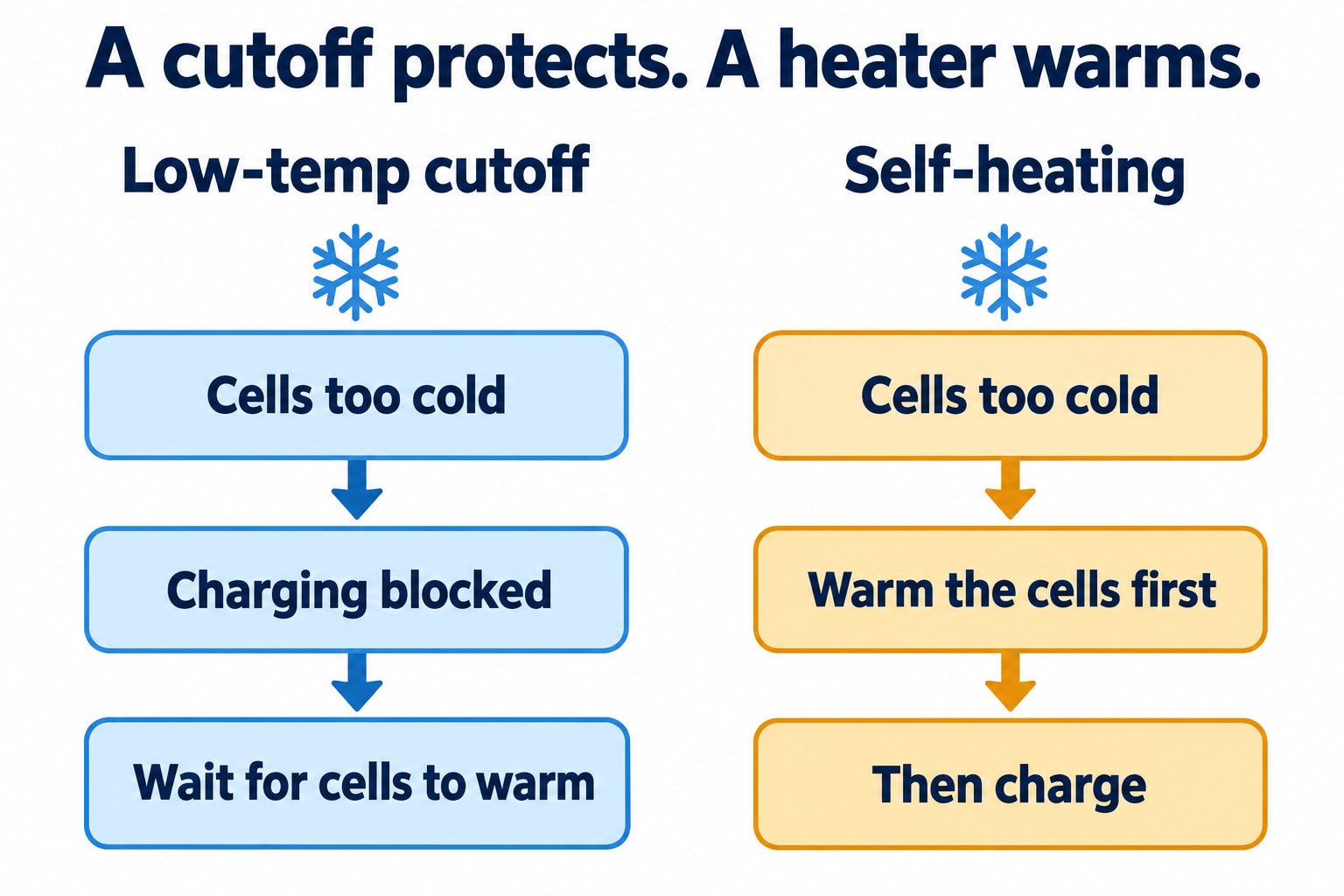
Where the battery lives decides which one you need. Inside the heated living space, even a battery with no cold protection works fine. In an outside compartment or on a trailer tongue with freezing nights, get a cutoff at minimum, and self-heating if you need to charge on cold mornings. Discharging is far less sensitive: the Redodo, for one, keeps powering loads down to -4°F.
Size, Monitoring and Lifespan
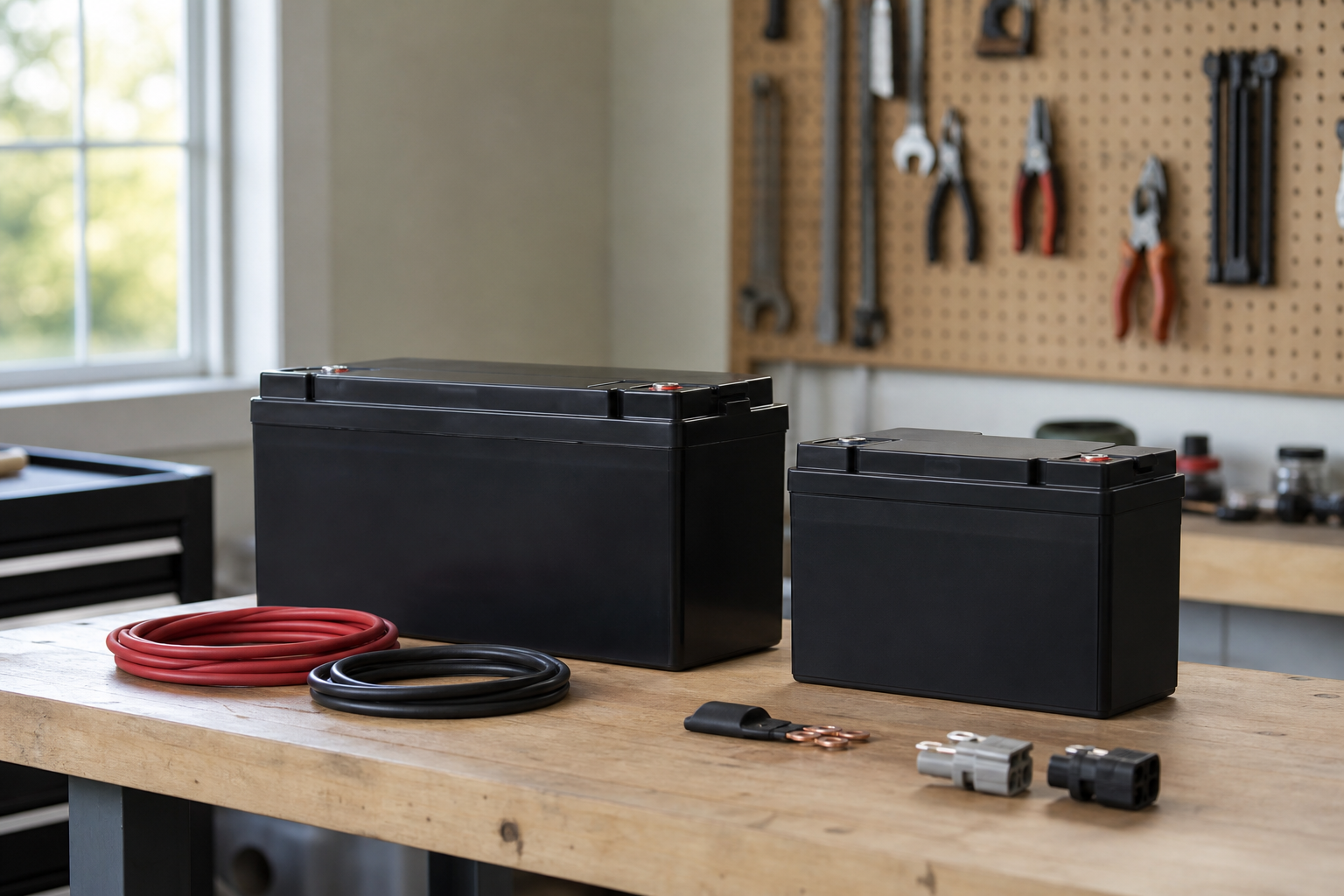
Measure before you order. Group sizes are only a rough guide, and two 100 Ah batteries can differ by several inches in length. Check the length and width of the tray, the height under the lid, and the space the cable lugs need above the terminals.
Don’t judge the charge by voltage. LiFePO4 holds an almost flat voltage through most of its range. That keeps lights and inverters steady, but it makes a voltmeter a poor fuel gauge. Bluetooth shows each battery’s own readings. A shunt-based monitor gives you one view of the whole bank, which is especially useful when several batteries work together; our guide to the best RV battery monitors (opens in a new tab) covers the options.
Read the warranty, not the cycle count. Makers rate cycle life at different depths of discharge, so the numbers don’t compare across brands. The warranty is the firmer number: five years for the Redodo and both LiTime batteries, seven years for the SOK, and seven years prorated for the Renogy Pro.
Check Your Charging Gear Before You Switch
A charger you already own can stay if its settings fit. Check every charge source against the battery maker’s voltage and current limits, use a LiFePO4 preset or compatible custom settings, and disable equalization and desulfation:
- Solar charge controller. Pick the LiFePO4 profile, or set the voltages by hand; LiTime calls for 14.4 V ± 0.2 V, for example, while SOK’s 314Ah wants no more than 14.0 V.
- Converter or shore charger. A multi-stage charger whose absorption voltage falls in the battery maker’s range can stay. A converter that only holds about 13.6 V charges a lithium battery slowly and seldom fills it, so check for a manufacturer-approved lithium upgrade before you replace it. The upgraded settings still have to suit your battery; if they don’t, choose a compatible replacement.
- Alternator. Lithium accepts far more current than lead-acid and can overwork an alternator wired straight to it. A DC-DC charger limits the current and supplies the right voltage; our guide on sizing one for your alternator (opens in a new tab) explains the math.
- Everything at once. When solar, shore power and the alternator charge together, their combined current has to stay within the bank’s charge limit.
Installation and Safety
- Fuse the positive cable close to the battery. Choose a DC-rated fuse that protects the cable, supports the expected load, and can interrupt the battery bank’s short-circuit current.
- Put the lug straight onto the terminal. Washers go between the lug and the bolt head or nut, never between the lug and the terminal, where they add resistance and heat. Tighten to the torque in the battery’s manual.
- Match the batteries in a bank. Use the same model, capacity and age, and charge each one to full on its own before you connect them, so they start at the same voltage.
- Secure the battery before you drive.
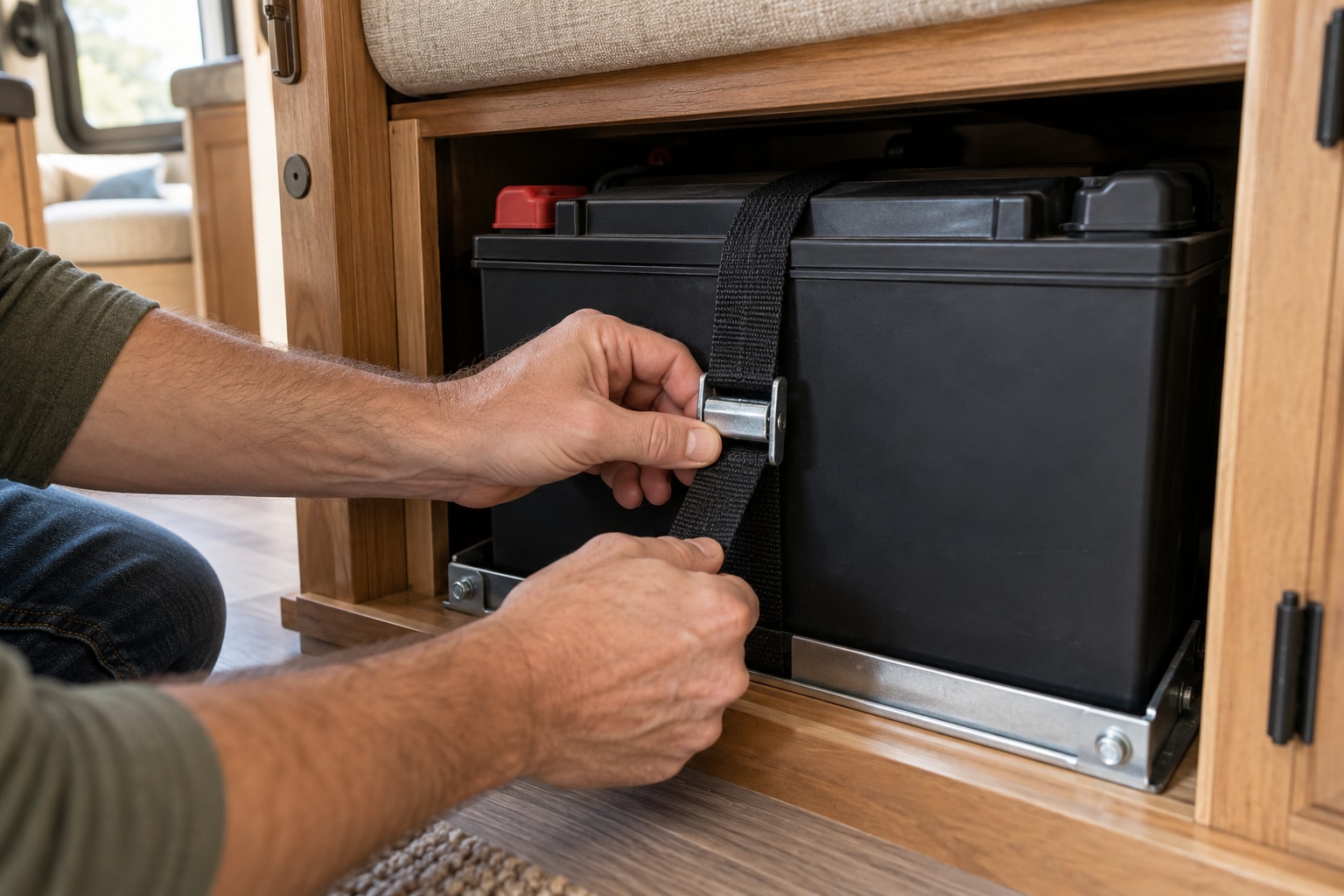
A tray and hold-down keep the battery from shifting on the road. Terminal covers protect the connections from accidental contact with tools. - Keep it dry and away from heat sources. LiFePO4 doesn’t vent gas in normal use the way flooded batteries do, but it still wants a protected, dry spot.
FAQs
- Is 100 Ah enough, or do I need 200 Ah? 100 Ah gives you about 1,024 Wh to plan with, plenty for lights, fans, a water pump and phones for a night or two. Add a 12V compressor fridge and regular inverter use and you’re closer to 200 Ah: the energy audit couple needs about 205 Ah to get through a day without charging. With solar sized to replace your daily use, the bank mainly has to cover nights and any cloudy spells you want to ride out.
- Can one battery run a 2,000 W inverter? Not at full output on a 100 A BMS: 2,000 W pulls about 185 A at 85 percent inverter efficiency. A 200 A battery like the LiTime 200Ah Xtra Mini covers the loads most people actually run, such as a 1,500 W microwave at about 140 A. At a full 2,000 W, though, it has little headroom: as the battery sags to 12.0 V, the draw rises to about 196 A, before other DC loads. For sustained loads near that level, choose a bank with more continuous-current capacity, such as two 200 A batteries or three 100 A batteries in parallel, wired to common bus bars with equal-length cables so they share the load. The cables and fuse have to be rated for that full draw too.
- Do I need self-heating, or is a low-temperature cutoff enough? A cutoff is enough if the battery stays above freezing most of the time, or if you can wait for the day to warm it before charging. Choose self-heating when the battery lives outside the heated space and you need to charge on freezing mornings. A cutoff blocks cold charging; a heater warms the cells so charging can begin, using part of the incoming charger power to do it.
- Can I keep my existing charger? Often, yes. What matters is whether its voltages and current fit the battery maker’s limits, not whether it says lithium on the label. A solar controller with a LiFePO4 profile or adjustable settings is fine, and so is a multi-stage converter with the right absorption voltage. If your converter is fixed at about 13.6 V, check for a compatible lithium upgrade before buying a replacement. Keep equalize and desulfation off, and put a DC-DC charger between the alternator and the battery.
- Can I expand the bank later? If you can, buy the whole bank at once. LiTime and Redodo both ask for matching models bought no more than about a month apart, so check with the maker before adding a new battery to an older bank. Wiring limits differ too: SOK can’t mix series and parallel, and the Renogy Pro can’t go in series at all, so check each battery’s limits in its specs above. Recheck the charge controller, cables and fuse for the bigger bank.
- Is lithium worth it if I mostly use shore power? If your lead-acid battery is healthy and you’re plugged in most nights, there’s little reason to replace it. When replacement is due, compare the installed cost, including any charging upgrades. Lithium pays off most when you camp off-grid often: you can use most of its capacity, it weighs far less per usable watt-hour, it recharges quickly from solar, and it lasts for thousands of cycles. Our AGM vs. LiFePO4 comparison (opens in a new tab) lays out the trade-offs.
Conclusion
For most RVs, the Redodo 12V 100Ah Ultra-Mini is the place to start: 1,280 Wh in a small, light case, with Bluetooth and a cold-charge cutoff. If the battery rides outside through freezing nights, the Renogy Pro’s self-heating earns its price. For a microwave or other big loads in a Group 31 tray, the LiTime 200Ah Xtra Mini gives you 200 A, and for longer stays between charges, the LiTime 320Ah Mini packs about 4 kWh into one case. If you run Victron gear with a GX device, the SOK 314Ah brings built-in heating and talks to it over CAN, for about the same energy.
Whichever you choose, size it from your daily watt-hours, check its continuous current against your biggest load, and match every charge source to the battery’s voltage and current limits. For more options at each size, compare our picks for the best 100Ah LiFePO4 battery (opens in a new tab) and the best 200Ah LiFePO4 battery (opens in a new tab).
Spot an error or an outdated detail in this guide?
Report it