AGM vs LiFePO4 for RV Solar: Pros, Cons & Verdict
On this page
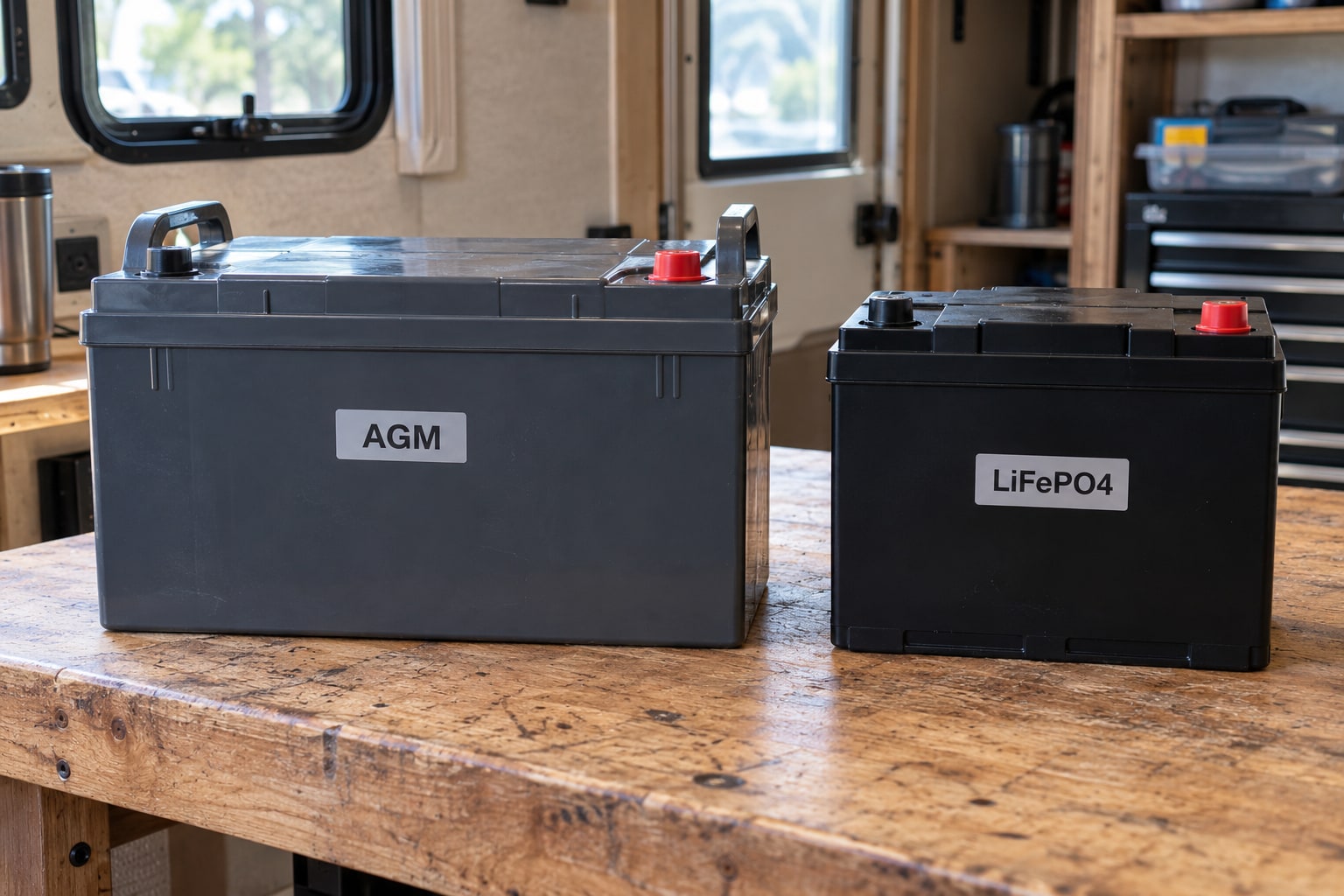
For an RV that camps off-grid regularly, LiFePO4 is the better battery. A 100 Ah lithium battery gives you about 1,000 Wh you can plan around, a 100 Ah AGM about 600 Wh, and the lithium battery weighs roughly a third as much. AGM still earns its place when your current bank already covers your trips, or when replacing it like for like saves you from reworking the charging system. Winter charging is the one question where the exact battery matters more than the chemistry, so it gets its own section before the six battery picks.
TL;DR
- Choose LiFePO4 for regular off-grid use: 100 Ah plans out to about 1,024 Wh against 600 Wh for AGM, at around a third of the weight.
- Keep or buy AGM when it already fits: a healthy bank that covers your needs, short trips with shore power, or chargers set up for lead-acid.
- Check your chargers before switching: the solar controller and converter must match the lithium battery’s voltages, with equalization and temperature compensation off, and alternator charging needs a current limit.
- Winter charging depends on the model: Renogy’s 100Ah AGM is rated to charge from 32°F, LiTime’s lithium battery blocks charging below 32°F, and a self-heating battery warms itself first.
- Our lithium picks: LiTime 100Ah Group 24 Bluetooth, Renogy 100Ah Pro Self-Heating and Redodo 100Ah Group 31 Basic.
- Our AGM picks: Renogy 100Ah, UPLUS 100Ah Group 27 and the 125 Ah VMAX SLR125.
AGM vs LiFePO4 at a Glance
The table compares the two chemistries, with the batteries in this guide as reference points. Usable energy is a planning figure: 50 percent of nominal energy for AGM, a common daily limit that protects its cycle life, and 80 percent for LiFePO4, which leaves a margin on batteries built to go deeper.
Scroll sideways to see every column.
| Factor | AGM | LiFePO4 |
|---|---|---|
| Planned usable energy, 100 Ah | About 600 Wh (50% of 1,200 Wh) | About 1,024 Wh (80% of 1,280 Wh) |
| Weight, 100 Ah | 60–64 lb | 22–27 lb |
| Charging | Long absorption stage as the current tapers, then float | High current until nearly full, short absorption, float optional |
| Charging below 32°F | Depends on the model; Renogy’s 100Ah AGM is rated from 32°F | Not without heating: a cutoff blocks it, and unprotected cells can be damaged |
| Rated cycle life | 500 cycles at 50% depth of discharge (Renogy) | 6,000 cycles at 80% depth of discharge (LiTime) |
| Charging equipment | A lead-acid profile that matches its voltages | Lithium voltages, no equalization or temperature compensation, current-limited alternator charging |
| A good buy when | Your bank already covers your needs, or trips are short with shore power | You camp off-grid often, weight is tight, or you need more usable energy |
Usable Energy and Weight: A Worked Example
An AGM battery isn’t a half-capacity battery; all its rated amp-hours are there. But 50 percent is a common daily limit, because deeper cycles cost it life: Victron’s AGM datasheet rates its deep-cycle AGMs for 600 cycles at 50 percent discharge and 400 at 80 percent, and Renogy tells owners of its 100Ah AGM not to go below half. LiFePO4 takes deep cycling in its stride. LiTime rates its Group 24 battery for 4,000 cycles even at full depth of discharge, so planning on 80 percent leaves a comfortable margin.
Compare the two in watt-hours, because their nominal voltages differ:
- 100 Ah AGM at 12 V: 1,200 Wh nominal, about 600 Wh at 50 percent.
- 100 Ah LiFePO4 at 12.8 V: 1,280 Wh nominal, about 1,024 Wh at 80 percent.
That’s about 1.7 times the planned usable energy from the same amp-hour rating. To size a bank, work backward from your daily use:
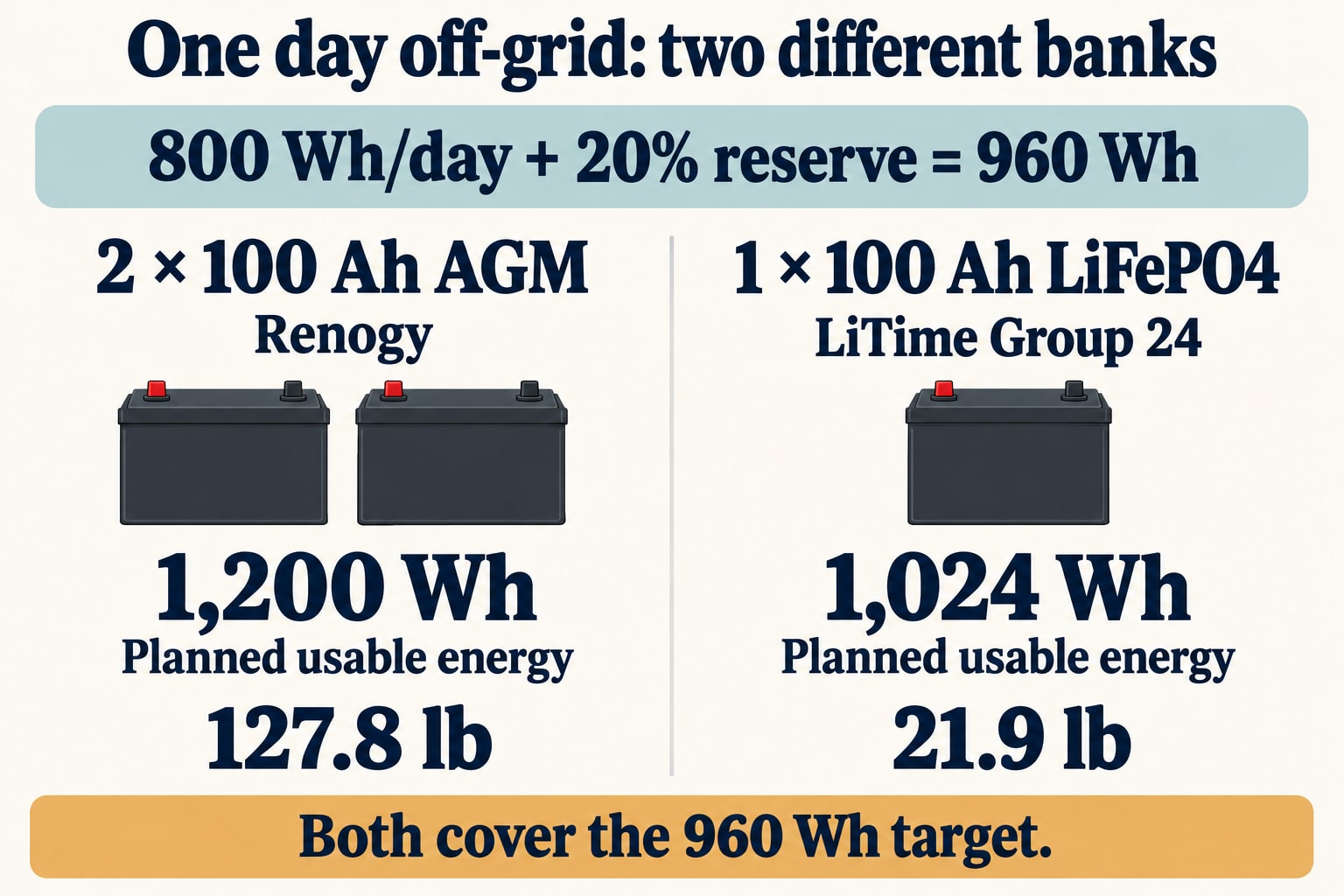
Take a small rig that uses 800 Wh a day, measured at the battery so inverter losses are already included, and size it for one day without charging plus a 20 percent reserve: 800 × 1.2 = 960 Wh.
- AGM: 960 ÷ (12 × 0.5) = 160 Ah. In practice that’s two 100 Ah batteries, with about 1,200 Wh of planned usable energy and 127.8 lb as a pair of Renogy AGMs.
- LiFePO4: 960 ÷ (12.8 × 0.8) = 93.75 Ah. One 100 Ah battery covers it, with about 1,024 Wh and 21.9 lb as a LiTime Group 24.
To compare AGM and lithium for your own trip (opens in a new tab), enter your daily watt-hours and days off-grid, then switch the battery type to see how many batteries each setup takes.
The two banks aren’t identical, since the AGM pair has a little more planned energy, but the lithium battery covers the same day at about a sixth of the weight and in about a third of the space. To find your own daily number, follow our RV energy audit guide (opens in a new tab); for longer stretches off the grid, our amp-hour sizing guide for boondocking (opens in a new tab) runs the same math over several days.
Heavy loads widen the gap. AGM capacity is quoted at a slow discharge and shrinks as the current rises; in Victron’s datasheet, its AGMs deliver 85 percent of their 20-hour rating over five hours and 65 percent over one hour, and Renogy rates its 100Ah AGM over 10 hours. A 1,000 W AC load draws about 93 A from a 12 V bank through a 90-percent-efficient inverter. That’s a heavy load for one 100 Ah AGM; a larger parallel bank spreads the current across more batteries. Under sustained heavy loads, AGM gives up more capacity and its voltage sags further, which can make the inverter shut down early. LiFePO4 holds its voltage much better under the same load.
What Switching to Lithium Means for Your Chargers
What matters is what each charger actually does: the voltages it holds, the current it delivers, its stages and any extra modes, not the label on its battery-type switch. A programmable charger can suit LiFePO4 without a button marked “Lithium”, and a charger that has one still has to match the battery maker’s specifications.
Set a lithium battery’s absorption voltage within its maker’s range: 14.2 to 14.6 V for the LiTime, 14.6 V for the Redodo. A float stage isn’t forbidden; Battle Born, for one, says a float under 13.6 V is fine for its batteries. What must be off is equalization or desulfation, which pushes the voltage far above what lithium tolerates, and temperature compensation, which raises it in the cold. For comparison, Renogy’s AGM absorbs at 14.4 to 14.8 V, floats at 13.5 to 13.8 V and takes no more than 30 A.
Go through your charging sources one at a time before you order:
- Solar charge controller. If it has a LiFePO4 preset or lets you set absorption and float yourself, the switch is a settings change. Make sure equalization and temperature compensation can be turned off. To refill the bank from the roof each day, work out the array size with our RV solar wattage guide (opens in a new tab).
- Converter or inverter-charger. Find out what it actually does. A converter fixed at about 13.6 V charges lithium slowly near the top and never reaches the recommended absorption voltage. Keep an existing converter if its settings meet the new battery’s charging requirements; otherwise, a compatible replacement gives you the intended charge profile and recharge speed.
- Alternator. If it charges the house bank, the charging path has to cap the current and suit lithium. A lithium bank can draw far more charge current than an AGM, enough to overwork an alternator through a plain isolator or combiner; a DC-DC charger is the usual fix, and it also applies the battery’s own charge profile.
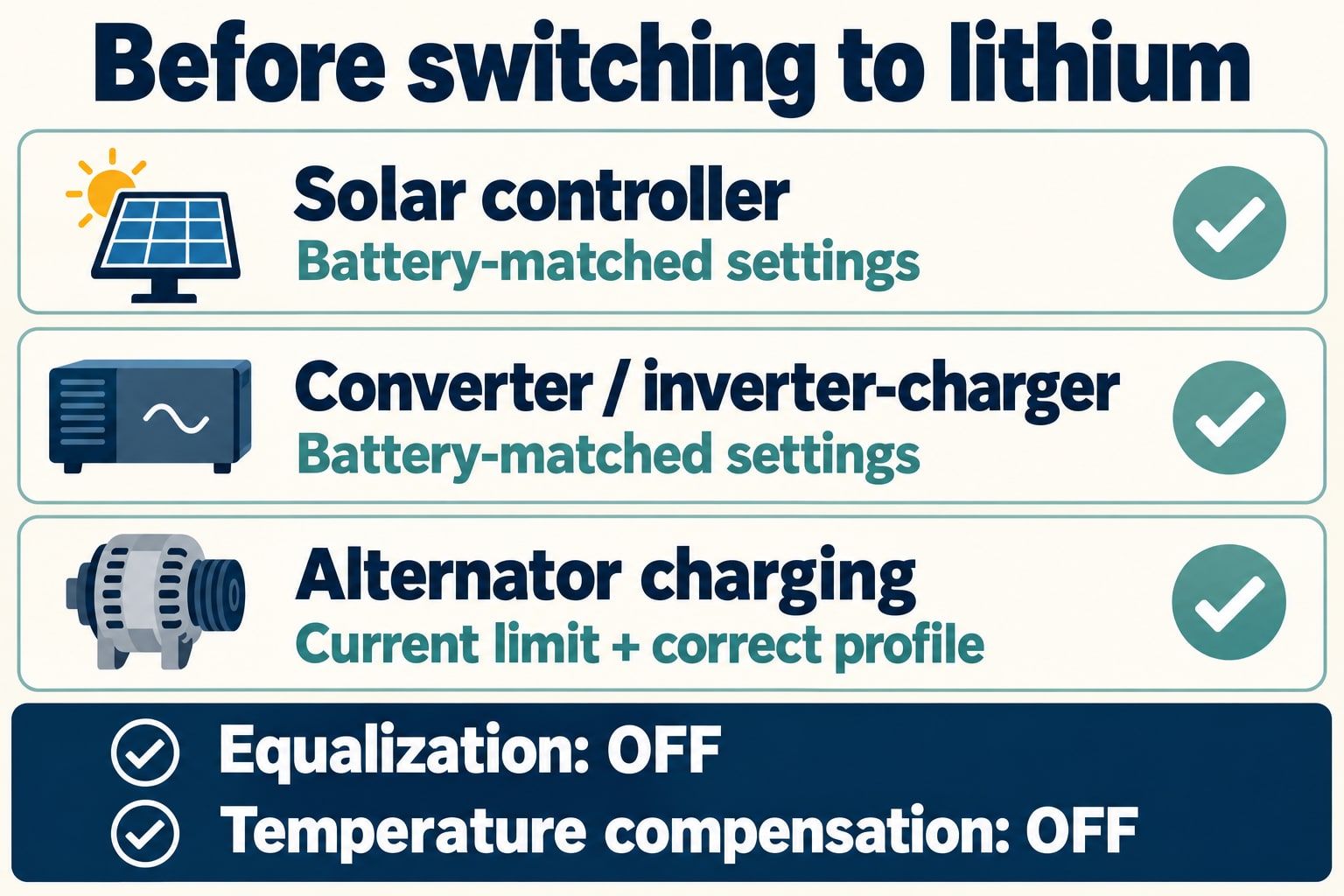
If your chargers already have an AGM setting in the right range, an AGM replacement needs none of this, which is why it’s the low-effort choice.
Charging in Cold Weather
Cold limits charging far more than use, and the limits belong to the exact battery model, not to the chemistry as a whole. Renogy’s AGM and all three lithium batteries here are rated to discharge down to −4°F. Charging is where they differ:
- Charging range. The temperatures at which a battery may be charged at all. Renogy’s 100Ah AGM is rated for charging only from 32°F, the same limit as standard lithium cells.
- Low-temperature cutoff. A BMS feature that stops charging when the cells are too cold. LiTime’s battery cuts off below 32°F and resumes at 41°F. It can stay connected in an unheated bay and protect itself, but no energy goes in until the cells warm up.
- No protection. Redodo’s Group 31 Basic has no low-temperature charging protection, so the converter, alternator and solar can all push current into frozen cells unless each one is set up to stop in the cold.
- Self-heating. The battery warms its own cells so it can take a charge. Renogy’s Pro battery starts heating below 41°F and stops above 50°F, provided the charger delivers a steady current above 4 A per battery.
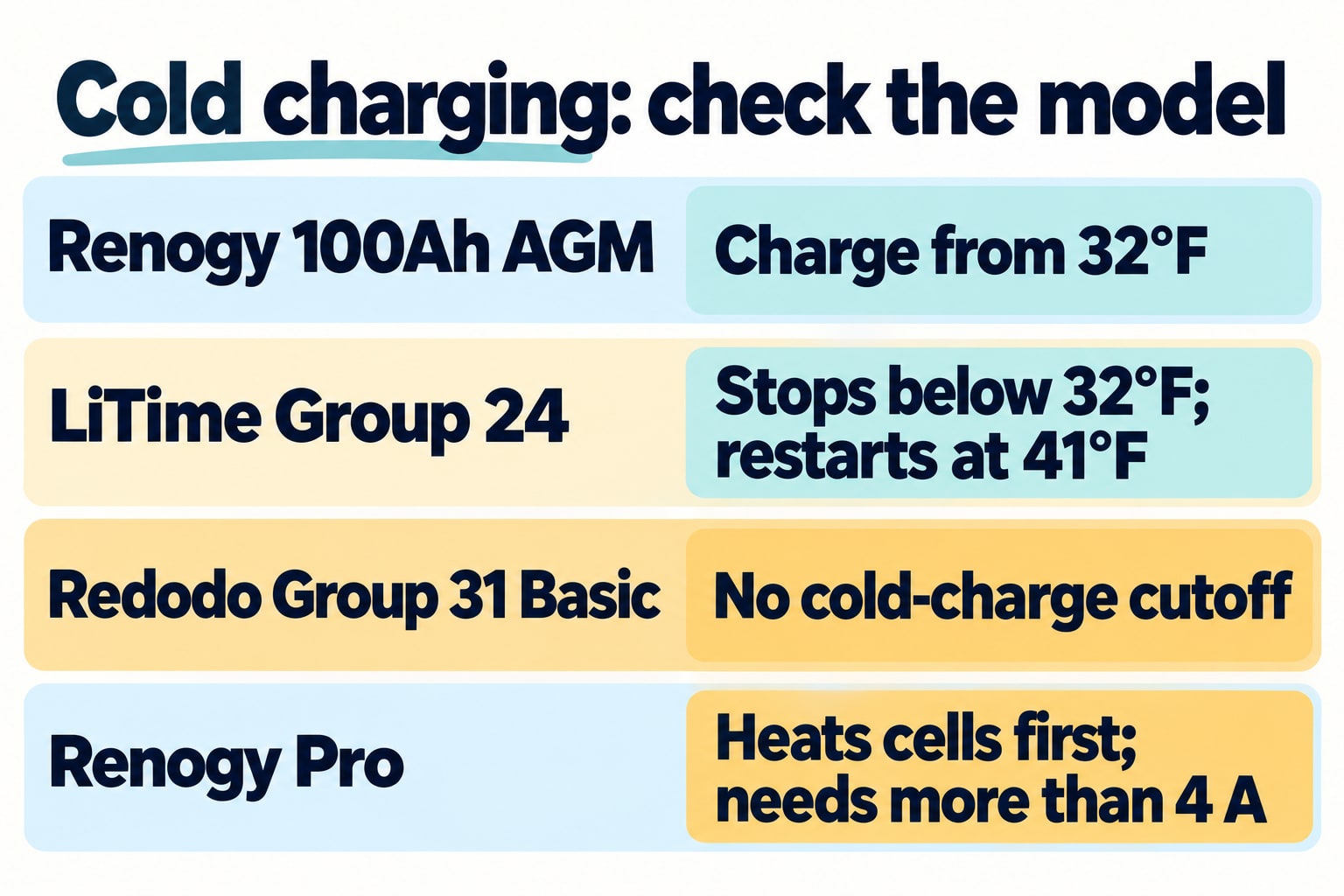
Insulation slows cooling, but it can’t warm a battery that has already cold-soaked overnight. For dependable winter charging, keep the cells in heated space or choose a self-heating model. If you prefer AGM, check that battery’s own charging range: some AGMs are rated to charge below freezing, but Renogy’s isn’t.
Lifespan and Total Cost
Cycle ratings come from tests at a set depth of discharge and temperature, so they show how batteries compare, not how many years one will last in your RV. Renogy rates its AGM for 500 cycles at 50 percent; LiTime rates its lithium battery for 6,000 at 80 percent. Daily cycling adds roughly 365 cycles a year, while 30 camping cycles a year add only 150 over five years. That’s why lithium’s cycle-life advantage matters far more to a full-timer than to a weekend camper, whose battery also ages between trips.
Warranties follow a similar pattern: 1 year for the VMAX, 2 years for the UPLUS, 2 years prorated for Renogy’s AGM, 5 years for LiTime and Redodo, and 7 years for the Renogy Pro. A warranty covers defects for that period; it isn’t a promise of service life.
Price the whole switch, not just the battery. Going lithium can add a converter or charger, a DC-DC charger, a shunt monitor, cables and fuses, and it often means buying fewer batteries, since one lithium battery can replace two AGMs. Frequent cycling, tight weight limits and the need for more usable energy all point strongly to LiFePO4. Without those pressures, a healthy AGM bank can stay in service until it wears out.
Six Batteries Worth Buying
These six cover both sides of the decision: three LiFePO4 batteries for different installations and three AGMs for owners staying with lead-acid. The figures come from each maker’s published specifications and product listings, not from tests of our own, and the usable-energy column uses the same 50 and 80 percent planning figures as the table above. Our lithium battery roundup for RV solar (opens in a new tab) covers bigger batteries and more choices.
As an Amazon Associate I earn from qualifying purchases.
Scroll sideways to see every column.
| Battery | Chemistry / Capacity | Planned Usable Energy | Weight | Main Reason to Choose It | Where to Buy |
|---|---|---|---|---|---|
| LiTime 12V 100Ah Group 24 Bluetooth | LiFePO4, 100 Ah | 1,024 Wh | 21.9 lb | Group 24 size, Bluetooth, low-temperature cutoff | Amazon ↗ |
| Renogy 12V 100Ah Pro Self-Heating | LiFePO4, 100 Ah | 1,024 Wh | 26.9 lb | Heats itself for winter charging | Amazon ↗ |
| Redodo 12V 100Ah Group 31 Basic | LiFePO4, 100 Ah | 1,024 Wh | 22 lb | Fits a Group 31 battery box | Amazon ↗ |
| Renogy 12V 100Ah Deep Cycle AGM | AGM, 100 Ah | 600 Wh | 63.9 lb | Like-for-like AGM replacement | Amazon ↗ |
| UPLUS 12V 100Ah Group 27 AGM-Gel | AGM/gel hybrid, 100 Ah | 600 Wh | 60.1 lb | Budget AGM for light loads | Amazon ↗ |
| VMAX SLR125 | AGM, 125 Ah | 750 Wh | 75 lb | 125 Ah in a single Group 31 case | Amazon ↗ |
LiTime 12V 100Ah Group 24 Bluetooth: Best Lithium Upgrade for Most RVs
For most RVs leaving AGM behind, this is the battery to start with. Its compact Group 24 case leaves extra room in many larger battery boxes, it weighs 21.9 lb, and the Bluetooth app shows the state of charge on your phone, something a voltmeter can’t do reliably for lithium. Its BMS allows 100 A continuously and refuses a charge below freezing.
- Key specs: 1,280 Wh at 12.8 V, 100 A continuous (500 A for 1 second), charge at 14.2 to 14.6 V, 20 A recommended and 100 A maximum, charging cutoff under 32°F with restart at 41°F, 6,000 cycles at 80 percent, IP65, 10.24 × 6.61 × 8.27 in, 5-year warranty.
- Choose it for: a first lithium battery to replace an AGM, with monitoring built in.
- Know before you buy: it doesn’t heat itself, so a cold bay delays charging until the cells reach 41°F. One battery’s 100 A limit suits an inverter of about 1,000 W; a 2,000 W inverter needs at least two in parallel. Expansion stops at 4S4P, with matching LiTime batteries purchased no more than a month or so apart. In a bigger box, check terminal clearance and secure the smaller case so it can’t shift.
Check the LiTime 12V 100Ah Group 24 Bluetooth on Amazon
Renogy 12V 100Ah Pro Self-Heating: Best for Winter Charging
If your solar or alternator has to charge in freezing weather, buy a battery that heats itself. Renogy’s Pro (model RBT12100LFP-BT) warms its cells below 41°F while it’s being charged and stops heating once they pass 50°F, which stretches its charging range down to −4°F. Bluetooth, an IP67 case and a 7-year warranty round it out.
- Key specs: 100 Ah, 100 A continuous and 245 A for up to 30 seconds, 100 A maximum charge, heating from below 41°F to 50°F, charges at −4 to 131°F, 5,000 cycles at 80 percent, IP67, 10.6 × 7.6 × 8.1 in, 26.9 lb, 7-year warranty.
- Choose it for: camping in freezing weather with solar or alternator charging.
- Know before you buy: weak winter sun that delivers less than 4 A per battery won’t start the heater. Renogy limits it to parallel banks of eight or fewer, which rules out a 24 V or 48 V system. It’s 7.6 inches wide, an inch more than a Group 24 case.
Check the Renogy 12V 100Ah Pro Self-Heating on Amazon
Redodo 12V 100Ah Group 31 Basic: Best Fit for a Group 31 Battery Box
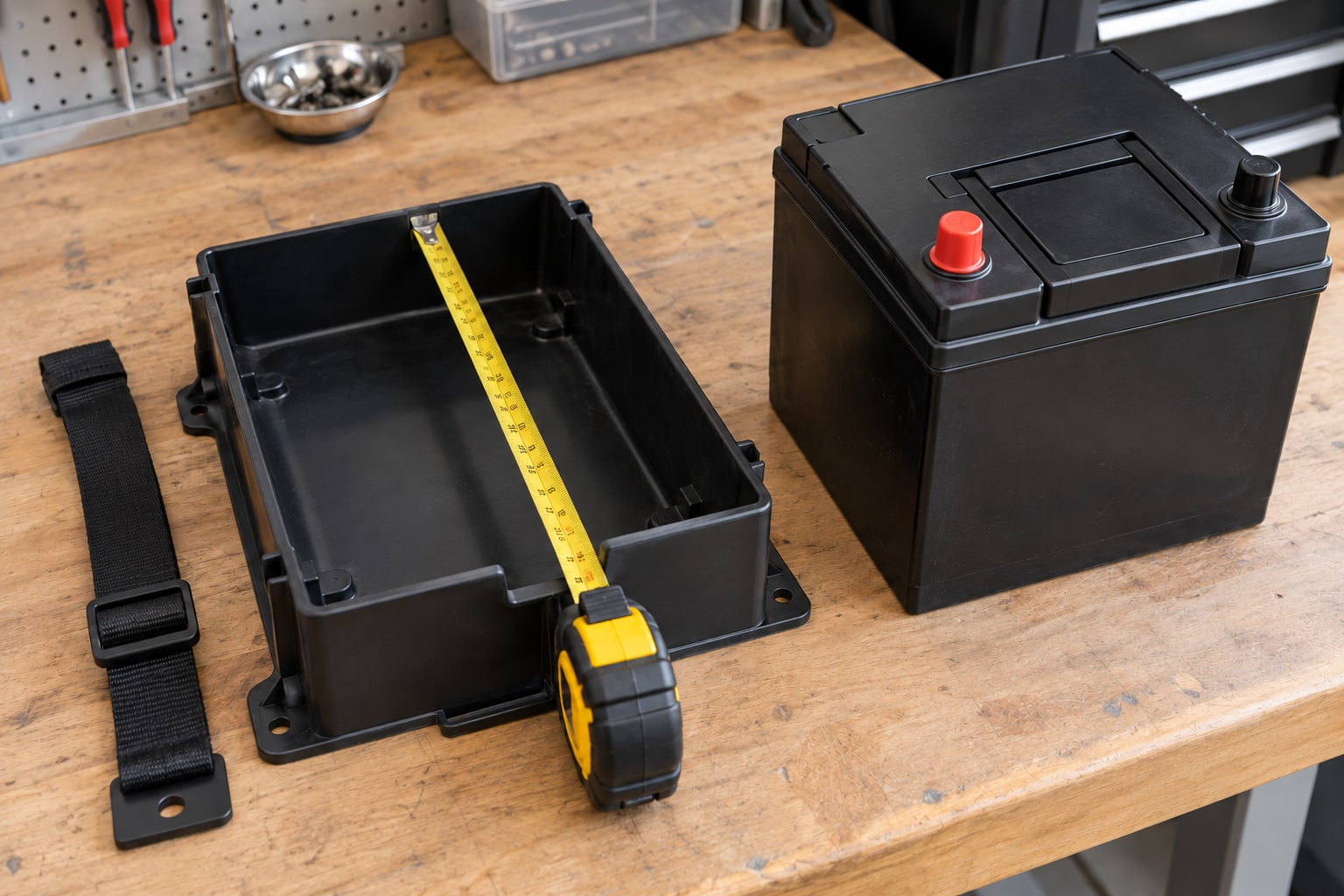
Redodo’s Group 31 Basic (model FE-A14114N-0D) has a Group 31 footprint, which makes it a straightforward candidate for an existing Group 31 tray; check the height, terminal clearance and hold-down before ordering. It keeps to the essentials: 1,280 Wh, a 100 A BMS and about 22 lb, with no Bluetooth and no low-temperature protection.
- Key specs: 12.8 V, 1,280 Wh, 100 A BMS with 300 A for 5 seconds, 14.6 V charge voltage, 20 A recommended charge current (100 A max), charges at 32 to 122°F, 4,000 cycles at 100 percent depth of discharge, up to 4S4P, 13 × 6.77 × 8.43 in, 5-year warranty.
- Choose it for: swapping a Group 31 AGM for lithium in a bay that stays above freezing.
- Know before you buy: the battery has no cold-charge cutoff. Keep it above freezing, or make sure every charging source stops when the battery is too cold; a temperature-controlled solar charger protects only the solar charging path. Redodo advises against mixing brands or models in a bank. Check that the listing says Group 31; Redodo also sells Mini, Group 24, Low-Temp and Self-Heating versions.
Check the Redodo 12V 100Ah Group 31 Basic on Amazon
Renogy 12V 100Ah Deep Cycle AGM: Best Like-for-Like AGM Replacement
When worn AGMs need replacing and your converter and solar controller already have a matching AGM setting, this is the simplest swap. Renogy’s window is 14.4 to 14.8 V for absorption and 13.5 to 13.8 V for float; if your chargers’ AGM setting falls inside it, nothing else changes. It needs no water and loses under 3 percent of its charge a month in storage.
- Key specs: 100 Ah at the 10-hour rate, 30 A maximum charge, charging range 32 to 122°F, discharge −4 to 140°F, 500 cycles at half depth of discharge, 1,100 A for 5 seconds, supports series connections and up to four in parallel, 13.1 × 6.9 × 8.6 in, 63.9 lb, 2-year prorated warranty.
- Choose it for: replacing worn AGMs without touching a charging system that already suits them.
- Know before you buy: its charging range starts at 32°F, so it isn’t a winter-charging answer. Install it upright, never upside down. Limit total charging current to 30 A for one battery; a larger adjustable charger can be turned down, so adding a second battery isn’t the only fix. The 1,100 A rating lasts five seconds, not the minutes an inverter load runs.
Check the Renogy 12V 100Ah Deep Cycle AGM on Amazon
UPLUS 12V 100Ah Group 27 AGM-Gel: Best Budget AGM for Light Loads
For weekend trips with modest 12 V loads, the UPLUS (model LDC12-100M) is the budget way to replace a worn AGM. It’s an AGM/gel hybrid in a Group 27 case, a little smaller and lighter than the Renogy AGM, and its low self-discharge suits a battery that sits between trips.
- Key specs: 12 V, 100 Ah, AGM/gel hybrid, 25 A maximum charge, 45 A maximum continuous discharge, 710 A for 5 seconds, self-discharge under 3 percent a month, Group 27, 12.05 × 6.61 × 8.19 in, 60.1 lb, 2-year warranty.
- Choose it for: lights, fans, the water pump and device charging on short trips.
- Know before you buy: the 45 A continuous limit keeps one battery to an inverter load of roughly 480 W, so it isn’t for microwaves or coffee makers. Keep charging at or below 25 A. UPLUS’s own site and its Amazon listing disagree on whether −4 to 131°F is the charging or the discharge range, so don’t plan on charging it below freezing.
Check the UPLUS 12V 100Ah Group 27 AGM-Gel on Amazon
VMAX SLR125: Most AGM Capacity in One Case
If you’re staying with AGM but need more than 100 Ah from one battery box, the SLR125 fits 125 Ah into a Group 31 case. At our 50 percent planning figure that’s about 750 Wh, a quarter more than a 100 Ah AGM in nearly the same space, and its 8 mm screw-in terminals take ring terminals directly.
- Key specs: 125 Ah, Group 31, 12.9 × 6.8 × 8.7 in, 75 lb, 8 mm screw-in terminals, 1-year warranty.
- Choose it for: AGM owners who need more capacity but have room for only one battery.
- Know before you buy: at 75 lb, it’s the heaviest battery here and a two-person lift into a high bay. VMAX advertises an 8- to 10-year float service life, which describes standby use on a float charger, not daily cycling in an RV.
Safety and Installation Mistakes
- Mixing chemistries in one bank. Keep AGM and LiFePO4 in separate banks. Their resting voltages and discharge curves differ, so they don’t share current evenly, and if the lithium BMS disconnects, the AGM suddenly carries the whole load. A lead-acid engine battery alongside a lithium house bank is fine, with a suitable charging connection between them.
- Leaving AGM unvented. AGM is valve-regulated, not gas-free: Victron notes that gas escapes through the valves when a battery is overcharged or a cell fails. Install AGMs in a compartment vented to the outside, not loose in the living space.
- Expanding outside the maker’s rules. LiTime wants identical LiTime batteries bought close together, Redodo advises against mixing models, and the Renogy Pro connects only in parallel. Follow the limits for the model you own.
- Treating the BMS as a fuse. The BMS protects the cells, not the cables. Fit a fuse sized to the cable close to each battery’s positive terminal.
- Undersizing the bank for the inverter. A 2,000 W inverter at 90 percent efficiency draws about 174 A at 12.8 V, more than one 100 A battery can supply. With AGM, size by continuous current too; 5-second ratings don’t apply to an inverter running for minutes.
- Expecting the monitor to stop a discharge. A battery monitor shows the state of charge and helps you manage loads, but it won’t disconnect anything unless your system has a disconnect it controls.
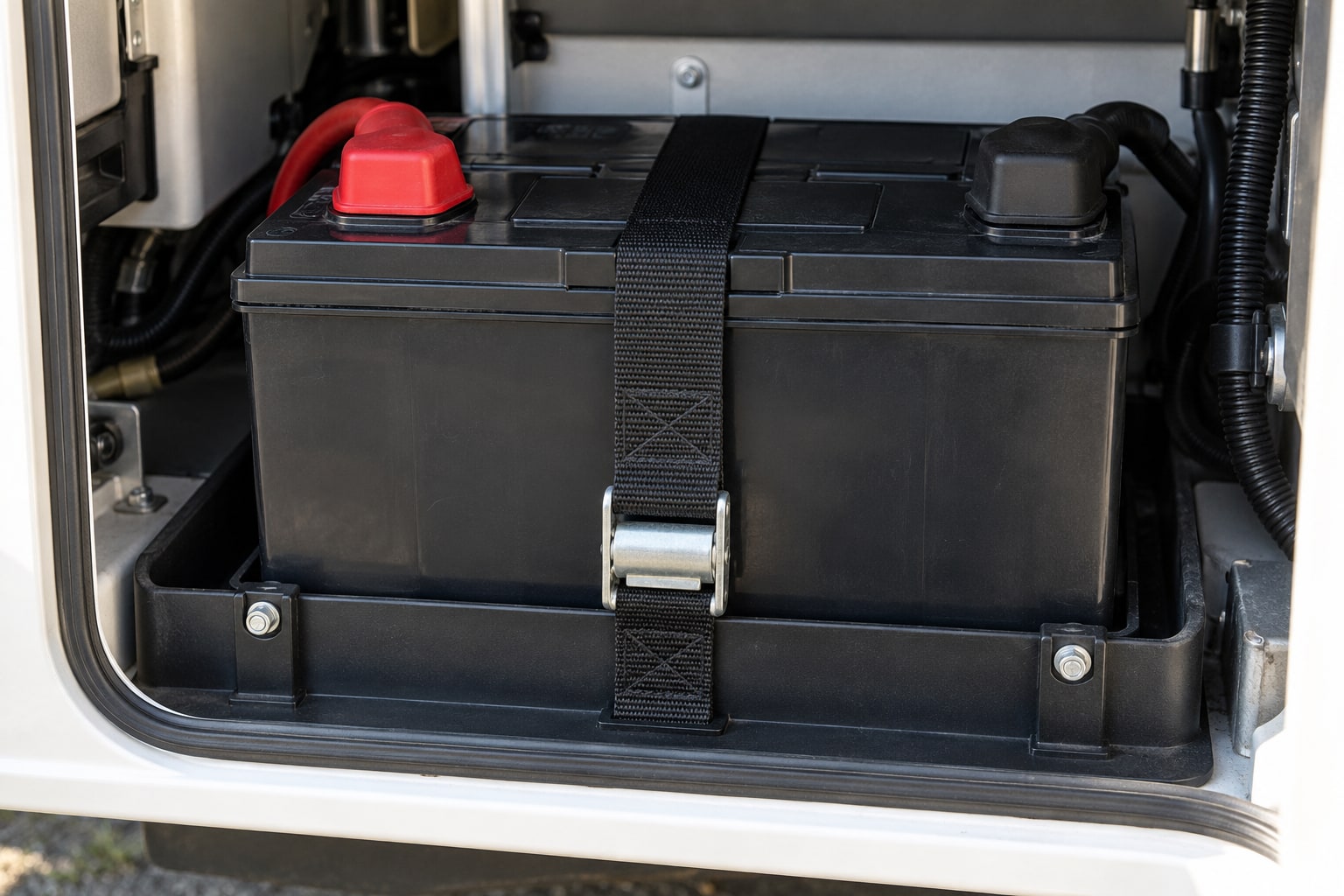
- Leaving batteries loose. Fix every battery with a hold-down so it can’t slide or tip in a sudden stop.
FAQs
- Is LiFePO4 better than AGM for RV solar? For regular off-grid camping, yes. Each 100 Ah gives you roughly 70 percent more planned usable energy than AGM at about a third of the weight, and it takes solar charge without a long absorption stage. AGM stays the sensible choice when your current bank covers your needs or your trips are short with shore power.
- Can I replace my AGM batteries with LiFePO4? Yes, and the lithium battery often fits the same box. Set the solar controller and converter to the new battery’s voltages, switch off equalization and temperature compensation, and if the alternator charges the house bank, make sure that path limits current and suits lithium, which usually means a DC-DC charger. Replace the whole bank rather than mixing the two.
- Can lithium RV batteries charge below freezing? Standard LiFePO4 cells shouldn’t be charged below 32°F. A cutoff like LiTime’s holds off charging until the cells warm to 41°F, while a self-heating battery like Renogy’s Pro warms itself first if the charge current is strong enough. Insulation alone won’t warm a cold-soaked battery.
- Which battery is cheaper over time? For frequent deep cycling, LiFePO4 is the stronger long-term buy. For occasional trips, keeping a healthy AGM bank can cost less than changing the batteries and charging equipment. Compare the complete installed cost, not just the price of one battery.
- How many AGM or lithium batteries does my RV need? Start with daily energy use, then multiply by the days you need without charging. At 800 Wh a day, one day plus a 20 percent reserve calls for two 100 Ah AGMs or one 100 Ah LiFePO4 battery. For longer trips, multiply the energy requirement first, then round up to a suitable bank size.
- Can I use AGM and lithium batteries in the same RV? Yes, as separate systems. The engine battery can stay lead-acid with a lithium house bank, typically linked by a DC-DC charger. What you can’t do is wire AGM and LiFePO4 together as one bank.
Conclusion
Pick by how you camp. Keep a healthy AGM bank that already covers your trips. When replacement time comes, AGM remains a simple choice for modest use with compatible chargers, and the Renogy AGM, UPLUS and VMAX cover that ground. Regular boondocking, tight weight limits and higher energy needs favor LiFePO4: the LiTime Group 24 suits most RVs, and the Redodo Group 31 Basic matches a Group 31 footprint. For winter charging, choose the self-heating Renogy Pro or keep the battery in heated space, and with AGM, confirm that exact battery’s charging range before you rely on it below freezing.
Spot an error or an outdated detail in this guide?
Report it