RV Solar Charge Controller Sizing: Get the Right Amps
On this page

Divide 400 W by 12 V and you get 33 A, which makes a 30A charge controller look too small. It isn’t. A 30A MPPT rated for at least 400 W at 12V, such as Victron’s SmartSolar 100/30, handles a 400 W roof. That shortcut leaves out two things: a charging battery sits above its nominal voltage, and the controller safely caps its own output at 30 A.
A 50A controller gives you room for more panels, but 400 W alone doesn’t require it. If you’re still deciding how many panels to buy, our RV solar wattage guide (opens in a new tab) works out the array size first.
TL;DR
- 400 W on 12V: a 30A MPPT whose maker allows 400 W or more at 12V will do; the SmartSolar 100/30 is rated for 440 W.
- Amps are on the battery side: the amp rating is the most current an MPPT controller can deliver to the battery; the actual current is roughly panel power, less conversion losses, divided by the charging voltage.
- Check the panel side separately: the array’s voltage on the coldest morning and its short-circuit current each need to fit the controller’s PV ratings.
- Go bigger for a reason: a 40A or 50A controller pays off when you’ll add panels or want to clip less, not because today’s array needs it.
- Fit the battery: solar plus any other charger running at the same time has to stay within the battery’s charge-current limit.
What You’ll Need
- Panel ratings from each panel’s label or datasheet: watts, Vmp and Imp (voltage and current at maximum power), Voc (open-circuit voltage), Isc (short-circuit current) and the Voc temperature coefficient.
- Battery details: the bank’s nominal voltage, its chemistry, and the maker’s charging voltages and charge-current limit.
- Coldest morning: the lowest temperature you expect anywhere you travel, for the cold-voltage check.
- Wiring plan: how many panels go in series per string, and how many strings run in parallel.
- Controller datasheet: charge current, the PV power rating for your battery voltage, maximum PV voltage and current, and the start-up voltage.
What the Controller’s Amp Rating Means
An MPPT controller’s amp rating is its charging current: the most it will deliver to the battery. It isn’t a limit on the panel side, which has its own voltage and current ratings. The controller takes power from the panels at their voltage and hands it to the battery at battery voltage, so the current rises as the voltage comes down. That’s how MPPT turns surplus panel voltage into extra charging current, minus some conversion loss, as Morningstar’s MPPT white paper shows.
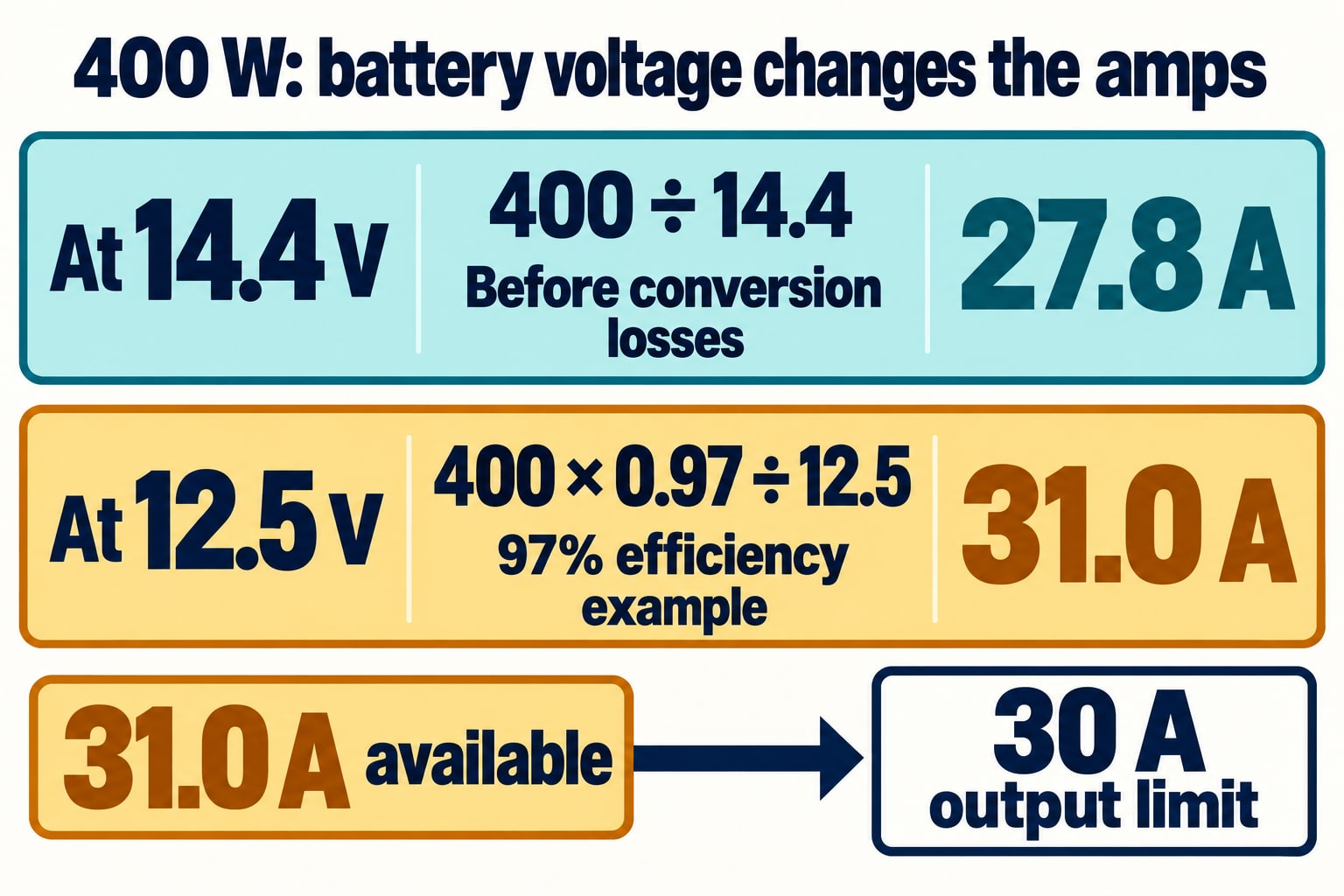
The 33.3 A from 400 ÷ 12 uses the bank’s nominal voltage; the actual charging current depends on its voltage at the time. With 400 W reaching the controller and the battery at 14.4 V, the current is about 27.8 A before losses. A low battery can still take the controller to its limit: at an example 97 percent efficiency and a battery at 12.5 V, 400 W would make about 31 A, so a 30A unit caps its output. The charging voltage and the maker’s published ratings tell you more than any blanket multiplier.
The familiar rule of thumb, watts ÷ battery volts × 1.25, would put a 400 W roof at 42 A. That 1.25 lumps together three separate things:
- The controller’s own ratings: the panel power, voltage and current its maker allows.
- Room to grow: buying a larger controller for panels you plan to add, which is a choice rather than a requirement.
- Cable and fuse sizing: the battery cable and its fuse follow the controller’s maximum charge current and its manual, and the PV wiring follows the panel and controller ratings.
Start from the maker’s ratings, and add margin only where one of those three calls for it.
30A, 40A and 50A Controllers Compared
Makers publish how much panel power each MPPT model is designed for at each battery voltage. Victron’s names help, too: in 100/30, 100 is the maximum PV voltage and 30 is the maximum charging current. These three are common RV sizes:
Scroll sideways to see every column.
| Controller | Charge Current | Published PV Power, 12V | Published PV Power, 24V | Max PV Voc |
|---|---|---|---|---|
| Victron SmartSolar 100/30 | 30 A | 440 W | 880 W | 100 V |
| Renogy Rover Li 40A (RNG-CTRL-RVR40) | 40 A | 520 W | 1,040 W | 100 V |
| Victron SmartSolar 100/50 | 50 A | 700 W | 1,400 W | 100 V |
None of these figures follows from amps × 12: the 50A Victron is rated for 700 W at 12V, not 600 W. They don’t all mean the same thing, either. In Victron’s specifications the watts are nominal: connect more panels and the controller throttles its input, within its other limits. Renogy, by contrast, lists its 520 W and 1,040 W as the Rover’s maximum PV input power. So the table isn’t a license to overpanel every model.
Check PV Voltage and Input Current
The amp rating says nothing about what the panel side can take. Three checks cover it: the highest voltage on a cold morning, the lowest voltage on a hot afternoon and the input current.
Cold Weather Raises the Voltage
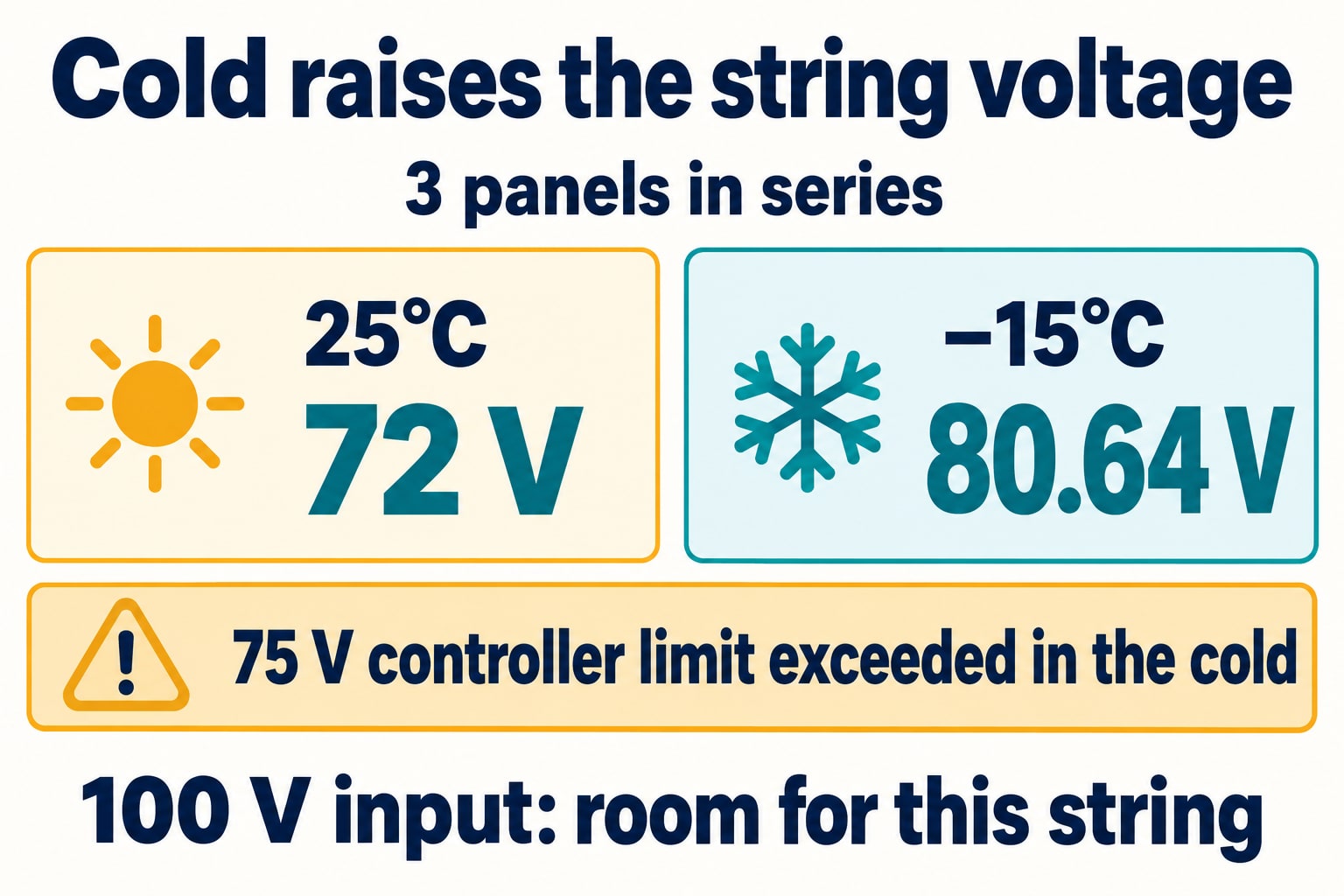
Panel voltage climbs as the temperature drops, and the controller’s maximum PV voltage is a hard limit. Take three example panels in series, each with a Voc of 24 V. At the 25°C (77°F) rating temperature, the string reaches 3 × 24 = 72 V. With a temperature coefficient of −0.30 %/°C for Voc and a −15°C (5°F) morning, 40 degrees below that reference, it rises to 72 × [1 + 0.0030 × 40] = 80.64 V.
That rules out a 75 V controller, while a 100 V input has room for this string. If a string’s cold Voc comes out too high, wire fewer panels in series and more strings in parallel, or choose a controller with a higher voltage limit.
Hot Panels Lower It
The voltage can be too low as well. These controllers only step a higher panel voltage down to battery voltage, never up, so a single 12V panel can’t charge a 24V bank. Heat lowers a panel’s Vmp too, so the array has to clear the controller’s starting and running thresholds when the roof is hot. On the Victron models in the table, the PV voltage has to exceed the battery voltage by 5 V to start charging and by 1 V to keep going; other makers set their own thresholds.
Input Current Is a Separate Limit
The panel side gets its own limit, usually a highest allowed PV short-circuit current and sometimes a separate maximum operating input current as well. The SmartSolar 100/30 charges at up to 30 A, yet its PV input is rated for 35 A of short-circuit current; the 100/50 pairs 50 A of charging with a 60 A input limit. The output rating can’t stand in for the input limit.
With identical panels, a series string adds up the voltages and keeps the current of one panel, while parallel strings add up their currents. Our series-parallel wiring guide (opens in a new tab) runs both layouts against a controller’s limits.
Worked Example: A 400 W RV Array
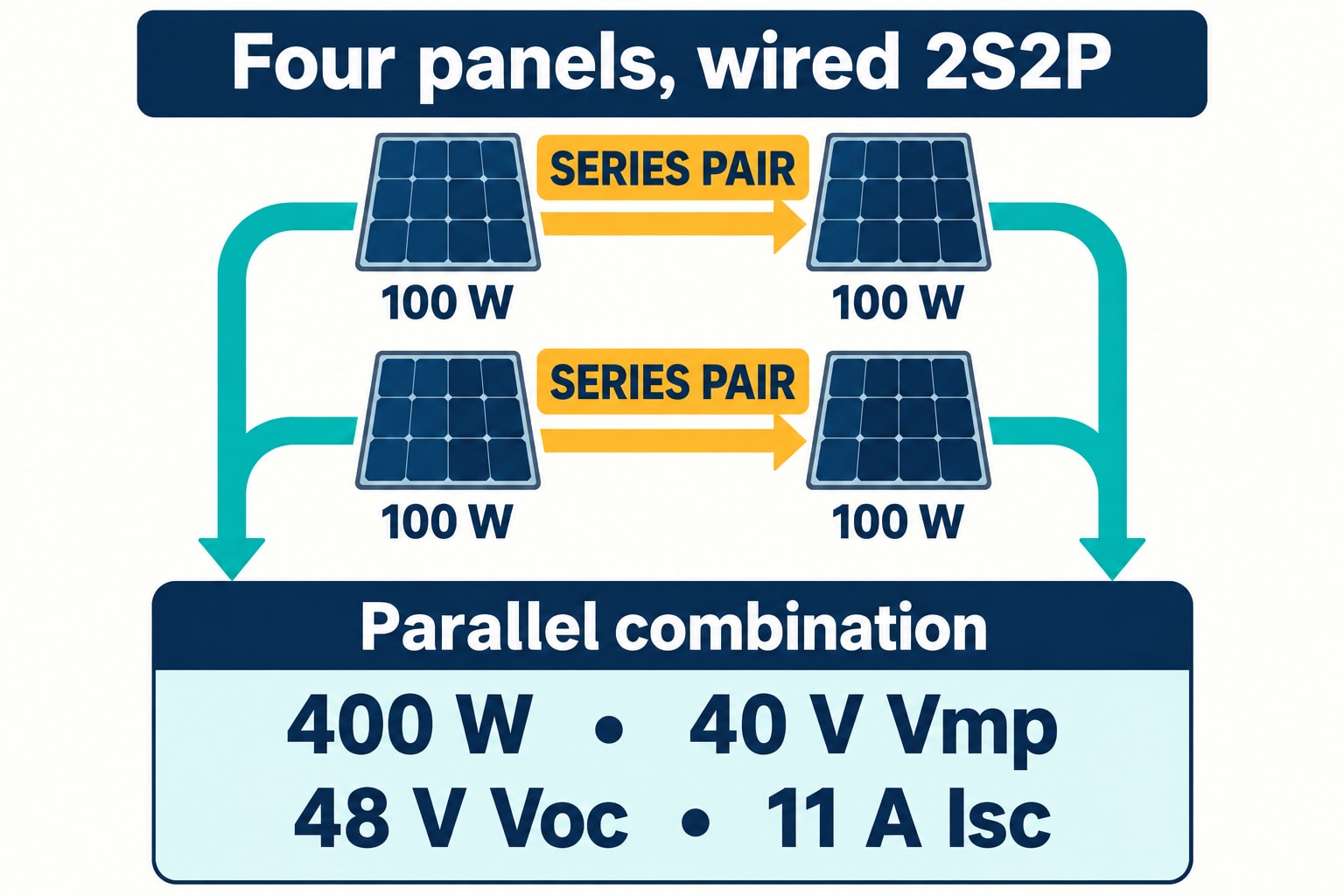
Here is the whole check for one array of example panels: four 100 W panels, each with a Vmp of 20 V, an Imp of 5 A, a Voc of 24 V, an Isc of 5.5 A and a Voc coefficient of −0.30 %/°C. They’re wired 2S2P, meaning two series pairs joined in parallel, on a 12V battery, with −15°C (5°F) as the coldest morning to plan for.
Scroll sideways to see every column.
| Check | 2S2P Array | SmartSolar 100/30 | Result |
|---|---|---|---|
| Panel power | 400 W | 440 W at 12V | Within the rating |
| Voc at 25°C | 48 V | 100 V max | Inside the limit |
| Voc at −15°C | 48 × 1.12 = 53.76 V | 100 V max | Plenty of margin |
| Short-circuit current | 2 × 5.5 = 11 A | 35 A max | Well inside |
| Operating voltage | About 40 V at Vmp | Battery + 5 V to start, + 1 V to run | Far above a 12V battery |
| Charging current | Before losses, about 27.8 A at 14.4 V | 30 A | Can reach the 30 A limit at lower battery voltage |
The 100/30 is a good fit for this 400 W roof, with generous voltage and input-current headroom. Strong sun on a low battery can push it to the 30 A limit, and the controller simply caps the current there.
24V sets the same trap: 800 W ÷ 24 V is 33 A. At a 28.8 V charging voltage, an 800 W array comes to about 800 ÷ 28.8 ≈ 27.8 A before losses, and the 100/30 is rated for 880 W at 24V. So the same 30A controller covers it, provided the array fits the 100 V and 35 A limits and keeps enough voltage above a 24V battery on hot days.
When a Larger Controller Is Worth It
A larger controller leaves room for expansion. If you’ll add panels within a few years, buying the 40A or 50A size now saves replacing a 30A unit once the array outgrows its rating.
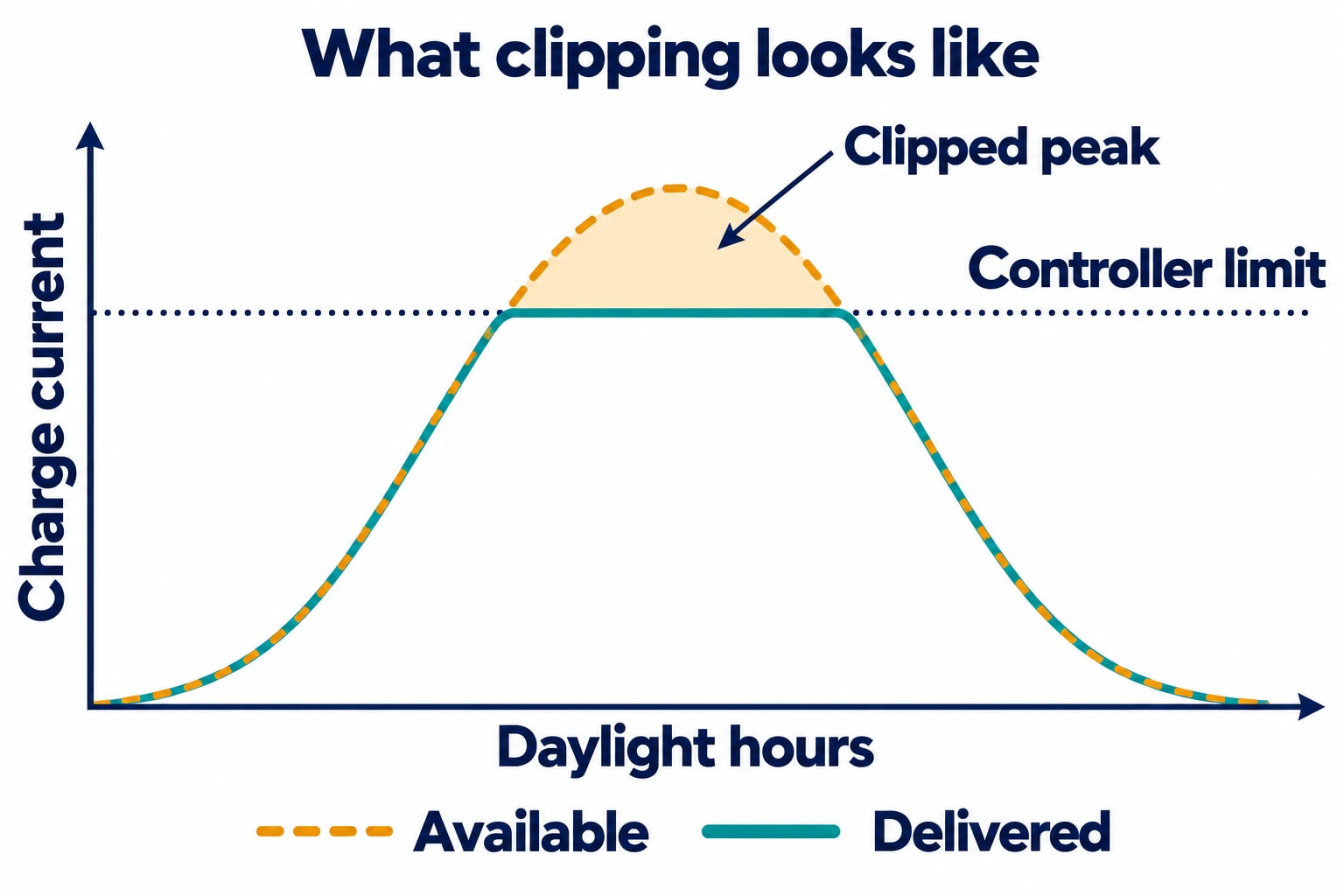
A larger array on the same controller does something different. Clipping means the controller limits its power or charging current when the panels could deliver more than it can pass on. Where the maker permits it, extra panels can improve charging in the morning, the evening and under cloud, even if the controller clips the midday peak, as Morningstar’s answer on oversized arrays illustrates. Permission to overpanel never extends to voltage or input current, though: the cold Voc and the array’s short-circuit current still have to fit.
If the controller sits at its current limit for hours on sunny days while the battery still isn’t full by evening, clipping is costing you energy you need. That’s the other reason to buy a larger controller.
Check What the Battery Can Accept
The battery has a say, too. Solar, the alternator charger and the shore-power charger can all contribute at once. Their combined output must fit the battery’s charge-current limit, and the BMS is protection, not the normal way to regulate charging. Where the controller lets you set a maximum charge current, set it to fit; where it doesn’t, choose one whose full output the battery can take. Our guide to charging while driving and with solar (opens in a new tab) works through the combined limit with an example.
How PWM Sizing Differs
PWM sizing is simpler, because PWM throws away the surplus voltage that MPPT uses. The panels are switched straight onto the battery, which drags their voltage down to its own, so the battery receives roughly the current the panels make at that voltage. Size the controller by the array’s short-circuit current plus whatever margin its manual requires, and match the panels’ nominal voltage to the bank: a 12V panel with a Vmp of around 18 to 20 V can still suit a 12V PWM system.
For a new or growing RV system, MPPT is usually the better buy. Our MPPT vs PWM comparison (opens in a new tab) shows where the gain is large and where it’s small.
Wiring and First-Start Checks
The wiring follows from the sizing, and our MPPT wiring walkthrough (opens in a new tab) takes the connections one at a time. These checks tie back to the numbers above:
- Battery side: put the fuse for the controller’s battery cable near the battery, rated as its manual specifies, and size the cable for that fuse and the controller’s full charging current. Keep the run short.
- Panel side: a DC-rated disconnect lets you isolate the array, but it isn’t overcurrent protection. Your parallel-string count and the panel and controller manuals tell you whether you need string fuses, and what size. A panel’s maximum series fuse rating is an upper limit, not automatically the fuse size to buy.
- Isolation: an open PV disconnect doesn’t make the panel leads dead, and a pulled battery fuse doesn’t make the battery terminals dead. Make the connections with both sides isolated, and power up in the sequence the maker gives, normally battery first. Check the system voltage, battery profile, charging voltages and any charge-current setting before enabling PV, and never pull solar connectors apart under load.
- Mounting: a SmartSolar mounts vertically on non-flammable material, with room to cool and never directly above the battery, as Victron’s installation section specifies. Other brands have their own position, clearance and surface rules.
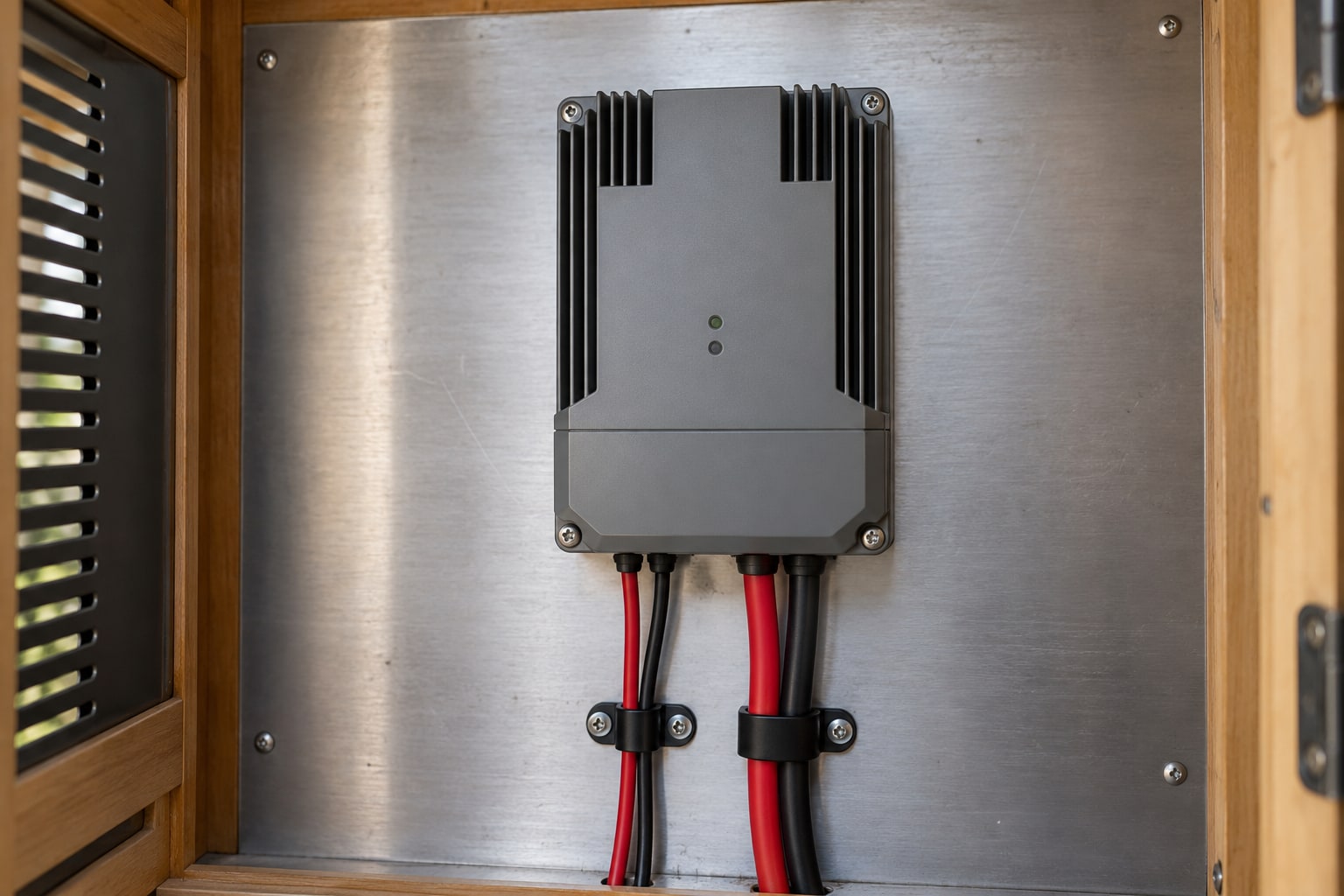
Judge the first readings against the sunlight, the array and the battery’s charging stage. A steady reading at the controller’s current limit can be normal clipping, and a lower one isn’t by itself a fault. To check the display, clamp a DC meter around the controller’s own battery-side output conductor, not a shared bank cable, which also carries other chargers and loads and only shows a net figure.
Then compare the controller’s battery voltage with a meter reading at the battery terminals while it charges at or near full current. Some drop is normal and grows with current. If it exceeds the allowance you used to size the cable, check the cable gauge, the connections and the fuse holder.
FAQs
- What size controller do I need for 400 W? On a 12V battery, a 30A MPPT is enough if its published PV rating at 12V is 400 W or more (the 100/30’s is 440 W) and the array also fits its 100 V and 35 A input limits. Choose 40A or 50A if you plan to add panels. On a 24V bank charging at 28.8 V, 400 W comes to about 14 A before losses, so a smaller controller rated for 400 W at 24V can do the job.
- How many watts can a 40A MPPT handle? Renogy’s figure for the Rover Li 40A is 520 W with a 12V battery and 1,040 W with 24V. Other 40A models publish their own figures, so go by the maker’s PV power rating rather than multiplying 40 by a nominal voltage.
- Can I put more panels on a 30A controller? Only where the maker allows it. Victron’s 100/30 limits its input power when more than its nominal PV power is connected, so extra panels can add early, late and cloudy-day charging, but the array’s voltage and short-circuit current must still fit the controller’s limits. If a manual sets a maximum array power, that’s the limit.
- Does a 24V battery bank change the size? Yes. The same panel power produces about half the charging current at 24V, and makers rate their controllers for roughly twice the panel watts: the 100/30 takes 880 W at 24V. The array also needs a higher voltage, enough to stay above the controller’s thresholds for a 24V battery when the panels are hot.
- Can a controller be too large for the battery? Yes, if its full output is more than the battery should take. Set its charge-current limit where the controller allows it, or choose one whose maximum fits, and include the alternator and shore-power chargers that can run alongside it.
Conclusion
So the 33 A from 400 ÷ 12 was never the number to size by. Start from the maker’s published PV power for your battery voltage, then check the array’s cold-weather voltage, hot-weather voltage and short-circuit current against the controller’s own limits. For a typical 400 W roof on 12V, a 30A model such as the SmartSolar 100/30 does the job. Step up to 40A or 50A when the roof will grow or clipping would cost you too much, and make sure the battery can take what all its chargers deliver together.
Spot an error or an outdated detail in this guide?
Report it