MPPT vs PWM for RV Solar: Real-World Difference
On this page
This guide breaks down how each technology behaves on an actual RV roof, which controller lines fit which use cases, and when the cheaper option is genuinely good enough.
TL;DR
- Best Overall: Victron SmartSolar MPPT — Full-time boondockers who want maximum daily harvest and room to grow the array
- Best Budget: Renogy Wanderer — Small weekend rigs running a single 12V panel in warm climates
- Best for Mid-Size Upgrades: Renogy Rover — Owners scaling past a couple hundred watts without a premium price tag
- Best for Battery Maintenance: Morningstar SunSaver — Stored RVs and small trickle-charge duty where reliability matters most
- Best for DIY Builders: EPEver Tracer — Hands-on installers building a value-focused MPPT system
Best MPPT vs PWM for RV real world difference Picks
The picks below span both technologies deliberately, because the honest answer to “MPPT or PWM?” depends on your array size, climate, and how far off-grid you live. Each pick is framed around the use case where that controller line actually earns its keep — not a generic ranking that pretends one answer fits every RV.
A quick framing before the picks: PWM controllers act like a fast switch that connects the panel more or less directly to the battery, so the panel is pulled down to battery voltage and any excess panel voltage is simply not harvested. MPPT controllers run a DC-to-DC conversion stage that tracks the panel’s maximum power point and converts surplus voltage into additional charging current. In real-world RV conditions, that difference typically translates into roughly 10–30% more daily energy harvest for MPPT, with the biggest gains in cold weather, in the morning and evening shoulders of the day, and when batteries are deeply discharged.
The short version: PWM discards excess panel voltage; MPPT converts it into charging current.
Victron SmartSolar MPPT
The Victron SmartSolar MPPT line is the default recommendation for full-timers, serious boondockers, and anyone building an RV solar system they expect to live on. Verify the relevant specification against the product manual, array layout, and applicable installation guidance before buying or wiring the system. Victron’s tracking is widely regarded as fast and stable in the variable light that RV roofs actually see — passing clouds, tree shade sliding across panels, and the low-angle sun of early morning.
The line is offered across a broad range of amperage ratings and panel-voltage windows, which matters for RVers in a specific way: higher input-voltage headroom lets you wire panels in series, push voltage up, and keep current — and therefore wire gauge (AWG), cost, and losses — down on the long run from roof to controller. Parallel and series limits vary by battery model, BMS design, and manufacturer documentation. On a long run through a wall cavity or under a chassis, thinner wire that still meets voltage-drop targets is a genuine installation win, not just a cost saving.
The trade-off is price — this is the premium option in the category, and on a very small system the extra harvest may never pay back the difference. But for a mid-size or large RV array, especially with lithium batteries and configurable charge profiles in play, the SmartSolar line is the pick that owners rarely regret.
Renogy Rover MPPT
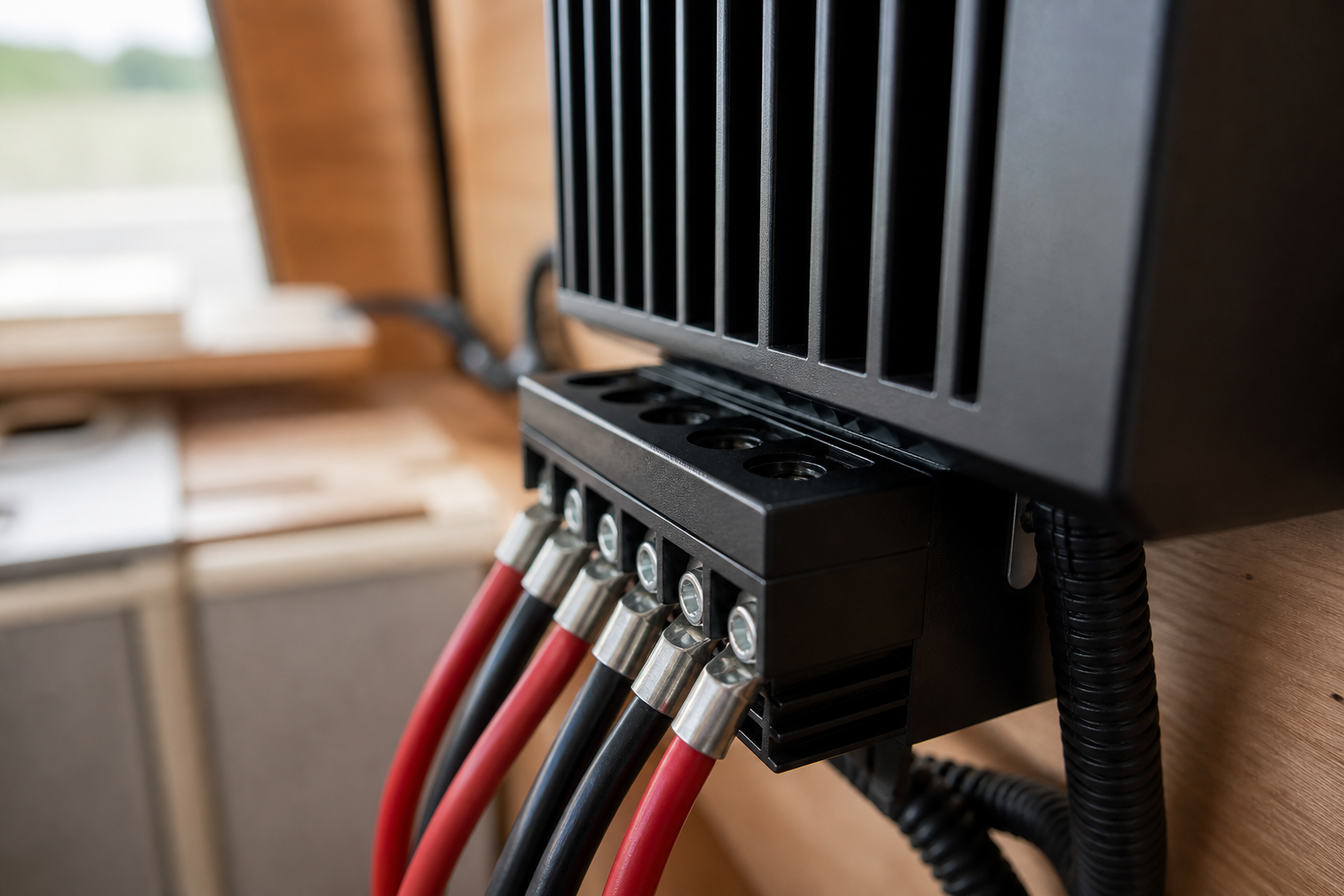
The Renogy Rover line is the value-MPPT pick, and its sweet spot is the RVer upgrading from a starter kit: you began with a modest PWM bundle, added a second or third panel, and now you’re leaving meaningful harvest on the table. The Rover series brings genuine maximum power point tracking at a price point noticeably below the premium European brands, which makes the “is MPPT worth it?” math work at smaller system sizes than it otherwise would.
Check the manufacturer specification for charge-controller requirements on the model you are considering. Rover controllers also support multiple battery chemistry profiles across the line, which matters if a lead-acid-to-lithium upgrade is anywhere in your future — buying a controller that can follow you through that transition avoids paying twice.
The compromise relative to the premium tier is mostly in refinement — configuration interfaces, documentation, and long-term ecosystem support are more basic. For a weekend-plus traveler with a few hundred watts on the roof, that’s usually an easy trade.
EPEver Tracer MPPT
The EPEver Tracer line serves the DIY builder who wants MPPT performance on a tight budget and doesn’t mind doing some homework. It’s a popular choice in self-built camper vans, truck campers, and cargo-trailer conversions where the owner is comfortable reading a manual, setting charge parameters manually, and wiring everything themselves. If that describes you, the Tracer series delivers the core MPPT benefit — voltage conversion and power-point tracking — at one of the lowest costs of entry in the category.
Check the manufacturer specification for charge-controller requirements on the model you are considering. Builders sourcing inexpensive higher-voltage residential-style panels — often the cheapest watts per dollar available — need MPPT to use them on a 12V RV bank at all. That panel-flexibility argument alone justifies the Tracer for many DIY systems.
The watchouts: configuration is less intuitive than premium brands, quality control and support have a more mixed reputation, and counterfeit or gray-market units circulate through third-party sellers, so buy from a reputable storefront. Plan for careful commissioning — verify your charge voltages against your battery manufacturer’s requirements before leaving the system unattended, and log the settings you programmed so you can re-check them after a firmware reset or battery swap.
Morningstar SunSaver
Morningstar has a long reputation in industrial and off-grid installations for controllers that simply do not fail, and the SunSaver line is the pick for small, permanent, set-and-forget systems — a single modest 12V panel maintaining batteries on a stored travel trailer, a pop-up camper, or a rig that spends most of its life on shore power.
Here’s the honest real-world math that favors it: on a small system with a true 12V-nominal panel in a warm climate, the MPPT advantage shrinks dramatically. There’s little excess panel voltage to convert, and the total daily deficit might be a handful of amp-hours — not enough to justify a controller that costs several times as much. In that scenario, spending your budget on proven reliability rather than tracking electronics is the smarter allocation, and the SunSaver’s durability is exactly what a battery-maintenance system needs.
Where it’s the wrong pick: any plan involving array growth, higher-voltage panels, series wiring, or heavy boondocking loads. PWM’s requirement that panel voltage match battery voltage is a hard architectural ceiling, and no amount of build quality changes that. Buy it for what it is — a bulletproof small-system controller — not as a substitute for MPPT on a growing setup.
Renogy Wanderer
The Renogy Wanderer is the entry-level PWM pick for small, simple 12V systems. At this scale, the harvest gap between PWM and MPPT translates into a small absolute number of amp-hours — often less than the day-to-day variation you’d see from parking angle or a passing cloud bank. Spending less on the controller and more on an extra panel or a better battery frequently produces a better outcome.
The Wanderer line is also the natural companion to the starter solar kits many RVers begin with, which keeps wiring and panel-voltage matching simple: 12V-nominal panel, 12V battery, done. For someone testing whether RV solar fits their travel style at all, it’s a low-risk entry point that does the essential job — preventing overcharge and managing the charge stages — without a big up-front commitment.
Its limitations are the category’s limitations. Pair it with a higher-voltage panel and the excess voltage is simply thrown away; discharge your batteries deeply and it can’t boost the harvest the way an MPPT can; and cheap PWM units in general (not this line specifically) have a reputation for loose voltage regulation, so set your charge parameters correctly for your battery chemistry.
Victron BlueSolar PWM
The Victron BlueSolar PWM line occupies an interesting niche: PWM simplicity with premium-brand engineering. Its best-fit buyer is the owner who has already decided PWM is the right architecture — small system, true 12V panel, warm-climate use — but wants better regulation quality and brand support than the bargain tier offers. It’s also a sensible choice for owners standardizing on one manufacturer’s ecosystem across their electrical system, which simplifies documentation and troubleshooting down the road.
The real-world scenario where it beats a budget PWM is precision: charge-stage behavior and voltage regulation on lead-acid banks affect battery lifespan over years of ownership, and a well-regulated controller pays for itself in battery replacement cycles avoided. The technology is safe when properly built and configured — corner-cutting units and wrong voltage settings are where the horror stories come from.
The same architectural ceiling applies as with every PWM pick: no series-wired arrays, no higher-voltage panel flexibility, no voltage-conversion harvest gains. If there’s any chance your system grows past a small single-panel setup, spend up for an entry MPPT instead. If it won’t, this is the polished way to do PWM.
Comparison Table
Scroll sideways to see every column.
| Search Target | Best Fit | What to Confirm Before Buying | Why It Might Fit | Watchouts | Where to buy |
|---|---|---|---|---|---|
| Victron SmartSolar MPPT | Best for full-timers who want maximum harvest and room to grow the array | Check the input-voltage ceiling against your string’s cold-weather voltage | Fits owners who value fast, stable tracking in variable RV light | Premium price — a very small system may never repay the extra harvest. | Amazon ↗ |
| Renogy Rover MPPT | Best value MPPT for scaling past a starter kit | Confirm the chemistry profiles cover a future lithium upgrade | Fits upgraders leaving harvest on the table with a small PWM bundle | Configuration and documentation are more basic than the premium tier. | Amazon ↗ |
| EPEver Tracer MPPT | Best budget MPPT for hands-on DIY builders | Buy from a reputable storefront and verify charge voltages before unattended use | Fits self-builders using cheap higher-voltage panels that PWM can’t harvest | Gray-market units circulate, and commissioning takes real care. | Amazon ↗ |
| Morningstar SunSaver | Best set-and-forget PWM for stored rigs and battery maintenance | Confirm your panel is a true 12V-nominal unit — PWM discards excess voltage | Fits small permanent systems where reliability beats tracking electronics | A hard ceiling if the array ever grows — no series strings, no voltage conversion. | Amazon ↗ |
| Renogy Wanderer | Best low-cost entry for a small, simple 12V starter setup | Set the charge parameters for your battery chemistry before first use | Fits new RVers testing whether solar suits their travel style at all | Pairs poorly with higher-voltage panels — excess voltage is thrown away. | Amazon ↗ |
| Victron BlueSolar PWM | Best PWM regulation quality when you’ve already decided PWM is right | Confirm your system will genuinely stay a small single-panel setup | Fits owners standardizing on one manufacturer across the electrical system | Same PWM ceiling as the budget tier — spend up for MPPT if growth is possible. | Amazon ↗ |
As an Amazon Associate I earn from qualifying purchases.
Which One Should You Buy
Start with the size of your system and how you actually camp, because that decides the technology before it decides the brand. For a small single-panel 12V system in a warm climate, PWM is usually enough. Above that — or with any boondocking ambition, lithium batteries, cold-weather travel, or plans to expand — MPPT’s real-world harvest advantage and its panel-flexibility benefits make it the better long-term buy.
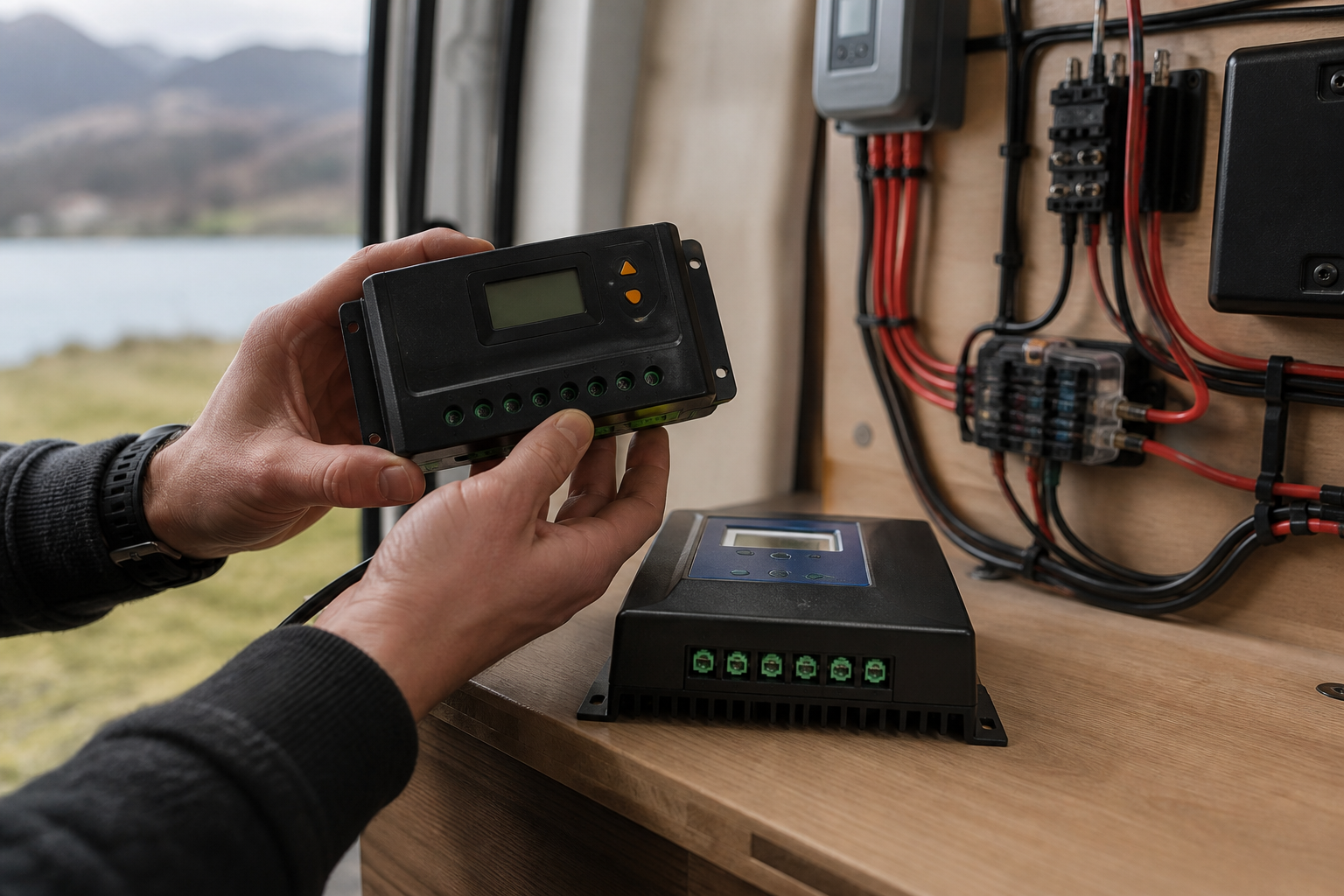
For rough controller sizing, use this formula: required controller output amps ≈ total panel watts ÷ battery bank voltage. Then add headroom above that number for future panels and for the brief periods when cool, bright conditions push panels above their rated output.
Best for the mid-size upgrade → Renogy Rover MPPT. It’s also the pragmatic pick if a lithium conversion is on your roadmap, since chemistry-profile flexibility means the controller survives the upgrade.
Best for DIY builders optimizing cost per watt → EPEver Tracer. The specific scenario where this pick shines is a self-build using inexpensive higher-voltage panels: PWM cannot use those panels efficiently on a 12V bank, so MPPT isn’t a luxury there — it’s a requirement. Tracer gets you into that architecture at the lowest cost, provided you’re comfortable configuring charge parameters yourself.
Best for small systems and stored rigs → Morningstar SunSaver or Renogy Wanderer. A single modest 12V panel maintaining a lead-acid battery is PWM’s home turf. Choose the SunSaver when the system will run unattended for months and reliability is the whole point; choose the Wanderer when budget leads and the system is small and simple. The Victron BlueSolar PWM splits the difference for buyers who want premium regulation quality in a small package.
Two cross-cutting considerations regardless of pick. First, chemistry: lithium banks charge at higher sustained currents and hold voltage differently than lead-acid, which both amplifies MPPT’s advantage and makes correct charge-profile support non-negotiable — lithium support varies by controller model, so confirm the specific unit you buy supports a LiFePO4 charge profile before pairing it with a lithium bank. Second, climate: cold weather raises panel voltage, which MPPT converts into extra current and PWM simply discards, so northern and shoulder-season travelers see the largest real-world gap between the two technologies.
Safety & Common Mistakes
- Never connect panels to the controller before the battery. Most controllers need to sense battery voltage first; wiring panels first can damage the unit or cause erratic charging behavior. Battery first, panels second — and reverse the order when disconnecting.
- Don’t pair higher-voltage panels with a PWM controller. The controller will pull the panel down to battery voltage and throw the excess away — you’ll harvest a fraction of the panel’s rating and may exceed the controller’s input limits. Match panel voltage to the technology you own.
- Fuse both the panel-to-controller and controller-to-battery runs. An unfused battery connection is a fire risk in a vehicle that vibrates down the highway; size overcurrent protection and wire gauge (AWG) to the controller manufacturer’s guidance.
- Set the correct battery-chemistry profile before first use. A controller left on a default lead-acid profile can chronically overcharge or undercharge a lithium bank (and vice versa) — this misconfiguration, not the PWM/MPPT choice itself, is how controllers “damage” batteries.
- Don’t undersize the controller’s amp rating for future expansion. Buying exactly to today’s array means replacing the controller when you add a panel; a size up is usually the cheapest insurance in the whole system.
- Account for cold-weather voltage rise when wiring in series. Panel open-circuit voltage climbs in cold temperatures; a series string that’s fine in summer can exceed an MPPT controller’s input limit on a freezing morning and destroy it.
This is general guidance only — always follow the installation instructions from your controller and battery manufacturers.
FAQs
- Why is MPPT better than PWM in an RV? MPPT converts excess panel voltage into additional charging current instead of discarding it, which typically yields meaningfully more daily harvest in real-world conditions — with the biggest gains in cold weather, low sun angles, and when batteries are deeply discharged. It also lets you use higher-voltage panels and series wiring, cutting wire losses on roof runs.
- Is PWM ever the right choice for an RV? Yes. For small systems with a true 12V panel, warm-climate use, and light loads, the absolute amp-hour difference is small, and PWM’s lower cost often makes it the rational buy — especially for battery-maintenance duty on stored rigs that spend most of their time on shore power.
- Can a PWM controller damage my battery? A properly built and correctly configured PWM controller won’t. Problems come from cheap units with loose voltage regulation or from wrong chemistry settings that chronically overcharge — a configuration and quality issue, not a flaw of PWM technology itself.
- Can I use an MPPT controller with lithium batteries? Yes, and it’s the preferred pairing. Lithium banks accept higher sustained charging current, which lets MPPT’s extra harvest actually get used; just make sure the specific controller variant you buy supports a LiFePO4 charge profile and set it before commissioning the system.
- How do I size a controller for my RV setup? Work from your total panel wattage and battery-bank voltage to the required output amps (panel watts ÷ bank voltage), then leave headroom for expansion. For MPPT units, also check the input-voltage limit against your series string’s cold-weather open-circuit voltage — one listing check on the exact variant prevents most sizing mistakes.
- Do I need MPPT for 12V panels? Not strictly — 12V-nominal panels are the one scenario where PWM performs respectably, since there’s little excess voltage to convert. You’ll still see some MPPT gain in cold weather and low battery states, but on a small single-panel system it may not repay the price difference.
Conclusion
The MPPT vs PWM decision comes down to an honest audit of your system size and camping style, not a universal winner. Shortlist by scenario: heavy boondocking or lithium banks point to the Victron SmartSolar or Renogy Rover MPPT lines; a DIY build around cheap higher-voltage panels makes EPEver Tracer the pragmatic pick; and a small, simple 12V system maintaining a lead-acid battery is exactly where the Morningstar SunSaver or Renogy Wanderer PWM units earn their keep.
Spot an error or an outdated detail in this guide?
Report it