12V vs 24V Solar for RVs: Which Is Better?
On this page

Keep 12V if you’re improving an RV that already has a working 12V electrical system. For a new build that will regularly run large inverter loads, price out 24V before you buy the inverter and batteries. It cuts the current on the battery side in half, but it takes extra equipment and work to keep the RV’s 12V lights, pump and furnace running.
Solar wattage alone doesn’t settle the question. The bank voltage mostly decides how much current the inverter pulls, how heavy the main cables get and how much of the RV’s 12V equipment needs a new supply. Below are the numbers behind each of those, what changes on the solar side, what a conversion involves and three typical setups with a verdict for each.
TL;DR
- Existing 12V RV: keep 12V. The lights, pump, furnace, chargers and inverter already match it, and converting replaces gear you’ve paid for.
- New build with big AC loads: price out 24V first. A 3,000 W load at 85 percent inverter efficiency pulls about 276 A from a 12.8 V bank and about 138 A at 25.6 V.
- Same batteries, same energy: two 12.8 V 100 Ah batteries hold 2,560 Wh whether they’re wired for 12V or 24V, so 24V doesn’t double the run time.
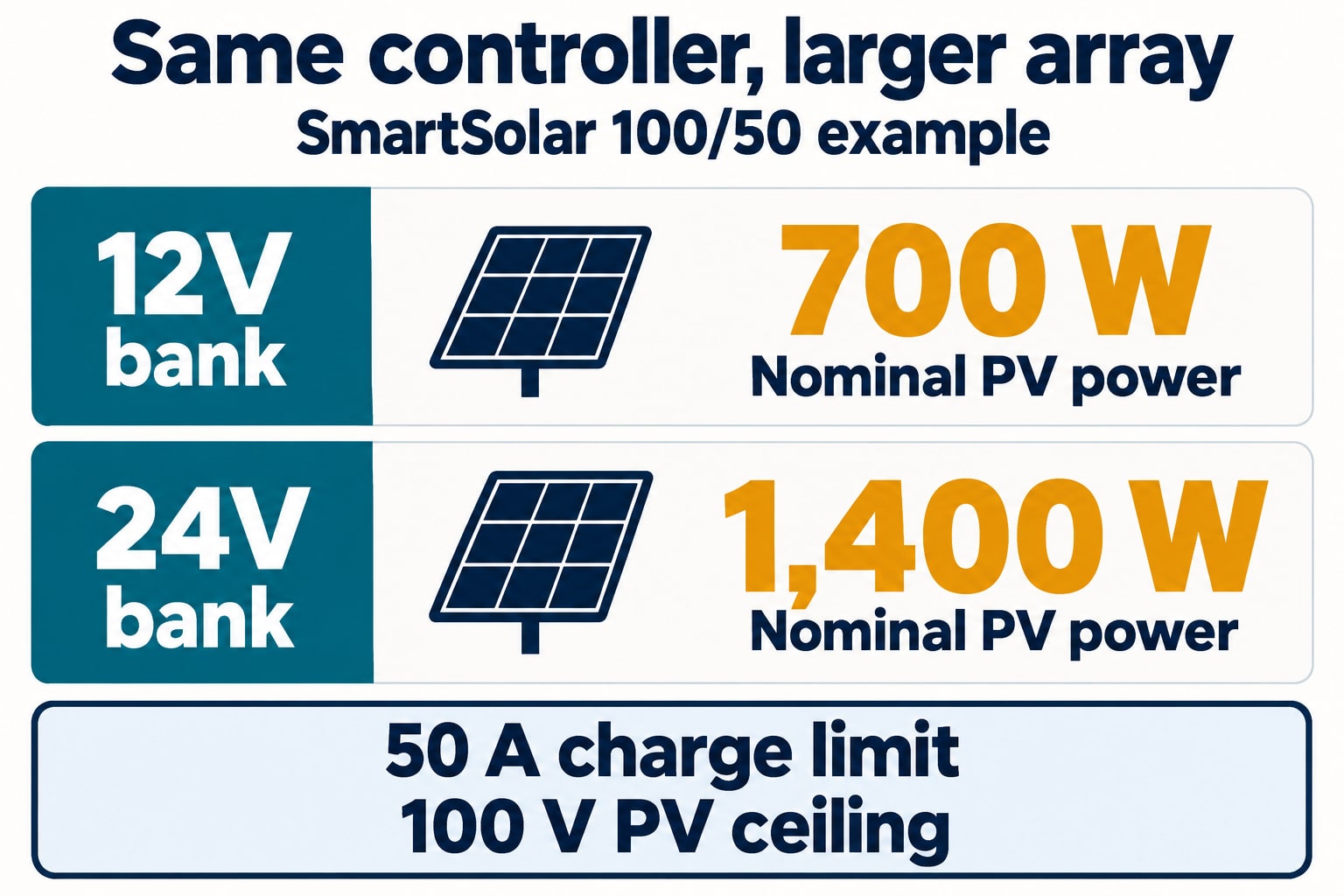
- Solar: the SmartSolar 100/50’s nominal PV capacity doubles at 24V, from 700 W to 1,400 W. The existing panels themselves don’t produce more.
- The 24V extras: a 24-to-12V converter for the RV’s 12V circuits, a 24V inverter and shore charger where the old ones are 12V-only, and a 12-to-24V charger if the vehicle’s alternator will charge the bank.
Battery, Panel and AC Voltage Are Separate
In this comparison, 12V and 24V mean the house battery bank: the voltage that the inverter, the chargers and the main DC wiring connect to. The solar array is its own circuit. An MPPT controller takes a higher string voltage from the roof and converts it down to the bank, so a 12V system can also wire its panels in series and send less current down the roof cable. Our series and parallel wiring guide (opens in a new tab) shows how a string’s voltage and current add up.
The AC side doesn’t depend on the bank either. An inverter in a North American RV supplies 120V AC from a 12V or a 24V bank, but its DC input has to match the bank. Victron’s MultiPlus-II 120V shows the split: the 12V model accepts 9.5–17 V DC, and the 24V model 19–33 V.
12V vs 24V at a Glance
These are the differences that decide a real RV build:
Scroll sideways to see every column.
| Factor | 12V House Bank | 24V House Bank |
|---|---|---|
| The RV’s 12V circuits | Run straight from the bank | Need a 24-to-12V converter that covers those loads |
| Battery current at 2,000 W AC | About 184 A | About 92 A |
| Two 100 Ah batteries at 12.8 V | 200 Ah, 2,560 Wh | 100 Ah, 2,560 Wh |
| SmartSolar 100/50 nominal PV power | 700 W | 1,400 W |
| Inverter and chargers | 12V models, as most RVs already have | 24V-capable inverter and shore charger, plus a 12-to-24V charger for charging while driving |
| Converting an existing 12V RV | No change needed | Replace any 12V-only inverter and chargers, add a 12V supply, and rewire as needed |
The current figures assume 85 percent inverter efficiency on lithium banks at 12.8 V and 25.6 V. The next sections show where each number comes from.
Battery Current and Cable Loss
An inverter draws its AC load plus its own losses from the bank, and at half the voltage the same power takes twice the current:
With an illustrative 85 percent inverter efficiency and lithium banks at their nominal 12.8 V and 25.6 V:
Scroll sideways to see every column.
| AC Load | 12.8 V Bank | 25.6 V Bank |
|---|---|---|
| 1,000 W | About 92 A | About 46 A |
| 2,000 W | About 184 A | About 92 A |
| 3,000 W | About 276 A | About 138 A |
These are running currents, not fuse sizes. Cable and fuse sizing also has to cover a low battery voltage, the surge when a motor or compressor starts, and any DC loads on the same cables. The inverter load comes from the appliances that run at the same time, while the bank’s size comes from the watt-hours you use per day; our RV energy audit (opens in a new tab) works out both.
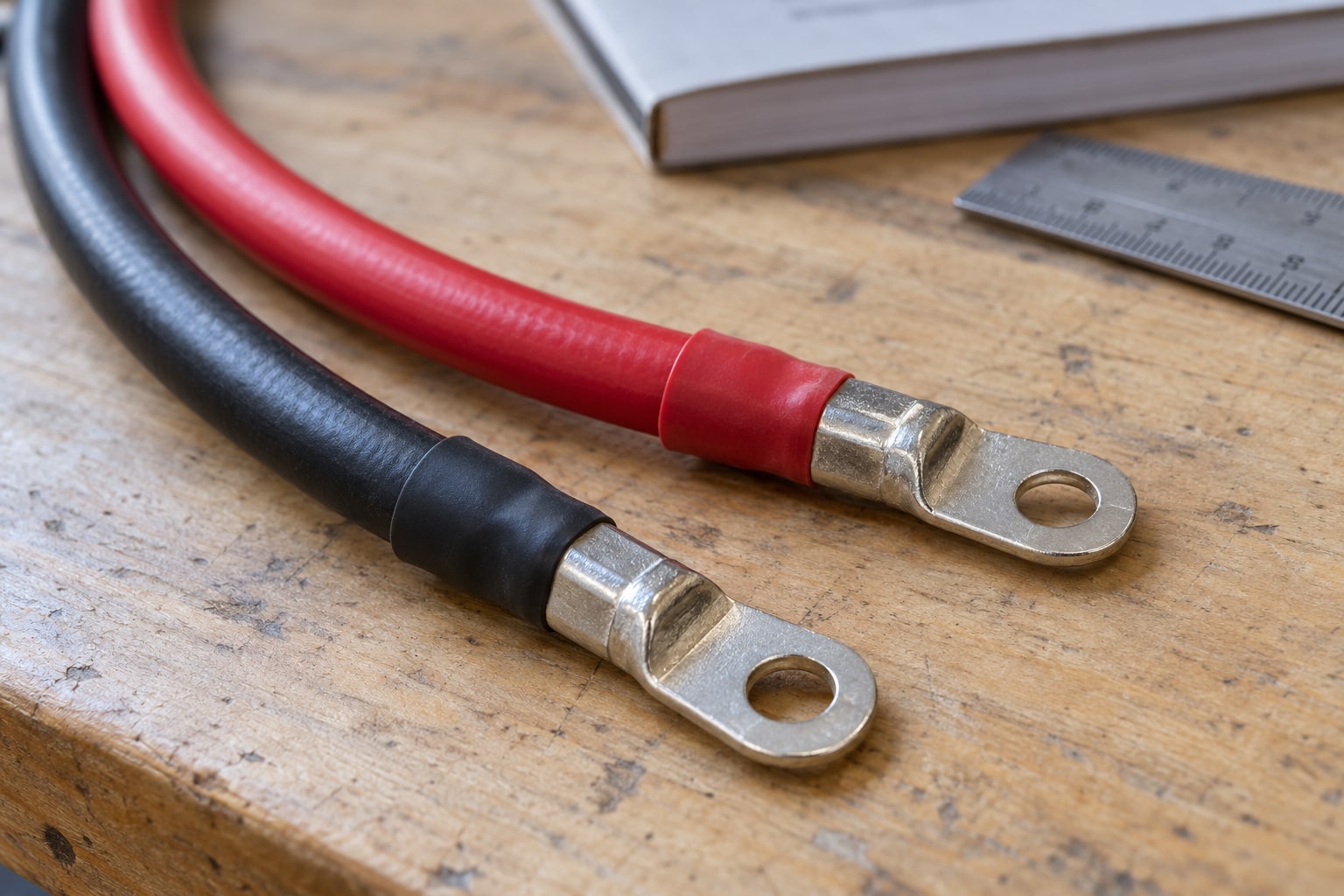
Current is what heats a cable. The loss is the current squared times the cable’s resistance, so half the current through the same cable means a quarter of the heat. Victron’s Wiring Unlimited illustrates the effect with two 1.5-meter, 16 mm² copper cables that have a combined resistance of 0.0032 ohms. A 2,400 W load draws 200 A from 12V and 100 A from 24V, before any inverter losses. At 200 A, that pair drops 0.64 V, about 5 percent of 12V, and loses 128 W as heat. At 100 A, the drop is 0.32 V, about 1.3 percent of 24V, and the heat loss is 32 W. These fixed-current figures illustrate cable losses; the cable size for an installation still has to meet its current and installation requirements.
That gain applies to the cables that carry the bank current, mainly the inverter cables and the bank’s main leads. It doesn’t cut the RV’s total energy use by three-quarters, and the 12V circuits carry the same current as before. At 24V you may get by with a smaller cable for the same voltage drop, but no rule halves the size: length, current, allowed drop, the installation and the equipment maker’s requirements still decide it. Keep the battery-to-inverter run as short as the layout allows at either voltage.
Same Batteries, Same Watt-Hours
Take two 12.8 V 100 Ah lithium batteries whose maker allows both layouts:
Scroll sideways to see every column.
| Wiring | Bank Voltage | Bank Capacity | Stored Energy |
|---|---|---|---|
| Parallel | 12.8 V | 200 Ah | 2,560 Wh |
| Series | 25.6 V | 100 Ah | 2,560 Wh |
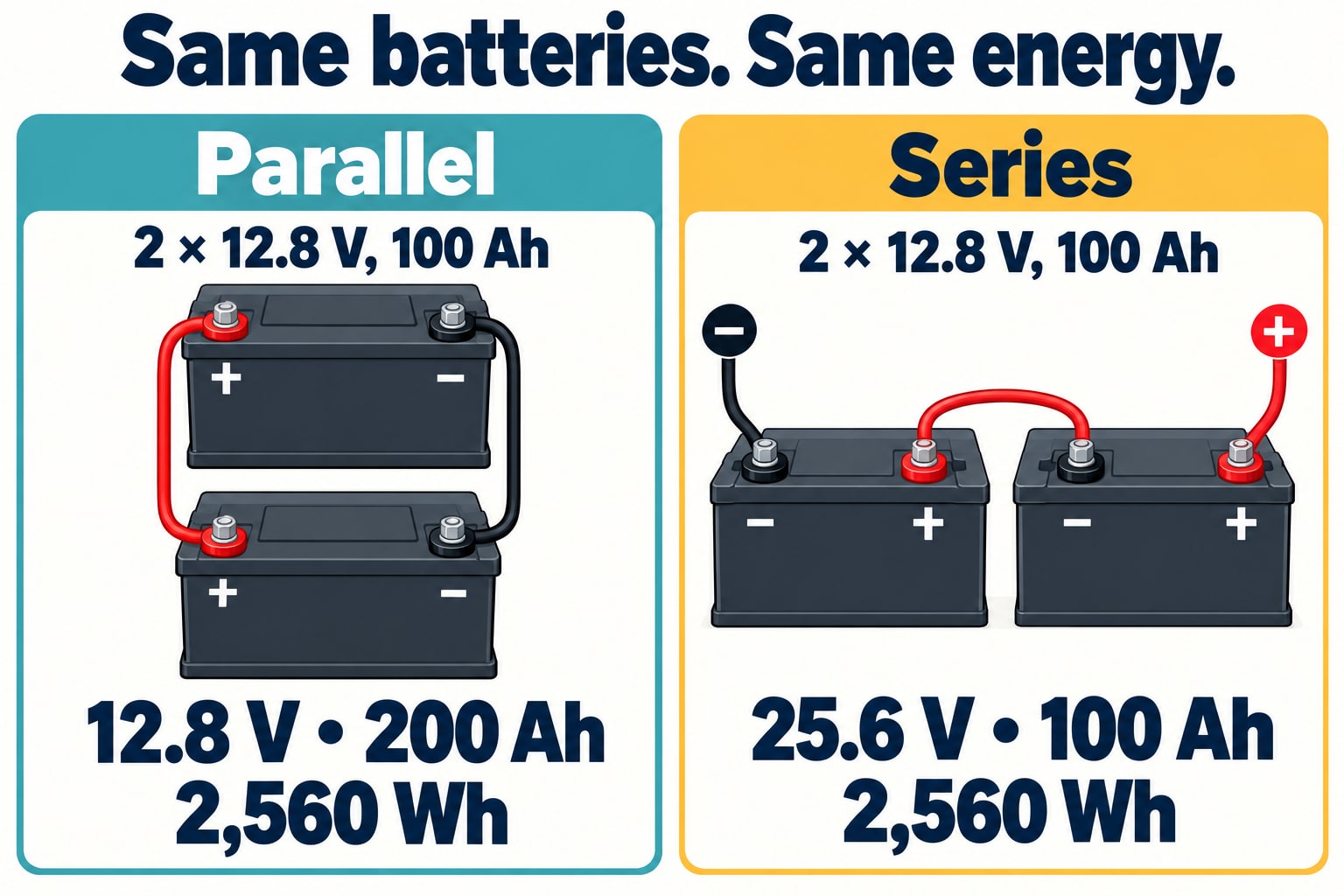
Compared with the parallel bank, the series bank shows half the amp-hours at twice the voltage, and the energy stays at 2,560 Wh. A 24V bank built from the same batteries doesn’t run the RV twice as long. System losses can shift what reaches the appliances a little either way, but the stored energy is identical.
Suppose each battery is rated for 100 A of continuous discharge. In series, the same current flows through both, so the bank still allows 100 A; in parallel, the pair can supply 200 A with proper current sharing. Either layout has a nominal DC power limit of 2,560 W before inverter losses. At the illustrative 85 percent efficiency used above, that leaves about 2,180 W for AC loads. Rewiring the same batteries for 24V doesn’t increase their combined continuous power rating.
Not every 12V battery can be wired in series. Victron’s Lithium SuperPack, for example, may be connected in parallel, but its maker states that series connection is not allowed. Before converting, check the battery maker’s rules for series wiring, the maximum number in series and how the bank has to be charged and balanced.
What Changes on the Solar Side
A controller’s amp rating is its maximum charge current, and at twice the bank voltage each amp carries twice the power. Victron’s SmartSolar 100/50 charges at up to 50 A on either bank, so its nominal PV power rises from 700 W at 12V to 1,400 W at 24V. Its maximum PV voltage stays at 100 V.
The same controller can therefore serve a larger array on a 24V bank. The same panels don’t harvest twice the energy, though; they produce the same power whichever bank they charge.
The string must clear the controller’s lower voltage requirement without exceeding its upper limit. These SmartSolar models only start charging once the PV side is over 5 V above the battery voltage; once running, the minimum difference is 1 V. On a 24V bank, that puts the starting point at roughly 30 V or more, against about 18 V on a 12V bank. Allow enough hot-panel voltage for reliable starting and operation, and keep cold-weather Voc below 100 V. These controllers step voltage down, so a single 12V-class panel isn’t enough to charge a 24V bank. Our controller sizing guide (opens in a new tab) runs these voltage and current checks on an example array.
Keeping the RV’s 12V Equipment Running
A typical RV runs its lights, water pump, furnace, vent fans and slide-out or jack motors on 12V. With a 24V bank, those circuits are fed through a 24-to-12V DC-DC converter. Size it for the 12V loads that can run together, their start-up currents and the temperature where it’s mounted, not for the battery’s amp-hours. The current in those 12V circuits doesn’t halve, because they still run at 12V.
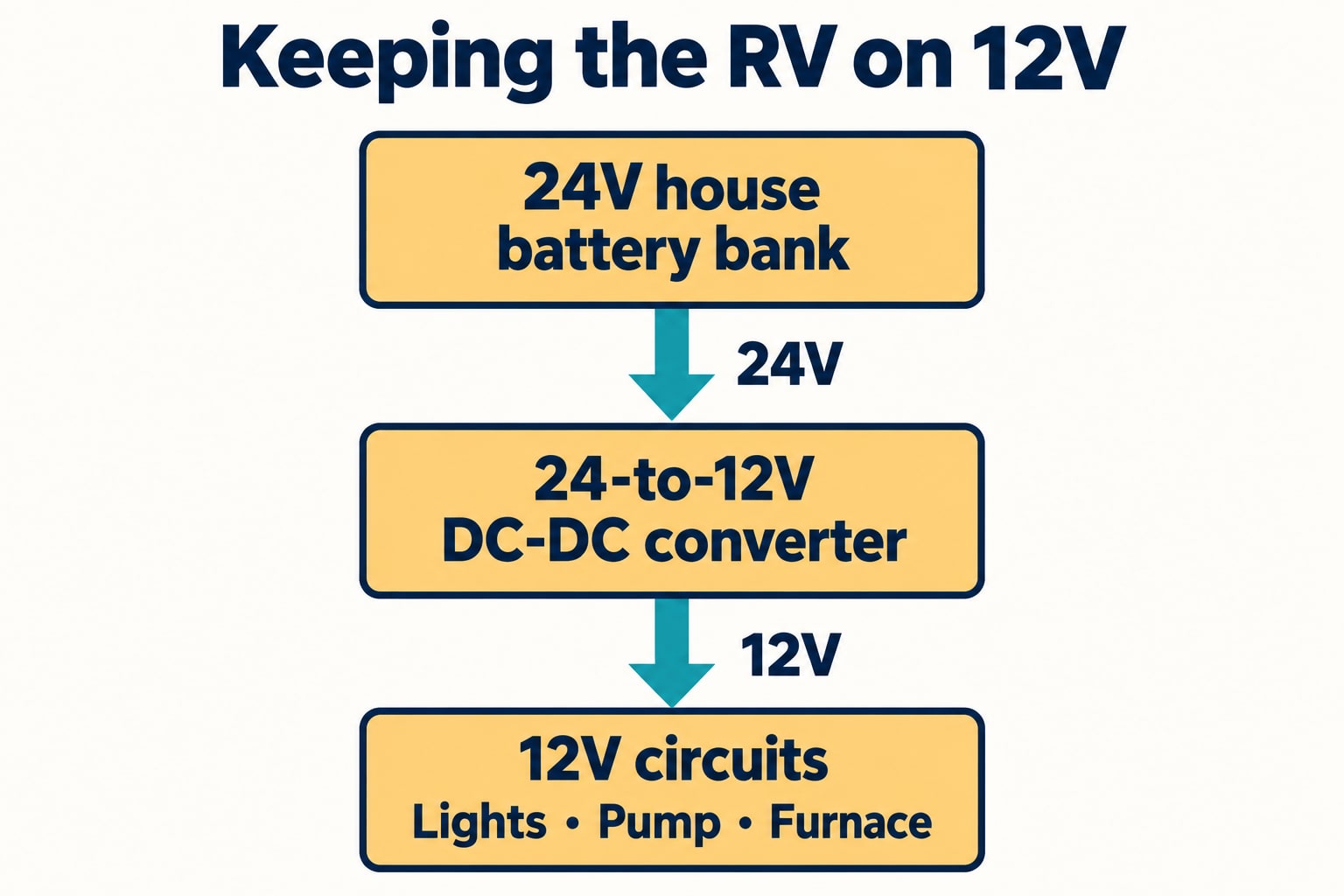
Don’t take 12V from one battery of a series bank. Victron’s battery bank chapter warns that a midpoint connection creates an imbalance far larger than a battery balancer can correct, and the battery that supplies the lower voltage fails early.
Some DC appliances are rated for both 12V and 24V, so check the labels before planning a converter for everything. Keep two devices apart as well: the DC-DC converter supplies the 12V circuits from the 24V bank, while the RV’s converter/charger charges the bank from shore power, and a 12V converter/charger can’t charge a 24V bank. If one DC-DC converter can’t cover the 12V loads, use a model that allows parallel operation; Victron’s isolated Orion-Tr converters, for example, can be paralleled to increase output current.
Charging From the Vehicle
The chassis or starting battery normally stays 12V. To charge a 24V house bank from the alternator, you need a 12-to-24V DC-DC charger, such as the 12/24 model of Victron’s Orion-Tr Smart. A towable’s 7-pin charge line can’t feed a 24V bank directly. To use that line, choose a compatible 12-to-24V charger whose input draw fits the vehicle wiring, connector and fuse. If that circuit can’t supply the required current, use a dedicated, correctly fused charging feed.
A 24V bank doesn’t halve the current drawn from the alternator. The alternator still works at 12V and has to supply the charger’s full output power plus its losses, so a charger that delivers 15 A at 24V draws roughly twice that current on the 12V side. Our alternator and solar charging guide (opens in a new tab) shows how the two share the battery’s limit.
What Converting a 12V System Involves
Switching an existing RV to 24V touches every device on the battery side. Check each of these against the new bank before you start:
- Batteries: wired in series only if the maker allows it, with its charging and balancing requirements met.
- Inverter or inverter-charger: a model with a 24V DC input. A 12V inverter can’t be reprogrammed for 24V.
- Shore and generator charging: a charger with a 24V output, or the charger in a 24V inverter-charger.
- Alternator charging: if required, a DC-DC charger from 12V to 24V, supplied by a vehicle circuit sized for its input current.
- Solar: a controller set up for 24V and a string with enough voltage to charge at that level.
- 12V circuits: a 24-to-12V converter sized for the RV’s 12V loads, with its own fuses.
- Fuses, switches and monitor: voltage ratings that cover the new system voltage, and a battery monitor set up for the 24V bank.
Then put the costs side by side. Count any savings on cable and solar controllers against a 24-to-12V converter, replacement of 12V-only inverter and charging equipment, and the rewiring. Keep existing chargers and solar controllers that are explicitly rated and configurable for the new bank. In an existing 12V RV, most of that equipment is already paid for and working. A new build starts from zero, which is why the answer often changes there. Put prices on both complete systems before you decide; neither voltage is automatically cheaper.
Three Typical Setups
Weekend Trailer With a Working 12V System
The loads are lights, the water pump, the furnace fan, the fridge, and phone and laptop charging, perhaps through a small inverter. The currents are modest, every device already runs on 12V, and a conversion would add cost without solving a problem. Verdict: stay 12V. If you want more solar, a suitable series string and MPPT controller can keep the roof cable current down, provided the array stays within the controller’s voltage and current limits.
Motorhome With a 3,000 W 12V Inverter-Charger
At full output, the inverter draws about 276 A on a 12.8 V bank. That works when the cables, the fuse and the batteries’ combined discharge rating are sized for it; a pair of 100 A batteries isn’t enough at either voltage, as the battery section showed. Converting would mean replacing a working inverter-charger and any other 12V-only chargers, and adding a converter. Verdict: keep 12V and make sure the high-current path fits the load. Reconsider 24V when the inverter-charger or the bank is due for replacement anyway. If you’re staying with 12V, our 12V inverter-charger picks for boondocking (opens in a new tab) compare the options.
New Build With Induction Cooking

A new build with an induction cooktop, a microwave and a 3,000 W inverter has no equipment to keep. At 24V, that inverter pulls about 138 A at full output instead of about 276 A, which eases the main cables, the fuse and the inverter’s DC connection, and a SmartSolar 100/50 can take 1,400 W of panels instead of 700 W. Against that, budget a 24-to-12V converter to keep the RV’s 12V equipment running, plus a 12/24 DC-DC charger if you’ll charge while driving. Verdict: price out both complete systems, and choose 24V if the totals are close; the lower current makes the high-power side simpler to build and to expand.
Safety Checks
- Fuse ratings: a fuse’s DC voltage rating has to cover the highest voltage in the system, its current rating has to protect the cable, and in a lithium bank at least one fuse needs an interrupt rating at least as high as the bank’s maximum short-circuit current. Victron’s DC wiring chapter notes that most DC fuses suit 12V and 24V but not necessarily 48V.
- Cable first: a cable too thin for its current is the fire risk, while a fuse that’s too small simply blows. Size the cable for the current, then fuse it to protect the cable.
- No 24V on 12V gear: feed 12V equipment only through a suitable converter, never straight from the 24V bank or from the midpoint of a series bank.
- Battery wiring: connect batteries in series only where the maker allows it, and follow its rules for charging and balancing.
- Connections and start-up: make the connections with every source isolated, then power up in the order each manual gives. For a solar controller, that’s normally the battery side first, with the battery settings checked before the PV is switched on.
FAQs
- Does 24V give twice the run time? No. The same batteries store the same energy however they’re wired: a pair of 12.8 V, 100 Ah batteries stores 2,560 Wh whether it’s wired as a 12V or a 24V bank. System losses can move the usable figure slightly either way.
- Can I use my existing panels? Usually. The batteries and their wiring set the bank voltage. Your existing string may already have enough voltage for 24V. Check its hot-weather operating voltage, the controller’s start-up requirement, cold Voc and PV current limits before changing the wiring. A standard MPPT controller such as the SmartSolar only steps voltage down, so one 12V-class panel on its own won’t charge a 24V bank.
- Can two 12V lithium batteries be wired in series? Only if their maker allows it. Some models are approved for series use, often with a limit on how many, and others aren’t: Victron’s Lithium SuperPack may be paralleled but not wired in series. Use identical batteries and follow the maker’s charging and balancing rules.
- Can I keep my 12V inverter? Only with a 12V bank. The inverter’s DC input must suit the battery voltage, and a 12V model can’t be set up for 24V; Victron, for one, builds separate 12V and 24V versions of its MultiPlus-II 120V.
- How does a 24V bank charge from a 12V alternator? Through a DC-DC charger with a 12V input and a 24V output, fitted between the starting battery and the house bank. The alternator side still runs at 12V, so its current isn’t halved. A towable’s 7-pin feed also needs voltage conversion, but it can only be used if its wiring, connector and protection can support the charger’s input draw.
- Is it worth converting a working 12V system? Rarely for efficiency alone. The cable savings are limited to the high-current runs, while a conversion replaces 12V-only inverter and charging equipment and adds a converter. It makes the most sense when that equipment is due for replacement anyway, or when planned AC loads would push 12V currents well past what the existing cables and fuses handle.
Conclusion
For an RV that already works on 12V, 12V remains the sensible choice: the equipment matches, it’s paid for, and a well-sized 12V system can still run large inverter loads. For a new build with heavy AC loads, price out 24V before buying anything big, because halving the battery current makes the high-power wiring easier and can make room for a larger array on a compatible controller. Either way, a given set of batteries holds the same energy at 12V or 24V, so let the loads, the wiring and the cost of the 12V supply make the decision.
Spot an error or an outdated detail in this guide?
Report it