AGM vs LiFePO4 for RV Solar: Pros, Cons & Verdict
On this page
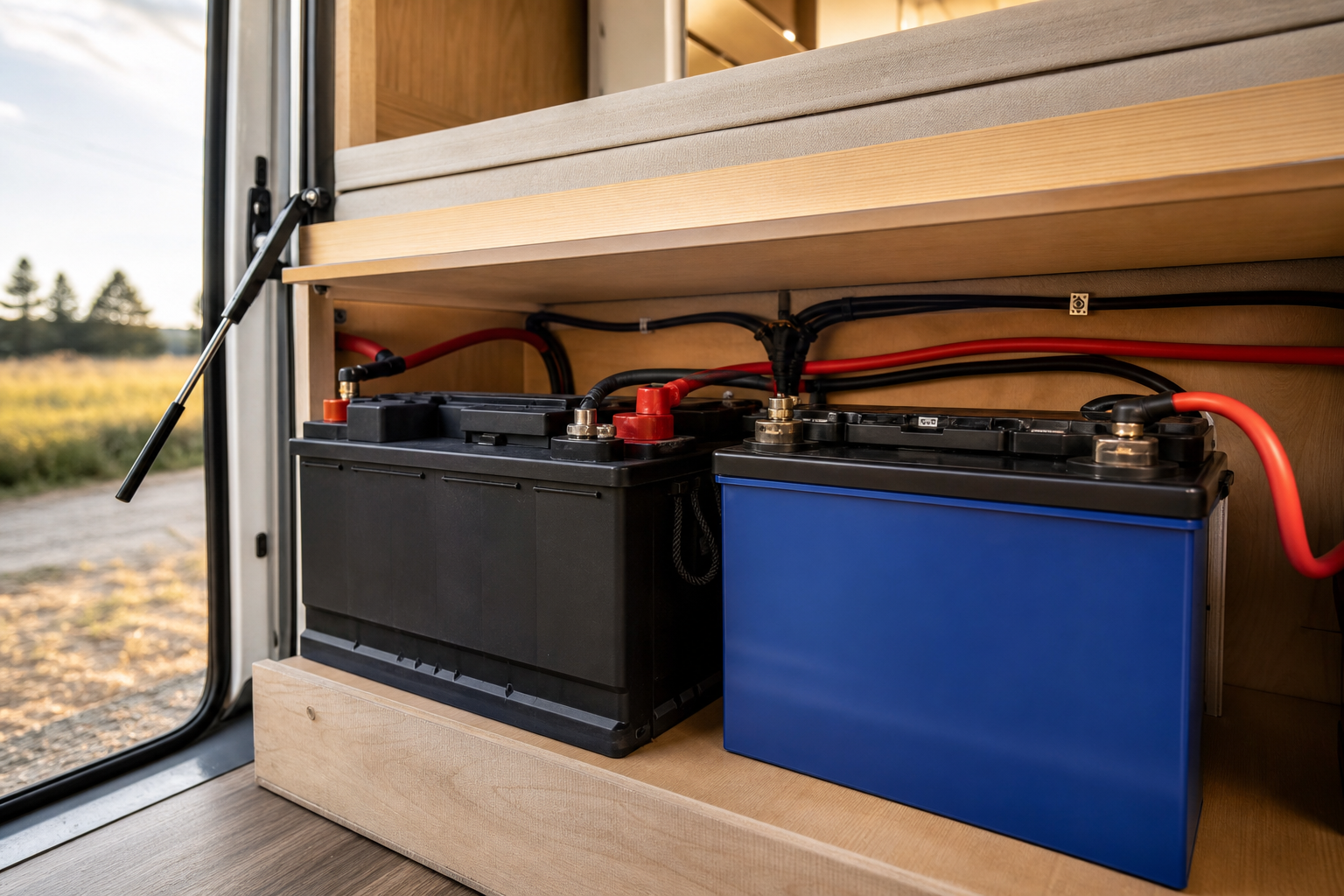
A pair of 12 V batteries in an RV bay, a rooftop solar array, and a hard weight limit on the tongue or axle: that is the real-world constraint most RV owners face when choosing between AGM and LiFePO4. The two chemistries solve the same problem — storing solar harvest for overnight loads — with very different trade-offs in usable capacity, charge acceptance, cold-weather behavior, and cost per cycle. This guide breaks those trade-offs down at the engineering level and maps them to specific, widely available battery lines in both chemistries.
TL;DR
- Best Overall: Battle Born Batteries 100Ah 12V LiFePO4 — Full-time RVers who want long-term value and deep usable capacity
- Best Budget: Weize 12V 100Ah AGM — Budget RV battery upgrades and occasional weekend trips
- Best Value Lithium: LiTime 12V 100Ah LiFePO4 — Owners moving to lithium without a premium-brand price
- Best AGM for Solar: VMAX SLR125 AGM — Cold-climate campers who charge below freezing
- Best Drop-In AGM: Renogy 12V 100Ah Deep Cycle AGM — Buyers pairing a battery with an existing Renogy solar setup
Product Details
The picks below cover both sides of the AGM vs LiFePO4 decision so you can compare like-for-like: three LiFePO4 options at different price tiers and three AGM options for buyers who prioritize upfront cost or sub-freezing charging. All of them are 12 V deep-cycle batteries intended for RV house-bank duty with solar charging. For each, the analysis focuses on chemistry behavior, system compatibility, and where that battery fits in a solar-charged RV — not lab-tested numbers.
Battle Born Batteries 100Ah 12V LiFePO4
Battle Born is the reference point most RVers use when they say “lithium upgrade.” It is a drop-in-format 12 V LiFePO4 battery built around an internal battery management system (BMS) that governs charge and discharge limits, protecting the cells from over-discharge, overcharge, and short-circuit conditions. For a solar-charged RV, the practical advantages are the ones inherent to the chemistry: you can routinely draw the battery far deeper than an AGM without damaging it, and it accepts charge current efficiently, which means more of your midday solar harvest actually lands in the bank instead of being throttled by absorption-stage tapering.
The trade-off is price. Battle Born sits at the premium end of the LiFePO4 market, and the value case rests on cycle life: LiFePO4 chemistry typically delivers thousands of cycles versus the few hundred you can expect from AGM, so heavy users amortize the cost quickly while occasional campers may not. It is a strong fit for full-timers, boondockers, and anyone running a 12 V compressor fridge overnight from solar. Plan your charging chain around a lithium charge profile — solar charge controller, converter/charger, and any alternator charging path all need lithium-appropriate settings. Confirm final compatibility and current warranty terms on the product listing before purchase.
LiTime 12V 100Ah LiFePO4
LiTime (formerly sold under the Ampere Time name) is the volume value play in LiFePO4. It targets the same use case as premium lithium — deep discharge, high charge acceptance, long cycle life — at a substantially lower price point, which has made it one of the most common batteries in DIY camper-van and travel-trailer solar builds. Like all LiFePO4 batteries, it holds voltage flat across most of its discharge curve, so inverter loads run consistently instead of sagging as the state of charge drops, a behavior AGM users know well when their microwave struggles at 60% charge.
The compromise relative to premium brands is generally in support infrastructure and cell provenance rather than day-to-day performance: budget lithium brands vary in how their BMS behaves at temperature extremes and how responsive after-sales support is. For a weekend-to-moderate-use RVer who wants lithium economics without the flagship price, it is a rational middle path. As with any LiFePO4 battery, verify that your charge controller offers a lithium profile and that the battery’s low-temperature behavior matches the climates you camp in.
Renogy 12V 100Ah Deep Cycle AGM
Renogy’s AGM line is the natural pick for owners who already run Renogy solar panels and charge controllers and want a battery from the same ecosystem. As a sealed absorbed-glass-mat battery, it is maintenance-free, spill-proof, and mountable in ventilated interior compartments where a flooded battery would be a hazard. Critically for the AGM vs LiFePO4 decision, it charges on the standard lead-acid profiles built into virtually every RV converter, solar controller, and alternator charging setup ever installed — no reprogramming, no component swaps.
The chemistry-level limits still apply: only around half of an AGM battery’s rated capacity is realistically usable without shortening its life, and charge acceptance tapers sharply in the absorption stage, so a short winter solar day may not fully recharge a deeply discharged bank. That makes AGM best suited to lighter loads, shorter trips, and setups with shore-power backup. For a buyer who wants a straightforward, budget-conscious battery that works with existing equipment on day one, this is the low-friction option.
Weize 12V 100Ah AGM
Weize competes almost entirely on price, and for a certain kind of RVer that is exactly the right optimization. If your rig sits in storage most of the year, sees a handful of weekend trips with modest 12 V loads, and spends most nights on shore power, the extended cycle life of lithium is value you will never collect. A low-cost AGM covers lights, water pump, furnace fan, and phone charging for a night or two of dry camping without asking you to touch your charging system at all.
Where budget AGM shows its limits is sustained deep cycling: repeated discharges past the halfway mark degrade lead-acid plates quickly, and a hard-used bank can need replacement within a few seasons. Treat it as a consumable, size the bank so typical overnight use stays in the top half of capacity, and it will do its job. Required accessories vary by model and setup. Check the manufacturer specification for the model you are considering.
VMAX SLR125 AGM
VMAX positions its SLR series specifically as solar-oriented deep-cycle AGM, built for repeated cycling duty rather than the dual-purpose starting/deep-cycle compromise many marine batteries make. For RV solar users committed to lead-acid — often because they camp and charge in genuinely cold conditions — a purpose-built deep-cycle AGM like this is the strongest version of the chemistry.
The buyer profile here is the winter boondocker, the ski-trip camper, or the off-grid cabin owner whose battery bay regularly sits below freezing during charge hours. You still carry AGM’s weight and usable-capacity penalties, so size the bank generously and keep discharge depth conservative.
Redodo 12V 100Ah LiFePO4
Redodo is another aggressively priced entrant in the budget-LiFePO4 segment, frequently cross-shopped with LiTime by DIY builders assembling multi-battery banks on a fixed budget. The appeal is the same lithium fundamentals — deep usable capacity, flat discharge voltage, high round-trip efficiency, and dramatically lower weight than an equivalent AGM bank — at a price that can undercut a quality AGM setup once you account for AGM’s roughly-half usable capacity. For weight-sensitive builds like small travel trailers and camper vans, shedding lead-acid mass is often the deciding factor by itself.
As with any budget lithium purchase, the diligence burden shifts to the buyer: BMS behavior, parallel/series configuration limits, and support responsiveness vary across budget brands and even across production batches. It fits best as a second or third battery expanding an existing lithium bank, or as a first lithium battery in a build where the owner is comfortable doing their own system integration.
How Deep and How Often Will You Cycle?
AGM batteries tolerate discharge to roughly half of rated capacity before lifespan penalties accumulate quickly; LiFePO4 manufacturers typically rate their batteries for far deeper discharge — commonly 80% or more of rated capacity, per each maker’s published guidance. In practical terms, a nominal 100Ah AGM behaves like a ~50Ah battery for planning purposes, while a 100Ah LiFePO4 delivers most of its label rating. Cycle counts diverge just as sharply at the chemistry level: AGM typically manages a few hundred deep cycles, with the count falling as average discharge depth increases, while LiFePO4 commonly delivers several thousand.
To size a bank, use this formula
Required bank size (Ah) = overnight load (Ah) ÷ usable fraction for the chemistry
Total your 12 V loads — fridge duty cycle, furnace fan, lights, pump, and parasitic draws from propane detectors and stereo memory — then divide by the usable fraction your battery manufacturer publishes: roughly half for AGM, substantially more for LiFePO4. The same overnight load can therefore demand roughly twice the AGM capacity, weight, and tray space.
If you camp off-grid a few weekends a year with light loads → a budget AGM like the Weize or Renogy is entirely rational; you will never wear through its cycle count. If you boondock frequently, run a 12 V compressor fridge, or live in the rig → LiFePO4 (Battle Born for premium support, LiTime or Redodo on a budget) is the clear choice, and its cost per usable kilowatt-hour over the battery’s life will almost certainly come in lower than AGM despite the higher sticker price.
Does Your Charging System Speak Lithium?
AGM’s quiet superpower is universality: every RV converter, solar charge controller, and alternator charging path built in the last several decades handles lead-acid profiles natively. LiFePO4 needs a lithium-appropriate charge profile — higher sustained absorption voltage, no long float at lead-acid voltages, and in many rigs a DC-DC charger between the alternator and the bank to protect the alternator from lithium’s aggressive charge acceptance. If your converter is an older single-stage unit, budget for its replacement as part of a lithium upgrade, not as an afterthought.
Audit the charging chain in this order before ordering a lithium battery
- Solar charge controller: does it have a selectable LiFePO4 profile, or user-programmable absorption and float voltages?
- Converter/charger: multi-stage with a lithium setting, or an older unit that will chronically undercharge lithium?
- Alternator path: is there an isolator or combiner that would expose the alternator to lithium’s high charge acceptance without current limiting?
- Monitoring: is there a shunt-based monitor, or only a voltage readout that LiFePO4’s flat discharge curve renders nearly useless for state-of-charge?
If your solar controller is a modern MPPT unit with selectable battery profiles → the lithium switch is usually a settings change, not a hardware change. If your rig has an older converter, no battery monitoring, and stock alternator charging → either add the AGM (zero changes required) or price the full lithium conversion honestly: battery, converter/charger update, possibly a DC-DC charger, and a shunt-based battery monitor. Many owners find the total is still worth it; the mistake is discovering the extra line items after the battery arrives.
Cold Weather and Weight: The Physical Constraints
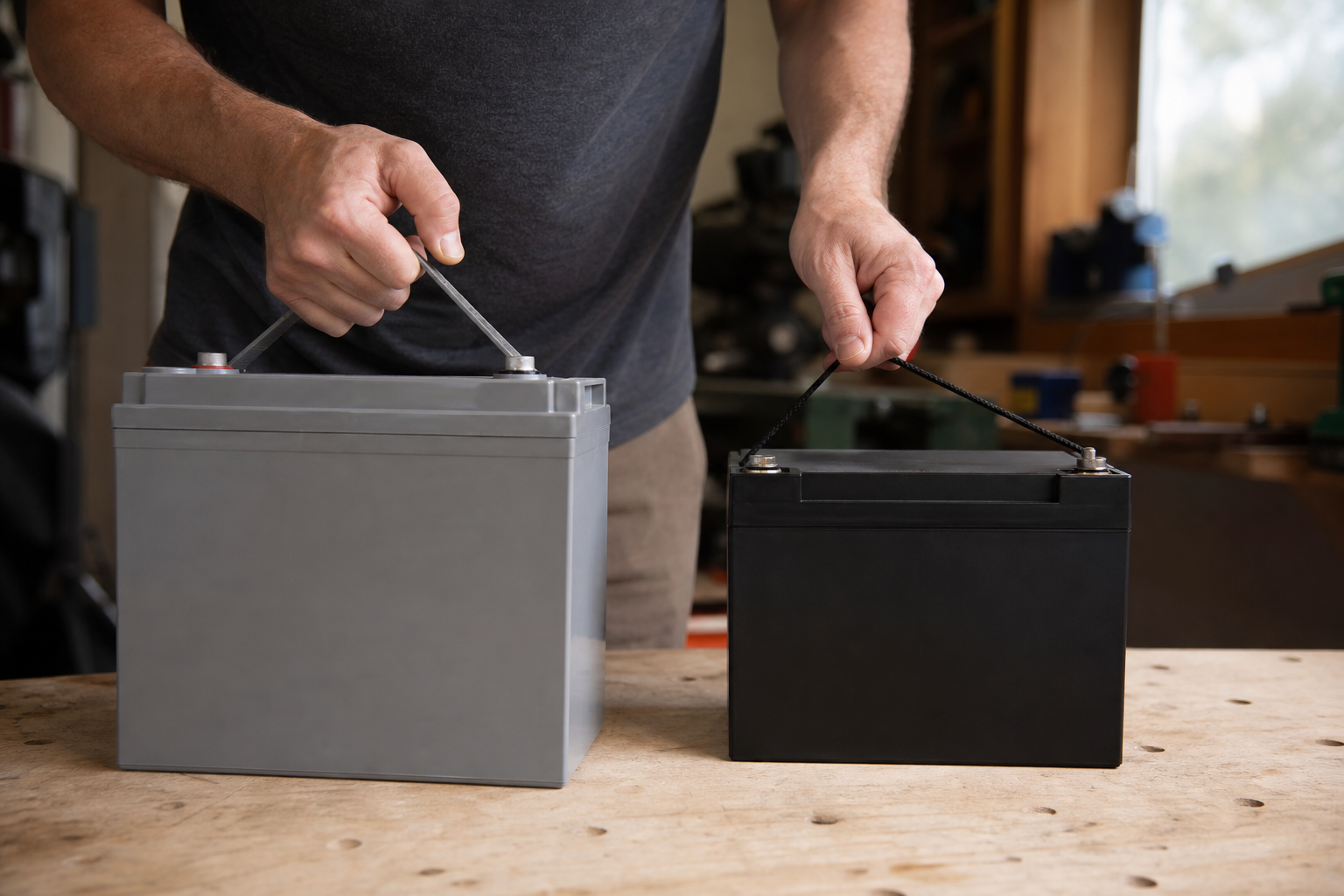
On cold-weather charging, AGM holds the practical edge: it charges below freezing on standard equipment, while standard LiFePO4 cells need low-temperature protection or a heated battery bay to charge safely in the same conditions. Weight cuts the other way. LiFePO4 is dramatically lighter per usable amp-hour than AGM — often less than half the mass for equivalent usable capacity — which matters enormously on small trailers near their cargo limit and van builds where every kilogram competes with water and gear. If you need a fixed number of usable amp-hours and your rig is weight-constrained → LiFePO4, full stop. If weight is a non-issue and your bay is cold → AGM remains a defensible engineering choice, not just a legacy one.
Comparison Table
Scroll sideways to see every column.
| Search Target | Best Fit | What to Confirm Before Buying | Why It Might Fit | Watchouts | Where to buy |
|---|---|---|---|---|---|
| Battle Born Batteries 100Ah 12V LiFePO4 | Best when your inverter and DC loads stay within the pack’s BMS current limit | Confirm the continuous and surge BMS current covers your inverter and DC loads | Fits builds whose peak draw stays inside the pack’s BMS limits | A high-draw inverter can trip the BMS if it exceeds the rated current. | Amazon ↗ |
| LiTime 12V 100Ah LiFePO4 | Best when you camp in the cold and need low-temperature charge protection | Confirm the pack has low-temperature charging protection for freezing conditions | Fits cold-weather owners who may charge below freezing | Charging lithium below freezing without protection can damage the cells. | Amazon ↗ |
| Renogy 12V 100Ah Deep Cycle AGM | Best when the case size and terminals fit your existing battery box | Confirm the dimensions, terminals, and mounting fit your battery box | Fits owners replacing a battery in a fixed bay or box | A pack that does not fit the bay or terminals adds rework on install. | Amazon ↗ |
| Weize 12V 100Ah AGM | Best when long-term warranty and responsive support matter to you | Confirm the warranty length and support terms genuinely cover your use | Fits owners who weigh long-term support against the up-front price | Thin warranty or hard-to-reach support can cost you later. | Amazon ↗ |
| VMAX SLR125 AGM | Best when your converter or charger has a matching AGM or lead-acid charge setting | Confirm your converter, charger, and controller offer the correct lead-acid setting | Fits owners whose existing chargers already handle lead-acid without new hardware | A charger left on the wrong profile can chronically under- or over-charge the bank. | Amazon ↗ |
| Redodo 12V 100Ah LiFePO4 | A strong fit when peak draw stays inside the battery’s BMS rating | Check the BMS continuous and peak current against your largest loads | Suits owners matching inverter size to the battery’s BMS current | Exceeding the BMS current limit will cut power under heavy load. | Amazon ↗ |
As an Amazon Associate I earn from qualifying purchases.
Which One Should You Buy
The AGM vs LiFePO4 decision is less about which chemistry is “better” and more about matching four variables: how often you cycle the bank, how cold your charging conditions get, how much weight your rig can carry, and what your existing charging equipment supports. Work through the three questions above in order — usage pattern first, then system compatibility, then climate — and the right answer usually falls out on its own.
One point up front: cycling frequency dominates the economics, so start there.
Safety & Common Mistakes
- Dropping lithium into a lead-acid charging chain. Running LiFePO4 on an old lead-acid converter or unmodified alternator charging can chronically undercharge the bank or stress the alternator. Update charge profiles and add a DC-DC charger where appropriate.
- Sizing an AGM bank by its label capacity. Planning around 100Ah of AGM when only about half is practically usable — per typical lead-acid depth-of-discharge guidance — is the most common cause of “dead by 2 a.m.” battery complaints.
- Mixing old and new batteries, or mixing chemistries. Paralleling a tired AGM with a new one — or worse, AGM with lithium — creates imbalanced charging and premature failure. Replace banks as matched sets of one chemistry.
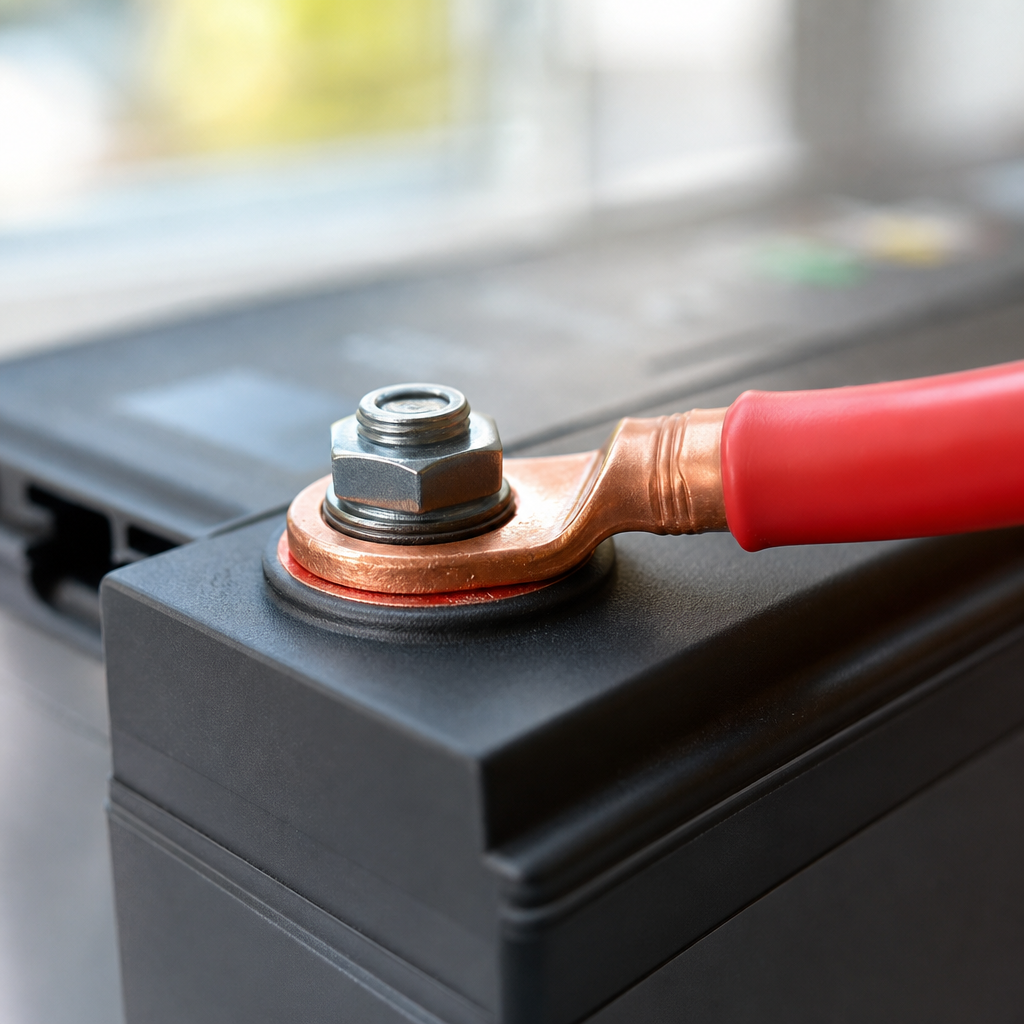
- Ignoring physical fit and restraint. Batteries must be secured against movement, with correct terminal torque and appropriately sized fusing close to the positive terminal. Measure your bay and tray capacity before ordering, especially for larger solar-class AGMs.
- Skipping a battery monitor. Voltage alone is a poor state-of-charge indicator — especially with LiFePO4’s flat discharge curve. A shunt-based monitor prevents both accidental deep discharges and false “full” readings.
This section is general guidance only; always follow the battery manufacturer’s installation manual and applicable RV electrical codes, and consult a qualified 12 V technician when in doubt.
FAQs
- Is LiFePO4 better than AGM for RV solar? For frequent and full-time use, yes: LiFePO4 offers substantially more usable capacity per rated amp-hour than AGM’s roughly-half planning figure, accepts solar charge faster, weighs far less, and delivers several times the cycle life. AGM keeps the edge on upfront cost and sub-freezing charging.
- Can I replace my RV’s AGM batteries with LiFePO4? In most rigs, yes — the batteries are physically drop-in format — but the charging system needs attention. Your solar controller and converter must be set to (or replaced with) a lithium charge profile, and alternator charging often needs a DC-DC charger added.
- Do LiFePO4 batteries work in cold weather? They discharge safely in the cold, but standard cells cannot be charged below freezing without damage. Cold-climate campers should choose a model with verified low-temperature charge protection, insulate or heat the battery bay, or stick with AGM, which charges below freezing without special handling.
- Which chemistry is cheaper over the life of the RV? LiFePO4 almost always wins on cost per usable kilowatt-hour for regular users, because thousands of cycles versus a few hundred more than offsets the higher purchase price. Occasional campers who cycle the bank a dozen times a year may never recover the lithium premium.
- How many batteries do I need for RV solar? Size by usable amp-hours against your overnight load: total your daily 12 V consumption, then remember AGM supplies only about half its label rating while LiFePO4 supplies most of it, per each manufacturer’s depth-of-discharge guidance. A load that needs two AGMs can often be covered by a single LiFePO4 of the same nominal capacity.
- What should I check before ordering either chemistry? Compartment dimensions and tray weight capacity, terminal type, your charger’s available battery profiles, and the seller’s return window — battery returns are expensive to ship, so it pays to confirm fit and compatibility once, up front.
Conclusion
Shortlist by usage pattern first: if you cycle the bank hard and often — boondocking, compressor fridges, full-time living — the math points decisively at LiFePO4, with Battle Born for premium support or LiTime and Redodo for value builds. If you camp occasionally, charge in genuinely cold bays, or want zero changes to your existing charging system, a quality AGM from Renogy, Weize, or VMAX remains a legitimate engineering choice rather than a compromise.
Those two data points — charging-chain readiness and physical fit — settle most AGM vs LiFePO4 decisions faster than any spec sheet, and they determine whether your upgrade is a battery swap or a small system project.
Spot an error or an outdated detail in this guide?
Report it