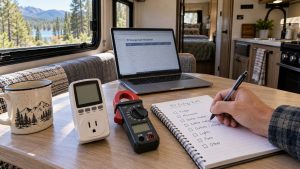
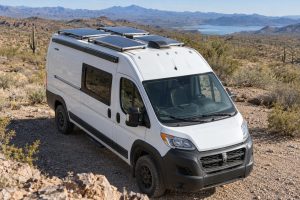
Do You Need a Generator If Your RV Has Solar?
On this page
- Generator or Not? Decide by How You Camp
- What Solar, Batteries and a Generator Each Do
- When Solar and Batteries Are Enough
- When a Generator Earns Its Place
- A Solar-and-Battery Example: How Long Before You Need Backup?
- Air Conditioning Changes the Decision
- How a Generator Charges Your RV Batteries
- How Much Generator Do You Need?
- Generator Rules and Safe Operation
- FAQs
- Conclusion
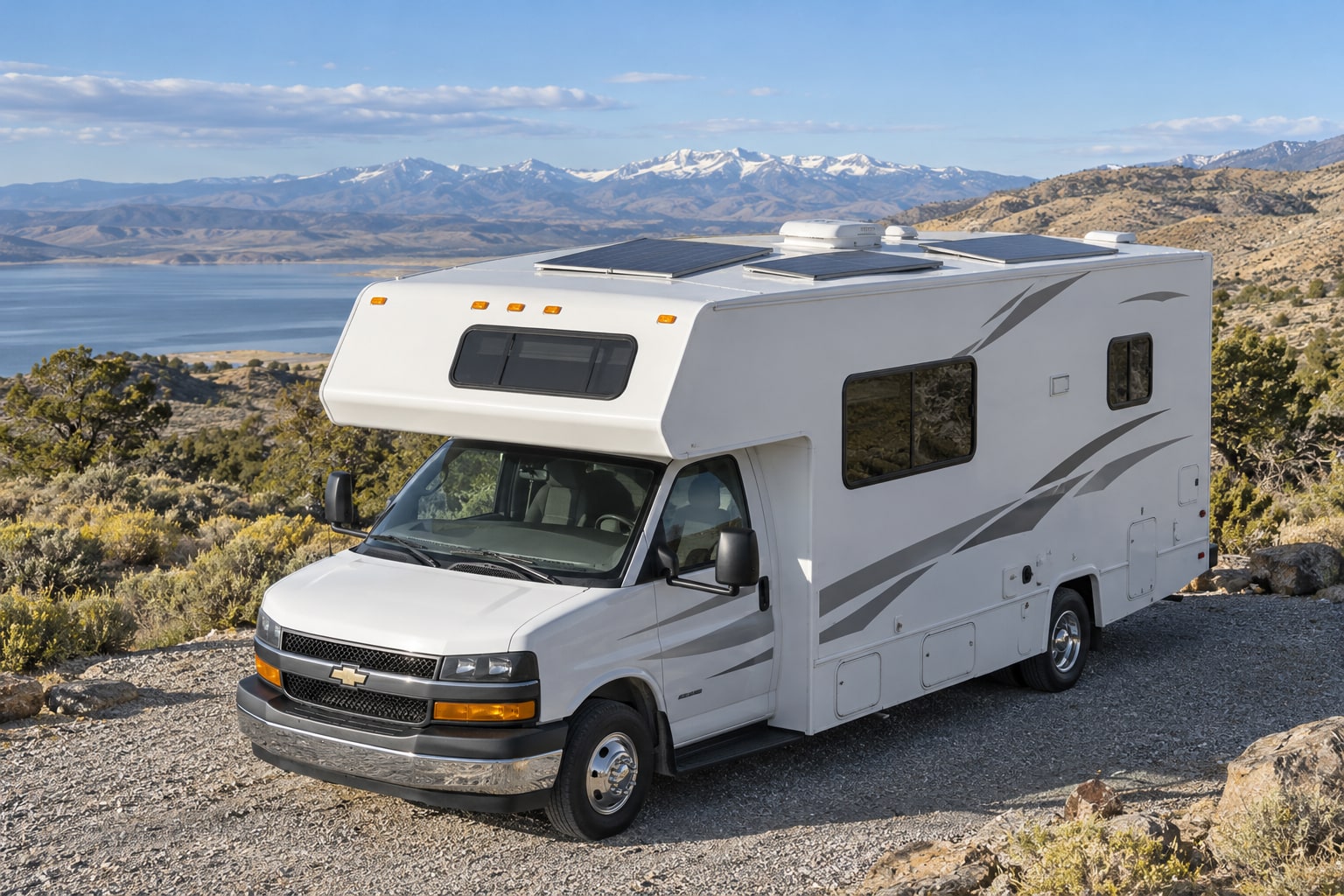
You can leave the generator at home when your battery and your solar, along with any other charging you’ve planned, cover the whole trip. A generator earns its space when you stay put through several dull or shaded days, want air conditioning for hours at a time, or run loads you can’t switch off. The deciding question is how long your stored energy lasts before the next reliable charge, and the worked example below puts numbers on it.
TL;DR
- Leave it at home when: your battery, plus your solar or other planned charging, covers the whole trip, nights and low-sun days included.
- Bring backup power for: long stays with little sun or heavy shade, and power needs you can’t cut back.
- Air conditioning changes the math: a few hours of compressor time take more energy than most RV battery banks hold, while lights, phones and the water pump barely register.
- A bigger battery buys time, not energy: it carries you through more cloudy days but doesn’t replace what the sun didn’t deliver.
- Check before you count on it: your converter or inverter charger has to charge from the generator, and the campground has to allow it when you need it.
Generator or Not? Decide by How You Camp
Panel wattage alone doesn’t settle it. What matters is how your stored energy, your solar harvest and your daily use line up on the trips you actually take:
Scroll sideways to see every column.
| How You Camp | Generator Verdict | What Makes the Difference |
|---|---|---|
| Short trips, full battery, modest loads | Can stay home | The battery covers the whole stay, even if the sun refills little of it |
| Long stays in open sun | Can stay home | Each day’s solar harvest replaces the day’s use, and the battery holds a reserve for a cloudy day |
| Several days of shade, winter sun or unsettled weather | Bring backup or plan a charging stop | Every low-sun day adds to the shortfall, and a bigger battery only postpones it |
| Hours of rooftop air conditioning | Generator or shore power | An afternoon of cooling needs more energy than most RV banks store |
| Generator-free campground | Leave it home and plan around it | Battery, solar and any charging away from the site have to cover the stay |
What Solar, Batteries and a Generator Each Do
- Solar panels add energy whenever sunlight reaches them. How much depends on the season, the weather, shade and the angle of the sun.
- The battery stores energy and covers the hours when you use more than the panels produce: every night, and on dull days.
- A generator supplies AC power on demand. It runs compatible 120V loads directly and recharges the battery through a suitable charger.
Keep storage and incoming energy apart, because they solve different problems. If your panels replace less than you use day after day, a bigger battery only delays the moment it runs low; the shortfall itself needs more solar, another charging source or lower use. Night is not that kind of problem. A battery with enough charge for the overnight loads carries the RV until the sun is back, as our guide to running an RV on solar at night (opens in a new tab) explains.
When Solar and Batteries Are Enough
For a short stay, a full battery may cover the whole trip. For longer stays, check these four parts of the plan:
- The sun replaces your daily use. On a typical day for the season and place, the array puts back what the RV used in 24 hours. Find your own number with our RV energy audit guide (opens in a new tab), and check the panel side with the RV solar wattage guide (opens in a new tab).
- The battery covers the gaps. It carries every night, plus the low-sun days you expect before you can recharge. Our amp-hour guide for boondocking (opens in a new tab) sizes a bank for exactly that.
- Keep heating and cooking in the budget. Propane cooking, water heating and space heating keep major loads off the battery, though the furnace blower still uses 12V power. Electric alternatives can work too; include their energy use when sizing the battery and charging system.
- You have a plan for a bad stretch. A travel day with alternator charging, a night on hookups or a move to open sun can stand in for a generator, as long as you’d really do it.
When a Generator Earns Its Place
- Long stays where the sun can’t keep up. Winter, a campsite under trees or a week of storms can leave even a large array short day after day, especially when moving isn’t an option.
- Air conditioning beyond short bursts. The section below shows why hours of cooling are a generator or shore-power job for most RVs.
- Loads you can’t cut. If a CPAP machine or a work setup has to keep running however the weather turns, a backup that doesn’t depend on the sun is worth carrying.
- Fast recovery. After a cloudy spell, a generator can put back in a few hours what the panels would need days to replace.
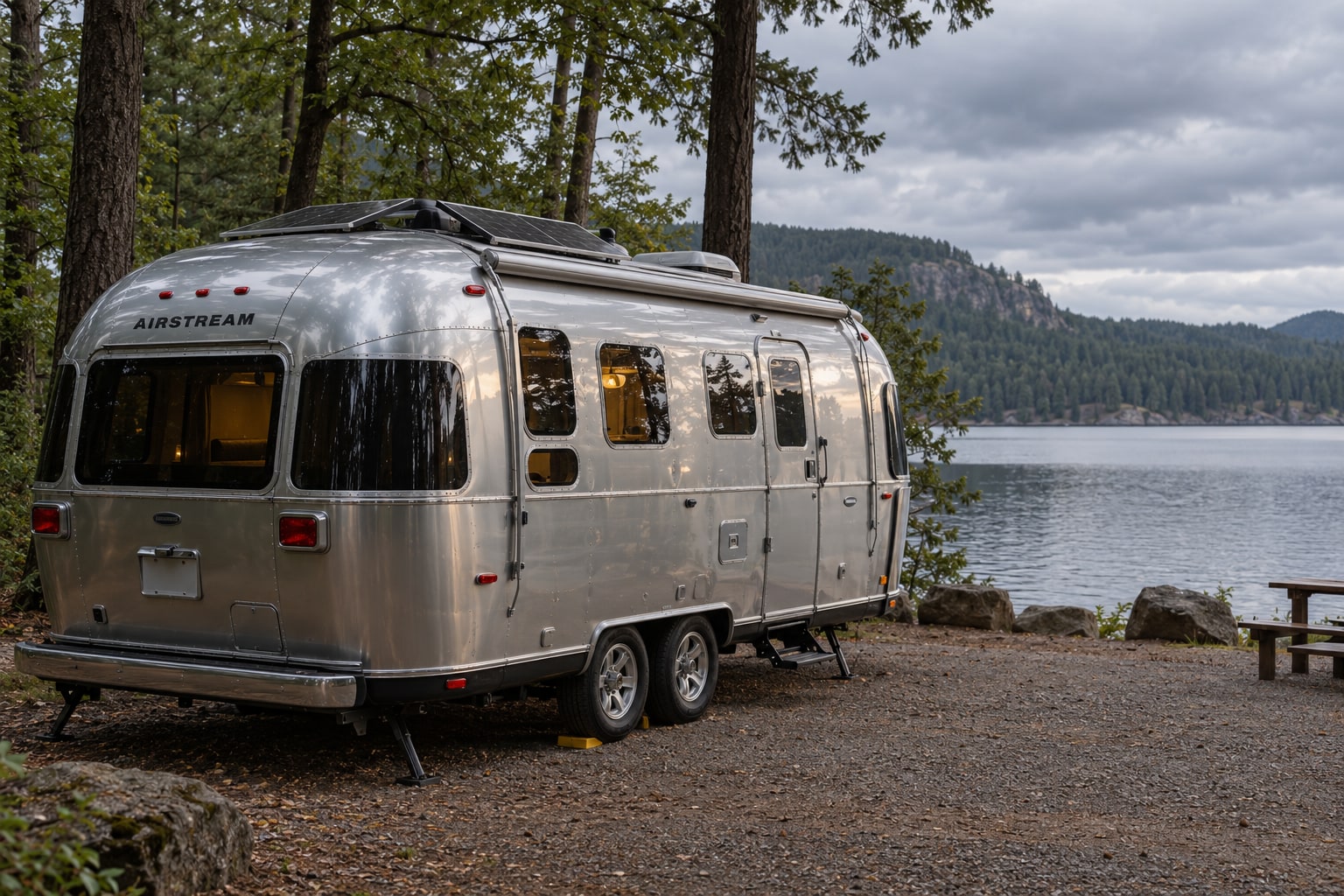
The trade-offs are real: fuel, weight, noise, maintenance and storage space. Honda’s EU2200i, for example, weighs about 47 lb dry, runs about 3.2 hours on its 0.95-gallon tank at rated load and measures 57 dB(A) at that load. Set that against how often you’d actually start it.
A Solar-and-Battery Example: How Long Before You Need Backup?
Take a common boondocking setup:
- Solar: 600 W of panels feeding an MPPT charge controller.
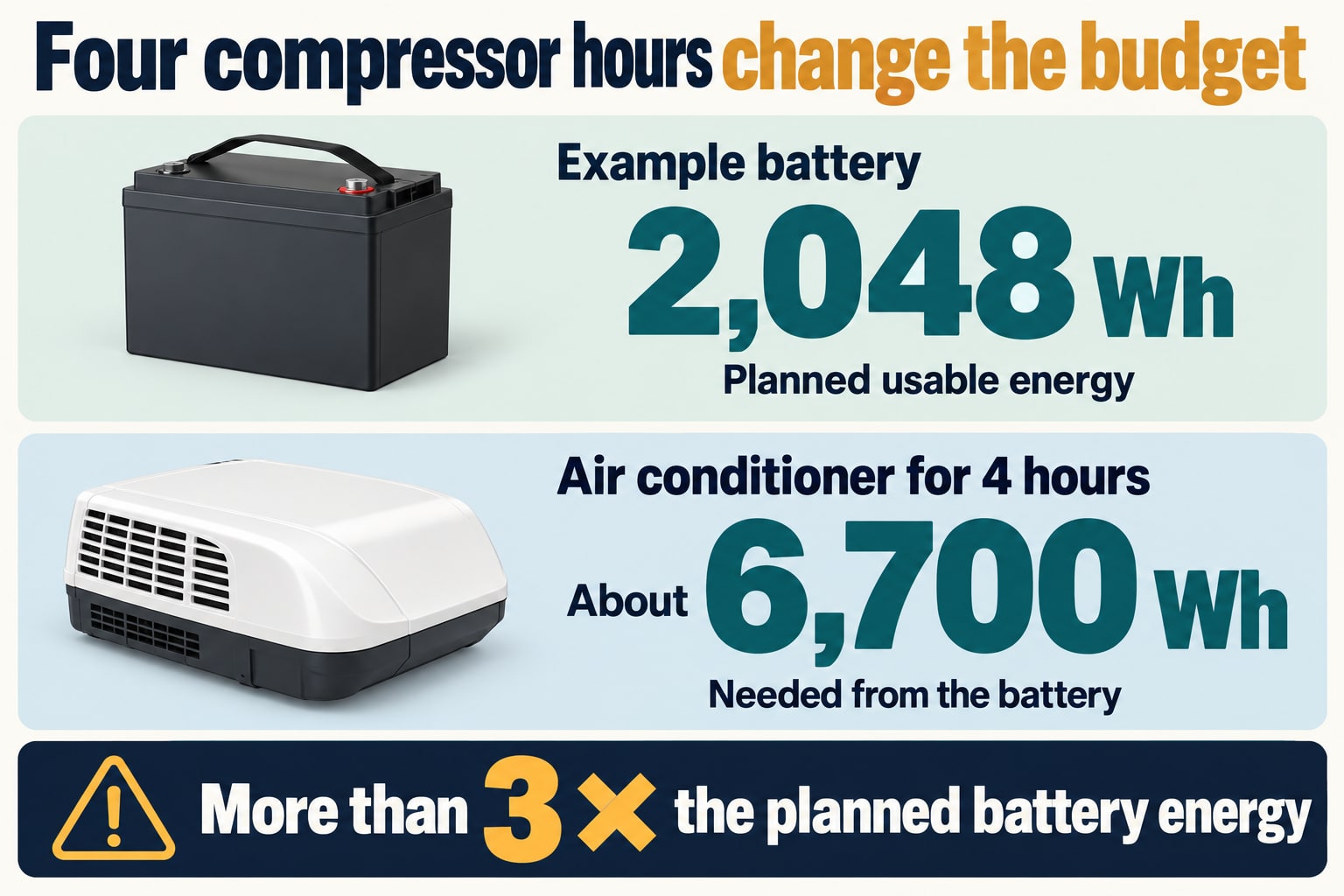
- Battery: 200 Ah of LiFePO4 at 12.8 V, or 2,560 Wh. Planning to use 80 percent and keep 20 percent in reserve leaves 2,048 Wh.
- Daily use: 1,500 Wh, measured at the battery, so inverter losses and the system’s own draw are included.
Estimate each day’s solar input with the planning factor from our solar wattage guide:
The 0.75 is an assumption for planning, covering heat, wiring, controller and charging losses with the panels in open sun; it isn’t a measured efficiency for every RV. Peak sun hours aren’t hours of daylight either. They count the day’s sunlight as hours of full-strength sun, the 1,000 watts per square meter that panel ratings assume, so a long but hazy or overcast day can add up to very few.
- Good day, 4 peak sun hours: 600 × 4 × 0.75 = 1,800 Wh, a 300 Wh surplus.
- Low-sun day, 1 peak sun hour: 600 × 1 × 0.75 = 450 Wh, a 1,050 Wh shortfall.
- No usable sun: 0 Wh, a 1,500 Wh shortfall.
Starting with a full battery and no backup charging, two low-sun days followed by a good one play out like this:
Scroll sideways to see every column.
| Day | Sun | Solar Harvest | Daily Use | Battery After 24 Hours |
|---|---|---|---|---|
| 1 | 1 peak sun hour | 450 Wh | 1,500 Wh | 59% |
| 2 | 1 peak sun hour | 450 Wh | 1,500 Wh | 18%, below the 20% reserve |
| 3 | 4 peak sun hours | 1,800 Wh | 1,500 Wh | 30% |
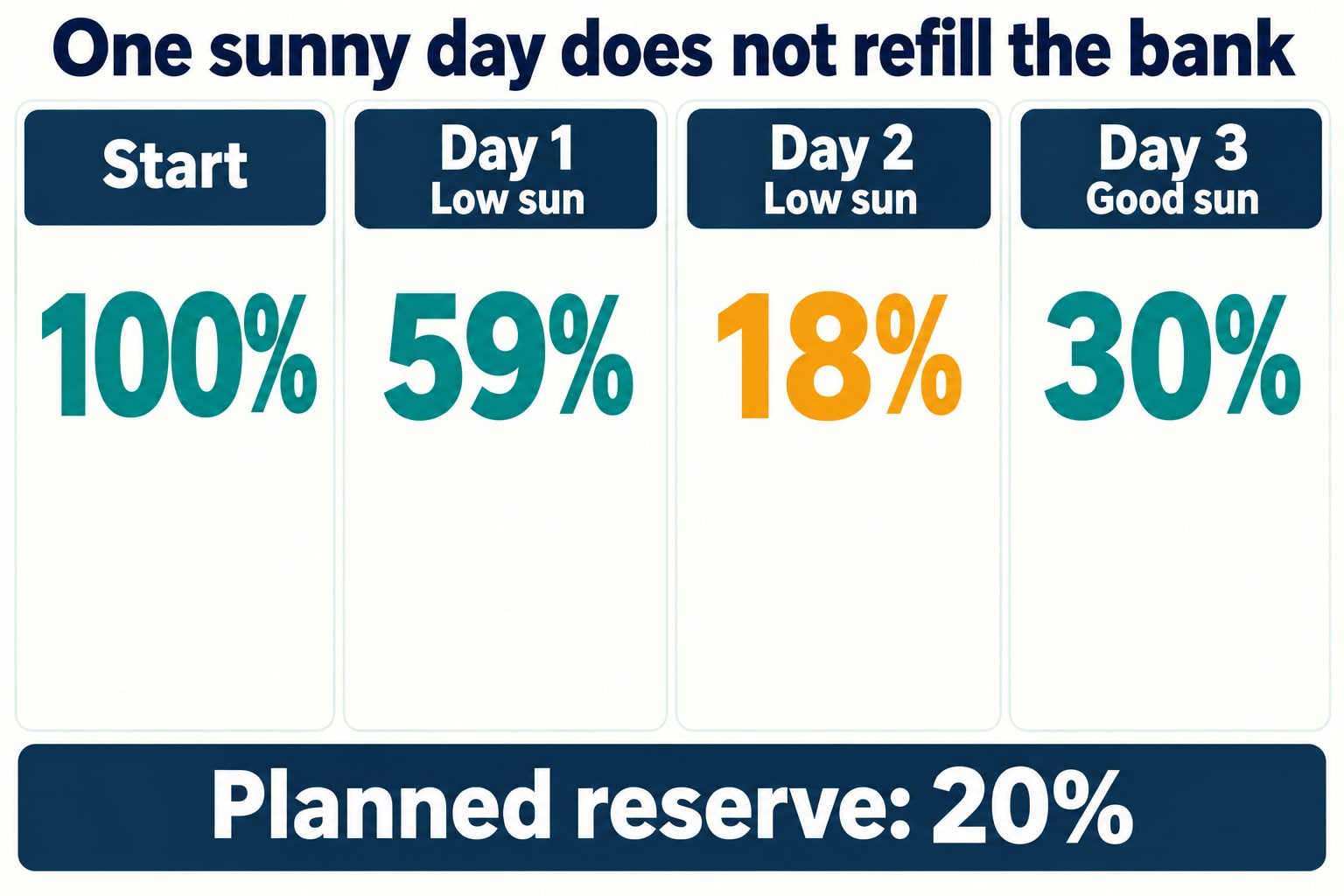
Two low-sun days in a row use up the planned 2,048 Wh, and the good day after them adds back only its 300 Wh surplus. That’s the trap of a cloudy spell: one sunny day covers its own use but doesn’t rebuild a reserve you’ve already spent. With no usable sun at all, under snow or in deep shade, the planned range lasts about a day and a third. Exactly when the battery runs low depends on when you use power and when the sun shows up, so read these as daily budgets, not a countdown.
To keep the 20-percent reserve in this setup, act during the second low-sun day: cut consumption, charge from another source or move somewhere the panels can work. Doubling the battery to 400 Ah would stretch the low-sun run to almost four days, but the 1,050 Wh daily shortfall stays the same. Only more incoming energy or lower use shrinks it. To estimate your own off-grid reserve (opens in a new tab), enter the battery and panels you already have, then try fewer sun-hours to see how much energy the panels can put back.
Air Conditioning Changes the Decision
Air conditioning raises two separate questions. The first is power: whether the generator or inverter can start the compressor and keep it running. The second is energy: how many watt-hours the cooling takes over a day, and that’s the one that usually rules out running it from the battery.
Assume a rooftop unit that draws 1,500 W while its compressor runs. Four compressor hours take 1,500 × 4 = 6,000 Wh on the AC side, or about 6,700 Wh from the battery through a 90-percent-efficient inverter, before any other load. That’s more than three times the example battery’s planned 2,048 Wh, and a good 4-sun-hour day from its 600 W array replaces barely more than one compressor hour. Count compressor hours, not hours with the thermostat on: in mild weather the compressor cycles, while in full sun it can run almost nonstop.
A soft starter helps with the first question only. Micro-Air, which makes the EasyStart soft starter, says it cuts the peak starting current by 50 to 70 percent, which can let a smaller generator start the unit. The running draw and the energy over a hot afternoon stay the same, and propane is no help here either: it takes cooking and heating off the battery, but it doesn’t run a rooftop air conditioner.
How a Generator Charges Your RV Batteries
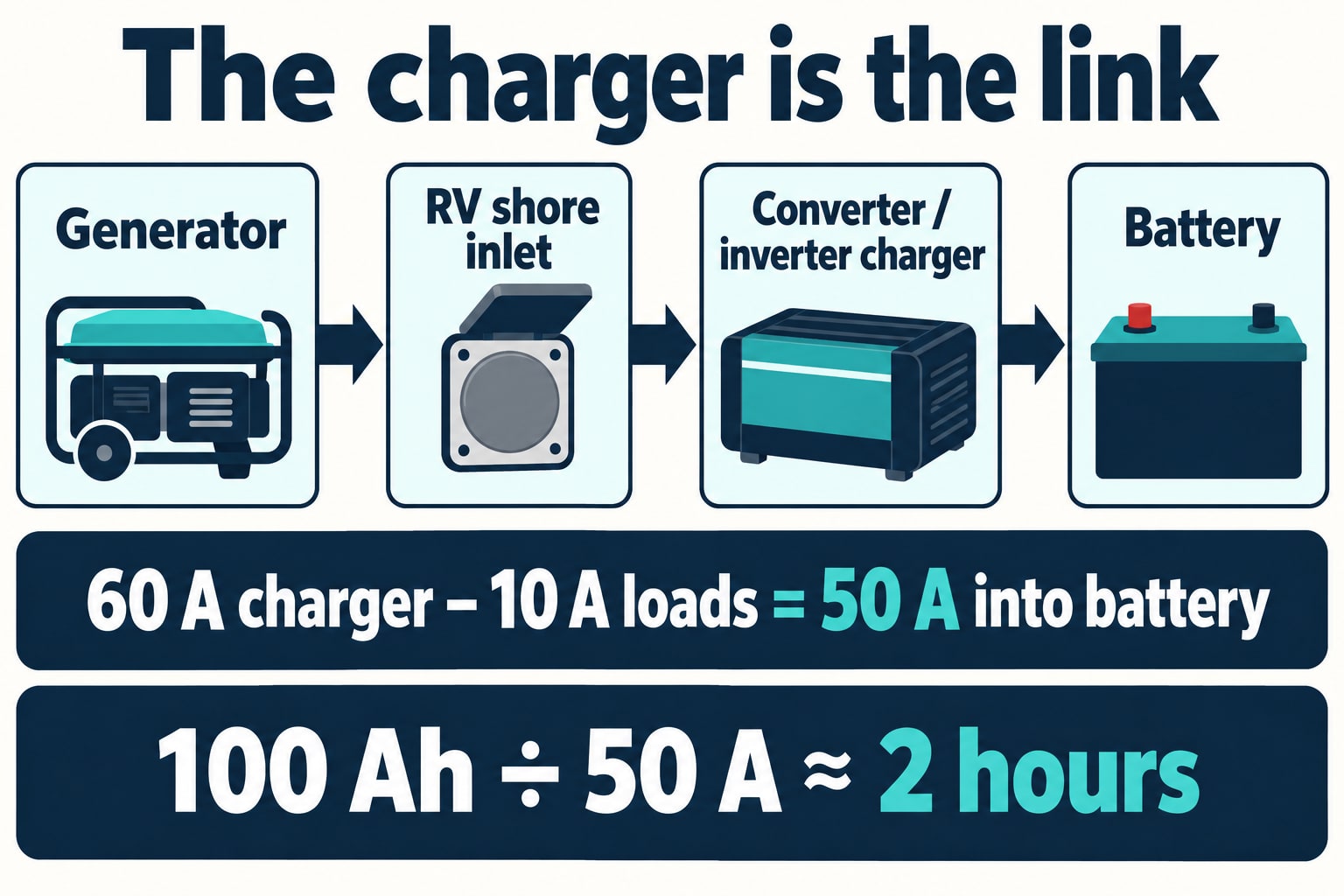
In a typical RV, generator power reaches the house battery by the same route as shore power:
A built-in generator feeds the same charger through the RV’s transfer switch, and a separate battery charger plugged into the generator works too. A few rules decide whether the setup actually charges:
- An inverter alone won’t charge. It only turns battery power into 120V AC. Charging takes a converter, an inverter charger or a separate charger, and our inverter charger guide (opens in a new tab) compares units built to share a small generator.
- Never connect a generator to the solar controller’s PV input. That input is for panels only.
- Set the charger for your battery. A LiFePO4 bank needs the charger’s lithium profile or settings within the battery maker’s range.
- Solar can keep charging while the generator runs. With both chargers set for the battery, they feed the same bank; just keep the total charge current inside the battery’s and the cables’ ratings.
- A bigger generator doesn’t charge faster once the charger or the battery is the limit. A 60 A converter delivers 60 A at most, whatever powers it.
Charging time follows from the net current going into the battery. A charger delivering 60 A while the RV’s 12V loads use 10 A puts about 50 A into the bank, and replacing 100 Ah at 50 A takes about two hours while that current holds. Charging slows near full, and a lithium battery below its permitted charging temperature has to warm up before it can be charged.
Chemistry matters here. LiFePO4 accepts a high current until it’s nearly full, and it’s fine to stop short of 100 percent; Victron’s lithium battery datasheet notes that partial charging even slightly improves service life. Lead-acid slows down in its absorption stage, so the last part of each charge takes hours at low current, and short generator runs that never finish the job leave it partly charged. Trojan lists running batteries in a partial state of charge as a cause of lost performance and early failure, so give an AGM or flooded bank a full charge regularly, from a long sunny day, hookups or a longer generator run.
How Much Generator Do You Need?
The generator has to supply three things at once: the charger’s AC input, any other AC loads running at the same time, and the starting surge of motors and compressors. Two published ratings show how that adds up:
- Charger: Progressive Dynamics rates its PD4060K converter at 60 A of DC output from 1,000 W of AC input.
- Generator: Honda lists the EU2200i at 2,200 W maximum and 1,800 W rated output, which is 15 A at 120V.
The converter’s listed 1,000 W input plus the example air conditioner’s 1,500 W would total 2,500 W, beyond the Honda’s 1,800 W rated output. Run them separately, or reduce charging if the equipment supports it. Check AC input amps as well as watts before adding appliances: the converter’s watt rating alone doesn’t tell you how much of the generator’s 15 A output remains available. An inverter charger with an adjustable input current limit shares a small generator more gracefully: Victron’s generator FAQ for its MultiPlus suggests starting the limit at about 80 percent of the generator’s capacity, roughly 12 A for a 1,800 W generator at 120V, and lowering the charge current if the generator still struggles.
Micro-Air’s RV sizing chart gives an average 13,500 BTU example a minimum of 2,000 W rated running output with EasyStart, or 3,500 W without it. The chart assumes starting capacity about 1.4 times the running rating and no other major loads at compressor startup. Use those as planning figures, then check the actual air conditioner’s requirements. Generator output also drops at altitude, about 3.5 percent per 1,000 feet by Micro-Air’s figure, and in extreme heat, so leave headroom.
Generator Rules and Safe Operation
Campground rules can limit a generator more than its size does. Allowed hours are often far shorter than the time outside quiet hours: Bryce Canyon National Park’s 2026 rules allow generators in its campgrounds only from 8 to 10 a.m. and 6 to 8 p.m., so the battery and solar carry the other 20 hours. Some campgrounds also have generator-free loops or ban generators entirely, and fire restrictions can add limits, so check before you build the plan around one.
When you do run one:
- Keep a portable generator outside and at least 20 feet away. The CPSC gives 20 feet from the house as the minimum, with the exhaust pointed away from buildings. Apply the same to your RV, your neighbors’ rigs and tents, and follow the generator maker’s instructions.
- Keep a working CO alarm in the RV. An automatic CO shutoff on the generator is worth having, but it doesn’t replace safe placement.
- Refuel only with the engine off and cooled down. Gasoline spilled on a hot engine can ignite.
- Connect through the RV’s shore-power inlet with a cord and adapter rated for the load. Never push power into the RV through an ordinary outlet.
- Keep it dry as its manual describes, without boxing in the exhaust.
- Treat a built-in generator differently. It relies on the RV’s own exhaust system, so keep the outlet clear of snow, tall grass and walls, get leaks or damage repaired, and follow the RV and generator makers’ operating instructions.
FAQs
- Can I camp without a generator if I have solar? Yes. Your battery and planned charging need to cover the stay, including nights and low-sun days. A short trip can run mostly on energy stored before departure; a long stay needs enough charging to keep up. Hours of air conditioning and prolonged cloudy weather are the main reasons to bring backup power.
- Can solar and a generator charge the batteries at the same time? Yes. The solar controller and the converter or inverter charger both feed the house bank and regulate their own output. Set both for the battery’s chemistry and keep the combined charge current within the battery’s limit.
- Will a 2,000-watt generator run my RV air conditioner? It can with a suitable air conditioner and soft starter, but check rated running output and starting capacity, not just the number on the generator’s label. Battery charging and other appliances count toward the same limit. Test the complete setup before a trip depends on it, especially at altitude or in hot weather.
- How long should I run a generator to charge RV batteries? Divide the amp-hours you need to put back by the net charging current: replacing 150 Ah at a net 50 A takes about three hours while that current holds. Lithium takes that current nearly to full, while lead-acid needs extra time in absorption and a full charge at regular intervals.
- Can a solar generator replace a fuel-powered generator? Yes, if its stored energy, output rating and charging options cover the trip. A portable power station can replace generator runs for modest loads, especially on short stays. Solar charging still depends on the same weather as your roof panels, so it adds storage rather than a weather-independent source of new energy. Our portable power station guide (opens in a new tab) covers what each size can run.
Conclusion
A modest power budget, enough battery reserve and dependable solar or other charging make generator-free camping straightforward. Bring backup power when you’ll sit through several low-sun days, need hours of cooling or run loads you can’t cut. Before you rely on it, make sure your charger can use it, size it for the charger plus whatever runs alongside, and check when the campground lets you start it.
Spot an error or an outdated detail in this guide?
Report it