Best RV Battery Monitor Shunt: Top Picks & Buyer Guide
On this page
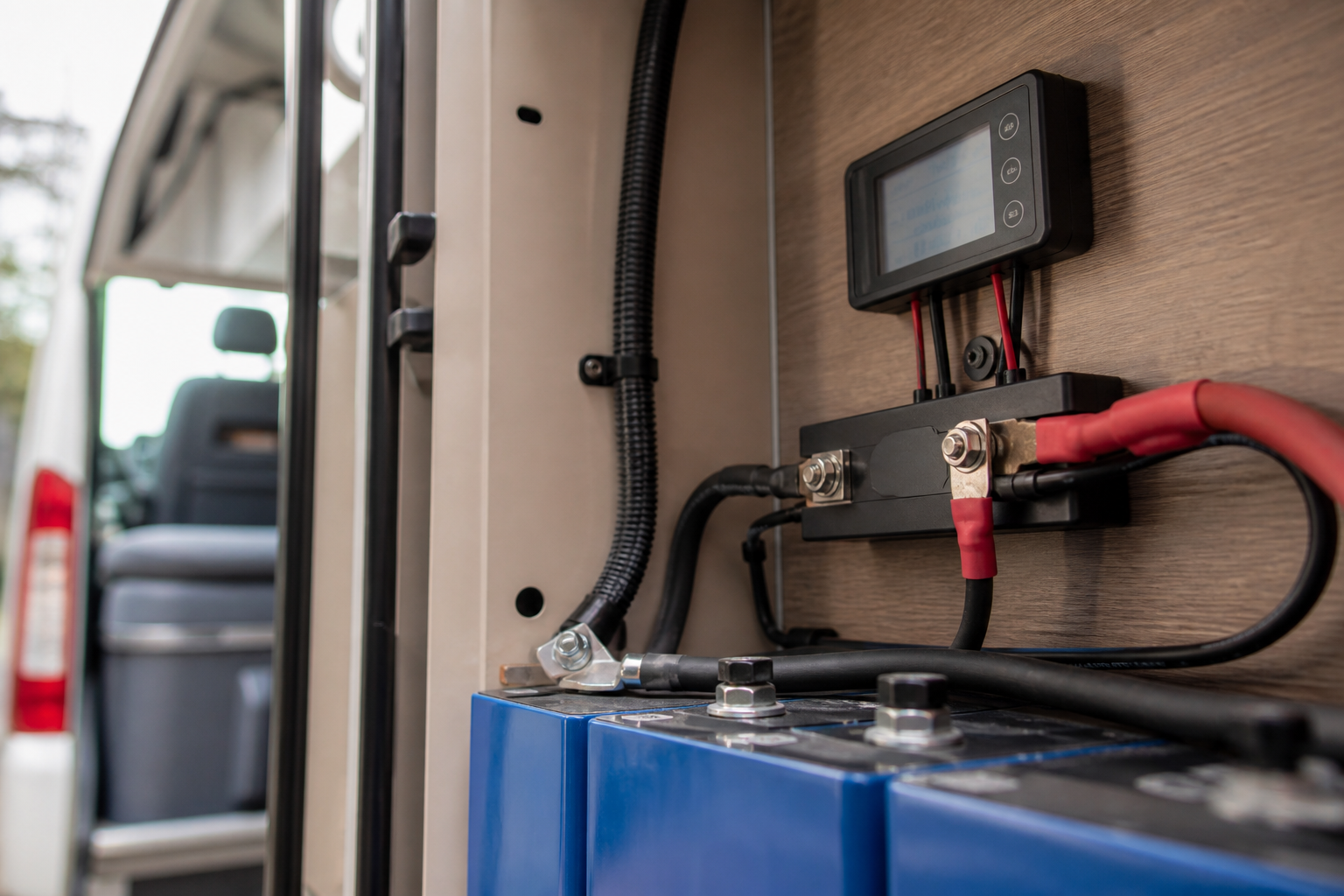
If your RV’s factory battery meter shows “2/3 full” right up until the furnace fan dies at 2 a.m., the root problem is measurement method: voltage-only meters cannot tell you how many amp-hours have actually left the battery bank. A shunt-based battery monitor solves that by measuring real current flow through the negative cable, and this guide compares the shunt monitors RV owners most commonly shortlist.
TL;DR
- Best Overall: Victron SmartShunt — RVers who want a proven, widely supported shunt monitor with a large user community.
- Best Display Option: Victron BMV-712 — Owners who want a dedicated panel readout mounted inside the coach.
- Best Budget: Renogy 500A Battery Monitor — Budget-minded builds that still need true current measurement.
- Best for Simplicity: AiLi Battery Monitor — Basic setups that just need state of charge on a simple screen.
Product Details
Every pick below is a shunt-based monitor: a precision resistor installs in series with the battery bank’s negative cable, and the monitor counts amp-hours in and out to calculate a genuine state-of-charge figure. That coulomb-counting approach is the fundamental reason these units outperform voltage-only meters, which can swing wildly under load or during charging. Because product-level specifications change between hardware revisions and sellers, the descriptions below focus on buyer fit and trade-offs rather than exact figures; confirm final specifications, accessories, and warranty terms on the current product listing before purchase.
One structural note up front: the SmartShunt and Thornwave assume you’ll check readings on demand, while the BMV-712, Renogy, AiLi, and Xantrex are built around a mounted screen. Decide which habit fits your household before comparing anything else.
Victron SmartShunt
The Victron SmartShunt is the monitor most experienced RVers and van builders name first, and for good reason: Victron’s battery-monitoring algorithms are mature, the configuration options are deep, and the installed base is enormous. That last point matters more than it sounds. When you hit a configuration question — Peukert exponent, charged-voltage detection, tail-current thresholds — there are thousands of forum threads, videos, and community write-ups walking through the exact setting. For a device you will configure once and trust for years, that ecosystem depth is a genuine feature.
The SmartShunt is a shunt-only device with no built-in wall display, which keeps the install compact: it lives in the battery compartment on the negative cable, with a small sense wire to the battery positive. Buyers who want a permanently visible readout at the entry door or galley should look at the BMV-712 below instead, or plan for an add-on display in the Victron ecosystem. Configuration supports multiple battery chemistries through adjustable charge parameters. For most mixed solar/inverter RV systems, this is the default recommendation.
Victron BMV-712
The BMV-712 is functionally a sibling of the SmartShunt with one decisive difference: it pairs the shunt with a round panel-mount display head connected by a data cable. If you want to glance at state of charge, current draw, and voltage while walking past the control panel — without pulling out a phone or opening a compartment — this is the layout to buy.
Trade-offs are modest. The display head adds cost over a shunt-only unit and adds one more component to mount, and the two-piece design means slightly more install labor. In exchange you get the same respected Victron measurement engine plus an always-on readout, which is particularly valuable for households where more than one person needs to read the batteries — a partner or guest can check charge state without any app onboarding. If your rig has an existing round hole from a factory meter, this can be close to a drop-in visual upgrade. As with any monitor, confirm the current hardware revision’s feature set on the listing before you commit.
Renogy 500A Battery Monitor
Renogy’s 500A battery monitor with shunt is the pick for buyers who want real coulomb counting without paying Victron money. It uses the same fundamental architecture — a 500A-class shunt on the negative cable feeding a display head — and Renogy’s broad presence in the RV solar market means it slots naturally into builds already using Renogy panels and charge controllers. For a weekend camper or a budget van conversion where the goal is “stop guessing from voltage,” it covers the core job at a meaningfully lower price point.
The honest trade-off versus the Victron units is refinement rather than function. Configuration options are typically simpler, documentation is thinner, and the community knowledge base is smaller, so edge-case tuning (for example, dialing in charged-detection behavior on an unusual charge profile) takes more trial and error. The 500A rating is generous headroom for typical RV loads including inverters, which is why 500A-class shunts have become the de facto standard for this category. If your budget is firm and your system is straightforward, this is the value play.
AiLi Battery Monitor
The AiLi battery monitor is the frequent answer in budget van-build threads when someone asks for the cheapest monitor that still uses a real shunt. It presents state of charge, voltage, and current on a compact screen, with a minimal settings menu — you tell it the bank’s amp-hour capacity and it counts from there. For owners who find deep configuration menus intimidating, that simplicity is the selling point rather than a limitation: fewer settings means fewer ways to misconfigure the readout.
The compromises are what you’d expect at the entry level. Synchronization behavior (how the monitor decides the bank is “full” and resets to 100%) is less sophisticated than on premium units, so the state-of-charge figure can drift over multiple partial-charge cycles until a full recharge re-anchors it. Support, warranty, and return policies vary by seller. If you understand those limits — and you run your bank to full charge regularly so the counter stays honest — it delivers the core benefit of shunt-based monitoring for very little money.
Thornwave PowerMon
The Thornwave PowerMon is the enthusiast’s alternative in this category: a compact shunt-based monitor that shows up repeatedly in van-dweller and DIY-solar discussions among people who like data. Its reputation is built on detailed measurement and logging depth, which appeals to owners who want to study consumption patterns — how many amp-hours the compressor fridge really uses overnight, or what the parasitic draw of the rig looks like when “everything is off.” If you enjoy analyzing your power system rather than just glancing at a percentage, this is the pick that rewards that mindset.
The flip side is that it takes a different approach to readouts than panel-display units, and it comes from a smaller company than Victron or Renogy, so retail availability and accessory options fluctuate more. Confirm the monitoring interface and current hardware version match how you actually want to check your batteries day to day. For a family rig where multiple non-technical users need instant readings at a wall panel, the BMV-712 is a better fit; for a tinkerer’s van build, the PowerMon is a strong dark-horse choice.
Xantrex LinkPRO
The Xantrex LinkPRO represents the old-guard approach to shunt-based monitoring: a panel-mount battery monitor line with a long history in marine and RV installations, from a brand many motorhome owners already know from factory-installed inverter/charger equipment. Its appeal is exactly that pedigree — buyers upgrading an older coach, or replacing a failed factory monitor, often prefer a unit designed around traditional panel-mount form factors and conventional wired displays.
Against the modern competition it reads as dated: the interface is button-and-segment-display rather than app-driven, and pricing typically isn’t competitive with the newer entrants for equivalent function. But “dated” also means well-understood, and for a chassis where a permanent, glanceable, no-phone-required readout is the requirement, it remains a legitimate option.
What Shunt Amperage Rating Do You Need?
Size the shunt to your worst-case simultaneous current, which in most RVs is dominated by the inverter. Use this formula: DC amps ≈ inverter continuous watts ÷ system voltage ÷ inverter efficiency (as a decimal, from the inverter’s datasheet). A 2,000W inverter on a 12V bank works out to well over 165A on the DC side before conversion losses are added. Layer on large DC loads that could run at the same time — hydraulic jacks, slide motors, winches — then leave comfortable headroom: shunts are most accurate well below their maximum rating, and undersizing risks overheating the shunt element.
In practice, a 500A-class shunt covers nearly all RV setups including inverter loads, which is why it has become the category standard.
If you run a very small system — no inverter, modest DC loads — a lower-rated shunt is electrically fine, but the price difference is usually small enough that buying the 500A class anyway preserves upgrade headroom. If you need more than 500A (large parallel inverter banks), you’re outside typical RV territory and should be specifying the monitor around the shunt, not the other way around.
Display, App or Both?
This is the most personal variable. If you want a permanently visible readout at the control panel — something a partner, kids, or guests can read without instructions — choose a display-head unit: the Victron BMV-712, the Renogy 500A monitor, the AiLi, or the Xantrex LinkPRO. If you’re comfortable checking readings on demand and prefer the cleanest possible install with nothing mounted in the living space, a shunt-only unit like the Victron SmartShunt keeps everything in the battery bay. Confirm the monitoring interface details for whichever unit you shortlist, since readout options vary by hardware version.
Placement matters more than it seems: mount a display where you already make power decisions — next to the thermostat or the inverter remote — so checking state of charge becomes a habit rather than a chore.
If you need both at-a-glance and on-demand access → the BMV-712 is the safest answer. If one technically inclined owner manages the whole system → the SmartShunt or Thornwave PowerMon fit better. If the budget is the constraint → the Renogy or AiLi with their built-in screens deliver the essentials.
Battery Chemistry and System Voltage Considerations
Lithium banks make shunt monitors nearly mandatory, because lithium’s flat voltage curve makes voltage-only estimation almost useless across the broad middle of the discharge range. Most quality shunt monitors in this category offer configurable settings for lithium, AGM, and flooded chemistries — capacity, charged-voltage threshold, tail current, and (for lead-acid) a Peukert correction — but the depth of that configurability varies by model, so confirm the chemistry profiles on the specific unit you buy. Deeper configurability is where the Victron units earn their premium: correct charged-detection settings are what keep the state-of-charge counter re-synchronizing accurately over months of partial-charge cycling.
One caveat worth internalizing: a coulomb counter tracks the capacity you tell it, not the capacity the bank actually retains. As batteries age and usable capacity fades, re-verify the capacity setting against the manufacturer’s guidance — an aging lead-acid bank programmed with its as-new rating will read optimistically.
Also match the monitor’s supported system voltage to your bank. If you run separate house and chassis banks, note that full amp-hour monitoring of both requires a shunt per bank — some monitors can additionally read a second bank’svoltage, which is useful for spotting a dying chassis battery but is not full monitoring.
Comparison Table
Scroll sideways to see every column.
| Search Target | Best Fit | What to Confirm Before Buying | Why It Might Fit | Watchouts | Where to buy |
|---|---|---|---|---|---|
| Victron SmartShunt | Best when you want the most proven shunt monitor with deep configuration options | Confirm the dimensions, terminals, and mounting fit your battery box | Fits owners who want a monitor they can tune precisely, backed by a large community | No built-in wall display — plan for on-demand checks or add a separate readout. | Amazon ↗ |
| Victron BMV-712 | Best when you want a permanently visible readout mounted in the coach | Confirm the display cable length reaches your planned panel location | Fits households where partners and guests read the batteries without an app | The display head adds cost and one more component to mount. | Amazon ↗ |
| Renogy 500A Battery Monitor | A strong fit when you want true coulomb counting on a budget | Confirm the shunt rating and display cable length suit your installation | Suits builds already running Renogy panels and charge controllers | Simpler settings and thinner documentation than the premium units. | Amazon ↗ |
| AiLi Battery Monitor | A strong fit for buyers weighing support alongside price | Check the warranty period and how reachable support actually is | Suits buyers who plan to keep the bank for many seasons | A short warranty or weak support undercuts a low purchase price. | Amazon ↗ |
| Thornwave PowerMon | Best for data-minded owners who want detailed logging of consumption | Confirm the monitoring interface matches how you’ll actually check readings | Fits tinkerers who study their power system rather than glance at a percentage | Smaller company — retail availability and accessories fluctuate more. | Amazon ↗ |
| Xantrex LinkPRO | Best traditional panel-mount monitor for older coaches and factory replacements | Confirm the panel cutout and wired-display layout suit your existing dash | Fits owners replacing a failed factory meter with a familiar form factor | Button-and-segment interface feels dated next to newer entrants. | Amazon ↗ |
As an Amazon Associate I earn from qualifying purchases.
Which One Should You Buy
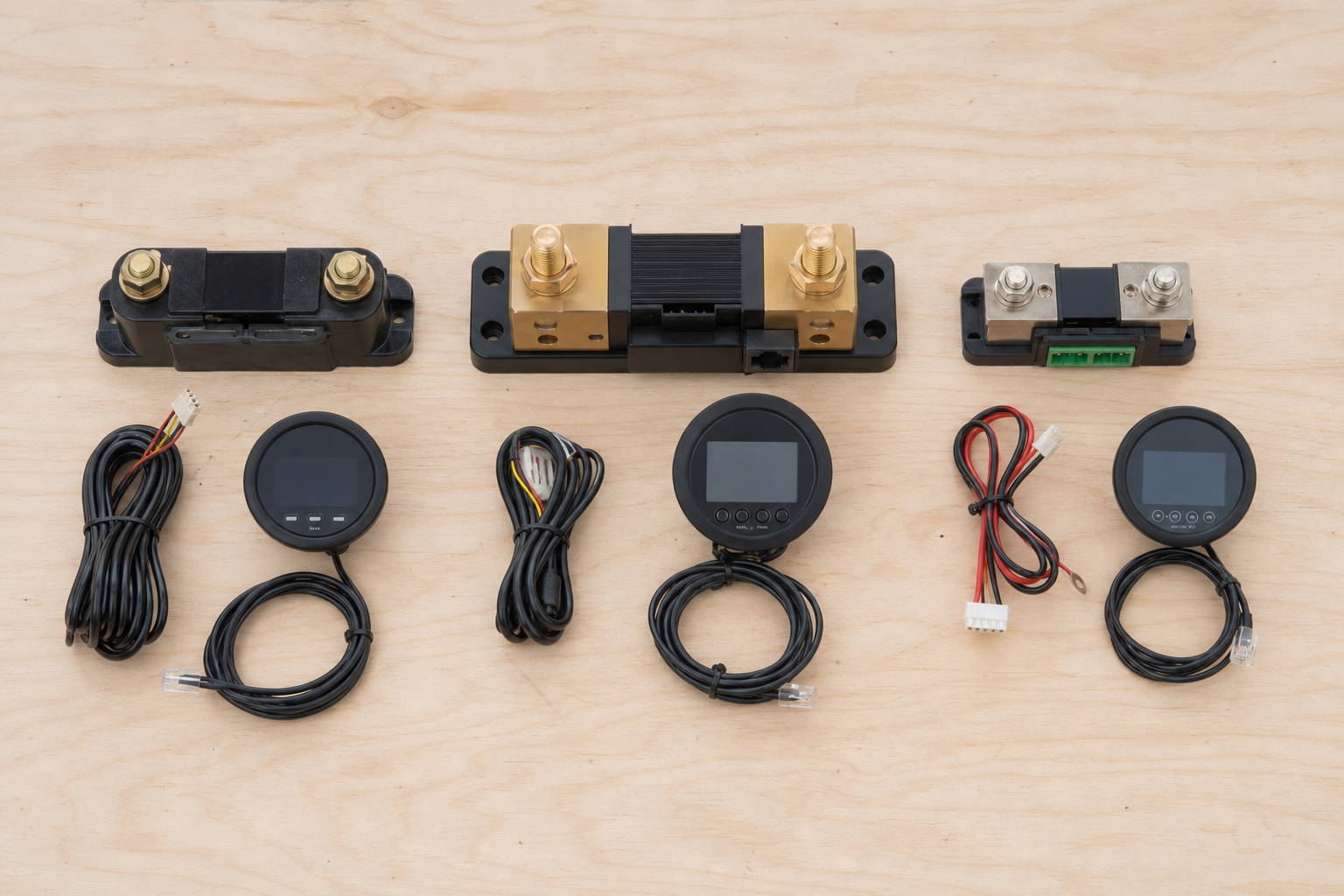
All six picks perform the same fundamental job — counting real amp-hours through a shunt — so the decision comes down to three variables: the shunt’s current rating relative to your loads, how you want to read the data, and how much configuration depth your system demands. Work through those in order and the shortlist usually collapses to one obvious choice.
Safety & Common Mistakes
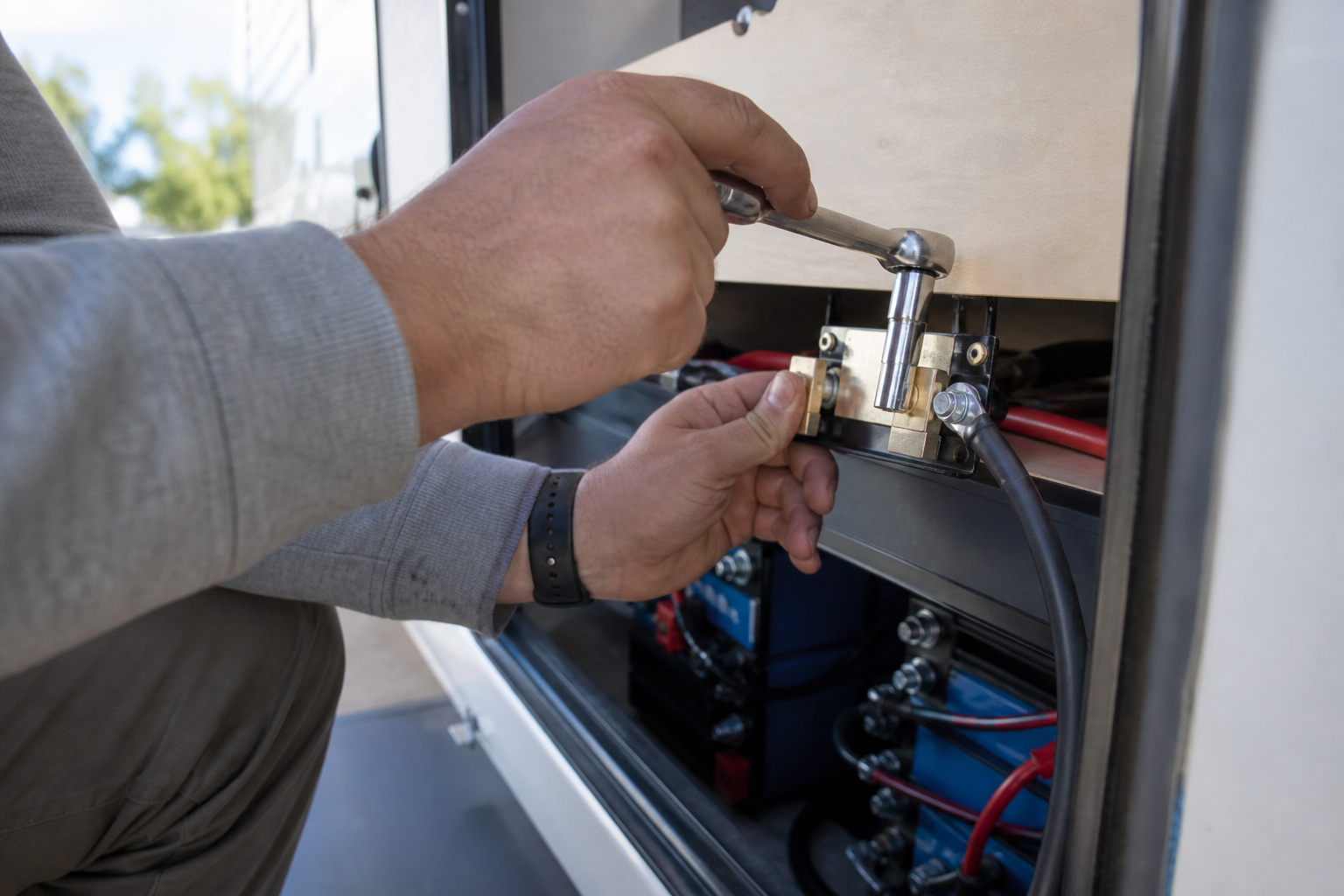
- Loads bypassing the shunt: Every negative connection must land on the load side of the shunt, not the battery post. Any ground wire attached directly to the battery negative terminal carries current the monitor never sees, and the state-of-charge figure will drift permanently optimistic.
- Working on a live bank: Disconnect or isolate the battery bank before cutting into the negative cable. An inverter’s DC input can arc violently, and lithium banks can deliver enormous short-circuit current — remove rings and use insulated tools.
- Undersized or unfused sense wiring: The small positive sense wire that powers the monitor should be fused close to the battery. An unprotected sense wire chafing against a chassis edge is a fire path, not a monitoring accessory.
- Wrong capacity or chemistry settings: A monitor programmed with the wrong amp-hour capacity or charged-voltage threshold will confidently display wrong numbers. Set the bank’s actual usable capacity per the battery manufacturer’s guidance and chemistry profile at install, and re-check after any battery upgrade.
- Never reaching full charge: Coulomb counters re-synchronize to 100% when the bank reaches its charged criteria. If you boondock on partial charges for weeks, expect drift — periodically charge to full so the counter re-anchors.
- Loose shunt terminations: The shunt carries your entire system current. Torque the main cable bolts properly and re-check after the first few trips; a loose high-current connection creates heat and voltage drop at exactly the point you’re measuring.
This is general guidance, not a substitute for the manufacturer’s installation manual or applicable low-voltage electrical codes; when in doubt, have a qualified 12V technician review the install.
FAQs
- Do I really need a shunt for an RV battery monitor? If you want an accurate state-of-charge percentage, yes. Voltage-only meters infer charge from a voltage curve that sags under load and rises during charging, so readings swing constantly. A shunt measures actual current flow and counts amp-hours in and out, which is the only way to know how much usable energy genuinely remains — especially with lithium banks, whose voltage barely changes across most of the discharge range.
- What size shunt should I buy for my RV? A 500A-class shunt covers nearly all RV setups, including systems with inverters, and has become the effective standard for this category. Size to your worst-case simultaneous DC draw with headroom to spare; only unusually large parallel-inverter systems need more.
- Can one monitor handle both house and chassis batteries? Full amp-hour monitoring requires a shunt in each bank’s negative path, so one monitor fully tracks one bank. Some units can additionally read a second bank’s voltage, which is enough to warn you about a weak chassis battery, but not enough to track its consumption. For two fully monitored banks, plan on two shunts.
- Do shunt monitors work with lithium batteries? Most quality shunt monitors support lithium, AGM, and flooded chemistries through configurable settings, and lithium owners benefit the most because voltage-based estimation is nearly useless on lithium’s flat discharge curve. Confirm the chemistry profiles on your specific unit before purchase, since configurability varies by model and hardware revision.
- How accurate are shunt-based monitors? Accuracy depends less on the hardware and more on setup: correct amp-hour capacity, correct charged-detection settings, every ground routed through the shunt, and periodic full charges to re-synchronize the counter. A properly configured shunt monitor tracks state of charge far more faithfully than any voltage-based meter, though every coulomb counter drifts slightly between full-charge resets.
- Does a battery shunt drain my battery? Negligibly. The shunt itself is a passive resistor, and the monitor electronics typically draw only a few milliamps — orders of magnitude below a propane detector or radio memory circuit. Over a season of storage it’s a rounding error compared with normal parasitic loads.
Conclusion
Choosing the best RV battery monitor shunt comes down to a short decision chain: confirm a shunt rating with headroom over your peak inverter draw (500A-class covers nearly everyone), decide whether you want a wall display or a shunt-only install, and match the monitor’s chemistry settings to your battery bank. For most owners the Victron SmartShunt or BMV-712 justifies its premium through configuration depth and community support; the Renogy 500A monitor is the sensible value pick, and the AiLi covers bare-bones builds.
Count the grounds you’ll need to relocate to the shunt’s load side and measure the cable run to your planned display location — that ten-minute audit determines which unit installs cleanly in your rig and prevents the single most common cause of inaccurate readings.
Spot an error or an outdated detail in this guide?
Report it