RV Inverter Sizing: Pure vs Modified Sine Guide
On this page
TL;DR
- Sum continuous watts: List every AC load you run simultaneously and add a safety margin appropriate to your load profile.
- Check surge rating: The inverter peak/surge must exceed the highest startup draw (compressors, motors).
- Choose pure sine: Sensitive electronics, microwaves, and CPAP machines benefit from pure sine output (some makers require it).
Inverter Sizing by Use Case
An undersized inverter trips on the startup surge of the first motor-driven appliance you plug in; an oversized one costs more up front and drains your battery bank through its own standby draw every hour it sits idle. The correct rating is not a universal wattage — it is a number you calculate from your own equipment. Two RVers with identical rigs can have wildly different load profiles depending on whether they cook with propane or electricity, work from a laptop or a desktop workstation, and camp with hookups or entirely off-grid.
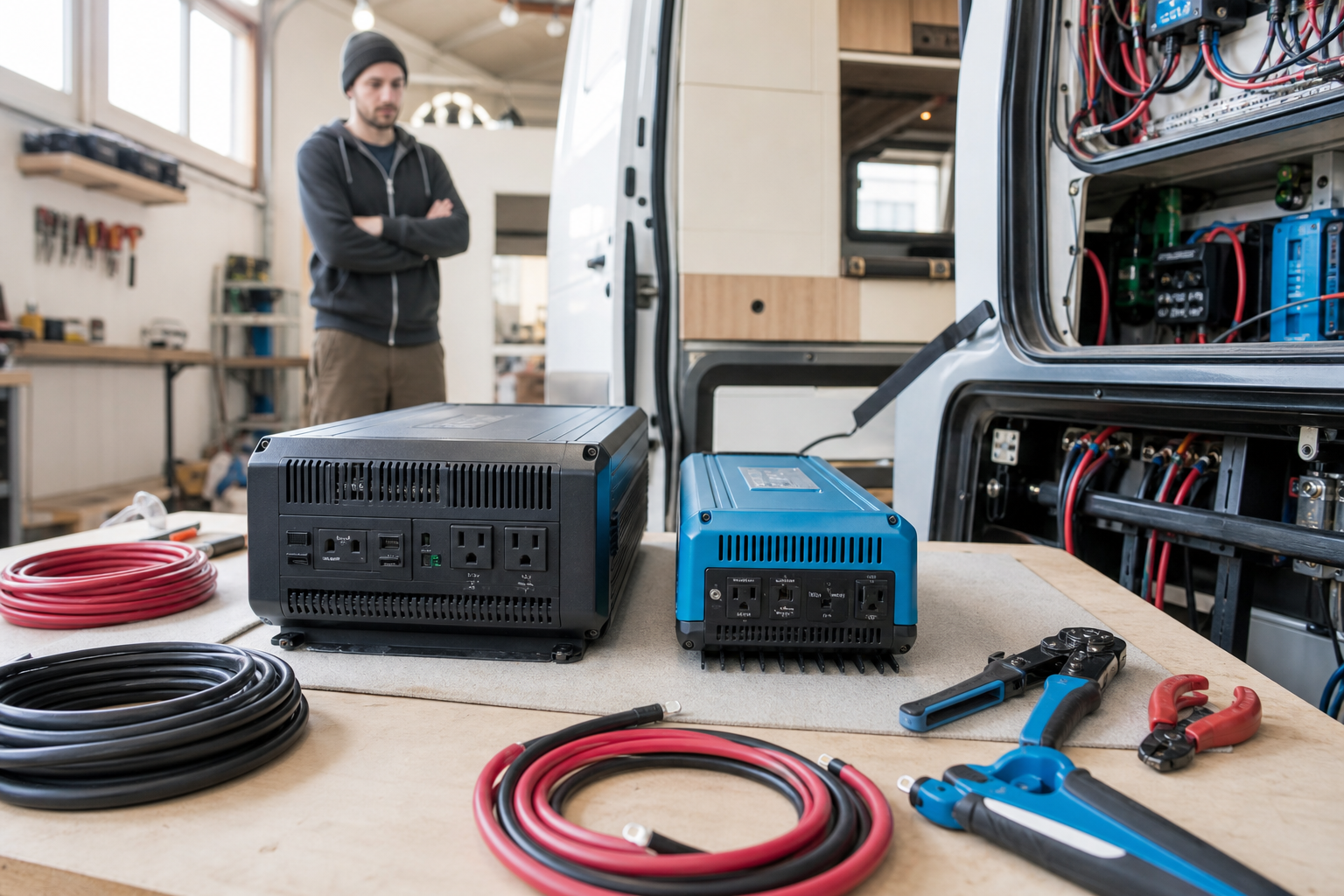
The worksheet below is the backbone of this guide. It deliberately contains no pre-filled wattages, because the numbers that matter most are the ones printed on the nameplates and datasheets of your appliances. Describe your use case in plain language, list the loads you genuinely expect to run at the same time, then read the labels. Every AC appliance sold has a rated input power (in watts, or in amps at 120V — multiply amps by 120 to get watts). Motor-driven and compressor-driven devices also have a startup surge, which the manufacturer’s datasheet may list as “locked rotor amps,” “peak watts,” or “starting watts.” Where the datasheet is silent, a clamp meter with an inrush function will measure it directly.
Scroll sideways to see every column.
| Your Use Case | Loads You’ll Run (describe) | Sum of Continuous W (from nameplates) | Highest Surge W (from datasheets / measured) | Inverter Sized Above the Total |
|---|---|---|---|---|
| (your use case) | (loads you plan to run simultaneously) | (your value) | (your value) | (your continuous sum plus margin) |
| (your use case) | (loads you plan to run simultaneously) | (your value) | (your value) | (your continuous sum plus margin) |
| (your use case) | (loads you plan to run simultaneously) | (your value) | (your value) | (your continuous sum plus margin) |
- Use case: Be honest and specific. “Coffee in the morning, laptop all day” is a different sizing problem than “electric kitchen with overlapping appliances.”
- Loads: Only list devices that will realistically run at the same time. Sequential loads (kettle in the morning, TV at night) do not stack for sizing purposes, though they all count for battery runtime.
- Continuous sum: Add the nameplate input watts of every simultaneous load. Use input power, not marketing figures like a microwave’s “cooking watts,” which describe output and understate the electrical draw.
- Surge: Identify the single load with the largest startup surge and add that surge (minus its continuous figure) on top of your continuous sum, assuming it starts while everything else is already running. This is your worst-case peak.
- Inverter size: Choose a unit whose continuous rating exceeds your continuous sum by roughly 20–25%, and whose surge rating exceeds your worst-case peak. The margin covers voltage sag, heat derating, and the appliance you forgot.
Short version: the inverter is sized to your worst simultaneous moment, not your average day.
Continuous vs Surge Watts Explained
Every inverter carries two ratings, and confusing them is the single most common cause of a “defective” inverter that is actually just undersized. The continuous rating is the power the inverter can deliver indefinitely without overheating — this is the number that must exceed the sum of everything running at once. The surge rating (sometimes “peak” or “starting” watts) is a much higher figure the inverter can supply for a brief burst, typically a fraction of a second up to a few seconds depending on the model. Check your specific inverter’s spec sheet for both the surge magnitude and its duration, because manufacturers define “surge” inconsistently.
Why do loads surge at all? Anything with an electric motor or a compressor — refrigerators, air conditioners, water pumps, power tools, fans — demands a large inrush of current at the instant the motor starts turning, before it settles down to its running draw. Depending on the appliance, that startup demand can be several times the running load. Purely resistive loads behave differently: a kettle, toaster, hair dryer, or electric heating element draws essentially its nameplate wattage from the first instant, with no meaningful surge. Electronics with switch-mode power supplies (laptops, TVs, chargers) can have a brief inrush as their capacitors charge, but it is short and rarely the sizing constraint.
- If your biggest load is resistive (heating elements), the continuous rating dominates your decision and surge headroom matters less.
- If your biggest load is a compressor or motor, the surge rating — and how long the inverter can hold it — often decides whether the appliance starts at all.
- A cheap inverter with an impressive surge number but a very short surge duration may still fail to start a compressor that needs a longer inrush window. Compressors are the loads most likely to expose this.
Don’t guess. The nameplate gives continuous input; the datasheet or a clamp meter with inrush capture gives you the surge. Both take five minutes to find and save you from an expensive mistake.
Pure Sine vs Modified Sine
Shore power delivers a smooth sinusoidal AC waveform. A pure sine wave inverter reproduces that waveform closely — often more cleanly than a rural grid connection — so anything designed for household power runs as intended. A modified sine wave inverter produces a stepped, blocky approximation: the voltage jumps between levels rather than sweeping smoothly. It is cheaper to build, which is its entire appeal.
- Generally tolerant of modified sine: simple resistive loads (heating elements, incandescent lamps) and basic universal-motor tools. They mostly care about average power, not waveform shape.
- Frequently problematic on modified sine: anything with an AC induction motor or compressor (refrigerators, some fans, some pumps) — these run hotter, noisier, and less efficiently, shortening their lives. Microwave ovens often cook unevenly or at reduced effective power. Devices that derive timing from the AC waveform can misbehave.
- High-risk on modified sine: medical equipment such as CPAP machines (some manufacturers require it for specific models — check your manual), variable-speed and “soft-start” appliances, laser printers, some battery chargers for power tools, audio equipment (which picks up an audible buzz), and sensitive electronics with marginal power supplies. Damage can be gradual — the device works for months, then fails early.
The honest decision rule: if your load list is exclusively simple resistive devices and cheap tools, a modified sine inverter can save money. If your list includes a CPAP, a residential-style refrigerator, a microwave, or anything you would be upset to replace, buy pure sine. The price gap between the two has narrowed enough that for most RVers building a system today, pure sine is the default and modified sine is the exception you choose deliberately, not the compromise you discover later.
Rule of thumb: if you have to ask whether a specific appliance tolerates modified sine, assume it doesn’t and check the manufacturer’s documentation before trusting it to one.
Matching Inverter to Appliances
Sizing is not just arithmetic — it is scheduling. Two questions govern which loads can share an inverter moment.

Which loads can run together? Low-draw electronics — laptops, phone chargers, LED lighting on an AC circuit, a TV — stack easily and rarely threaten a reasonably sized inverter’s continuous rating. Check their nameplates, sum them, and you will usually find comfortable headroom. Add one high-draw appliance (a heating element or a microwave) on top of that background load and the sum jumps dramatically; add a second high-draw appliance and you are into territory that demands either a large inverter or discipline.
What should be staggered?
- Don’t start the microwave while the coffee maker’s heating element is active — run them back to back instead. The coffee finishes in minutes; sequencing costs you nothing.
- Let a refrigerator’s compressor be the “always allowed” load, and treat everything else as scheduled around it. You cannot control when a compressor cycles on, so your continuous budget must always leave room for it.
- Air conditioning through an inverter is a category of its own. The startup surge of an AC compressor is severe, and many installations add a dedicated soft-start device specifically to tame it. If AC-through-inverter is your goal, size around the AC unit’s documented locked-rotor or starting requirement, with the soft-start’s effect included — from the AC manufacturer’s data, not a generic figure.
- Heating with electricity (space heaters, electric water heating) is the fastest way to overwhelm both an inverter and a battery bank. Most off-grid RVers push heating to propane or diesel and reserve the inverter for everything else. If you insist on electric heat, it becomes the dominant term in every calculation you do.
Some loads justify their own dedicated circuit from the inverter’s AC output — typically the highest-draw appliance — so a fault or overload there doesn’t drop power to everything else. Wire branch circuits with appropriately rated AC breakers just as you would in a house.
The one-question test: “What is the worst realistic combination of things running at the same instant, including a compressor kicking on uninvited?” That combination — not your average evening — is what the inverter must survive.
Worked Examples
Both examples below exist to demonstrate the arithmetic, nothing more. Every figure is an assumption; substitute your own nameplate and datasheet numbers before making any decision.
Example 1: Light-Load Weekend Setup (illustrative — assumed values, not a default profile)
Every number below is an assumed input chosen purely to demonstrate the math — not a typical value, not a recommendation, not a default.
Assume a camper who, after reading their own nameplates, records: a laptop charger at an assumed 90 W continuous, a small fan at an assumed 40 W continuous with an assumed 80 W startup surge, and a drip coffee maker at an assumed 800 W continuous (resistive, negligible surge). The camper’s honest answer to “what runs simultaneously?” is: all three, on a slow morning.
- Continuous sum: 90 + 40 + 800 = 930 W.
- Worst-case peak: the fan starting while everything else runs: 90 + 800 + 80 = 970 W. (The fan’s surge replaces its running draw at the instant of startup.)
- Margin: 930 W × 1.25 ≈ 1,163 W continuous requirement.
Under these assumptions, an inverter with a continuous rating around 1,200–1,500 W and a surge rating comfortably above 970 W satisfies both constraints. Because the load list includes only electronics, a fan, and a resistive heating element — no medical gear or compressor appliances — this user could consider modified sine, though pure sine removes any doubt about the laptop supply and future purchases. If your coffee maker’s nameplate says something different, your math says something different.
Example 2: Heavy-Load Full-Timer (illustrative — assumed values, not a default profile)
As before, every figure is an assumption for illustration only. Read your own labels.
Assume a full-timer whose nameplate survey produces: a compressor refrigerator at an assumed 150 W running with an assumed 900 W startup surge, a microwave whose nameplate input is an assumed 1,500 W, a background of electronics (router, laptop, lights) totaling an assumed 250 W, and an induction burner at an assumed 1,800 W. The full-timer decides, realistically, that the microwave and induction burner will not run simultaneously — a staggering rule they commit to — but the refrigerator and electronics are always potentially on.
- Continuous sum (worst allowed combination): fridge running + electronics + induction burner = 150 + 250 + 1,800 = 2,200 W.
- Worst-case peak: the refrigerator compressor starting mid-cook: 900 + 250 + 1,800 = 2,950 W.
- Margin: 2,200 W × 1.25 = 2,750 W continuous requirement.
Under these assumptions, an inverter rated for 3,000 W continuous with a surge rating well above 2,950 W is the target — and verify the surge duration in the spec sheet, because a compressor inrush must fit inside the inverter’s surge window. Pure sine is non-negotiable here: the compressor refrigerator and microwave both belong to the categories that suffer on modified sine. Note what the staggering rule bought this user: without it, microwave plus induction plus fridge plus electronics would have pushed the continuous requirement past this inverter class entirely, forcing a larger unit, heavier cables, and a bigger battery bank. Discipline is cheaper than copper.
Battery Runtime Estimation
The inverter rating tells you what you can run; the battery bank tells you for how long. The estimation chain has four steps, and skipping any of them produces optimistic nonsense.
- Convert battery capacity to watt-hours. Capacity in amp-hours × nominal bank voltage = watt-hours. A bank’s amp-hour rating is on its datasheet.
- Apply usable depth of discharge. No battery chemistry offers the usable share of its rated capacity (varies by chemistry) as usable energy. Use the manufacturer-recommended depth of discharge (DoD) for your specific battery: lead-acid batteries are typically limited to a much shallower DoD than lithium iron phosphate, but the exact recommended figure varies by manufacturer and model, so take it from the datasheet, not from a chemistry stereotype. Usable Wh = rated Wh × recommended DoD.
- Apply inverter efficiency. DC-to-AC conversion is never lossless. Use the rated efficiency from your inverter’s specification sheet — and note that efficiency varies with load level, typically dropping at very light loads relative to the inverter’s size. Energy drawn from the battery = AC energy delivered ÷ efficiency.
- Divide. Runtime (hours) ≈ usable Wh ÷ (AC load in watts ÷ inverter efficiency).
As a formula: Runtime ≈ (Ah × V × DoD × η) ÷ Pload, where η is the inverter’s rated efficiency at your load level and Pload is the AC load in watts. Two additional honesty adjustments: the inverter’s own idle consumption (listed on its spec sheet as no-load or standby draw) subtracts from runtime whenever the inverter is on, even with nothing plugged in — a real argument against grossly oversizing. And battery capacity degrades with age, temperature, and discharge rate, so treat any runtime estimate as a ceiling, not a promise.
Sizing consequence: the inverter and the bank must be sized together. An inverter big enough to run a heavy load is useless if the bank can only sustain that load for minutes — and a large bank behind a tiny inverter strands energy you can’t deliver. Also check your battery’s maximum continuous discharge current against the DC draw of your inverter at full load; the battery datasheet, not the inverter, sets that limit.
DC-Side Note
The AC watts are gentle; the DC amps are not. Current on the battery side is I = P ÷ V — inverter output power (plus conversion losses) divided by bank voltage. A 12V system multiplies current tenfold relative to the 120V side: the same power that flows politely through household wiring demands enormous current through the battery cables. Divide by your actual bank voltage (a 24V or 48V bank halves or quarters the current for the same power) and add the inverter’s inefficiency to the draw.
Three brief consequences: choose cable gauge (AWG) rated above your maximum DC current with the run length taken into account (voltage drop grows with length — keep inverter-to-battery runs as short as practical); install a fuse or DC breaker sized to protect the cable, close to the battery, per the inverter manufacturer’s recommendation; and torque every lug properly, because a loose high-current connection is a heat source and a fire risk. This is also why large inverters push builders toward higher-voltage banks — the copper savings alone can be substantial.
Safety and Common Mistakes
- Never treat the surge rating as usable capacity. Surge is for seconds. Sustained loads must fit within the continuous rating — with margin — or the inverter will shut down on thermal or overload protection, often at the least convenient moment.
- Don’t defeat overload protection. A good inverter shuts down or current-limits when abused; repeated overload trips are a sizing message, not a nuisance to work around with a bigger fuse.
- Ventilate the inverter. Heat is the top reliability killer. Mount it in a dry, ventilated space with clearance around the cooling fins and fans, never sealed in a tight cabinet, and never directly above batteries that can vent gases.
- Keep DC cable runs short and correctly sized. Long or undersized cables cause voltage sag under load, which the inverter interprets as a low battery — triggering shutdowns even when the bank is healthy — and dissipates energy as heat in the cable itself.
- Never daisy-chain undersized cables or “temporary” jumper leads to reach the battery. Every splice is resistance, and resistance at hundreds of amps is heat.
- Fuse the DC side at the battery. An unfused inverter cable that chafes through to the chassis is a welding electrode.
- Don’t size from marketing numbers. “Cooking watts,” “peak music power,” and similar output figures understate electrical input. Nameplates and datasheets only.
- Don’t forget standby draw. An inverter left on around the clock consumes battery even at zero load; switch it off or use its remote/eco mode when idle.
- Respect the battery’s discharge limit. The inverter can only deliver what the bank can safely supply; check the battery datasheet’s maximum continuous discharge current.
This is general guidance; always follow your inverter and battery manufacturers’ installation instructions and applicable electrical codes.
FAQs
- What size inverter for a microwave? Read your microwave’s rated input power from its nameplate (input watts, not “cooking watts,” which describe output and understate the draw), check the datasheet for any startup figure, then choose a pure sine inverter whose continuous rating exceeds that input plus whatever else runs simultaneously, with margin. Microwaves vary widely — there is no reliable generic figure.
- What should I never run on a modified sine wave inverter? Medical devices such as CPAP machines, appliances with induction motors or compressors, variable-speed and soft-start appliances, laser printers, and sensitive electronics whose manufacturers specify sine-wave power. When documentation is ambiguous, treat the device as pure-sine-only.
- Can I run two large appliances at once? Only if the sum of their continuous draws — plus all background loads — fits under your inverter’s continuous rating, and the worst overlapping surge fits under its surge rating for the rated surge duration. Staggering startups is free capacity: run high-draw appliances back to back instead of together.
- Is a bigger inverter always better? No. Oversized inverters cost more, demand heavier DC cabling and fusing, run at a less efficient point under light loads, and consume more standby power. Use a sizing margin based on the component, load profile, and manufacturer documentation.
- How long will my battery run a given load? Multiply the bank’s amp-hours by its voltage to get watt-hours, multiply by the manufacturer-recommended depth of discharge for your specific battery, multiply by the inverter’s rated efficiency from its spec sheet, then divide by the AC load in watts. Subtract something for the inverter’s standby draw and battery aging — the formula is a ceiling, not a guarantee.
- Should I upgrade to a 24V or 48V bank for a big inverter? Higher bank voltage cuts DC current proportionally (I = P ÷ V), which shrinks cable gauge, fuse size, and connection heating. For large inverters it often simplifies the whole DC side — but it must match your charging sources and DC appliances, so it’s a system decision, not just an inverter decision.
Conclusion
The inverter-sizing decision reduces to four moves, in order. First, sum the nameplate continuous watts of every load you will genuinely run at the same time — your worst simultaneous moment, including the compressor that starts uninvited — and add 20–25% margin; that sets the continuous rating. Second, identify the largest startup surge in your load list, stack it on top of the running background, and confirm the inverter’s surge rating and surge duration cover it; compressors and motors are where undersized inverters fail. Third, choose the wave type from your appliance list, not the price tag: any CPAP, compressor appliance, microwave, or sensitive electronics on the list makes pure sine the answer, and for most modern builds it’s the sensible default anyway. Fourth, respect the DC side — I = P ÷ V means big inverters pull enormous battery-side current, so keep cable runs short, size the gauge above the calculated amps, and fuse at the battery. Do the arithmetic with your own nameplate numbers, check runtime against your bank’s manufacturer-rated usable capacity and your inverter’s rated efficiency, and the inverter you buy will be the one your rig actually needs — no more, no less.
Spot an error or an outdated detail in this guide?
Report it