RV Inverter Sizing: Pure vs Modified Sine Guide
On this page
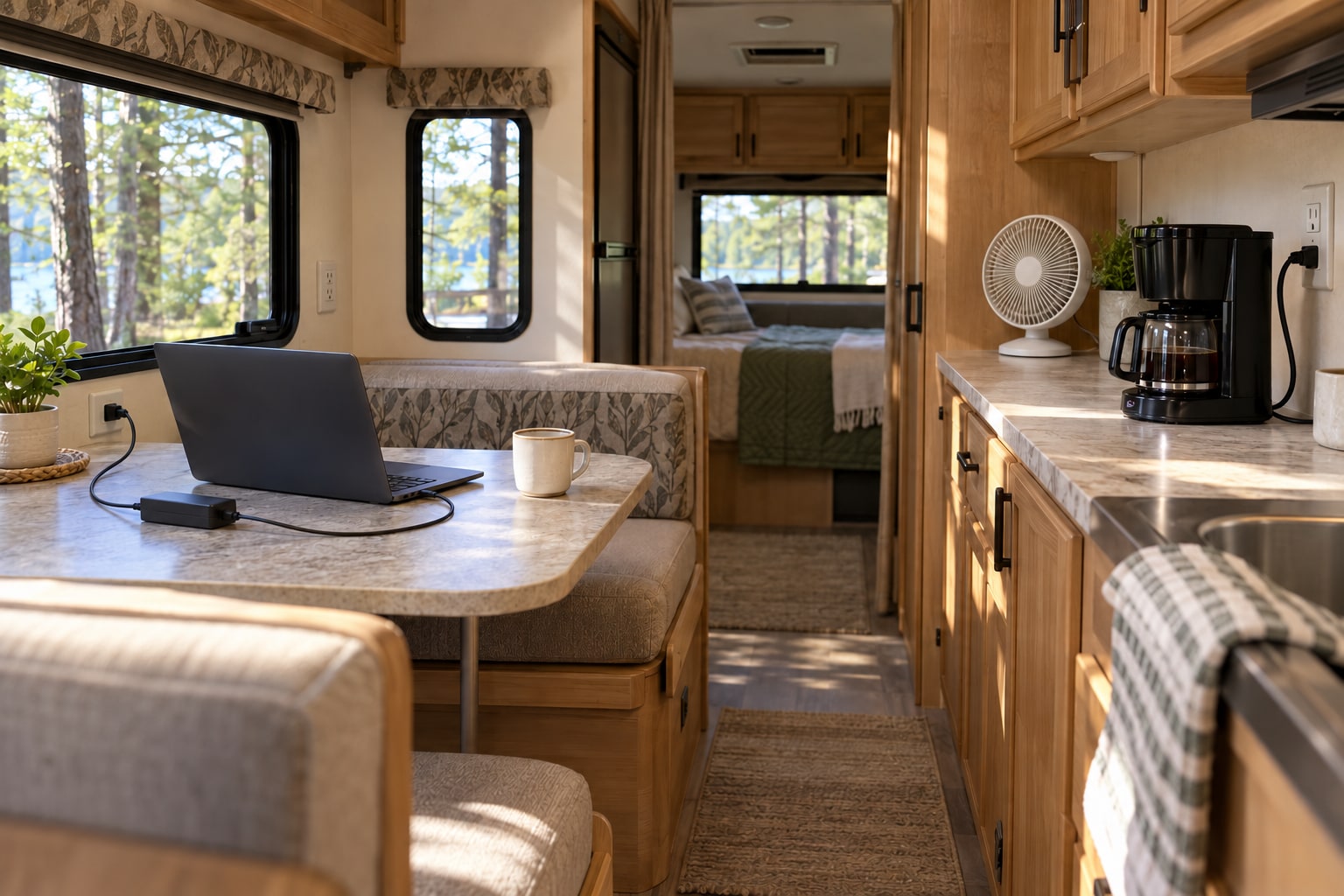
A coffee maker, a laptop and a small fan draw 930 W in our weekend example, comfortably within a 1,500 W inverter’s rating. Start the microwave as well, and the inverter shuts down with the coffee half-brewed. Size for that busiest moment, then check that the battery can deliver the current. Running watts tell you what the inverter has to carry, startup demand what it has to ride out, and the battery’s ratings whether it can keep up.
Two units are easy to mix up along the way. Watts are power at a single moment, and they set the inverter rating. Watt-hours are energy over time, and they decide how long the battery lasts. A larger inverter makes more power available at once, but it stores no energy of its own, so it can’t add a minute of runtime.
TL;DR
- Running watts: add the AC input watts of every appliance that runs at the same moment.
- Startup: add the largest starting load to everything already running, and make sure the inverter can carry that total for the full length of the start.
- Margin: our examples add 25 percent to the running total before picking a continuous rating.
- Battery current: at 85 percent efficiency, 2,200 W of AC draws about 202 A at 12.8 V, and more as the voltage at the inverter drops.
- Runtime: divide usable battery energy by the total draw on the battery. At 12.8 V with 80 percent usable capacity, a 200 Ah lithium bank supplies a 511 W battery draw for about four hours.
- Waveform: pure sine for a new system. An existing modified sine inverter suits only loads approved for it.
Size It in Five Steps
Each step answers its own question. Skip one, and the inverter ends up tripping at breakfast or the battery shuts down halfway through the evening.
- Running watts: what runs at the same moment? Add up those appliances’ AC input watts.
- Startup: what switches on while the others run? Add its full starting demand to the others’ running watts, and note how long it lasts.
- Capacity: how much headroom? Put a margin on the running total and choose a continuous rating above the result.
- Battery current: can the battery feed it? Convert the AC load into DC amps and compare them with the battery’s discharge limit.
- Runtime: how long can you run your loads? Divide the battery’s usable energy by everything it has to supply.
Here is how the two worked examples below come out:
Scroll sideways to see every column.
| Scenario | Running Together | Running Total | Startup Peak | Running + 25% |
|---|---|---|---|---|
| Weekend, light use | Laptop, fan, coffee maker | 930 W | 970 W as the fan starts | 1,163 W: a 1,500 W inverter fits |
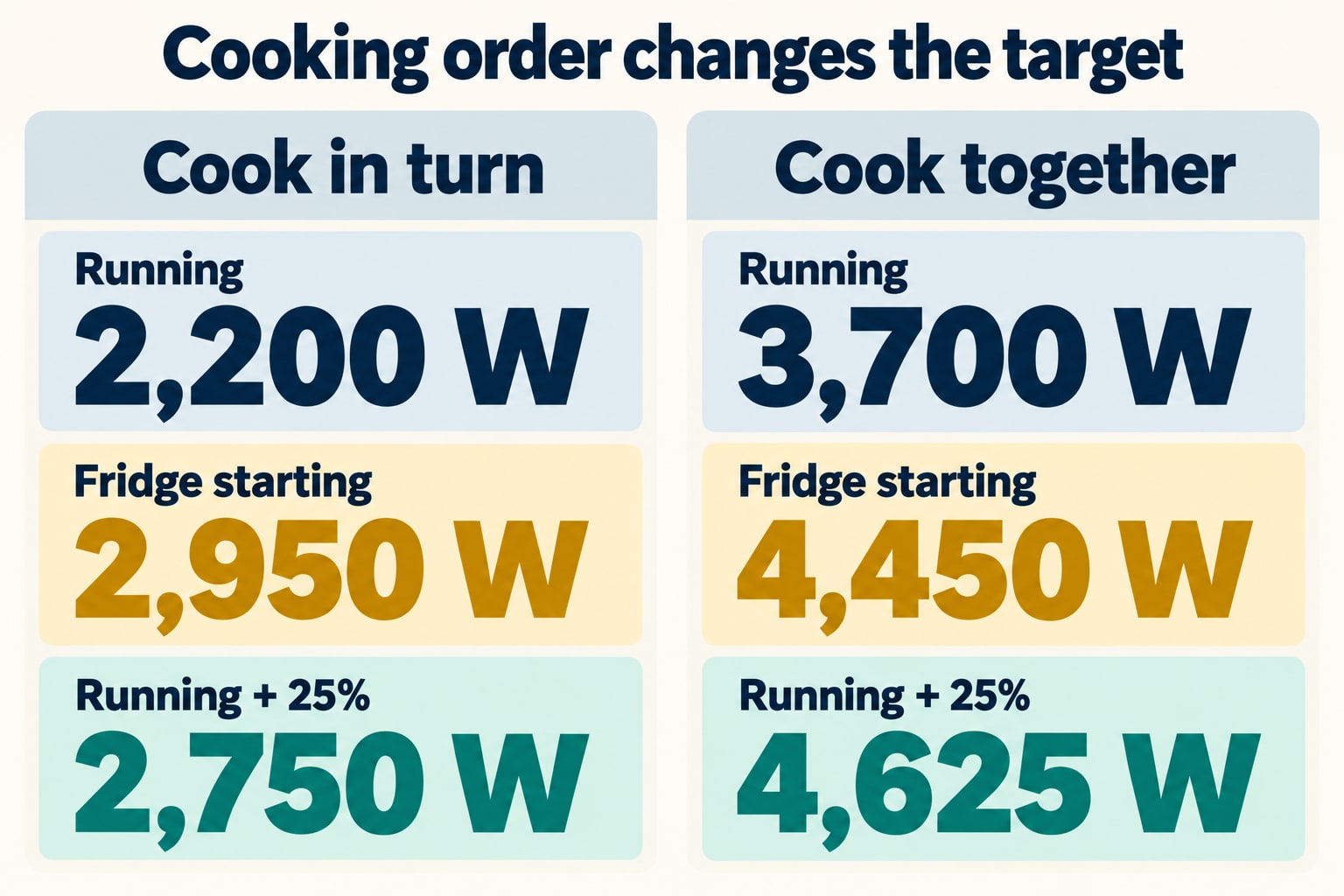
| Full-timer, cooking in turn | Fridge, electronics, induction cooktop | 2,200 W | 2,950 W as the fridge starts | 2,750 W: a 3,000 W inverter fits |
| Full-timer, cooking together | Fridge, electronics, cooktop, microwave | 3,700 W | 4,450 W as the fridge starts | 4,625 W: beyond a 3,000 W inverter |
Running Watts
Use each appliance’s AC input watts, the power it draws from the outlet. Output ratings are the trap: a microwave’s front panel advertises cooking power, and an RV microwave sold on 1,000 W of it can be rated for around 1,500 W of input. The nameplate input is the number that counts.
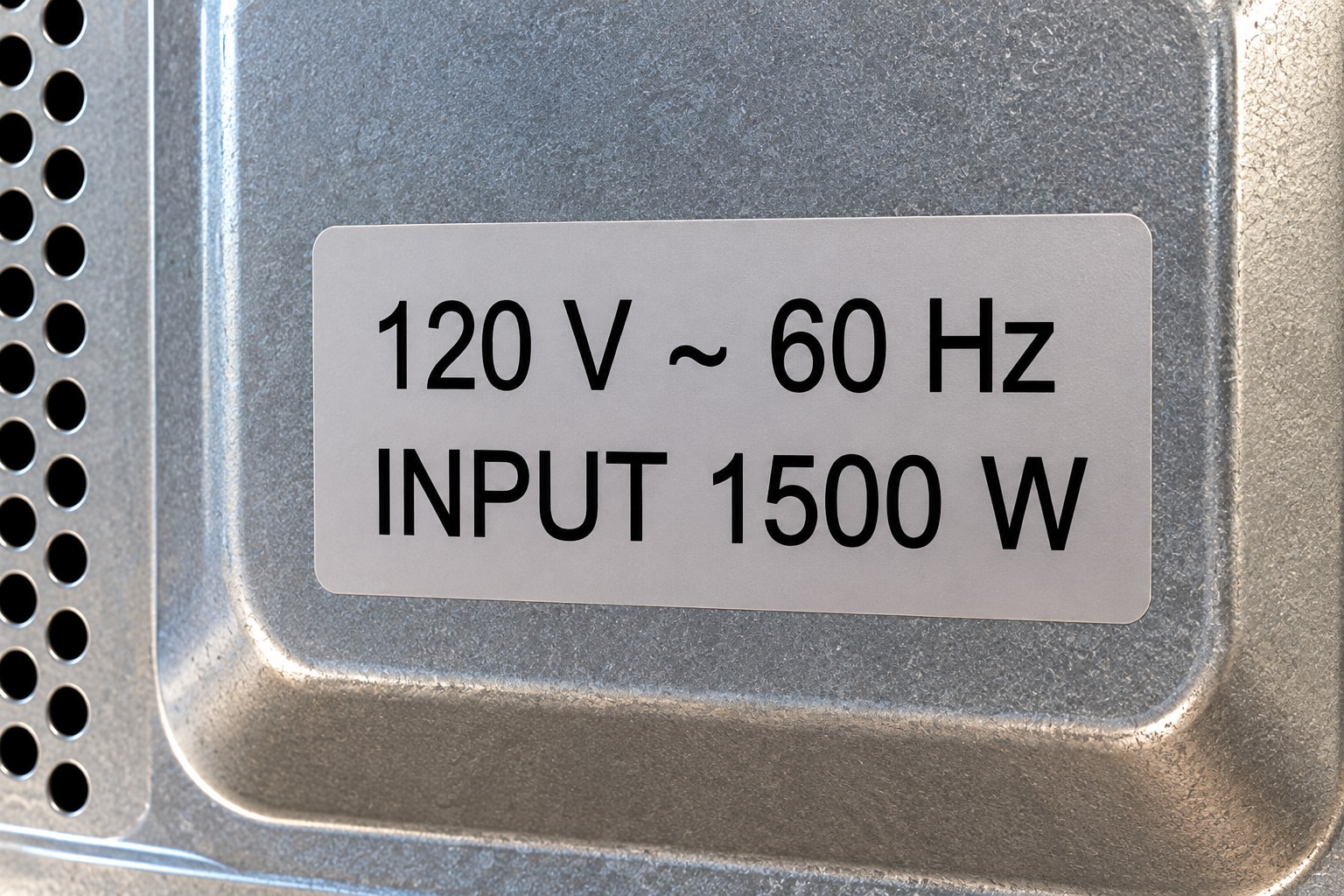
If the label lists only volts and amps, multiplying them gives volt-amperes (VA), not necessarily watts. A VA figure errs high: safe for sizing, though it overstates the energy the appliance uses over a day. For a closer number, check the maker’s input-power figure, or measure with a plug-in power meter if the appliance has a standard plug and stays within the meter’s current rating. A hardwired load such as the roof air conditioner is out of a plug-in meter’s reach. Our RV energy audit (opens in a new tab) covers measuring each appliance and logging its daily use.
Leave DC loads out of the inverter total. A 12V water pump, a 12V compressor fridge, LED lights and the furnace fan never pass through the inverter. They still drain the battery, though, so they come back in at the battery-current and runtime steps.
Read the inverter’s own specifications just as carefully: its continuous watts and, where listed, its VA or output-current limit both have to suit the load. A model name ending in 1200 doesn’t promise 1,200 W continuous. The older generation of Victron’s VE.Direct 12/1200 is a 1,200 VA unit, and its datasheet lists only 850 W continuous at 104 °F, against 1,000 W at 77 °F. Victron’s newer generation is rated differently.
Startup Demand
Motors and compressors pull a burst of power as they start: fridge and freezer compressors, pumps, fans, air conditioners and power tools. Power supplies in electronics can also draw a sharp inrush when switched on, so motors aren’t the only loads that need startup capacity. Resistive loads such as a kettle, a coffee maker’s heating element or a toaster are the exception: they draw close to their rated power from the first instant.
Size for the whole startup moment, not just the motor that starts. Take the running watts of everything else that’s on and add the full startup demand of the appliance that starts, counting that appliance once, not twice. The inverter has to hold that combined figure for as long as the start lasts. Where two automatic loads, such as a fridge compressor and the air conditioner, can start at the same moment, count both.
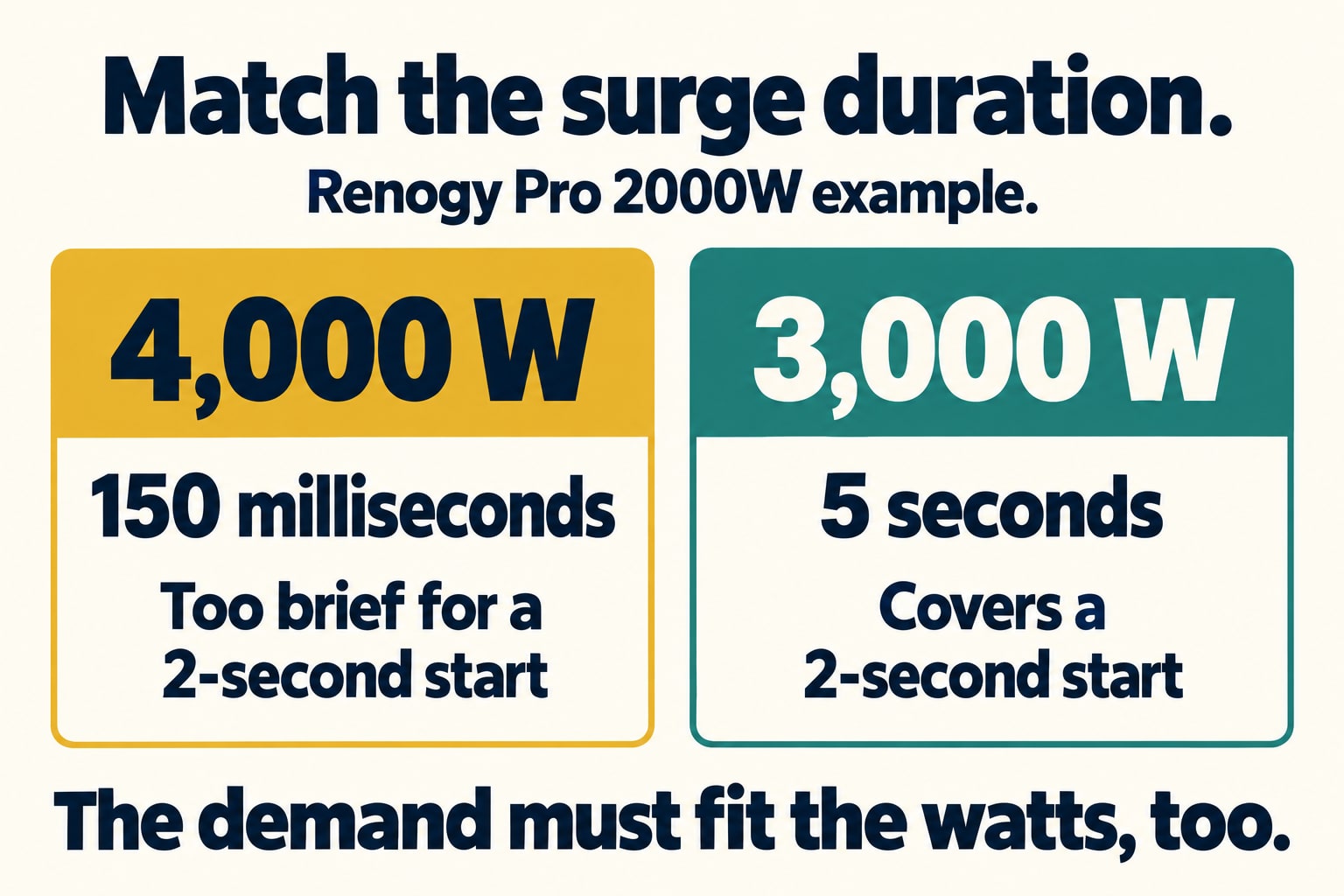
A surge figure only means something with its time limit, and some last mere milliseconds. Renogy’s Pro 2000W, for example, is rated for 4,000 W over 150 milliseconds and 3,000 W over five seconds. For a startup lasting two seconds, only a rating that covers at least two seconds counts. On this model that’s the five-second figure; the 4,000 W peak is over long before the motor is up to speed.
Take startup figures from the appliance maker where you can. If you measure, remember that a clamp meter’s inrush function reads amps, not watts. Put the clamp around a single conductor, for example through a line-splitter adapter for a plug-in appliance, and never open a live installation or cut into a cord to get at one.
Worked Examples
The appliance figures below are samples, so swap in your own. The 25 percent margin is our planning choice, not a rule, and so are the 85 percent efficiency and 80 percent usable capacity you’ll meet later. Your inverter’s temperature and load limits still apply.
Example 1: Weekend Light Use
A laptop charger draws 90 W, a small AC fan 40 W with 80 W at startup, and a drip coffee maker 800 W. On a slow morning, all three run together.
- Running total: 90 + 40 + 800 = 930 W.
- Fan starting: 90 + 80 + 800 = 970 W, with the fan’s startup replacing its running draw.
- With margin: 930 × 1.25 = 1,162.5 W, rounded to 1,163 W.
Any inverter with at least that much real continuous capacity will do, and a 1,500 W model clears it with room to spare; even the 970 W fan start stays inside its continuous rating. Just confirm that its output current or VA and its startup capacity suit the actual appliances too.
Example 2: Full-Time Kitchen
A full-timer’s list has an AC compressor fridge at 150 W running and 900 W at startup, 250 W of electronics such as a router, a laptop and a TV, and two cooking appliances: a 1,800 W induction cooktop and a microwave with 1,500 W of electrical input. Cooking one thing at a time, so the microwave and the cooktop never overlap:
- Running total: 150 + 250 + 1,800 = 2,200 W.
- Fridge starting: 900 + 250 + 1,800 = 2,950 W.
- With margin: 2,200 × 1.25 = 2,750 W.
That points to 3,000 W of continuous capacity. The 2,950 W startup moment already fits inside that rating, so the fridge start doesn’t lean on the surge figure at all. Put both cooking appliances on at once and the running total becomes 3,700 W, rising to 4,450 W when the fridge starts. The same 25 percent margin then sets a continuous target of 4,625 W, too much for a 3,000 W inverter. Cooking in turn is what keeps this kitchen on a smaller inverter, with lighter cables and a lower battery current.
Battery Current
Amp-hours measure capacity, not how much current a battery can deliver. That comes from its continuous discharge limit and any short-term limit, which a lithium battery’s BMS enforces, so check both on the datasheet.
At 85 percent efficiency, Example 2’s 2,200 W running total needs:
- At 12.8 V: 2,200 ÷ (0.85 × 12.8) ≈ 202 A.
- At 11.5 V: 2,200 ÷ (0.85 × 11.5) ≈ 225 A.
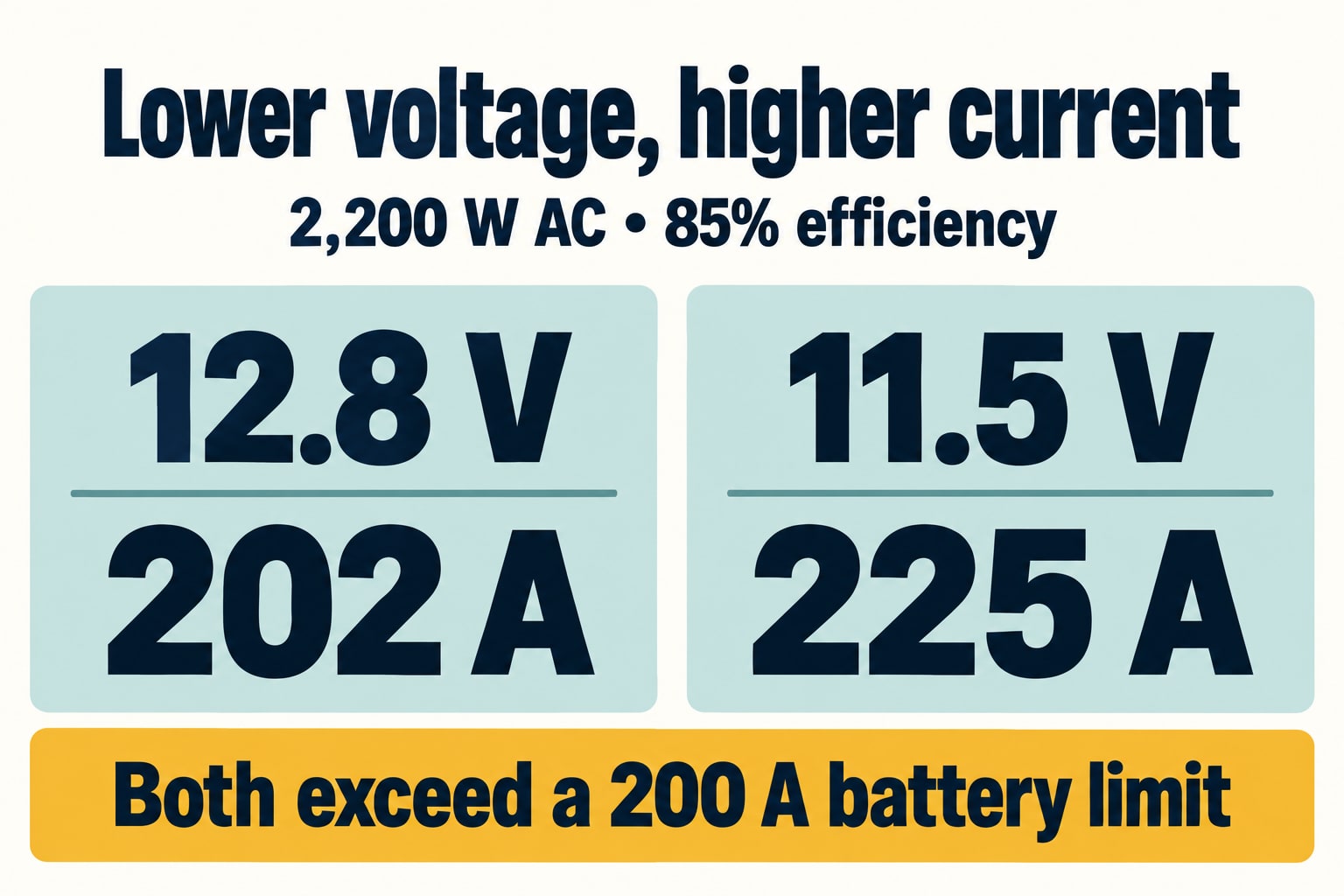
A bank limited to 200 A continuous is already too small for this example, before the DC loads come on top. The 11.5 V line isn’t a discharge target; it shows that when the battery sags under load or the cables lose some voltage on the way, the same AC load pulls more current. Currents like these are where a higher system voltage starts to pay: our 12V vs 24V comparison (opens in a new tab) shows how a 24V bank halves them.
Runtime
Runtime comes from energy, in two steps:
An example with no charging along the way:
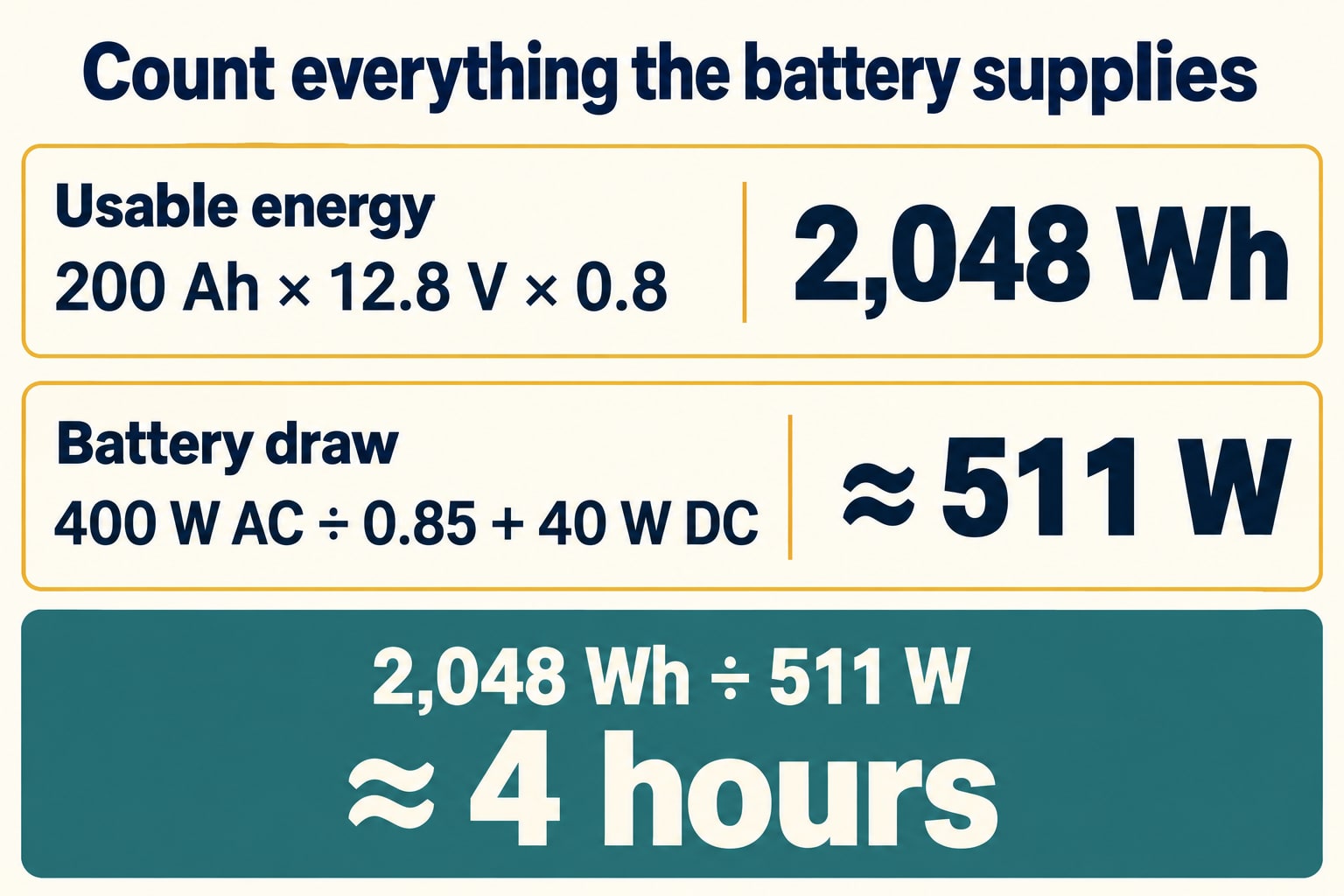
- Usable energy: a 200 Ah LiFePO4 bank × 12.8 V × 80 percent = 2,048 Wh.
- AC load at the battery: 400 W of AC at 85 percent overall efficiency takes about 471 W.
- DC loads: 40 W of direct DC use brings the total to about 511 W.
- Runtime: 2,048 ÷ 511 ≈ four hours.
Two details bring the estimate closer to your own use:
- Efficiency: use the inverter’s efficiency at the load you’ll actually run; a spec sheet’s maximum-efficiency figure may not hold there.
- Cycling loads: for a fridge that switches on and off, use its average energy for runtime and its startup demand for choosing the inverter.
To size the bank around your daily use and the days between charges, see how many amp-hours to plan for boondocking (opens in a new tab).
Idle Draw and ECO Mode
Idle draw is what the inverter uses while it sits switched on with nothing running, so count those hours at the model’s published figure, but don’t add it on top of an efficiency figure that already covers all the inverter’s losses at that load. A larger inverter doesn’t automatically idle higher: Renogy’s Pro 2000W and Pro 3000W are both rated at about 9.6 W with no load, so compare published figures rather than assuming a smaller model always saves energy.
An ECO or search mode puts the inverter to sleep between loads and wakes it when something switches on. That saves energy in the gaps, but a small device has to draw enough to wake it, and an appliance that runs without a break never lets the inverter sleep, so the saving disappears.
Pure Sine or Modified Sine
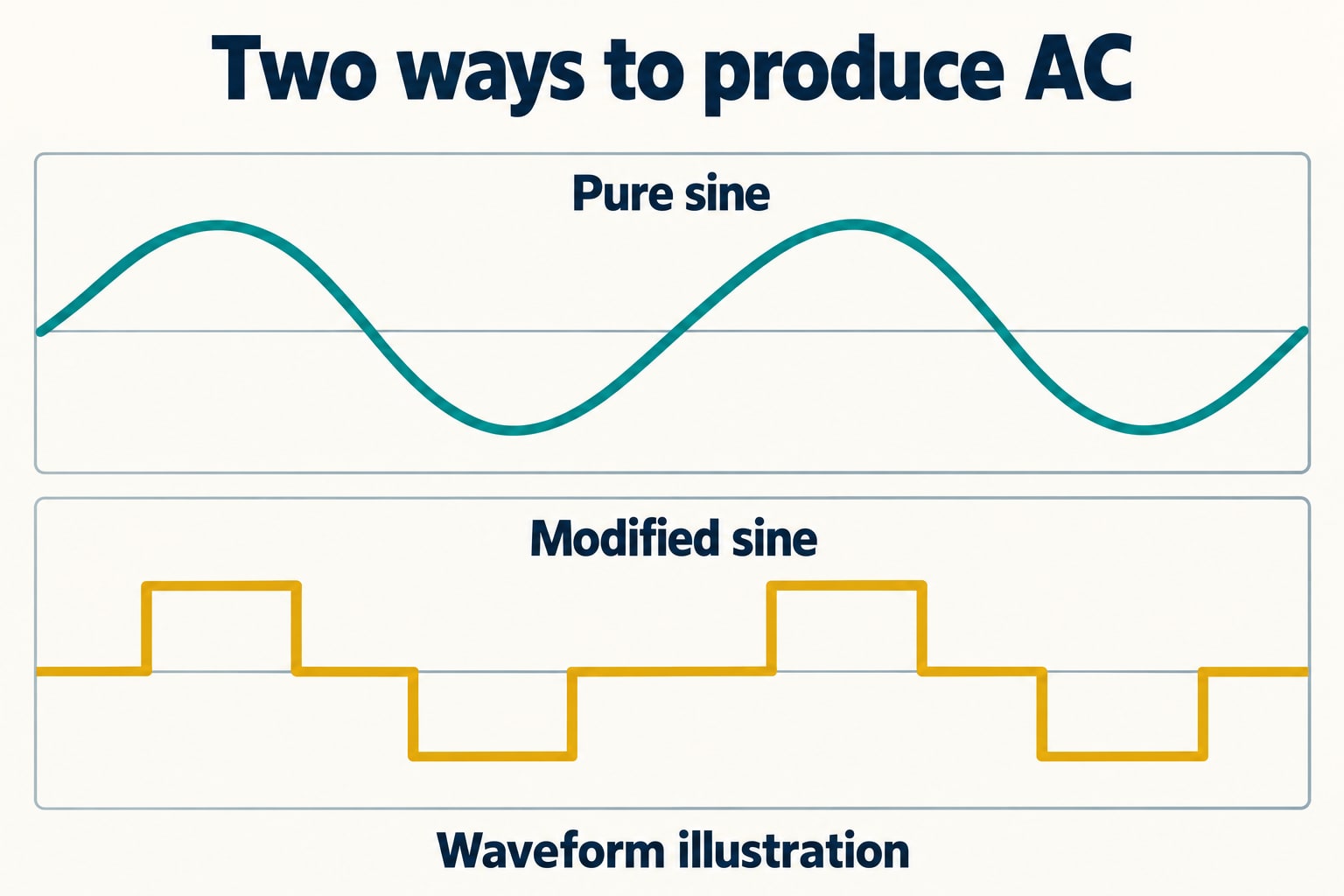
For a new RV system, choose pure sine: it runs a wider range of appliances, and you never have to check the load list against a stepped waveform. A modified sine inverter you already own can stay in service for the loads it suits.
A modified sine wave inverter jumps between flat voltage levels instead of following a smooth curve. A kettle, a toaster and other resistive loads usually cope with that. Motors and power adapters often run louder or warmer on the stepped wave, and some motor loads, chargers, timers and audio equipment don’t work properly on it at all. Which ones struggle varies by model, so go by each maker’s instructions, not the category.
A CPAP needs a decision for the exact machine and humidifier. ResMed’s battery guide approves a 150 W modified sine inverter for only a few named older setups, and some heated humidifiers shouldn’t run from an inverter at all. Follow your own machine’s manual, especially if the guide doesn’t list it, or run it from the maker’s DC power option and leave the inverter out of the night entirely.
Appliance Notes for RVs
- Fridge: an AC compressor fridge starts on its own schedule, so leave room for its startup in every combination it can overlap with.
- Air conditioner: a soft starter can cut the compressor’s startup demand, but it doesn’t reduce the energy the unit uses while it runs. Size from the starting data for that air conditioner with that soft starter, not from a general promise about what a given inverter size can run.
- Electric heat: space heaters and water-heater elements draw their full rating for as long as they run, which strains the inverter and the battery at the same time. Where you can, leave heating to propane or diesel.
- Staggering: run high-draw appliances one after another. The microwave is often one of the largest loads in an RV kitchen, and starting it once the coffee maker finishes costs a few minutes and can save a whole size class.
- Dedicated circuits: giving the largest appliance its own circuit and breaker protects that wiring, but an overload can still trip the inverter’s own protection and shut down its entire AC output.
Installation Safety
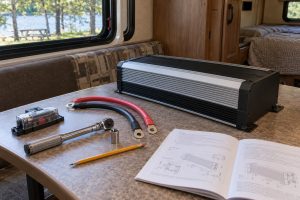
Sizing decides the cable and the fuse as much as the inverter. Follow the inverter and battery manuals and the electrical code; these are the points the sizing changes:
- Cable: current is only the starting point; the length, the acceptable voltage drop, the installation conditions and the manufacturer’s requirements set the size. Thin or long cables drop voltage under load, and the inverter can read that as a flat battery and shut down while the battery is fine.
- Fuse: DC-rated overcurrent protection near the battery, matched to the cable and to the fault current the battery can deliver. A BMS doesn’t replace it.
- Live parts: pulling the fuse leaves the battery terminal and the short cable up to the fuse live, so treat that section as live whenever you work near it.
- Connections: use crimped lugs that fit the studs, tightened to the specified torque. A loose high-current joint heats up.
- Mounting: put the inverter in a dry, ventilated spot close to the batteries, so the DC cables stay short, but never directly above them. Keep its cooling openings clear, or it derates or shuts down.
- AC side: the RV’s existing outlets get nothing from the inverter until they’re wired to it. Hardwiring it into the RV’s AC system means handling the switching between inverter and shore power, the grounding and the protection as the manufacturer instructs.
- Repeated shutdowns: check the fault indication before changing the system size. Low battery voltage, loose connections, overheating and overload can all cause shutdowns. Fix the cause; never bypass the protection or fit a larger fuse to stop the trips.
FAQs
- What size inverter does a microwave need? Take the input watts from its nameplate, add everything else running alongside it, and put your margin on top. Microwaves vary too much for a generic figure, so the input rating of your own unit decides. Choose pure sine.
- Can I keep using a modified sine wave inverter I already own? Yes, for loads whose makers allow it. Resistive loads usually cope; check the instructions for anything with a motor, a charger, a timer or a medical use such as a CPAP. For a new system, buy pure sine.
- Can I run two large appliances at once? Only if their running watts plus the background loads fit the continuous rating with your margin, and the largest startup in that combination fits the surge rating for long enough. In Example 2, running the microwave and the cooktop together lifts the requirement from 2,750 W to 4,625 W.
- Is a bigger inverter always better? No. It costs more, needs heavier DC cable and a larger fuse, and at full output it can ask more current of the battery than the battery can supply. Idle draw depends on the model rather than the size, so compare published figures instead of assuming either way.
- Can my battery run the inverter at full power? Compare its continuous discharge limit with the inverter’s DC current at full output. At 85 percent efficiency and 12.8 V, a 3,000 W model at its rated output needs roughly 276 A. Even Example 2’s 2,200 W calls for about 202 A, so a 200 A battery limit is too small before any DC loads.
- How long will my battery run a given load? Multiply amp-hours by the nominal voltage and your usable fraction, then divide by everything the battery supplies, DC loads included. In the example, 200 Ah × 12.8 V × 0.8 gives 2,048 Wh, enough for about four hours at 511 W.
- Should I switch to 24V or 48V for a big inverter? A higher system voltage cuts the DC current for the same power, which eases cable and fuse sizing. It also has to suit your chargers and DC appliances, so treat it as a change to the whole system rather than to the inverter alone.
Conclusion
Size the inverter for your busiest moment, not your average one. Put your margin on the combined running watts, and check the startup demand and its duration separately. Then make sure the battery can supply that current near full charge and as the voltage drops, and estimate runtime from its usable watt-hours. For a new system, choose pure sine. With your own numbers in hand, check them against the six models in our pure sine wave inverter picks (opens in a new tab), from small plug-in units to 3,000 W.
Spot an error or an outdated detail in this guide?
Report it