Best Portable Power Stations for RV Camping: Top Picks
On this page
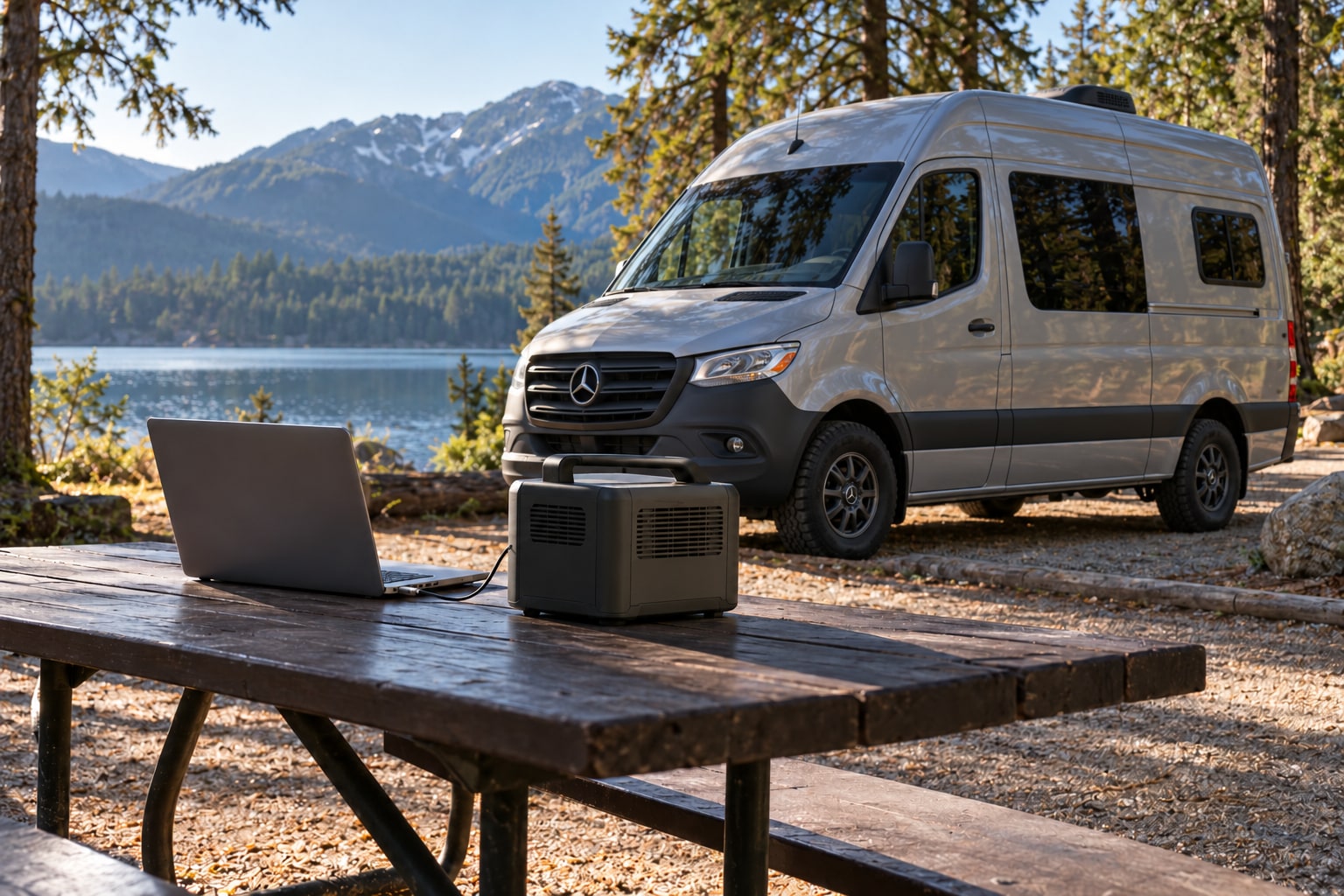
A power station that charges your laptop at the picnic table can be the wrong one to plug into your RV. What separates them is how much energy they store, which appliances their inverter can start and keep running, and how quickly you can refill them between nights off-grid. The six picks below run from a 7.5 lb unit you carry in one hand to 3 kWh-plus stations with a 30-amp RV outlet, and after them comes a simple way to size one for your own loads.
TL;DR
- Best overall: EcoFlow DELTA 3, with 1,024 Wh, an 1,800 W inverter, a 56-minute recharge from the wall and room for extra batteries, at 27.6 lb.
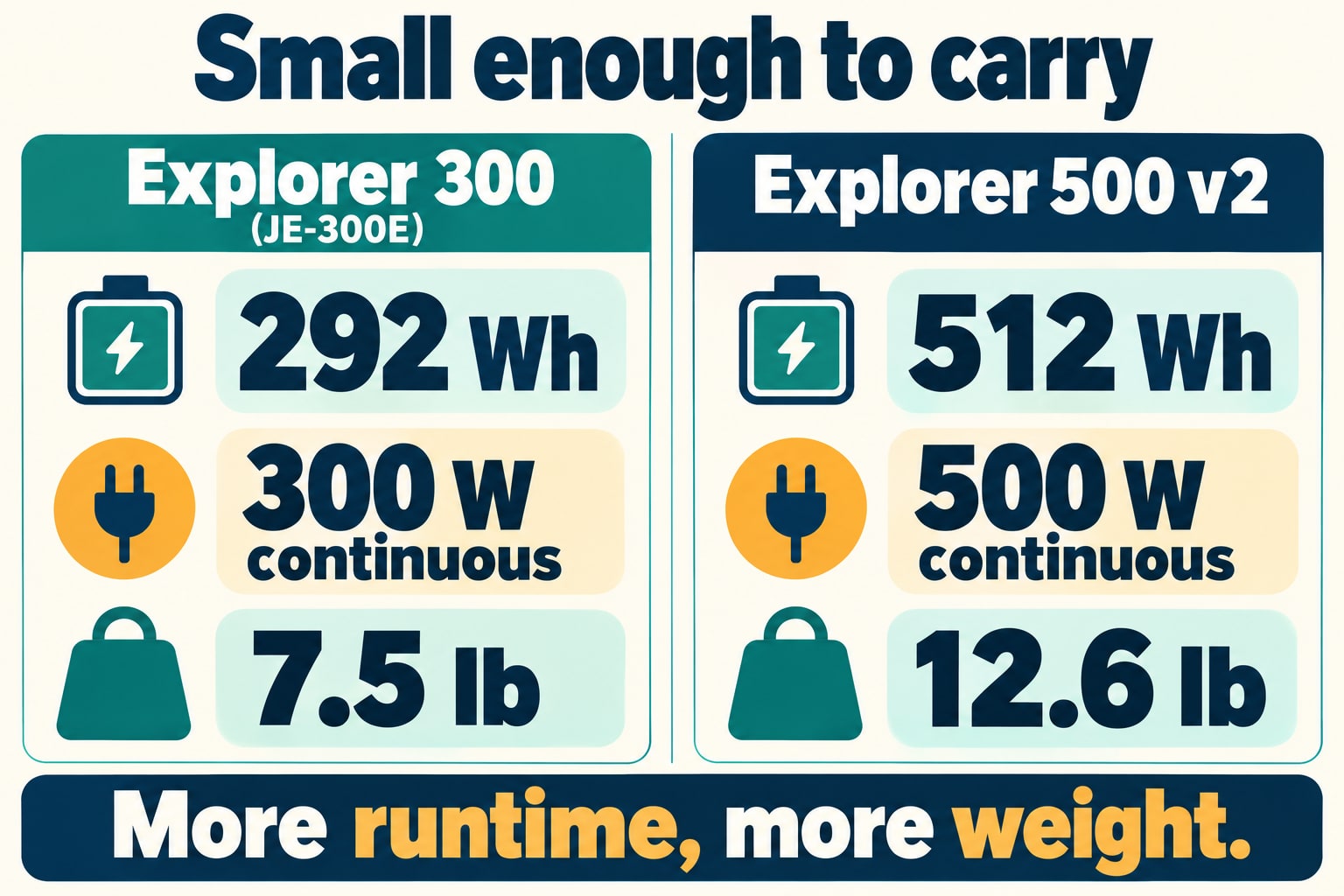
- Best lightweight: Jackery Explorer 300 (JE-300E), with 292 Wh and 300 W in a 7.5 lb unit for devices, lights and fans.
- Best for light camping loads: Jackery Explorer 500 v2, with 512 Wh, 500 W and fast AC recharging, but no expansion.
- Best compact 2 kWh: BLUETTI Elite 200 V2, with 2,074 Wh and 2,600 W in a 53.4 lb case.
- Best for big solar arrays: Anker SOLIX F3000, with 3,072 Wh, up to 2,400 W of solar input and a TT-30R RV outlet.
- Most storage in one unit: EcoFlow DELTA Pro, with 3,600 Wh, a 30 A RV outlet and wheels under its 99 lb.
- Size it right: watts decide what can run at once and watt-hours how long; 600 Wh a day for two days calls for about 1,700 Wh.
Best Portable Power Stations for RV Camping Compared
We compared these six on their makers’ published specifications, not on tests of our own. Continuous AC output is each inverter’s sustained rating, without boost modes.
As an Amazon Associate I earn from qualifying purchases.
Scroll sideways to see every column.
| Power Station | Capacity | Continuous AC | Max Solar Input | Weight | Where to Buy |
|---|---|---|---|---|---|
| EcoFlow DELTA 3 | 1,024 Wh | 1,800 W | 500 W | 27.6 lb | Amazon ↗ |
| Jackery Explorer 300 (JE-300E) | 292 Wh | 300 W | 100 W | 7.5 lb | Amazon ↗ |
| Jackery Explorer 500 v2 | 512 Wh | 500 W | 200 W | 12.6 lb | Amazon ↗ |
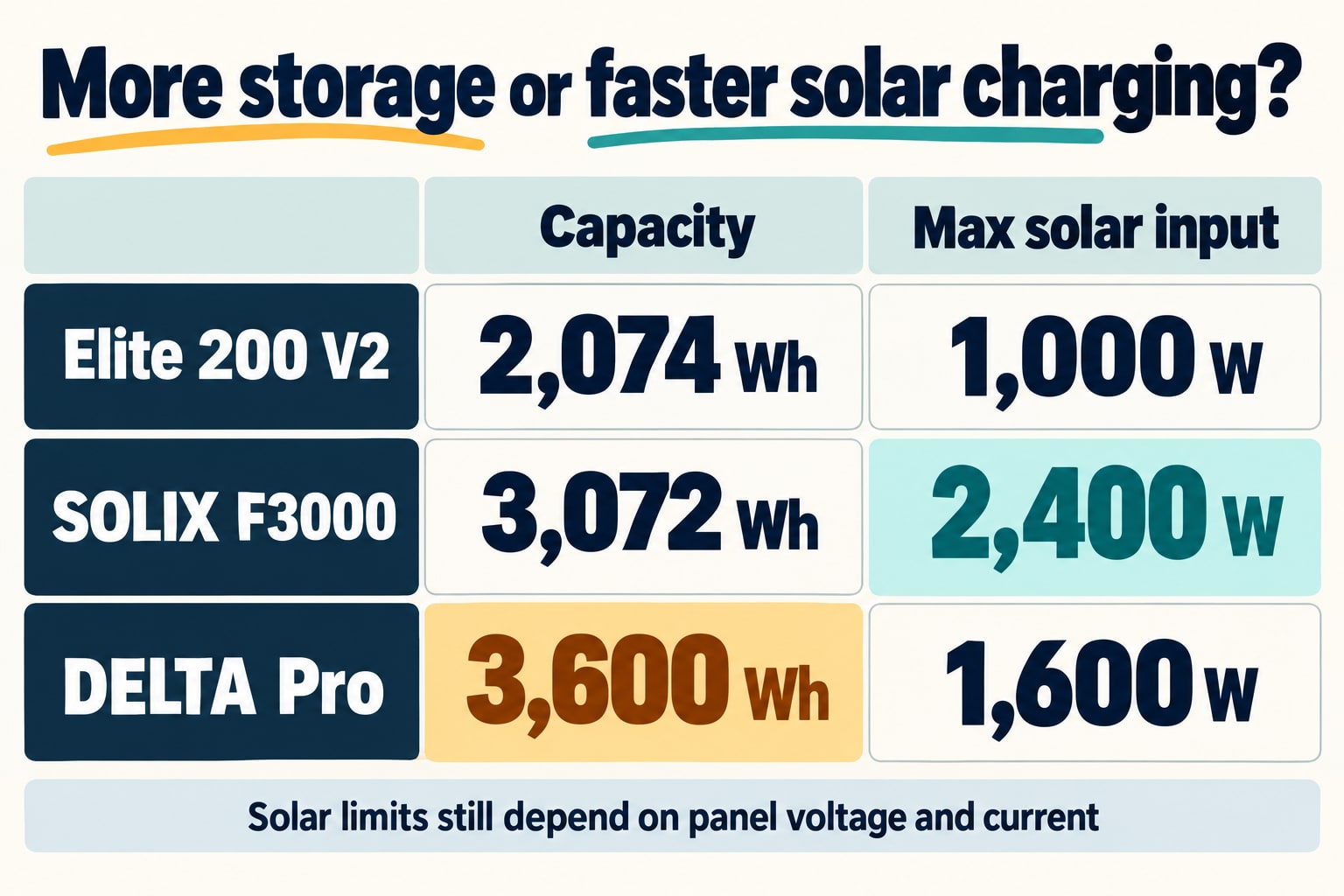
| BLUETTI Elite 200 V2 | 2,074 Wh | 2,600 W | 1,000 W | 53.4 lb | Amazon ↗ |
| Anker SOLIX F3000 | 3,072 Wh | 3,600 W | 2,400 W total | 91.5 lb | Amazon ↗ |
| EcoFlow DELTA Pro | 3,600 Wh | 3,600 W | 1,600 W | 99 lb | Amazon ↗ |
Our Picks in Detail
EcoFlow DELTA 3: Best Overall
The DELTA 3 fits the most RV jobs without becoming a piece of furniture. Its 1,024 Wh LiFePO4 battery and 1,800 W inverter run a coffee maker or a small microwave that a 500 W unit can’t, yet at 27.6 lb it still goes from the RV to the picnic table in one trip. When one kilowatt-hour stops being enough, EcoFlow’s extra batteries take it as high as 5 kWh, so you add storage instead of replacing the station. Its 500 W solar input has room for a useful campsite array, and EcoFlow quotes a full recharge in 56 minutes from a wall outlet at up to 1,500 W.
- Key specs: 1,024 Wh LiFePO4, 1,800 W continuous (3,600 W surge), six AC outlets, two 100 W USB-C ports, 1,500 W AC charging, solar 11 to 60 V and 15 A, 500 W max (XT60), 12V car charging at 8 A, expandable to 5 kWh, 15.7 × 8 × 11.2 in, 27.6 lb.
- Choose it for: weekend boondocking with household appliances, and a path to more storage later.
- Know before you buy: with a fridge in the mix, 1,024 Wh isn’t a multi-day supply: a 12V compressor fridge drawing 600 Wh a day, plus lights and devices, takes most of it in a single day. X-Boost lets some heating appliances run above 1,800 W at reduced power; it doesn’t raise the real limit. The 12V socket input adds only about 100 W while you drive, so EcoFlow’s separate 800 W Alternator Charger is the way to charge on the road.
Check the EcoFlow DELTA 3 on Amazon
Jackery Explorer 300 (JE-300E): Best Lightweight
At 7.5 lb, the Explorer 300 is the station you carry rather than park. Make sure the listing says JE-300E: this LiFePO4 version stores 291.84 Wh, and an older 293 Wh version is still described on some pages. Its 300 W inverter and two AC outlets handle a laptop, a camera charger or a fan, and the 100 W USB-C port works both ways, charging a laptop directly or refilling the station from a USB-C charger. It takes one solar panel of up to 100 W, and its small size makes it a good second station for the campfire while a bigger one stays in the RV.
- Key specs: 291.84 Wh LiFePO4, 300 W continuous (600 W surge), two AC outlets, 100 W USB-C input and output, two USB-A ports, 12V socket, solar 16 to 28 V and 6 A, 100 W max from one panel (DC8020), 65 W AC adapter included, 9.1 × 6.0 × 7.8 in, 7.5 lb.
- Choose it for: phones, laptops, cameras, lights and fans, and as a grab-and-go second station.
- Know before you buy: the included 65 W wall adapter needs several hours to refill it; a USB-C charger of up to 100 W is quicker. Energy-saving mode, described in Jackery’s JE-300E manual, is on by default and turns the AC outlets off after six hours at 25 W or less, which can cut a small overnight load; holding the AC and main power buttons for three seconds turns the mode off. It charges from 12V vehicle sockets only, not 24V.
Check the Jackery Explorer 300 on Amazon
Jackery Explorer 500 v2: Best for Light Camping Loads
The Explorer 500 v2 (model JE-500A) steps up from the 300 to 512 Wh and a 500 W inverter in a 12.6 lb case. That covers an evening of lights, fans, phones and laptops, or a few hours of a small TV. It refills from 0 to 80 percent in about 52 minutes on AC, takes up to 200 W of solar, and backs up connected devices automatically when wall power fails. Its LiFePO4 cells are rated to keep at least 70 percent of their capacity after 6,000 cycles.
- Key specs: 512 Wh LiFePO4, 500 W continuous (1,000 W peak), two AC outlets, 200 W solar (DC8020, 16 to 60 V, 10.5 A), 80% AC charge in about 52 min, UPS backup, 12.2 × 8.1 × 6.2 in, 12.6 lb.
- Choose it for: weekend campers with light loads who want quick recharging at a powered site.
- Know before you buy: there’s no expansion battery, so outgrowing 512 Wh means buying a bigger station. It can’t carry a 12V compressor fridge through a weekend; at 600 Wh a day, the fridge alone would drain it in under a day. The 500 W inverter won’t run most coffee makers, microwaves or hair dryers.
Check the Jackery Explorer 500 v2 on Amazon
BLUETTI Elite 200 V2: Best Compact 2 kWh
The Elite 200 V2 puts 2,073.6 Wh and a 2,600 W inverter in a 13.8 × 9.8 × 12.7 inch case. It stows in less space than the 3 kWh stations, but it still needs open air around its vents while it runs or charges. With twice the DELTA 3’s storage, it covers a day or two of fridge, lights, devices and morning coffee, and its four household outlets run most kitchen appliances one at a time. In Turbo mode it charges from the wall at up to 1,800 W, which BLUETTI says reaches 80 percent in roughly an hour, and its solar input accepts up to 1,000 W. BLUETTI also puts its standby draw at about 10 W, which matters when a small load runs all night.
- Key specs: 2,073.6 Wh LiFePO4, 2,600 W continuous, Power Lifting up to 3,900 W for heating appliances, four AC outlets, a pair of 100 W USB-C ports, 1,800 W Turbo AC charging, 1,000 W solar input (12 to 60 V, 20 A), car charging 96 W on 12V or 192 W on 24V, 15 ms UPS, 13.78 × 9.84 × 12.74 in, 53.4 lb.
- Choose it for: RVers who need about 2 kWh and 2,600 W in a compact case.
- Know before you buy: it can’t take an expansion battery, and it has no TT-30 RV outlet, so it’s better at running appliances plugged into it than at powering the whole RV. At 53.4 lb, it’s a two-handed lift. Power Lifting runs heaters and kettles above 2,600 W at reduced power; it isn’t extra continuous capacity.
Check the BLUETTI Elite 200 V2 on Amazon
Anker SOLIX F3000: Best for Big Solar Arrays
The F3000 is built around charging. Its two solar inputs take up to 2,400 W together: 1,600 W on the high-voltage input (11 to 165 V) and 800 W on the low-voltage input (11 to 60 V), each at up to 17 A. On generator days, Anker’s TT-30 charging cable, sold separately or in a bundle, lets it charge at up to 3,600 W from a generator’s 30 A outlet; a standard outlet gives 1,800 W. For the RV, its TT-30R outlet can deliver the full 3,600 W, and each of the four household outlets handles up to 2,400 W within the same 3,600 W total. Wheels and a pull handle move its 91.5 lb, and BP3000 expansion batteries add 3,072 Wh each.
- Key specs: 3,072 Wh LiFePO4, 3,600 W continuous AC output, a TT-30R RV outlet and four NEMA 5-20R outlets (up to 2,400 W each), 7,200 W surge, solar 1,600 W (11 to 165 V) plus 800 W (11 to 60 V), AC charging 1,800 W or 3,600 W with the TT-30 charging cable, 20 ms UPS, BP3000 expansion, 25.6 × 11.8 × 14.8 in, 91.5 lb.
- Choose it for: large portable solar arrays, generator top-ups and RVs plugged in through the TT-30R outlet.
- Know before you buy: the 6,000 W in the Amazon title is a combined charging figure for a generator plus solar with an expansion battery, not AC output. A 200 W folding panel won’t come close to the 2,400 W input; that takes large arrays matched to each input’s voltage and 17 A limit. On a generator, charge from a 120V outlet, even if the generator also offers 240V; Anker’s F3000 manual notes that the 120V capacity is usually about half the 240V running wattage, so check it first. It charges only between 32 and 104°F.
Check the Anker SOLIX F3000 on Amazon
EcoFlow DELTA Pro: Most Storage in One Unit
The original DELTA Pro, not the newer DELTA Pro 3 or Ultra, stores the most energy here: 3,600 Wh, without an extra battery. Its 30 A outlet can carry all 3,600 W, so you can plug the RV’s shore cord straight into it, and up to two DELTA Pro Smart Extra Batteries take it to 10.8 kWh. It charges at up to 1,800 W from a standard outlet, which EcoFlow puts at about 2.7 hours for a full charge, up to 3,000 W from a 240V outlet, and up to 1,600 W from solar between 11 and 150 V. Compared with the F3000, it holds more energy but weighs more and takes less solar.
- Key specs: 3,600 Wh LiFePO4, 3,600 W continuous (7,200 W surge, X-Boost up to 4,500 W for heating appliances), five AC outlets including a 30 A outlet, AC charging up to 1,800 W at 120V or 3,000 W at 240V, 1,600 W solar input at 11 to 150 V and 15 A, car charging at 8 A, 30 ms EPS switchover, wheels, 25 × 11.2 × 16.4 in, 99 lb.
- Choose it for: running the RV’s 30 A system from a battery for a day or more.
- Know before you buy: the charging-speed switch chooses between maximum X-Stream charging and a custom rate, which defaults to 400 W and can be changed in the app; match the rate to what your outlet or generator can supply. The MC4-to-XT60 solar cable is sold separately. And 3,600 Wh doesn’t replace a generator for full-timers on its own: whatever you use each day has to come back from solar, a generator or the alternator.
Check the EcoFlow DELTA Pro on Amazon
How Big a Power Station Do You Need?
Two numbers decide it. Watts (W) are how much power the inverter can deliver at once, so they decide which appliances can run together. Watt-hours (Wh) are how much energy the battery holds, so they decide for how long. A 1,500 W coffee maker needs a station rated for at least 1,500 W continuous, but brewing for ten minutes uses only about 250 Wh.
Starting power is a separate check. Motors and compressors draw a surge for a moment as they start, which is what the surge or peak rating covers. Boost modes such as EcoFlow’s X-Boost, BLUETTI’s Power Lifting and Anker’s SurgePad let some appliances, mainly heaters and kettles, run above the rating at reduced power. They don’t add continuous capacity, so the table above uses each station’s continuous rating.
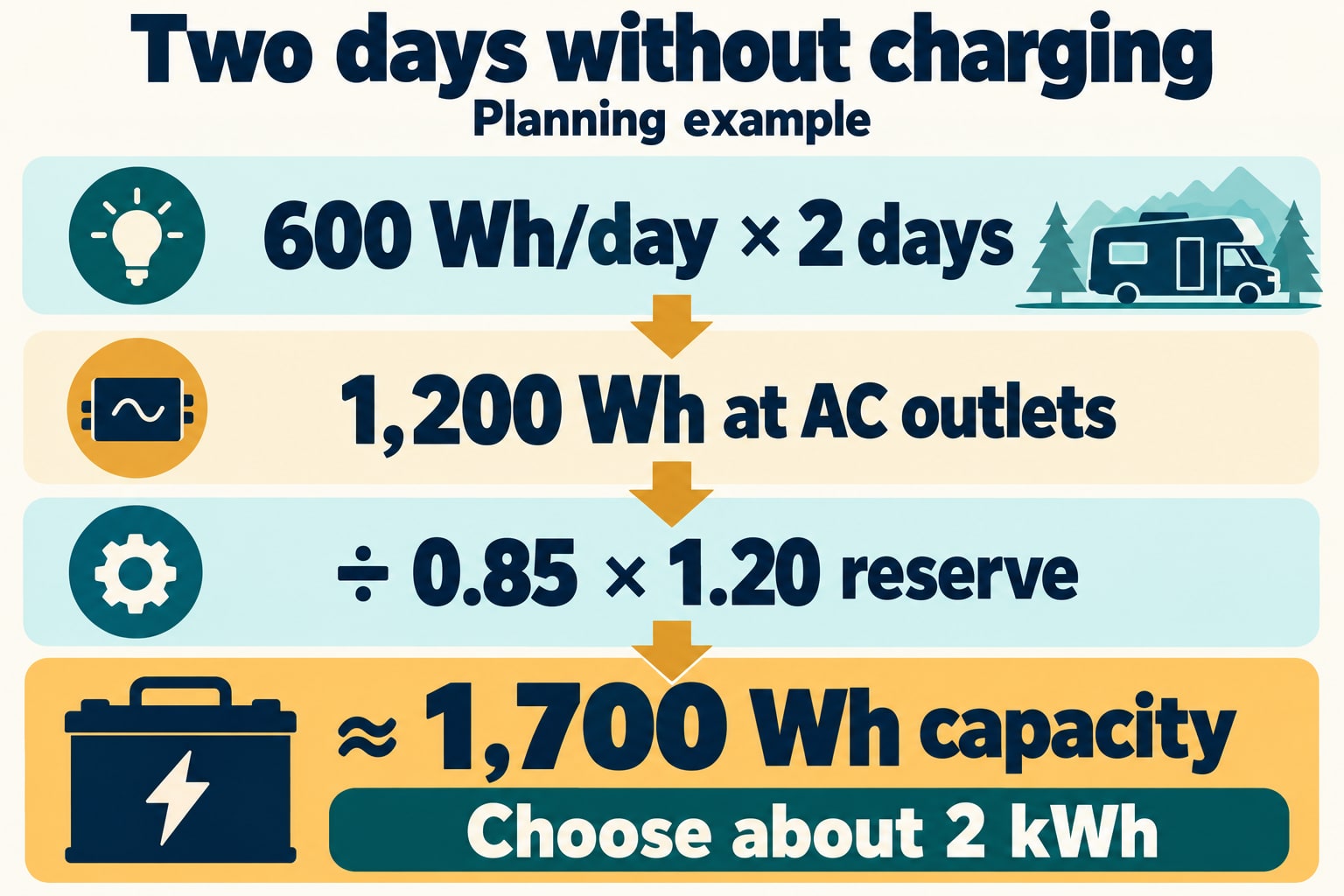
For the battery, start from what you actually use; our RV energy audit guide (opens in a new tab) shows how to measure it. Say you’ve measured 600 Wh a day at the station’s AC outlets and want to get through two days without charging. For planning, assume about 85 percent of a station’s rated capacity reaches those outlets, and add a 20 percent reserve:
Here that’s 600 × 2 ÷ 0.85 × 1.2 ≈ 1,694 Wh, so a station of about 2 kWh, like the Elite 200 V2, fits the plan, and a 500 Wh unit doesn’t come close. The 85 percent is a planning assumption, not a measured figure for every model. With a small load running all night, the inverter’s own draw can matter more; at BLUETTI’s 10 W standby figure, a 12-hour night costs about 120 Wh before your devices use anything. If you measured your use on the battery side, the conversion loss is already in your number, so don’t take it off twice.
The same arithmetic shows the limit of even the largest single unit here. At a steady 1,500 W, a rooftop air conditioner uses up a 3,600 Wh DELTA Pro’s estimated usable energy in about two hours: 3,600 × 0.85 ÷ 1,500 ≈ 2.0. That’s two hours of compressor running time; a compressor that cycles off stretches it over a longer evening, while other RV loads shorten it. Starting the compressor is a separate check, and a soft starter can help.
How to Use a Power Station in an RV
There are three ways to put a power station to work in an RV, and they suit different stations:
- Plug appliances straight in. The station’s AC outlets, USB ports and 12V socket power whatever you connect to them, with the RV’s wiring left out of it. The two Jackery stations are made for exactly this.
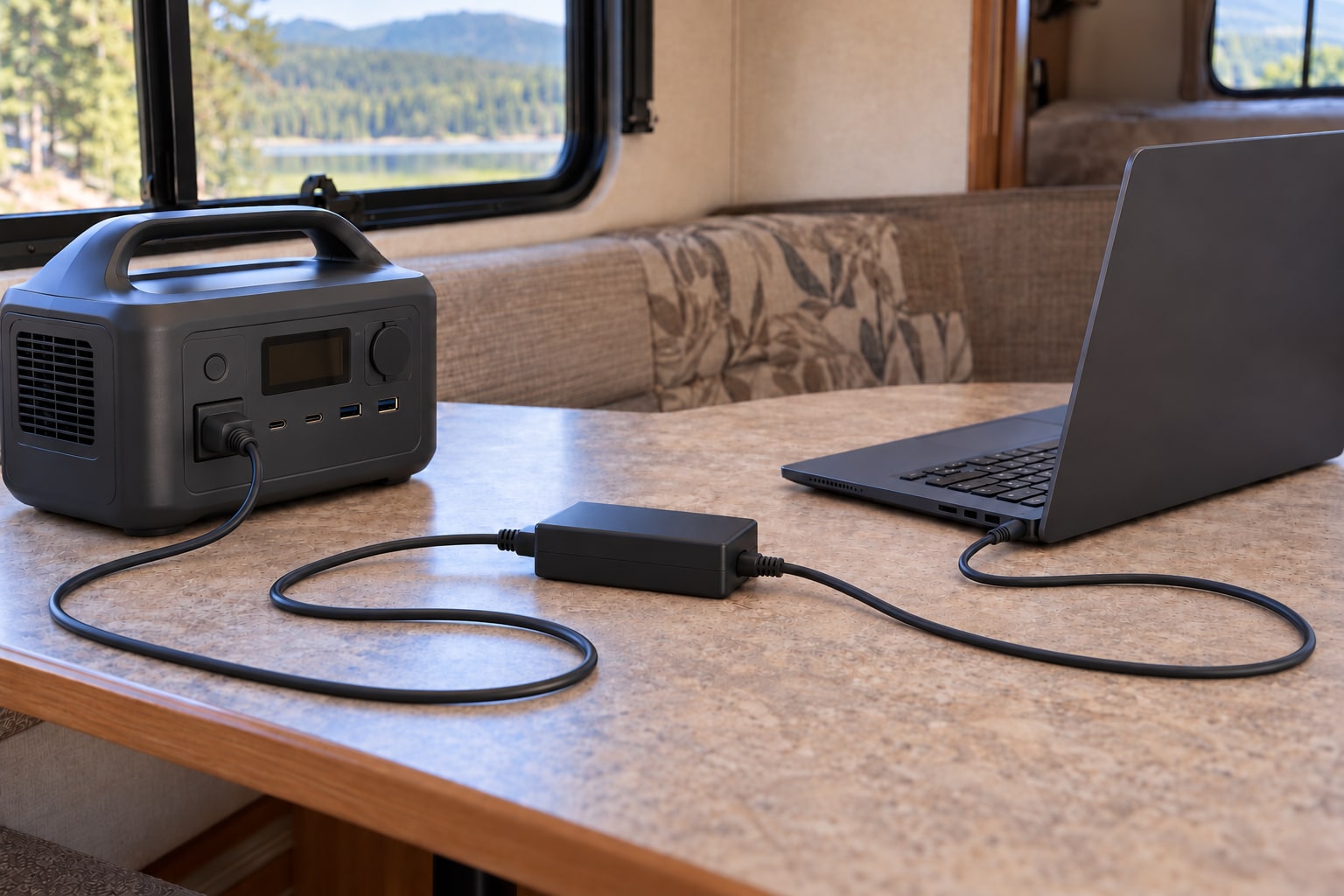
Plug the laptop’s charger into the station’s AC outlet, then connect the charger to the laptop. This leaves the RV’s wiring out of the connection. - Feed the RV’s shore inlet. A station with a 30 A outlet, like the DELTA Pro or the F3000’s TT-30R, can supply the RV through its shore cord, so the RV’s own outlets and 12V system run from the station. A TT-30 adapter on a smaller station only changes the plug; it adds neither power nor capacity. Count the converter (the RV’s built-in battery charger) and other loads that start automatically in your budget, and work out how the RV’s 12V side will be supplied before you switch anything off. Never charge the station from an outlet it is powering, and never feed power backward through an ordinary wall outlet. If the RV’s surge protector or a ground-neutral setting objects, follow the station maker’s instructions rather than improvising a fix.
- Build a permanent system. If you’d run the whole RV from battery every day, a fixed LiFePO4 house battery with its own inverter and charging does it without cords to plug and unplug; our lithium battery guide (opens in a new tab) compares batteries for that kind of setup.
Recharging Between Nights Off-Grid
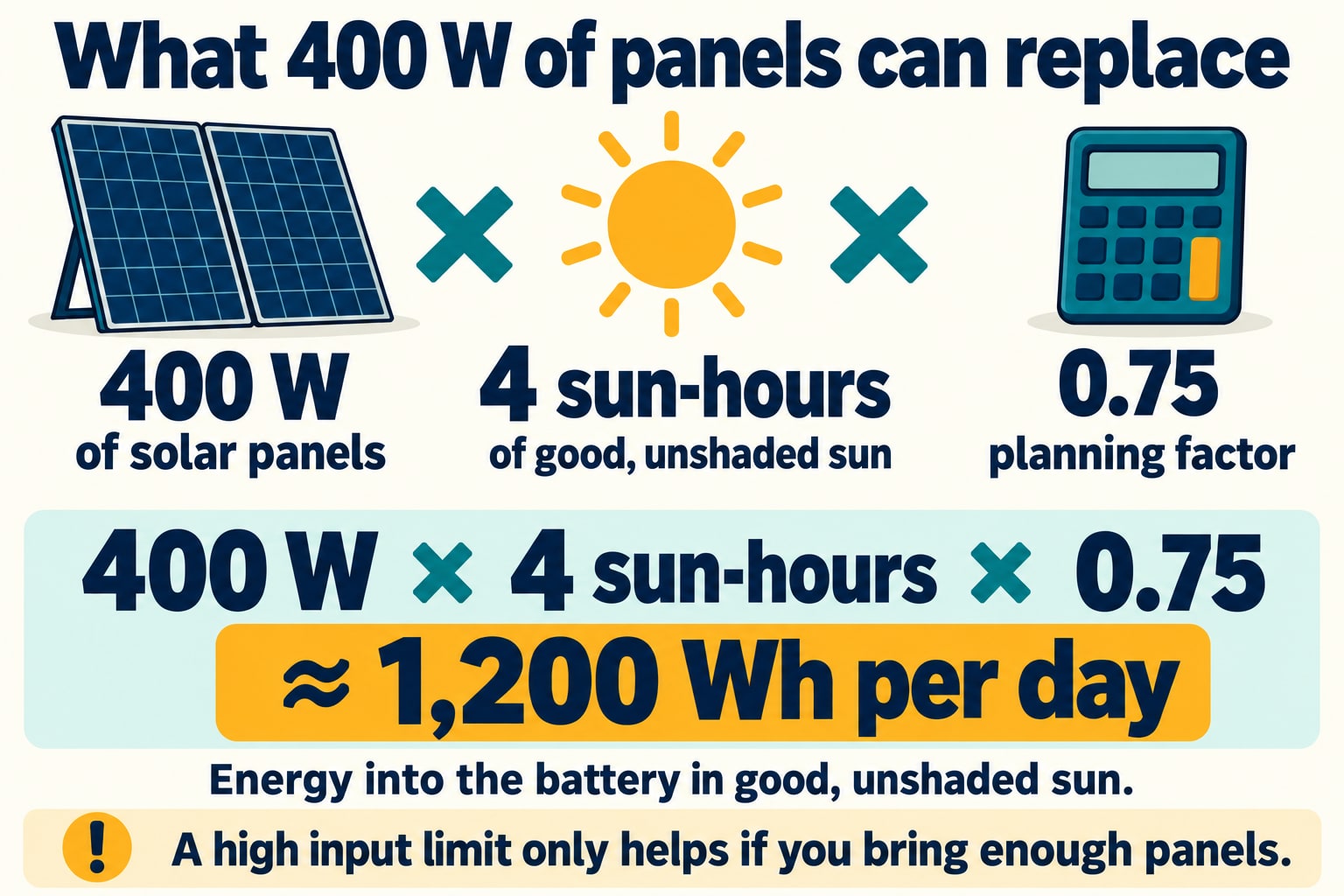
A station’s maximum input says how fast it can charge, not how much energy you’ll get. Give 400 W of panels open sun for 4 peak sun-hours and they put about 1,200 Wh into the battery: 400 × 4 × 0.75, with the planning factor our solar sizing guide (opens in a new tab) uses. That assumes suitable panels, set out unshaded in good weather. The F3000’s 2,400 W and the Elite’s 1,000 W inputs only matter if you carry that many panels; a single 200 W folding panel delivers a fraction of it.
- Use the station’s own solar input. The station regulates charging itself, so the panels plug straight into its solar port, with no separate charge controller in between.
- Check the panel against the input. Cold raises a panel’s voltage, so its open-circuit voltage must stay below the input’s maximum even on a frosty morning; the current must stay within the input’s limit, and the connector and polarity must match. A plug that fits doesn’t prove the panel is compatible; our guide to portable RV solar panels (opens in a new tab) covers which ones suit a power station.
- Let driving days top it up. A 12V socket gives only about 100 W on most of these stations, so a dedicated alternator charger, where the maker offers one, is far faster.
Solar only charges in daylight, so the energy for your evening and overnight loads has to be in the battery by sunset; our guide to RV solar at night (opens in a new tab) explains how to plan for that.
Safety Tips for Power Stations in an RV
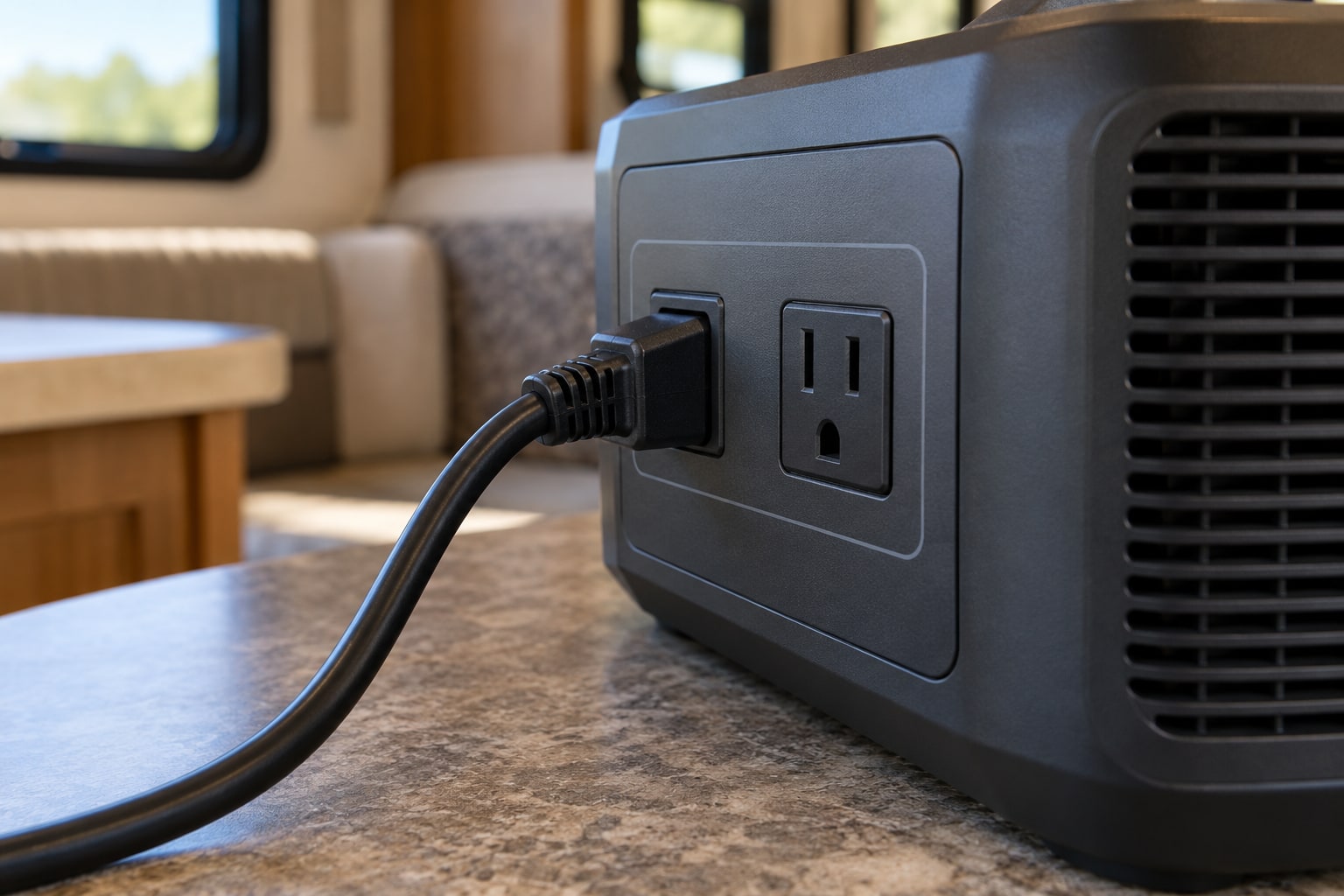
- Give it air. The fans need open space while the station charges or works hard, so keep it out of closed cabinets and off bedding.
- Secure it for travel. In a sudden stop, a loose station becomes a projectile, whether it weighs 7.5 lb or 99 lb; fasten it with straps or a suitable mount.
- Respect the temperature limits. Most of these stations won’t charge below 32°F, and Jackery suggests keeping the JE-300E between 32 and 77°F for long-term storage. A closed RV in summer gets far hotter than that.
- Stay within the continuous rating. Running loads at the limit for hours heats the inverter; leave some margin.
- Look after cables and plugs. Use the maker’s charging cables, seat plugs fully and keep connections dry.
FAQs
- Can a portable power station run an RV air conditioner? For a limited time. A rooftop unit drawing 1,500 W without a break gets about two hours of compressor time from the 3,600 Wh DELTA Pro, and starting the compressor often takes a soft starter. If the compressor runs 40 percent of an 8-hour night, it uses about 4,800 Wh, more than any station here holds on its own, so overnight cooling calls for shore power or a generator.
- What size power station do I need for RV camping? Multiply your measured daily watt-hours by the days between charges, divide by about 0.85 and add a 20 percent reserve. For two days without charging, 150 to 350 Wh of daily AC use points to a station of roughly 500 to 1,000 Wh, and 600 Wh a day to about 1,700 Wh.
- Can I plug my RV into a portable power station? Yes. Connect the RV’s shore cord to a matching outlet or a properly rated adapter. The DELTA Pro and F3000 have dedicated 30 A RV outlets; with a household outlet, the station, the outlet and the adapter limit what you can run. Count the converter and other automatic loads in your budget, and follow the station maker’s connection instructions.
- Can I charge a power station while driving? Yes, from a 12V socket, but most models take only about 100 W that way. A dedicated alternator charger from the station’s maker is much faster, so long driving days can refill the battery.
- Will a power station run a CPAP all night? Measure before you count on it, because a heated humidifier and hose can multiply what a CPAP uses. Record one night at your usual settings, use the maker’s DC adapter if there is one, and check the station’s auto-off: the Explorer 300’s energy-saving mode shuts off AC output when the load stays at 25 W or less for six hours, unless you disable it.
- Is it safe to use a power station inside an RV? Yes. It makes no exhaust, unlike a generator. Give the fans room, keep it dry, strap it down for travel and stay within its temperature limits.
Conclusion
For most RVers, the EcoFlow DELTA 3 is the station to start with: 1,800 W runs real appliances, a wall outlet refills it in under an hour, 27.6 lb stays portable, and extra batteries take it to 5 kWh. The Explorer 300 and 500 v2 handle devices and light loads at 7.5 and 12.6 lb. For a full day or two of fridge and kitchen use, the Elite 200 V2 fits about 2 kWh in a small case. To run the RV itself through the shore cord, choose between the F3000, with its 2,400 W solar input, and the DELTA Pro, with the most storage in one unit. Whichever you pick, size it from your measured watt-hours, and plan how you’ll refill it before the next night off-grid.
Spot an error or an outdated detail in this guide?
Report it