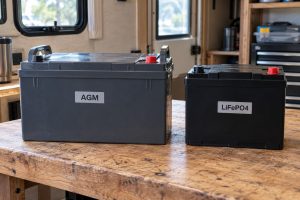
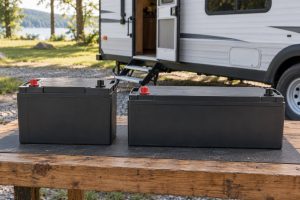
Best AGM Batteries for RV Solar: Top Picks & Guide
On this page
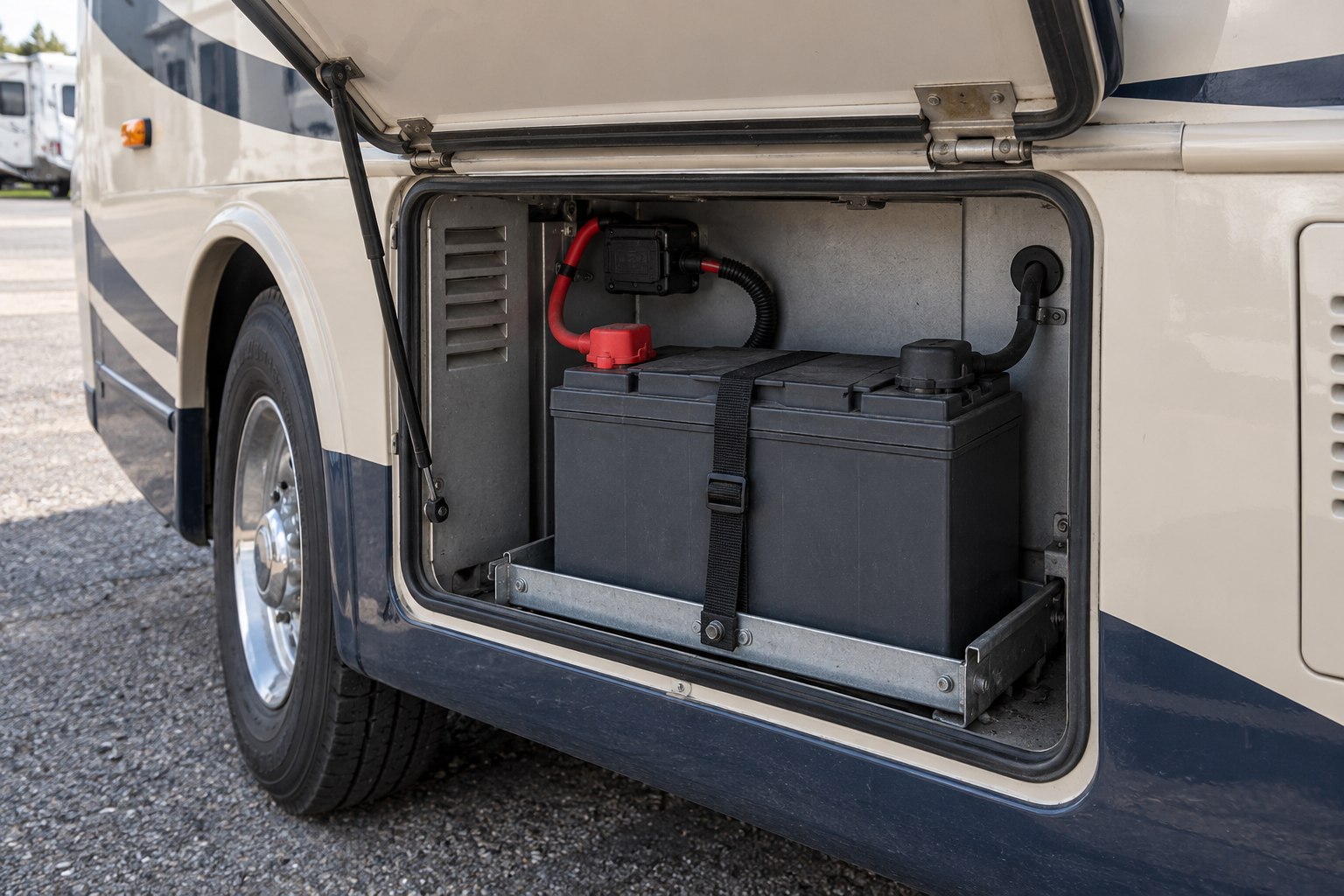
Most people shopping for AGM batteries aren’t designing a power system from scratch. They have a tray built for lead-acid batteries, a converter and a solar controller that already charge them, and a worn-out bank to replace. AGM keeps that job simple: no water to top up, and often no new charging gear, as long as the new battery’s limits suit the chargers you have.
The five picks below run from a straight 100 Ah swap to a pair of 6 V golf-cart batteries. If you haven’t settled on AGM yet, our AGM vs LiFePO4 comparison weighs the two; this guide starts once you’ve chosen.
TL;DR
- Standard 100Ah swap: Renogy 12V 100Ah Deep Cycle AGM, rated for 100 A continuously and 30 A of charging.
- Short Group 27 tray: UPLUS LDC12-100M, an inch shorter end to end than the Renogy. Its 45 A continuous limit rules out a microwave.
- 125Ah in a 100Ah footprint: Mighty Max ML125-12, 25 Ah more in a case close to the Renogy 100Ah’s size.
- One big battery: Renogy 12V 200Ah Deep Cycle AGM, 127.9 lb in a single 20.6 × 9.4-inch case.
- Two 6V spaces: a pair of Fullriver DC224-6 in series gives 12 V and 224 Ah. The Amazon listing is for one battery.
- Before ordering: measure the tray, budget roughly half the rated capacity, and check what your chargers can deliver together.
Five AGM Batteries Compared
The table lists the five by bank capacity. The planning column is nominal voltage × amp-hours × 0.5: a planning figure for discharging to about half, not a guaranteed runtime. Charging limits are in the reviews and in the charging table further down.
The group number on your old battery’s label, such as 24, 27, 31 or GC2, gives a first idea of what the tray takes; then hold the sizes below against the tray itself. A standard Group 24 case is about 10.25 inches long. If your tray only has room for that size, none of these 12 V picks will fit. Heights are the makers’ figures, so leave room above them for the cable lugs.
We compared the manufacturers’ specifications and manuals and checked the linked Amazon models. This is a specification-based comparison, not a hands-on test.
As an Amazon Associate I earn from qualifying purchases.
Scroll sideways to see every column.
| Battery | 12V Bank Capacity | Planning Energy at 50% | Size and Weight | Best For | Where to Buy |
|---|---|---|---|---|---|
| Renogy 12V 100Ah Deep Cycle AGM | 100 Ah | About 600 Wh | 13.1 × 6.9 × 8.6 in, 63.9 lb | A like-for-like 100Ah replacement | Amazon ↗ |
| UPLUS LDC12-100M | 100 Ah | About 600 Wh | 12.05 × 6.61 × 8.19 in, about 60 lb | A Group 27 tray and light 12 V loads | Amazon ↗ |
| Mighty Max ML125-12 | 125 Ah | About 750 Wh | 13.11 × 6.81 × 8.74 in, 70–74 lb | More capacity in nearly the Renogy 100Ah’s footprint | Amazon ↗ |
| Renogy 12V 200Ah Deep Cycle AGM | 200 Ah | About 1,200 Wh | 20.6 × 9.4 × 8.8 in, 127.9 lb | One large block for a long, wide bay | Amazon ↗ |
| Fullriver DC224-6, two in series | 224 Ah from two 6 V batteries | About 1,344 Wh | Each 10.24 × 7.09 × 9.65 in (10.71 with posts), 67.9 lb | RVs built for two 6 V batteries | Amazon ↗ (buy two) |
The Five Picks in Detail
Renogy 12V 100Ah Deep Cycle AGM: The Standard 100Ah Swap
For a direct 100 Ah replacement with limits you can plan around, start here. Renogy’s manual allows up to 30 A of charging and a continuous discharge of 100 A. With an inverter that’s 85 percent efficient, a 1,000 W appliance needs about 98 A at 12 V, leaving almost nothing for the RV’s other loads; for sustained loads that size, choose a larger bank. The 1,100 A on the listing lasts five seconds, so it covers a motor starting up, not a load you leave running. Its 100 Ah is rated over 10 hours rather than the more common 20, which makes it a slightly conservative figure.
The limit to plan around is charging current. One battery should see no more than 30 A, and a converter rated higher can exceed that on its own; the charging section below explains what to do then. A pair in parallel can take 60 A between them, and Renogy allows up to four. Any charger you can set to the values in the charging table below will charge it, Renogy’s own included; a matching brand doesn’t set them for you.
- Key specs: 100 Ah (10-hour rate); 30 A maximum charge; 100 A maximum continuous discharge; 1,100 A for 5 seconds; charges from 32°F to 122°F; M8 terminal bolts.
- Size and warranty: 13.1 × 6.9 × 8.6 inches, 63.9 lb; 2-year prorated warranty.
- Pick it if: you’re replacing worn 100 Ah batteries and your chargers can stay at or below 30 A per battery.
- Before you order: check your converter’s amp rating.
See the Renogy 12V 100Ah Deep Cycle AGM on Amazon
UPLUS LDC12-100M: Short Tray, Light Loads
The UPLUS fits a 100 Ah rating into a Group 27 case of 12.05 × 6.61 × 8.19 inches. That’s about an inch shorter in length and four pounds lighter than the Renogy 100Ah, and when we checked in October 2026 it also cost less. UPLUS calls it AGM-gel: glass-mat separators with a gel electrolyte. Charge it to the figures in UPLUS’s own charging chart, not to a charger’s GEL setting picked because of the name.
The catch is current. UPLUS rates it for 45 A continuously, and a 500 W appliance on an 85 percent efficient inverter already draws about 49 A at 12 V. One battery handles lights, fans, the water pump, a 12 V fridge and device charging; a microwave or a coffee maker, often 1,000 W or more, needs a bank rated well above 100 A, such as the Renogy 200Ah or two Renogy 100Ah batteries in parallel. The UPLUS’s 25 A charging limit is the lowest of the five, and its temperature ratings don’t agree from one UPLUS page to the next, so keep its charging above freezing.
- Key specs: model LDC12-100M; 100 Ah AGM-gel hybrid; 25 A maximum charge; 45 A maximum continuous discharge; M8 terminals.
- Size and warranty: 12.05 × 6.61 × 8.19 inches, about 60 lb; 2-year warranty on the Amazon listing.
- Pick it if: you have a Group 27 tray, mostly 12 V loads, and chargers that together stay at or below 25 A.
- Before you order: list the inverter loads you run; anything near 500 W is too much for one battery.
See the UPLUS LDC12-100M on Amazon
Mighty Max ML125-12: 125Ah in a 100Ah Footprint
If 100 Ah leaves you short and the tray can’t grow, the ML125-12 adds 25 Ah in nearly the same space. Its length and width are within a tenth of an inch of the Renogy 100Ah’s, it stands 0.14 inch taller, and it lifts the planning energy from about 600 to 750 Wh. Don’t count on exactly 25 percent more runtime, though: makers don’t all rate amp-hours at the same discharge time, and Mighty Max doesn’t say which one its 125 Ah comes from.
The Amazon title sells it as a sump-pump backup battery, but the listing describes the same ML125-12 that Mighty Max sells for solar and other uses, so check for that model number. Its charging figures are printed on the label, and they’re in the charging table below. Mighty Max lists it at 69.6 lb and Amazon at 74; plan the lift for the higher figure.
- Key specs: 12 V, 125 Ah AGM; initial charging current below 37.5 A; threaded terminals with screws included.
- Size and warranty: 13.11 × 6.81 × 8.74 inches, 69.6 lb (74 on Amazon); 1-year warranty.
- Pick it if: you want more capacity than the Renogy 100Ah in nearly the same footprint, your tray clears the listed dimensions, and your chargers together stay below 37.5 A.
- Before you order: note the one-year warranty, and that Mighty Max publishes no continuous current rating or charging temperature range.
See the Mighty Max ML125-12 on Amazon
Renogy 12V 200Ah Deep Cycle AGM: One Big Battery
One case means no cables between batteries and no batteries to balance against each other: all 200 Ah come off a single pair of terminals. Renogy rates it at the 20-hour rate and allows 60 A of charging and 200 A of continuous discharge, double the 100Ah model’s limits.
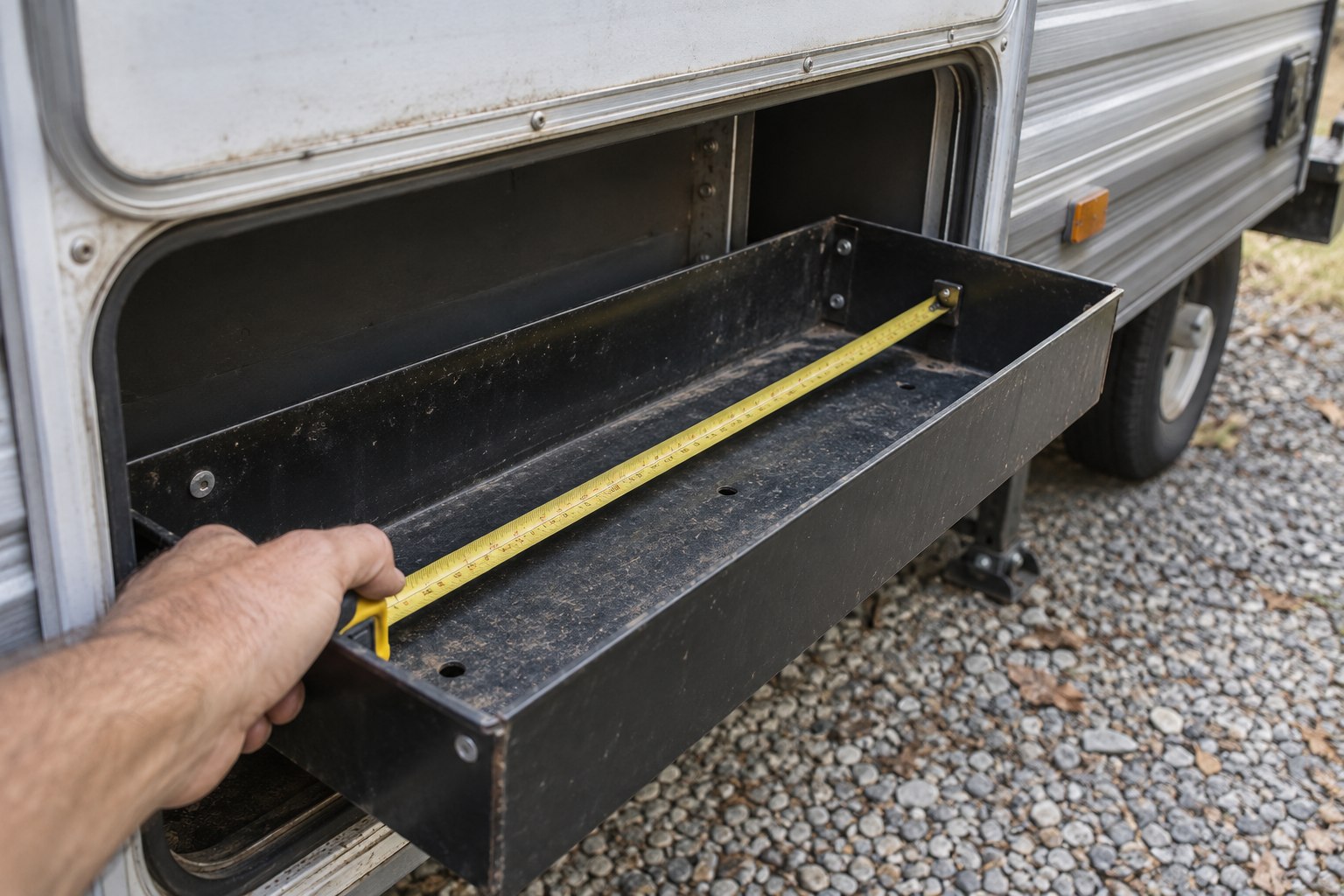
What it costs you is weight and space. At 127.9 lb it weighs the same as two of Renogy’s 100 Ah batteries, but it can’t be split into two lifts. The tray and floor have to carry it, and every pound counts against your RV’s cargo capacity. Its case measures 20.6 × 9.4 inches before any clearance, so measure the whole tray rather than assuming that room for two smaller batteries will take one large case.
- Key specs: 200 Ah at the 20-hour rate; 60 A maximum charge; 200 A maximum continuous discharge; 2,000 A for 5 seconds; M8 terminal bolts.
- Size and warranty: 20.6 × 9.4 × 8.8 inches, 127.9 lb; 2-year prorated warranty.
- Pick it if: you want 200 Ah without building a parallel bank.
- Before you order: check the access opening as well as the tray, and arrange help for the 128 lb lift.
See the Renogy 12V 200Ah Deep Cycle AGM on Amazon
Two Fullriver DC224-6 in Series: For RVs Built Around 6V Batteries
Plenty of RVs carry two 6 V golf-cart batteries, the GC2 size, wired in series. The Fullriver DC224-6 keeps that layout as a sealed AGM. Each battery is 6 V and 224 Ah at the 20-hour rate, so two in series give 12 V and 224 Ah, not 448. That’s the most capacity here, about 1,344 Wh to plan with, in two lifts of 67.9 lb each, about 136 lb together.
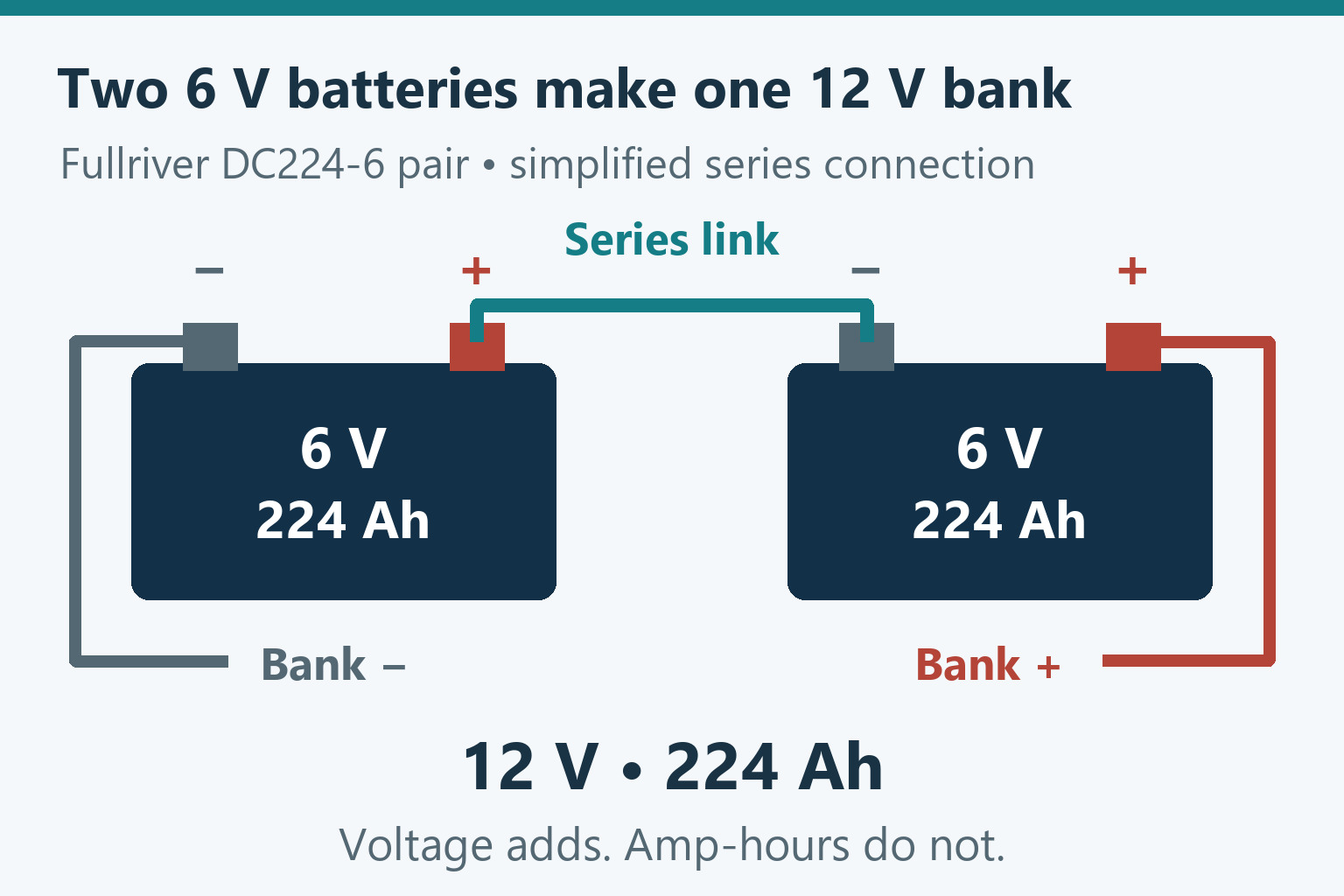
Measure the height carefully. Fullriver’s datasheet gives 9.65 inches for the case and 10.71 inches with the brass terminal posts that come with it, while Amazon lists 9.88; go by the datasheet and add room for the cable lugs. Leave at least half an inch between the two batteries, as the datasheet asks. For charging, Fullriver recommends a bulk current of 20 to 25 percent of capacity, 45 to 56 A for this pair, and allows up to 35 percent, about 78 A.
- Key specs: two 6 V batteries in series make a 12 V, 224 Ah bank; 78 A maximum charging current; no published continuous discharge limit.
- Size and warranty: each 10.24 × 7.09 inches, 9.65 inches tall (10.71 with the terminal posts), 67.9 lb; no warranty stated on the Amazon listing.
- Pick it if: your RV already has two GC2 spaces wired in series.
- Before you order: you need two, which made this the most expensive route in our October 2026 price check. The listing also mentions a possible core charge, so confirm the total and any old-battery return requirement.
See the Fullriver DC224-6 on Amazon (sold singly, so order two)
How Much Capacity You Need
Plan on using about half of an AGM’s rated capacity. That isn’t a cliff the battery falls off the moment you pass half; it’s a budget that protects cycle life, and Renogy warns that frequent discharges below 50 percent seriously shorten service life.
Take a couple who want two days without charging and use 400 Wh a day from the battery, a light setup: LED lights, the water pump, a roof fan, phones, and a fridge running on propane. That’s 800 Wh, and 800 ÷ 12 V ÷ 0.5 comes to about 133 Ah. One 100 Ah battery falls short, and the 125 Ah Mighty Max nearly gets there at about 750 Wh. The Renogy 200Ah covers three such days, and the Fullriver pair a little more.
Measure that daily figure at the battery, ideally with a shunt-based battery monitor. If you add it up from appliance labels instead, add the inverter’s losses to everything that runs on 120 V before you divide. For the whole calculation, reserve included, see our boondocking battery sizing guide.
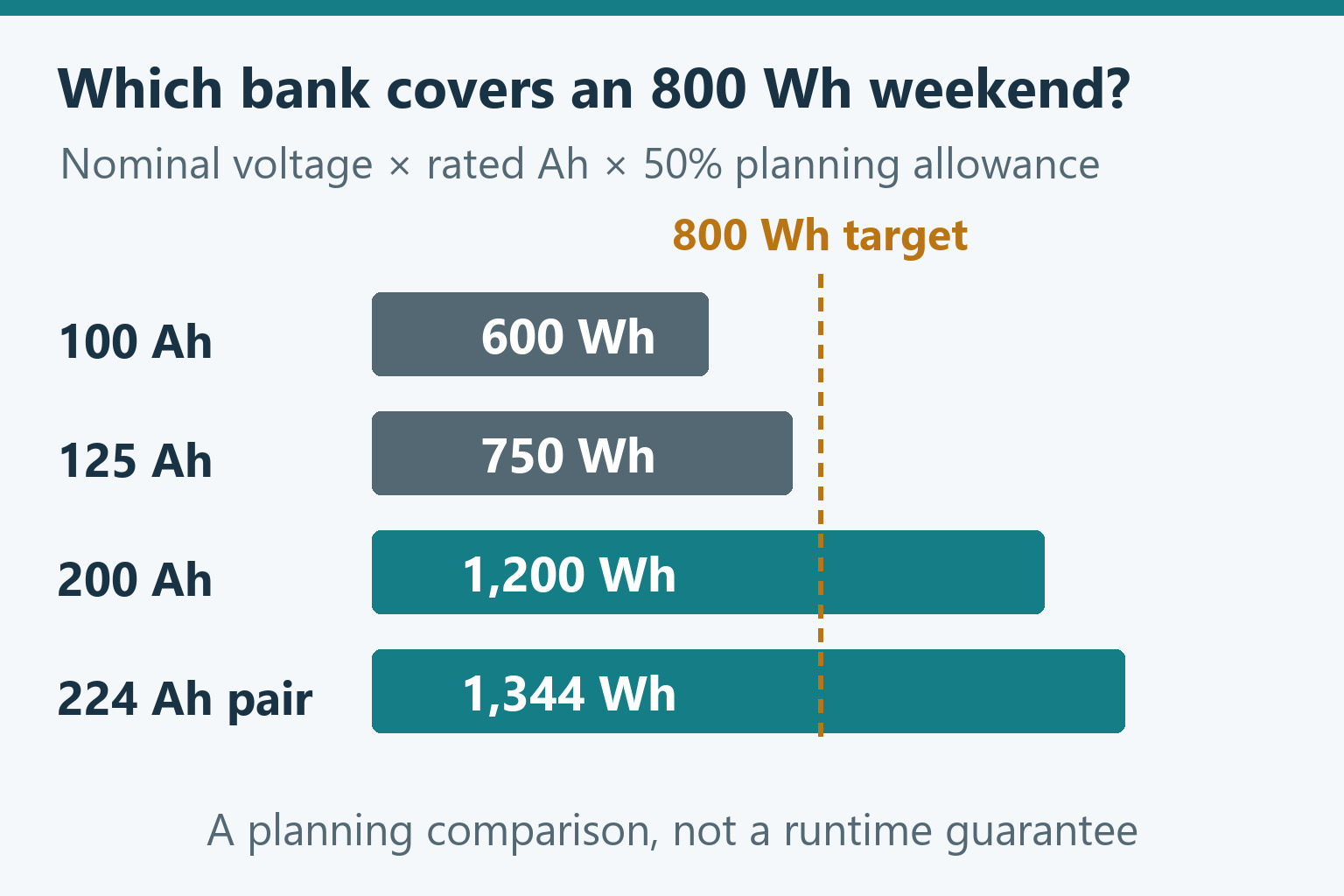
The amp-hour rating also depends on how fast you draw it. The Renogy 100Ah is rated over 10 hours, the 200Ah and the Fullriver over 20, and a faster discharge gets you less. Renogy’s listing for the 200Ah gives 190.5 Ah over 10 hours and 152.9 Ah over three. Cold takes its share as well. Lifeline, an AGM maker we use as a reference rather than a pick, says in its technical manual that a battery working at 0°F delivers about 60 percent of its room-temperature capacity, so a bank sized for summer nights comes up short on a frozen weekend.
Charging AGM Batteries in an RV
An AGM setting on a charger is a starting point, not a guarantee. Check it against four numbers from the battery’s maker: the absorption voltage that finishes a charge, the lower float voltage that holds the battery full, temperature compensation and the maximum charging current. The five picks don’t share one set of values.
Scroll sideways to see every column.
| Battery | Absorption | Float | Max Charging Current |
|---|---|---|---|
| Renogy 12V 100Ah | 14.4–14.8 V | 13.5–13.8 V | 30 A |
| UPLUS LDC12-100M | 14.7–14.9 V | 13.7–13.9 V | 25 A |
| Mighty Max ML125-12 | 14.6–14.8 V | 13.6–13.8 V | Below 37.5 A |
| Renogy 12V 200Ah | 14.4–14.8 V | 13.6–13.8 V | 60 A |
| Fullriver DC224-6 pair | 14.7 V | 13.6 V | 78 A (45–56 A recommended) |
The voltages are quoted for 77°F (25°C). If your charger has a temperature sensor, mount it on the battery case: Renogy, UPLUS and Fullriver all specify −24 mV per °C at absorption for a 12 V battery (Renogy uses −18 mV for float), so the charger raises the voltage in the cold and lowers it in the heat. On a programmable charger, also cap the absorption time: Renogy lists two to four hours, and for solar charging Fullriver specifies four at most. Keep equalization switched off unless the battery’s maker gives settings for it; Fullriver doesn’t recommend it for any of its batteries.
Why AGM Needs Full Charges
A lead-acid battery left partly charged builds up lead sulfate on its plates and loses capacity, and Renogy’s manual names long-term undercharging as a cause of early failure. Solar makes this easy to miss, because the last stretch is slow: at absorption voltage, the current tapers off as the battery fills. Lifeline’s manual estimates the time to a full charge, for its own batteries, as the amp-hours removed divided by the charger’s current, plus about two hours for that slow finish. Refilling half of a 200 Ah bank, 100 Ah, at 25 A then takes about six hours, more than a short winter day of good sun. Each charge also has to return a little more than was taken out, typically 102 to 110 percent in Lifeline’s guidance, to cover charging losses; fall short, and the state of charge walks down cycle after cycle.
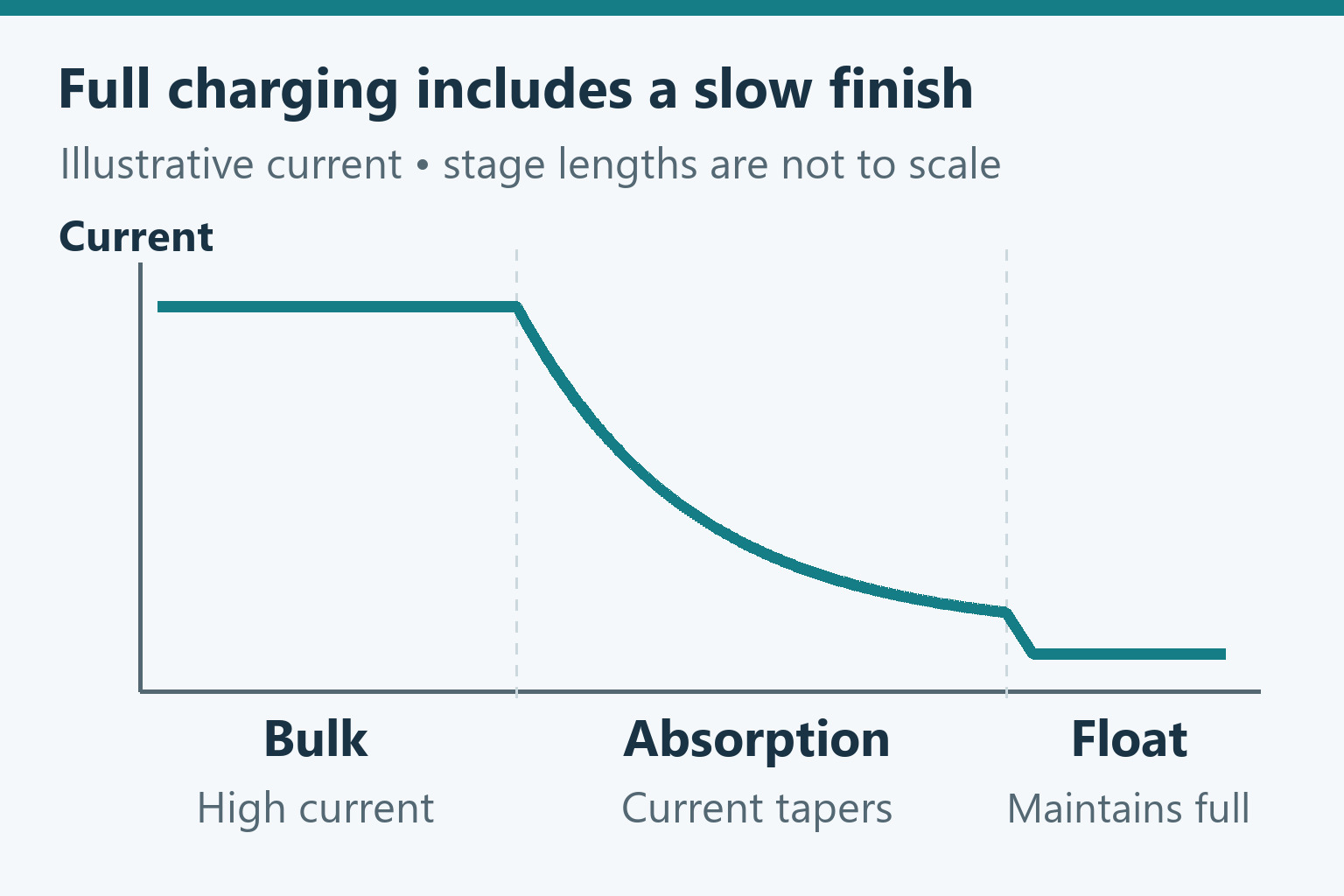
So size the solar for the finish, not just the day’s watt-hours. Fullriver’s solar guidance recommends at least 10 percent of bank capacity, about 22 A for the DC224-6 pair, so there’s time to finish charging. Less current takes longer, and a brief midday peak of 22 A doesn’t guarantee a full battery by sunset. For the panel side, our solar wattage guide does the sums.
Chargers Add Up
Plugged in on a sunny day, the converter and the solar controller can both be charging, and a DC-DC charger adds to the solar while you drive. Their combined current has to suit the bank, because Renogy warns that charging above the limit shortens a battery’s life or damages it. A 55 A converter can push one Renogy 100Ah past its 30 A limit before the solar even joins in; the Renogy 200Ah accepts 60 A and the Fullriver pair up to 78 A. Plan around the chargers’ combined maximum rather than counting on your appliances to soak up the excess.
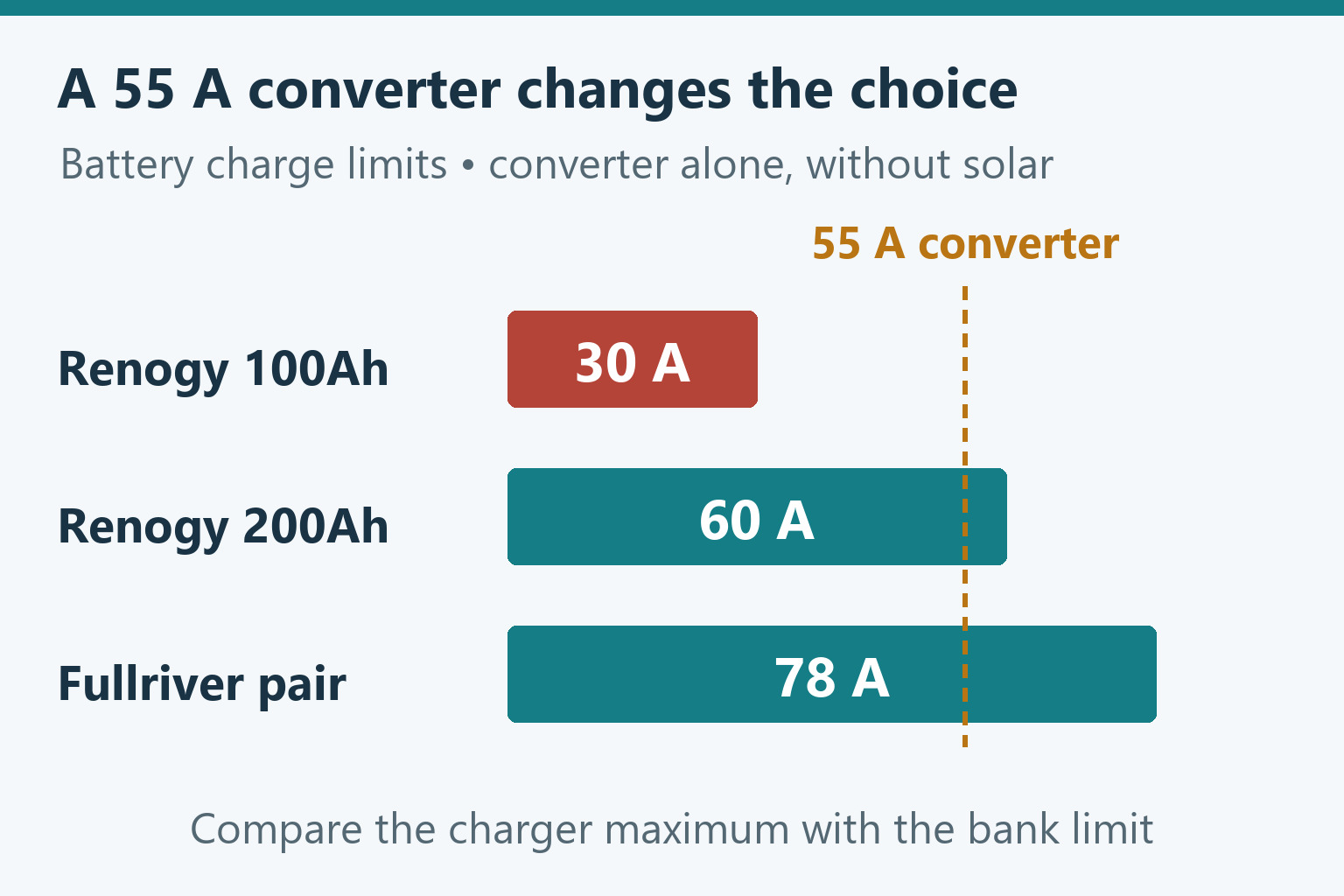
So check the converter before you order. Its amp rating is on the label or in the manual. If it’s above your new battery’s limit, turn its output down if it has that setting, build a bank that can take the current (a second battery, the Renogy 200Ah or the Fullriver pair), or replace it with a converter that has an AGM setting and an adjustable current limit.
Converters, Alternators and Older Controllers
Voltage matters as much as current. Look up the converter’s model and charging profile, and compare its settings with the battery’s. If you can’t find those settings, follow a recharge from a low state of charge with a voltmeter. Look for a higher-voltage charging stage followed by a lower float voltage. A reading near 13.6 V alone doesn’t identify the charger type. If the model uses a fixed 13.6 V output, it will refill a depleted AGM much more slowly than a suitable multi-stage charger. If a charger offers only Flooded, AGM and GEL presets, check each preset’s whole profile: voltages, absorption time, equalization and current limit. If none suits the battery, use a compatible programmable charger.
A DC-DC charger tops the bank up while you drive, but it doesn’t make up for a converter that falls short: the batteries still spend their parked days undercharged. The alternator side has its own guide: how to size a DC-DC charger.
An older PWM controller can still be a good fit for AGM. It needs a panel array suited to the battery voltage, array voltage and current within its input limits, and charging settings that match the battery. An MPPT controller gets more out of the same panels, most of all in cold weather or with panels wired well above battery voltage. Whether that’s worth a new controller is worked through in our MPPT vs PWM guide.
Cold Weather and Ventilation
Discharge and charge limits are different numbers. Renogy’s AGMs can supply power down to −4°F but should only be charged from 32°F up, the same floor as many lithium batteries, and UPLUS and Mighty Max give no clear charging floor, so keep all three above freezing while they charge. Fullriver’s recommended charging range goes lower: down to 5°F with temperature compensation, compared with 32°F without it. Compensation adjusts the voltage; it doesn’t lower the floor another maker sets. And never charge a frozen battery, as Fullriver’s charging instructions put it.
Keep AGMs charged through the winter, too. A discharged battery freezes far sooner than a full one: Lifeline puts the freezing point at about 21°F when empty and −13°F at half charge, against −94°F when full.
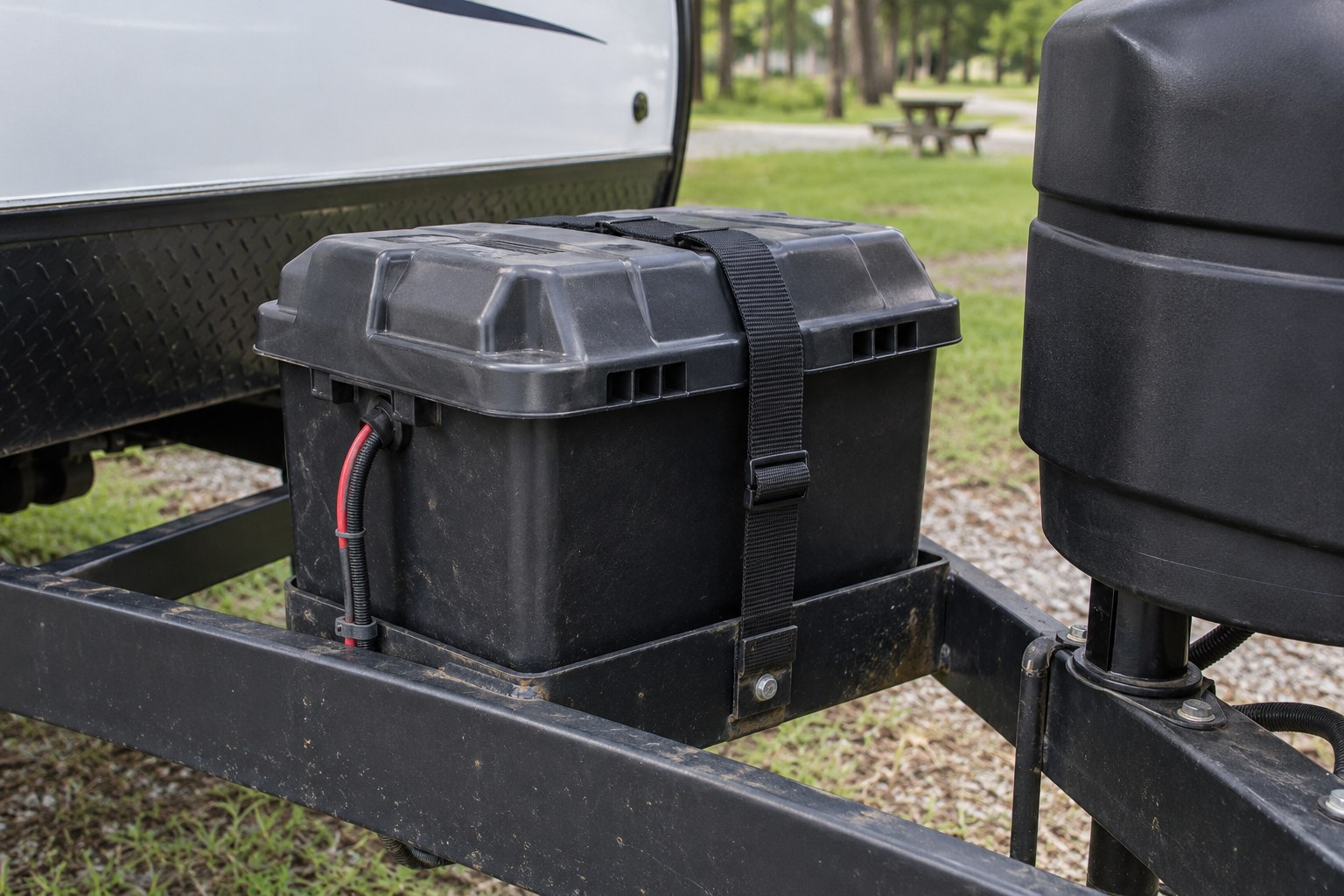
“Sealed” on an AGM means valve-regulated, not gas-tight. Small amounts of hydrogen escape through the valves during normal charging, Lifeline’s manual explains, and more when a battery is overcharged. Never shut AGMs in an airtight box. Inside the RV, give them a battery box or compartment with its own vent to the outside, not an open cabinet in the living area.
Which One Should You Buy?
Once you know what fits, match your loads and your chargers:
- A short Group 27 space, small loads and chargers within 25 A: the UPLUS LDC12-100M.
- An ordinary 100Ah swap, with inverter loads well under 1,000 W: the Renogy 12V 100Ah, rated for 100 A continuously, with chargers held to 30 A.
- More capacity in about the same space as a Renogy 100Ah: the Mighty Max ML125-12, once you’ve checked its dimensions against your tray.
- Room, and a floor, for one heavy battery, with chargers that stay within 60 A together: the Renogy 12V 200Ah.
- Two 6 V spaces already wired in series: a pair of Fullriver DC224-6.
- Charging below freezing, through a temperature-compensated charger: again the Fullriver pair, the only pick with a clear recommended charging range down to 5°F.
Installation and Safety
- Swap in a safe order: switch off the chargers and loads first, disconnect the negative cable before the positive and reconnect it last, and take the old batteries to a recycler. Some sellers add a core charge that’s refunded when you return an old battery.
- Hold it down and check what it sits on: strap or bolt each battery so it can’t shift under braking, and make sure the tray and floor can carry it. Weigh the new batteries against the old ones, too; any gain counts against your cargo capacity.
- Cover the positive terminal: a boot or cover stops a dropped wrench from bridging it to the frame or the negative terminal.
- Size the fuse and the cable together: the fuse protects the cable, so choose both for the current the circuit carries. Ratings like 1,100 A for five seconds describe short bursts the battery can deliver; they aren’t fuse sizes. Our fuse and breaker guide has the details.
- Put the lug straight on the terminal: the cable lug sits directly on the terminal face, and any washer goes on top of the lug. Fullriver’s installation manual warns that a washer between the two adds resistance and heat.
- Torque to the maker’s figure: terminal types differ, and Fullriver by itself lists a different torque for each type.
- Treat the monitor’s reading as an estimate: a shunt-based monitor counts the current in and out, so it’s only as good as its capacity setting and its regular resync at full charge.
- Match the batteries in a bank: same model, capacity and age. For two 12 V batteries in parallel, link them with cables of equal length and gauge, and take the main positive from one battery and the main negative from the other. For the Fullriver series pair, connect one battery’s positive to the other’s negative; the two free terminals take the RV’s main positive and negative.
FAQs
- Can I replace flooded lead-acid batteries with AGM? Yes, if the new batteries fit and your chargers can be set for them. Move every charger from its flooded setting to the AGM’s values, switch off any automatic equalization meant for flooded batteries unless the AGM’s maker allows it, and you’re done with topping up water.
- Can I add a new AGM to my old ones? Avoid it. Renogy warns that mixing batteries of different ages can shorten their life or damage them, and asks for batteries bought no more than six months apart; Fullriver also advises against mixing new and old. And AGM should never share a bank with flooded or lithium batteries.
- How long do AGM batteries last in an RV? It depends on how deeply you cycle them and how warm they live. Renogy lists 500 cycles at 50 percent depth of discharge. One such cycle a day reaches that count in about 16 months; a weekend camper takes years, so storage and charging habits decide. Either way, the figure is a cycle-test rating, not an expiry date. Heat costs life too: Lifeline’s rule of thumb is that it halves with every 10°C (18°F) rise. UPLUS and Fullriver show cycle charts tested under other conditions, and Mighty Max publishes none, so the five can’t be ranked on cycle life.
- Can an AGM battery be mounted on its side? Sometimes. Renogy recommends upright and allows the side only for a special reason, Fullriver accepts the side when necessary, and Mighty Max’s listing says the ML125-12 can go in any position. Renogy and Fullriver both rule out upside down.
- How should I store AGM batteries over the winter? Charge them fully, disconnect them from anything that draws power, and check the resting voltage every few months. Fullriver says to recharge a 12 V battery once it falls below 12.5 V (6.2 V for a 6 V battery). For winter top-ups, keep the battery above freezing, or follow Fullriver’s recommended range, which reaches 5°F with a temperature-compensated charger.
Conclusion
Whichever battery you pick, run it through three checks first. Does it fit in length, width and height, with space left on top for the cable lugs? Do your chargers together stay within its charging limit? And can each charger reach its absorption voltage and hold it long enough to finish? Get those right, keep the bank fully charged, and AGM stays the low-fuss choice it’s meant to be.
Spot an error or an outdated detail in this guide?
Report it