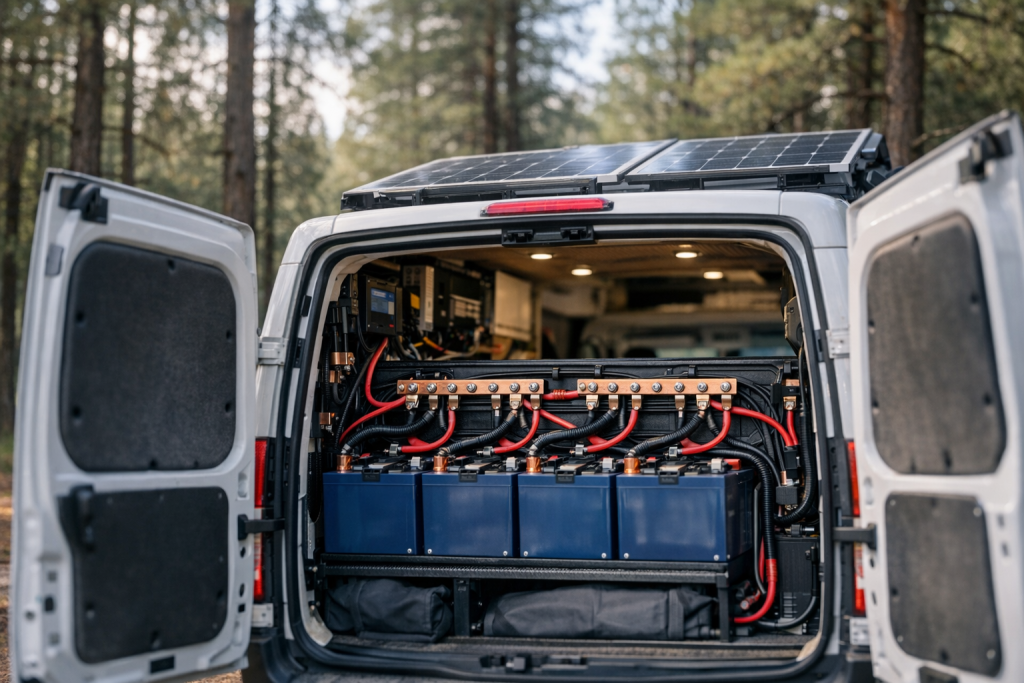
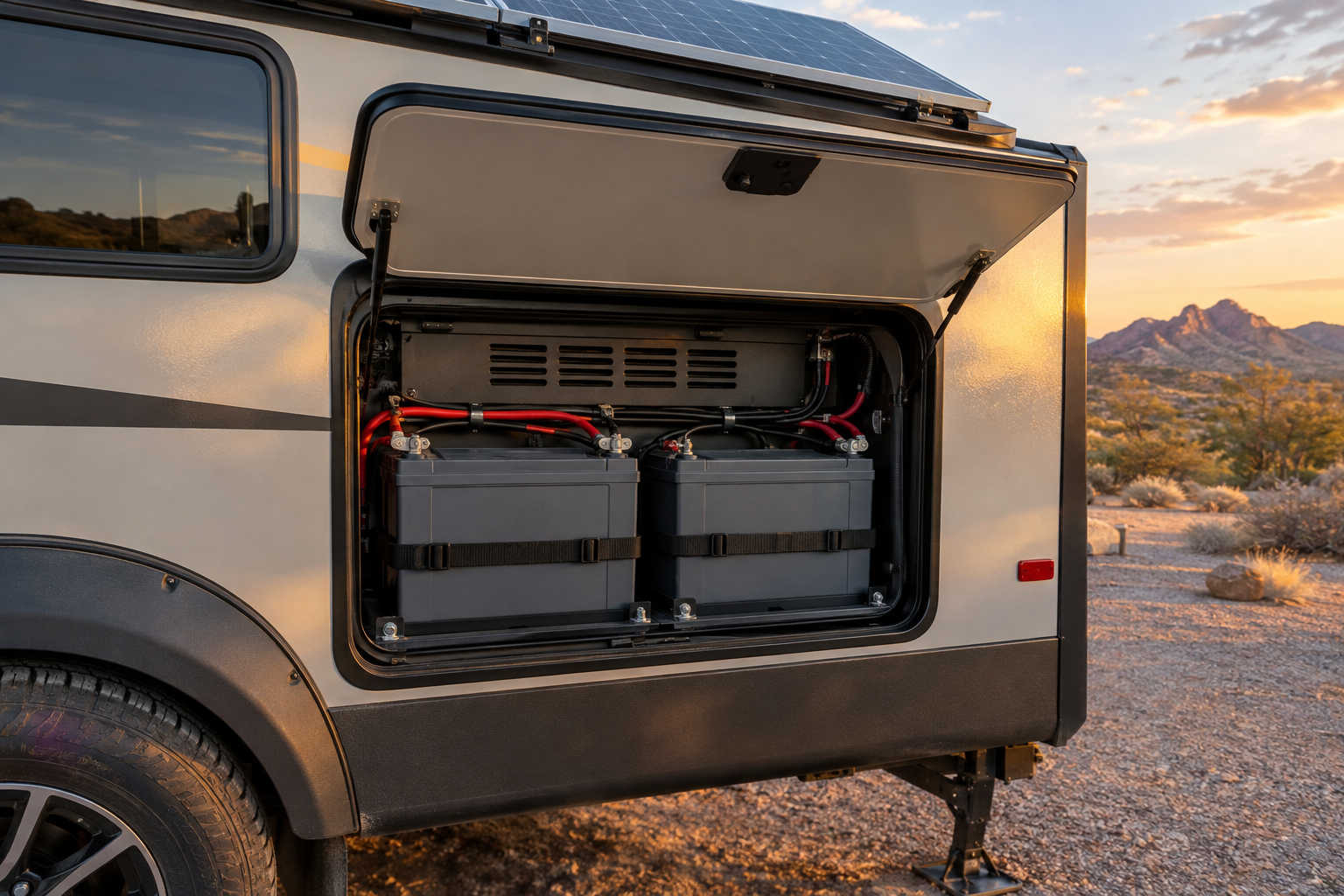
A 12V RV house bank that has to carry roughly a kilowatt-hour of overnight load, recharge from a rooftop array in a single sunny day, and ride out sub-freezing mornings in an unvented under-step compartment narrows the battery decision quickly: the chemistry has to tolerate partial-state charging, the case has to be sealed, and the price per usable amp-hour has to make sense against lithium. That is the niche where a deep-cycle absorbed glass mat (AGM) battery still earns its place in RV solar systems.
TL;DR
- Best Overall: Renogy Deep Cycle AGM Battery — RV owners building a solar bank around a single-brand ecosystem
- Best Budget: Weize Deep Cycle AGM Battery — Budget RV battery upgrades and first solar installs
- Best for Large Off-Grid Banks: VMAXTANKS SLR Series — Boondockers scaling to multi-battery parallel banks
- Best for Long-Service Builds: Lifeline GPL Series — Owners comparing long-term value over lowest upfront cost
Best AGM Batteries for RV Solar: Our Top Picks
The picks below are sealed, valve-regulated deep-cycle AGM batteries from established brands that RV owners and forum communities repeatedly reference for solar storage. Each entry leads with buyer fit and system-planning considerations rather than spec-sheet numbers, because model-level capacity, weight, and warranty figures change between production runs and sellers. Treat the descriptions as a shortlist framework, then match the specific variant to your tray footprint and daily load before ordering.
Renogy Deep Cycle AGM Battery
Renogy’s deep-cycle AGM line is the default recommendation for RV owners already running Renogy panels, charge controllers, or DC-DC chargers who want one brand’s documented charging profiles across the whole system. That alignment matters: the controller’s AGM preset and the battery’s published absorption and float targets come from the same engineering team, which removes a common source of undercharging in mixed-brand builds. Parallel and series limits vary by battery model, BMS design, and manufacturer documentation. Check the exact manual before wiring multiple batteries together.
This is the pick for weekend-to-week-long campers with a moderate rooftop array who value low-maintenance operation. AGM construction means no electrolyte top-offs, low self-discharge during storage, and a spill-proof case that can be mounted on its side or in an enclosed compartment where a flooded battery would be unsafe. The trade-off, shared by every AGM, is that only about half the nameplate capacity is realistically usable if you want the battery to last for years rather than seasons; check Renogy’s published depth-of-discharge guidance for the specific variant.
Installation planning is straightforward: budget for appropriately sized cable, an inline fuse or breaker at the positive terminal, and a battery monitor with a shunt so you see actual state of charge rather than guessing from resting voltage.
Weize Deep Cycle AGM Battery
Weize occupies the value tier of the AGM market and shows up constantly in RV forum threads from owners who replaced a dead OEM flooded battery and wanted a sealed upgrade without paying premium money.
The engineering trade-off with budget AGMs is generally in cycle-life consistency and plate quality rather than in headline capacity. Under gentle duty — shallow discharge, a full recharge most days, and no long stretches at partial state of charge — a value AGM can deliver respectable service. Under hard boondocking duty with frequent deep draws and slow recovery from a small array, the gap between budget and premium AGM widens. Size the bank conservatively so the battery spends most of its life above the halfway mark.
This pick suits owners of smaller travel trailers and pop-ups running LED lighting, a furnace blower, a water pump, and phone charging from a modest rooftop or portable array. It is also sensible for a first-generation system likely to be replaced by lithium in a few years, where minimizing sunk cost is the priority.
VMAXTANKS SLR Series
VMAXTANKS markets its SLR line specifically as solar-oriented deep-cycle AGM, and the brand is a fixture in off-grid and RV boondocking discussions where owners need banks larger than a single battery. The SLR series is positioned around heavy-duty plates intended for repeated deep cycling — the failure mode that separates a true deep-cycle AGM from a repurposed starting battery.
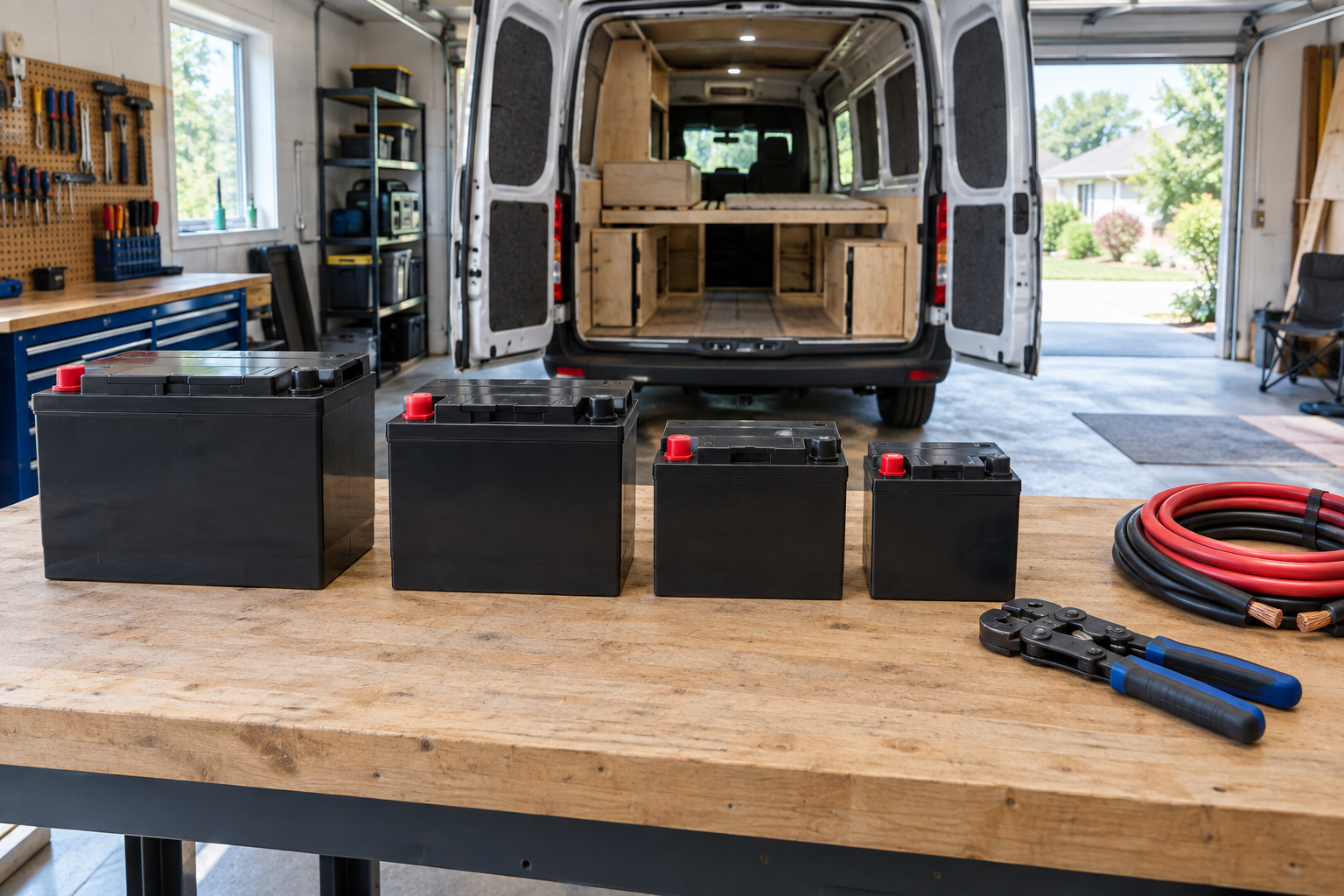
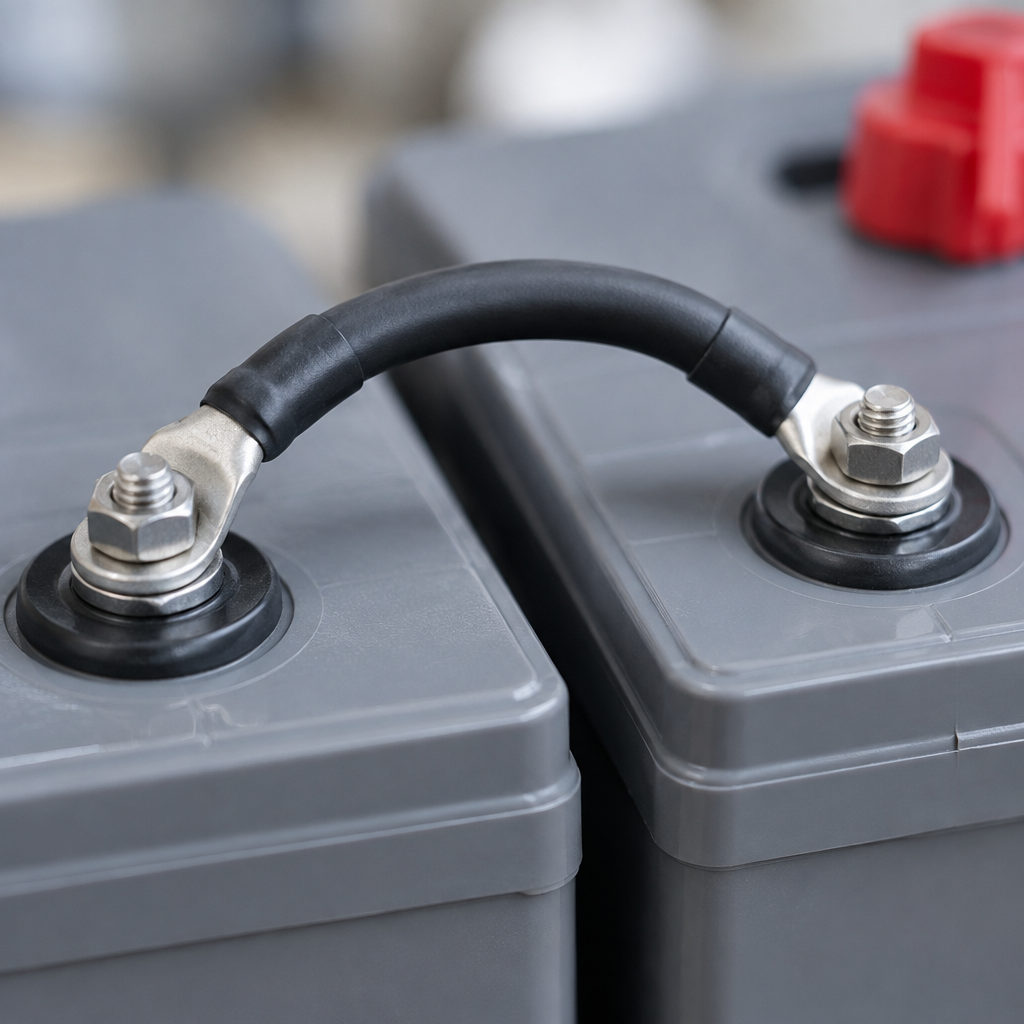
The natural buyer is the full-timer or extended boondocker planning a bank of two to four batteries wired in parallel behind a substantial rooftop array. In that scenario the question shifts from “which battery” to “how do I keep four batteries balanced”: identical age and capacity per battery, equal-length interconnects, and a diagonal-terminal wiring layout that draws from and charges every unit evenly. Charge-controller type and pairing varies by kit. Check the manufacturer specification for the model you are considering. Weight is the honest downside of any high-capacity AGM bank.
Lifeline GPL Series
Lifeline batteries, built by Concorde in the United States, sit at the premium end of the AGM market and trace their design lineage to aviation and military sealed-battery work. Among marine and RV owners who have run AGM banks for a decade or more, Lifeline is the name most often cited as the benchmark for consistency and longevity. The GPL series is the general-purpose deep-cycle line intended for house-bank duty in RVs and boats.
The buyer profile is an owner who has decided that AGM — rather than lithium — is the right chemistry for their situation and intends to keep the same bank for the life of the RV. Common reasons include a converter or alternator setup that cannot be reprogrammed for lithium, frequent cold-weather camping where AGM’s tolerance for charging at low temperature is an advantage, or a preference for a chemistry that fails gracefully rather than shutting off through a battery management system.
Lifeline publishes unusually detailed technical documentation, including recommended charging voltages, temperature-compensation guidance, and an equalization procedure that is uncommon for sealed batteries. That documentation is valuable when programming a custom controller profile. The cost premium is substantial relative to value-tier AGMs, so this pick only makes sense if the buyer values a long, predictable service life over minimal initial outlay.
Fullriver DC Series
The DC designation refers to deep cycle, and the line is offered across a range of voltages and capacities that allow both 12V parallel banks and series-wired banks built from lower-voltage units. Component popularity varies by segment and price tier.
This is the pick for the engineering-minded buyer who wants to design the bank around a specific daily load and array size rather than buying two of whatever fits the OEM tray. Fullriver publishes charge-voltage tables and cycle-versus-depth-of-discharge curves in its technical literature, which lets you estimate how sizing decisions affect service life instead of relying on rule-of-thumb guidance. Check the manufacturer specification for charge-controller requirements on the model you are considering.
Availability through general retail channels is less consistent than for Renogy or Weize, so buyers may need to source through solar or battery distributors and should confirm the exact variant, terminal style, and current warranty terms with the seller. As with any AGM, plan the daily budget around the manufacturer’s recommended depth of discharge rather than nameplate capacity.
Odyssey Extreme Series
Odyssey’s Extreme series uses thin-plate pure-lead AGM construction, a design that trades some raw deep-cycle capacity per dollar for vibration tolerance, high charge-acceptance rates, and strong performance in both starting and deep-cycle roles. In the RV world this makes it a frequent choice for van conversions and truck campers where a single battery or small bank must handle rough roads, occasional engine-start backup, and house loads.
The buyer who benefits most runs a compact solar system in a vehicle that sees washboard roads and off-pavement travel. Conventional AGM plates can shed material under sustained vibration; pure-lead thin-plate designs are notably more resistant. High charge acceptance also matters for solar: a battery that absorbs current quickly makes better use of a short midday charging window than one that tapers early.
The trade-offs are cost and the fact that Odyssey’s charging recommendations tend to specify higher absorption voltages than generic AGM presets, so the controller must be programmable or offer a matching profile. Read the Odyssey charging guide and set the controller to the published values rather than a default AGM preset. This pick is oriented toward durability under mechanical stress rather than maximum amp-hours per dollar.
Sizing the Bank: Usable Capacity, Not Nameplate
Start with a load audit. List every DC and inverter-fed load, estimate its wattage and daily run time, and total the watt-hours. A small trailer running LED lights, a furnace blower for a few hours, a water pump, a 12V fridge, and device charging often lands near a kilowatt-hour per day; a rig with a residential fridge on an inverter can be several times that. Divide daily watt-hours by the nominal system voltage to get amp-hours consumed per day, then add the inverter’s conversion losses for any AC loads.
Then apply the AGM depth-of-discharge rule. Lead-acid cycle life falls off steeply as discharge deepens, so the widely cited planning target for AGM is to draw the bank down no further than about 50% on a routine night; the battery maker’s cycle-life curve gives the exact trade-off for a given model. That means nameplate bank capacity should be at least double the daily amp-hour consumption, with more margin if cloudy days are common where you travel.
A category-level worked example: roughly 1,200 Wh per day at 12V is about 100 Ah consumed, which implies a bank in the neighborhood of 200 Ah nameplate to stay near the 50% line.
If you need a compact bank for a small trailer with light loads → choose a single value-tier battery such as the Weize Deep Cycle AGM or a single Renogy Deep Cycle AGM and keep loads modest. If you need maximum service life from a bank you intend to keep for the life of the RV → choose the Lifeline GPL Series and size it generously so daily discharge stays shallow.
AGM vs Lithium: When AGM Is Still the Right Call
Lithium iron phosphate batteries offer far more usable capacity per nameplate amp-hour, substantially lower weight, and flat voltage under load. For many RV owners upgrading a house bank, lithium is the better long-term value. AGM remains the correct engineering choice in several specific situations, and it is worth being honest about which ones apply to you.
The first is cold-weather charging. AGM batteries accept charge at temperatures where a lithium battery’s management system will refuse current, so an RV that camps in freezing conditions without a heated battery compartment is a natural AGM application. The second is charging-source compatibility: many older converters, alternators, and PWM controllers have no lithium profile and may undercharge or overheat a lithium bank, whereas they were designed around lead-acid targets. The third is budget: a two-battery AGM bank costs a fraction of an equivalent-usable lithium bank, and for a system expected to be replaced within a few years, the lower sunk cost can be rational.
Controller Compatibility and Charging Profiles
Every AGM battery is sold with a manufacturer-specified absorption voltage, float voltage, and often a temperature-compensation coefficient. Category-wide, AGM absorption targets typically fall in the low-to-mid 14V range and float targets in the mid-13V range, but the exact values differ between brands, and the gap between a generic preset and the manufacturer’s number is enough to chronically undercharge or overcharge a bank over a season. Undercharging causes sulfation and capacity loss; overcharging dries the electrolyte in a sealed battery with no way to refill it.
A programmable MPPT controller with user-defined voltage setpoints and a remote temperature sensor is the ideal companion to any AGM bank. PWM controllers can charge AGM adequately if they have a matching AGM preset, but they lack the array-to-battery voltage conversion that lets MPPT harvest more energy during cool mornings and partial shade. Since AGM already limits the usable fraction of nameplate capacity, recovering that energy quickly each day is what keeps the bank healthy.
If your controller has fixed presets only → choose Renogy Deep Cycle AGM or Weize Deep Cycle AGM, whose charging expectations align closely with generic AGM presets, and make sure the preset labeled AGM (not flooded or gel) is selected. If your controller is fully programmable → any pick works, and Odyssey Extreme Series or Lifeline GPL Series become viable because you can enter their specific published values. If the RV’s factory converter is an older single-stage unit → budget for a converter upgrade or a DC-DC charger regardless of which AGM you buy, because shore-power charging matters as much as solar for battery life.
Comparison Table
| Search Target | Best Fit | What to Confirm Before Buying | Why It Might Fit | Watchouts | Where to buy |
|---|---|---|---|---|---|
| Renogy Deep Cycle AGM Battery | Best when your converter or charger has a matching AGM or lead-acid charge setting | Confirm your converter, charger, and controller offer the correct lead-acid setting | Fits owners whose existing chargers already handle lead-acid without new hardware | A charger left on the wrong profile can chronically under- or over-charge the bank. | Amazon ↗ |
| Weize Deep Cycle AGM Battery | Best when you want a proven chemistry and can plan around its usable capacity | Confirm the manufacturer-recommended depth of discharge and any ventilation guidance for the battery type and mounting location | Fits owners comfortable planning capacity around the manufacturer-recommended depth of discharge | Long storage without a float or maintenance charge costs capacity over time. | Amazon ↗ |
| VMAXTANKS SLR Series | Best when the case size and terminals fit your existing battery box | Confirm the dimensions, terminals, and mounting fit your battery box | Fits owners replacing a battery in a fixed bay or box | A pack that does not fit the bay or terminals adds rework on install. | Amazon ↗ |
| Lifeline GPL Series | Best when long-term warranty and responsive support matter to you | Confirm the warranty length and support terms genuinely cover your use | Fits owners who weigh long-term support against the up-front price | Thin warranty or hard-to-reach support can cost you later. | Amazon ↗ |
| VMAXTANKS SLR solar AGM battery | A strong fit when your charge sources offer a lead-acid profile out of the box | Check that every charge source can be set to the battery’s recommended profile | Suits builds that keep the current converter and controller unchanged | Verify the charge setting after install — the factory default may not match. | Amazon ↗ |
| Lifeline GPL AGM battery | A strong fit for owners who follow the manufacturer’s depth-of-discharge guidance | Check the usable-capacity guidance and storage-charging recommendations for the battery type | Suits seasonal rigs that can give the bank a proper float or maintenance charge in storage | Deep discharges below the recommended level shorten the bank’s life. | Amazon ↗ |
As an Amazon Associate I earn from qualifying purchases.
Which One Should You Buy
Choosing among AGM batteries for RV solar comes down to three engineering questions: how many usable amp-hours the bank must deliver each night, whether AGM is actually the right chemistry versus lithium for your charging sources and climate, and whether your controller can be set to the battery’s published charging targets. The subsections below work through each decision in order, because the answer to the first constrains the second and third.

Safety & Common Mistakes
- Mixing chemistries or ages in one bank. Never combine AGM with flooded or lithium batteries, and avoid pairing a new AGM with an old one; mismatched internal resistance causes uneven charging and shortens the life of every battery in the bank.
- Running the wrong charging profile. A controller left on a flooded or gel preset will either overcharge or undercharge a sealed AGM. Set the AGM profile or enter the manufacturer’s published absorption and float values, and install the controller’s remote temperature sensor on the battery case.
- Skipping over-current protection. A short across an AGM bank can deliver enormous current. Main fuse sizing depends on expected current, conductor ampacity, equipment ratings, interrupt-rating requirements, and manufacturer documentation.
- Routinely discharging past the halfway mark. Deep discharges are the fastest way to turn a multi-year AGM into a single-season battery. Use a shunt-based monitor rather than resting voltage to track true state of charge and set a low-voltage cutoff on the inverter.
- Assuming “sealed” means zero ventilation. AGM batteries vent hydrogen only under fault or overcharge conditions, but that possibility still exists. Keep the compartment free of ignition sources and preserve any factory vent path even though daily gassing is minimal.
- Ignoring weight and mounting. AGM batteries are heavy and must be secured with proper hold-downs against road vibration. Check the RV’s cargo-carrying capacity and tongue or axle loading before adding a multi-battery bank, and lift with care during installation.
This guidance is general; follow the battery manufacturer’s installation and charging instructions and applicable RV electrical codes, and consult a qualified technician if you are unsure.
FAQs
- Do AGM batteries work well with RV solar? Yes. AGM batteries pair well with solar as long as the charge controller uses an AGM-specific charging profile and, ideally, a remote temperature sensor. Their low self-discharge and tolerance for partial-state charging make them forgiving of the variable input a rooftop array delivers, provided the bank is sized so daily discharge stays shallow.
- What is the best AGM battery for RV solar? The best option balances deep-cycle plate construction, strong published charging documentation, and a reputable brand with a track record in RV and marine house-bank duty. Renogy’s line is the easiest all-around fit for most rigs, VMAXTANKS suits large parallel banks, and Lifeline is the benchmark when longevity outweighs upfront cost.
- How long do AGM batteries last in an RV? With correct charging voltages and routine discharge limited to about half of capacity, AGM batteries in RV service commonly last several years — often cited as roughly four to seven — or on the order of several hundred to around a thousand cycles depending on quality and depth of discharge. Frequent deep discharges or chronic undercharging can cut that dramatically.
- Is AGM or lithium better for RV solar? Lithium offers more usable capacity per nameplate amp-hour and far less weight, while AGM costs less upfront, works with older lead-acid-only converters and alternators, and can accept charge in cold conditions where lithium management systems shut charging off. Cold-climate campers and budget-limited first installs favor AGM; heavy boondockers with lithium-capable chargers favor lithium.
- What voltage should a solar controller charge AGM batteries to? Category-wide, most AGM batteries charge best at an absorption voltage in the low-to-mid 14V range with float in the mid-13V range, but the exact values differ by brand. Enter the manufacturer’s published setpoints from the battery’s datasheet into a programmable controller rather than relying on a generic preset.
- Can I mount an AGM battery inside the RV living space? AGM batteries are sealed and spill-proof, so they can be mounted in enclosed compartments and, in many cases, on their side, which flooded batteries cannot. Still keep the compartment away from ignition sources, secure the battery against vibration, and preserve any factory venting path as a precaution against fault-condition gassing.
Conclusion
The right AGM battery for an RV solar system is the one whose realistic usable capacity — roughly half of nameplate under typical AGM guidance — covers your worst typical night with margin, fits the compartment and cargo limits of your rig, and comes from a brand whose published charging targets your controller can reproduce. Shortlist by duty cycle first: a value-tier Weize or a Renogy unit for light weekend loads, a VMAXTANKS or Fullriver bank for extended off-grid stays, Lifeline or Odyssey when service life and rough-road durability justify the premium.