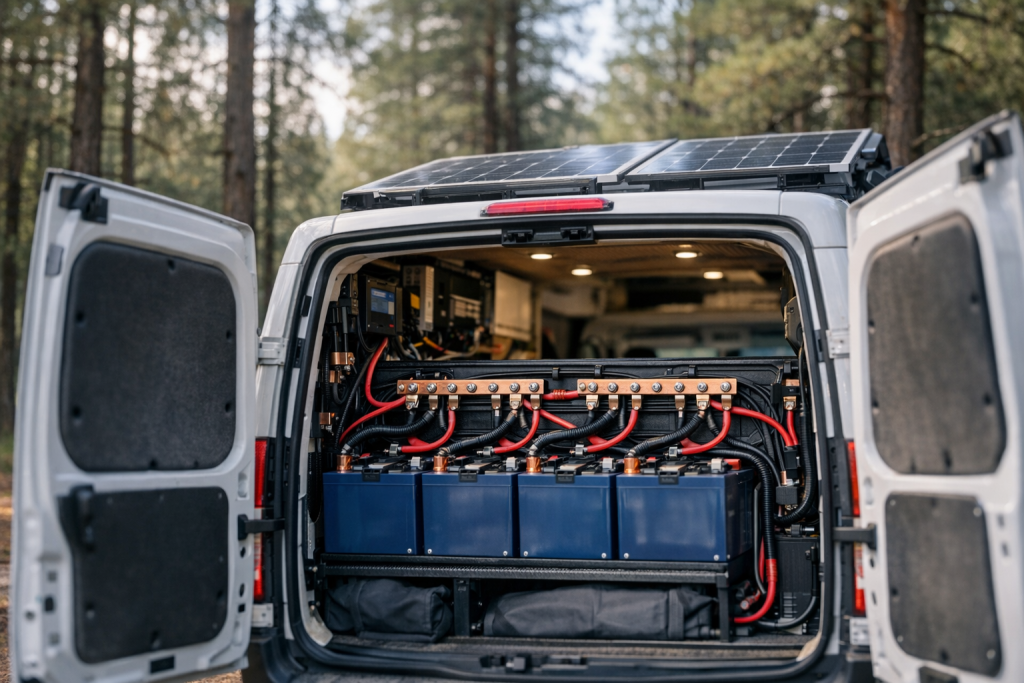
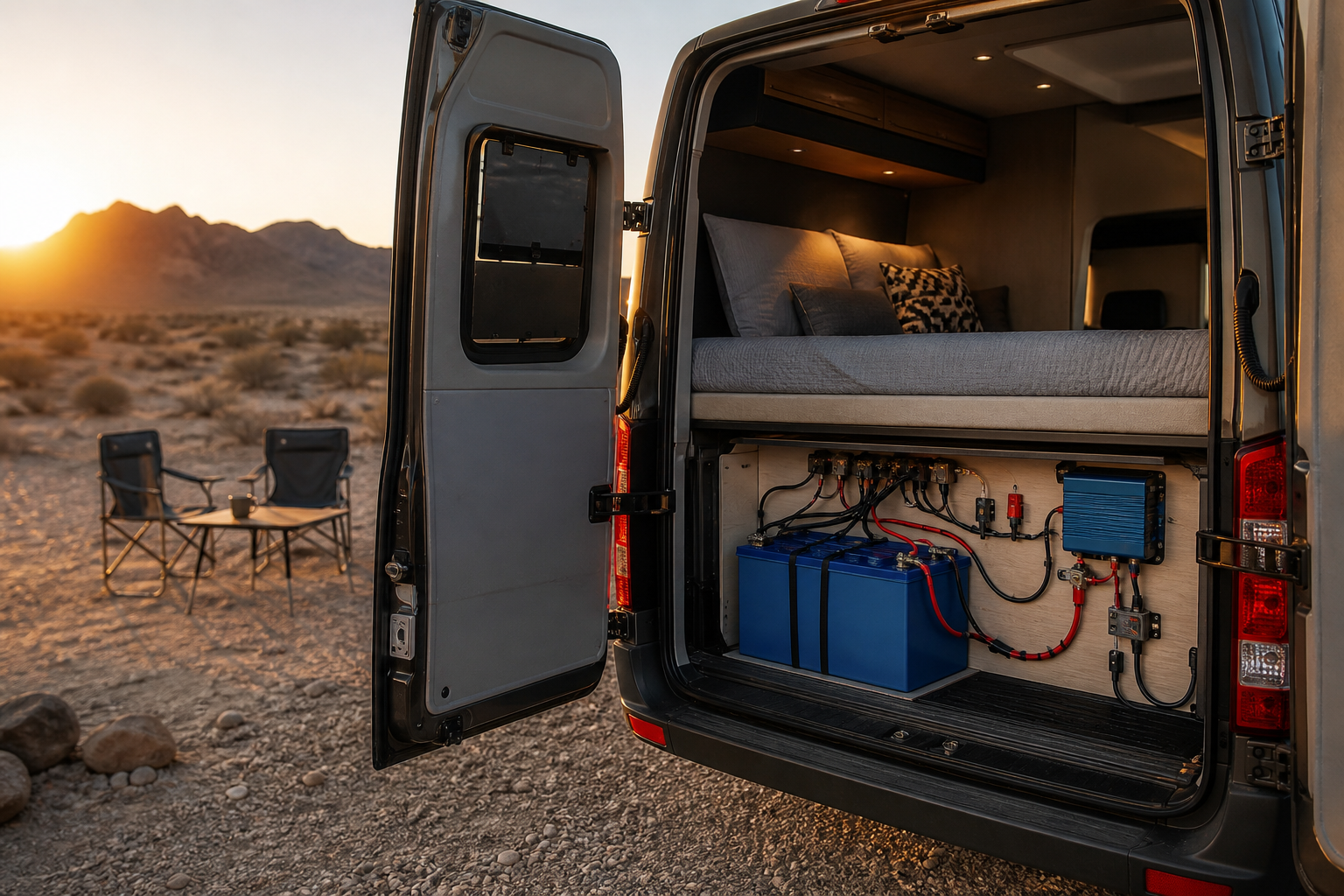
A 12V compressor fridge, a furnace fan running overnight, lights, a water pump, and a couple of laptops add up to a daily draw that a single 200Ah LiFePO4 battery covers comfortably for two to three nights off-grid. That works out to roughly 2,560Wh of nominal capacity (200Ah × 12.8V) in one box — most of it usable within the manufacturer’s recommended depth of discharge — at about half the weight of an equivalent lead-acid bank. The picks below are organized by the scenario you actually camp in: weekend boondocking, tight compartments, solar-heavy rigs, budget rebuilds, and full-time living.
TL;DR
- Best Overall: LiTime 12V 200Ah — All-around weekend boondocking and first-time lithium upgrades
- Best Budget: Redodo 12V 200Ah — Budget RV battery upgrades where every dollar per amp-hour counts
- Best for Tight Battery Bays: LiTime 12V 200Ah Xtra Mini — Weight-sensitive builds and compact compartments
- Best for Solar-Heavy Rigs: Renogy 12V 200Ah Core — Buyers building inside one solar ecosystem
- Best Premium: Epoch Batteries 12V 200Ah — Full-timers comparing long-term value and support
Best 200Ah LiFePO4 Battery for RV Picks
Rather than ranking them on a single scoreboard, each one is framed around the camping scenario it serves best, because a battery that’s perfect for a weekend trailer can be the wrong call for a full-time fifth wheel.
LiTime 12V 200Ah
Best for: weekend boondockers making their first lithium upgrade. LiTime (formerly sold under the Ampere Time name) has become one of the most frequently recommended brands in RV forums and owner groups for a reason: the 200Ah line hits the middle of the market on price while maintaining a reputation for consistent cell quality and a battery management system (BMS) that handles typical RV loads without drama. If your rig runs a 12V fridge, furnace blower, lights, water pump, fans, and device charging — the classic two-to-three-night boondocking load profile — this is the default answer that’s hard to argue against.
Common lead-acid guidance limits routine discharge to roughly half of rated capacity, while LiFePO4 packs allow much deeper discharge within their manufacturers’ recommendations — so a 200Ah lithium battery can roughly double real-world usable energy versus a similarly rated lead-acid pair while cutting weight substantially. The trade-off versus premium brands is largely in support infrastructure and documentation polish rather than day-to-day performance. For a weekender who isn’t stressing the pack with big inverter loads, that trade is usually worth making.
Where you’d look elsewhere: if you routinely run a large inverter for a residential microwave or induction cooktop, compare continuous-discharge ratings across your shortlist carefully. Parallel and series limits vary by battery model, BMS design, and manufacturer documentation.
LiTime 12V 200Ah Xtra Mini
Best for: tight battery bays, tongue boxes, and weight-sensitive builds. The Xtra Mini is LiTime’s answer to the most common physical problem in RV lithium upgrades: 200Ah of capacity traditionally came in a physically large case, and plenty of trailers only have room for a standard-size battery footprint.
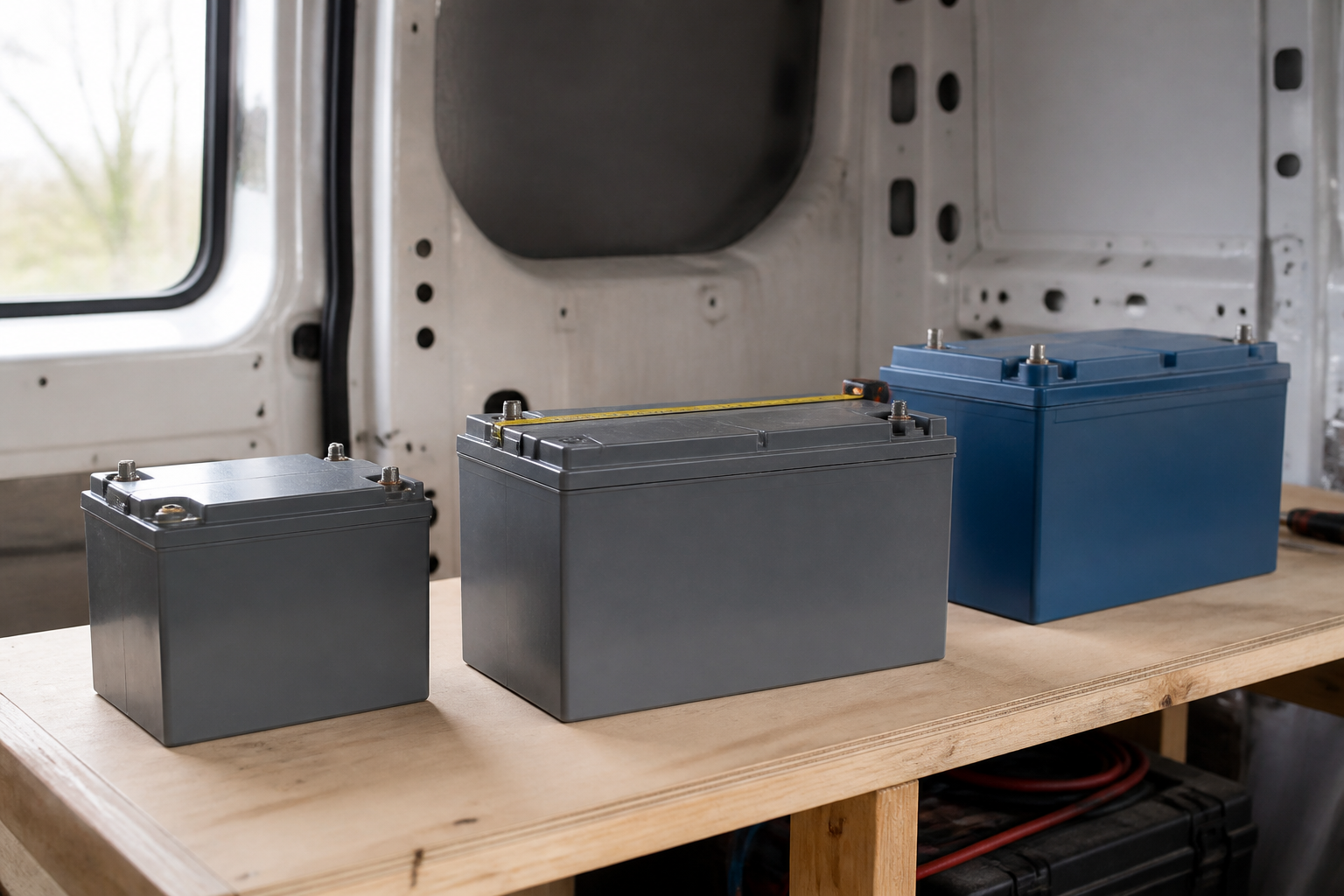
The scenario this serves best is the teardrop, A-frame, or small travel trailer owner whose tongue box or front compartment was sized for one conventional battery. Instead of engineering a custom tray or giving up storage space for a second battery, you get the full 200Ah in the space you already have. Phone-based monitoring matters more in these rigs, too: small trailers rarely have a factory battery monitor, and guessing state of charge by voltage alone is notoriously unreliable with the flat LiFePO4 discharge curve.
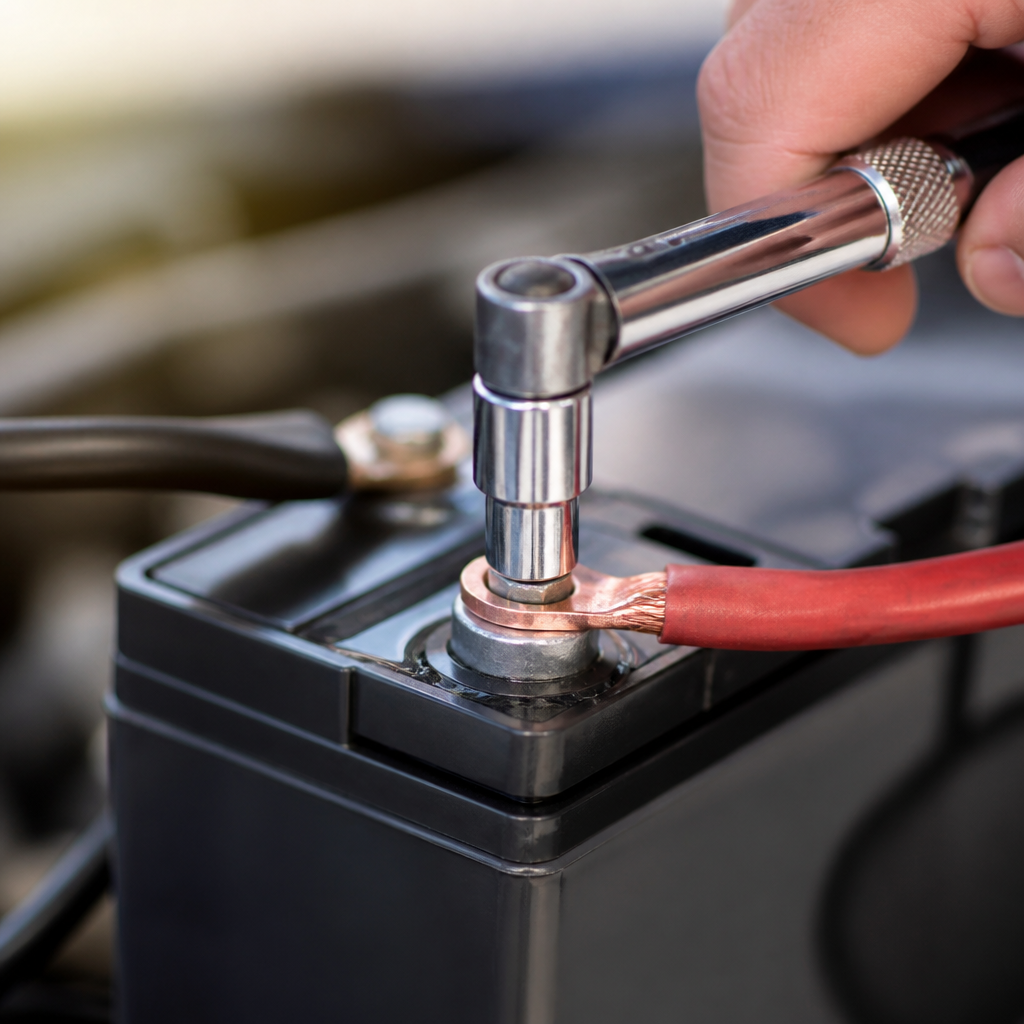
The watchout with any compact high-capacity battery is heat and terminal access. Denser packaging means you should be more deliberate about ventilation, cable routing, and torque on terminal hardware.
Renogy 12V 200Ah Core
Best for: RVers already invested in a single-brand solar ecosystem. Renogy’s Core series is the natural pick for owners who already run Renogy charge controllers, DC-DC chargers, panels, and monitoring hardware, or who plan to build the whole system from one catalog. There’s real practical value in that: matched-brand systems tend to have documented charge profiles, tech support that understands the whole chain, and fewer finger-pointing scenarios when something behaves oddly. For a buyer designing a 400–600W rooftop solar setup alongside the battery purchase, that coherence is worth genuine money.
The use case profile is the couple building out a mid-size travel trailer or camper van for one-to-two-week trips with meaningful solar recharge between hookups. A 200Ah bank paired with a properly sized rooftop array can sustain fridge, lights, fans, and electronics more or less indefinitely in decent sun, and Renogy’s documentation makes it easier for a first-time system builder to get charge parameters right the first time. Renogy also has broad retail availability, which helps if you prefer buying major components from a large marketplace with straightforward returns.
Trade-offs: Renogy’s batteries typically price above the direct-import value brands like Redodo and Power Queen while sitting below boutique premium options, so you’re paying partly for ecosystem and brand infrastructure. If you’re mixing components from several brands anyway, that premium buys you less, and a value-brand battery plus a quality standalone monitor may serve you equally well.
Redodo 12V 200Ah
Best for: budget rebuilds and second-battery expansions. Redodo competes almost entirely on price per amp-hour, and in the 200Ah class it’s consistently among the cheapest routes to a full-size lithium house bank. The scenario where it makes the most sense is the owner of an older trailer doing a whole-rig refresh — new converter, new tires, new battery — where the budget has to stretch across everything.
What you give up at this price tier is mostly polish and long-horizon confidence: documentation is thinner, support response can be slower, and the brand doesn’t have the decade-long track record of the premium names. What you don’t necessarily give up is core chemistry — LiFePO4 cells across this market segment come from a relatively small pool of manufacturers, and owner reports for Redodo’s capacity delivery are generally solid for typical RV duty cycles. For a budget buyer running lights, fridge, and furnace rather than a big inverter, that’s usually an acceptable risk profile.
Be disciplined about the buying workflow here: capacity-test the battery when it arrives (a simple controlled discharge with a known load), photograph everything, and do it inside the return window. That habit costs one afternoon and converts most of the value-brand risk into a non-issue.
Power Queen 12V 200Ah
Best for: value shoppers who want a step up in documentation and support from the cheapest tier. Power Queen occupies the same value segment as Redodo but has built a somewhat stronger reputation for responsive customer service and clearer product documentation, which matters more than spec sheets suggest when you hit a question mid-install. Its RV-oriented 200Ah batteries are pitched directly at camper, trailer, and motorhome house-bank duty, and the brand shows up regularly in owner recommendations for exactly this application.
Before ordering, confirm two things: that the listed dimensions and terminal layout fit your bay, and that your converter or charger offers a LiFePO4 profile. Those two checks eliminate most of the mismatches that generate bad reviews in this segment.
Epoch Batteries 12V 200Ah
Best for: full-timers and four-season travelers who treat the battery as long-term infrastructure. Epoch has carved out a reputation in the RV and marine community as a premium-leaning brand that competes on build quality, robust BMS behavior, and strong support, without reaching boutique-flagship pricing. For someone living in their rig — where a battery failure isn’t an inconvenience but a genuine problem — the calculus changes: you’re buying reliability, support responsiveness, and confidence under sustained loads, not just amp-hours.
The scenario fit is the full-time couple in a fifth wheel or Class C running heavier daily cycling: inverter loads for cooking and work equipment, deep daily discharge, and recharging from a mix of solar, alternator, and shore power. Under that duty cycle, differences in BMS quality, cell matching, and thermal behavior show up over months in ways a weekend rig never exposes.
The honest counterargument: if you camp one weekend a month, the premium over a LiTime or Power Queen buys you very little that you’ll ever notice. This tier earns its price through hours of use, so match the spend to how hard you’ll actually cycle the bank.
Comparison Table
| Search Target | Best Fit | What to Confirm Before Buying | Why It Might Fit | Watchouts | Where to buy |
|---|---|---|---|---|---|
| LiTime 12V 200Ah | Best when your inverter and DC loads stay within the pack’s BMS current limit | Confirm the continuous and surge BMS current covers your inverter and DC loads | Fits builds whose peak draw stays inside the pack’s BMS limits | A high-draw inverter can trip the BMS if it exceeds the rated current. | Amazon ↗ |
| Renogy 12V 200Ah Core | Best when you camp in the cold and need low-temperature charge protection | Confirm the pack has low-temperature charging protection for freezing conditions | Fits cold-weather owners who may charge below freezing | Charging lithium below freezing without protection can damage the cells. | Amazon ↗ |
| Redodo 12V 200Ah | Best when your charger and controller already support a lithium charge profile | Confirm your charger or converter supports the correct LiFePO4 charge profile | Fits owners whose charge sources are already set up for lithium | A lead-acid charge profile can under- or over-charge a lithium bank. | Amazon ↗ |
| Power Queen 12V 200Ah | Best when the case size and terminals fit your existing battery box | Confirm the dimensions, terminals, and mounting fit your battery box | Fits owners replacing a battery in a fixed bay or box | A pack that does not fit the bay or terminals adds rework on install. | Amazon ↗ |
| Epoch Batteries 12V 200Ah | Best when long-term warranty and responsive support matter to you | Confirm the warranty length and support terms genuinely cover your use | Fits owners who weigh long-term support against the up-front price | Thin warranty or hard-to-reach support can cost you later. | Amazon ↗ |
| LiTime 200Ah Xtra Mini lithium battery | A strong fit when peak draw stays inside the battery’s BMS rating | Check the BMS continuous and peak current against your largest loads | Suits owners matching inverter size to the battery’s BMS current | Exceeding the BMS current limit will cut power under heavy load. | Amazon ↗ |
As an Amazon Associate I earn from qualifying purchases.
Which One Should You Buy
Start with a daily load budget, not a brand. Many RVers are better served by sizing around a simple load budget: daily watt-hour use, battery capacity, sun exposure, and how many cloudy days they want in reserve. If your total lands between 60 and 130Ah per day, a single 200Ah battery gives you one to two full days of reserve with margin; above that, plan a two-battery bank from the start.
Weekend trips, two to four nights off-grid → LiTime 12V 200Ah. For the most common RV load profile — fridge, furnace fan, lights, pump, fans, phones, laptops — a single 200Ah LiFePO4 battery covers two to three days without solar, and much longer with even a modest rooftop array. If your loads are modest and your compartment is standard-sized, stop overthinking it.
Small trailer, tight compartment, or weight budget → LiTime Xtra Mini. When the constraint is physical space rather than money, the compact-format battery is the pick. Owners of teardrops, A-frames, and lightweight trailers should measure their bay first and shop by footprint before capacity — a battery that doesn’t fit is worthless at any price. The Xtra Mini’s compact case plus phone monitoring is purpose-built for exactly this buyer.
Building solar and battery together → Renogy Core. If you’re speccing panels, a charge controller, a DC-DC charger, and a battery in one project, single-brand coherence reduces design errors and support runaround, and Renogy’s ecosystem is the widest and best-documented in the RV DIY space. The premium over value brands is the cost of that convenience; decide whether you’d rather spend the difference on an extra panel.
Tightest budget → Redodo, with Power Queen as the step-up. Both compete hard on cost per amp-hour. Choose Redodo when price is the overriding factor and your loads are light; choose Power Queen when you want value pricing but expect to lean on documentation or support during a slightly more complex install, such as a parallel bank feeding an inverter. In either case, bench-test capacity within the return window — that single habit neutralizes most value-tier risk.
Full-time living and heavy cycling → Epoch. Daily deep discharge, sustained inverter loads, and four-season travel expose differences in BMS quality and build consistency that weekend use never will. If the battery is infrastructure you’ll live on for years, the premium tier amortizes well. Low-temperature charging limits vary by battery model and BMS design. Check the manufacturer specification before charging in cold conditions.
First, charging: your RV’s factory converter may not have a lithium charge profile, and an old lead-acid profile will chronically undercharge a LiFePO4 bank — check your converter’s model number against the manufacturer’s lithium-compatibility documentation, and budget for a lithium-capable converter or DC-DC charger if needed. Second, sizing headroom: if air conditioning or induction cooking is on your wish list, plan the wiring, fusing, and tray space for a second parallel 200Ah battery now, even if you buy one today. Doubling later is cheap if you designed for it and painful if you didn’t.
Safety & Common Mistakes
- Follow your battery’s low-temperature charging limits — most packs block or limit charging below freezing, and charging a cold cell outside those limits can cause permanent damage.
- Match your charger or controller to a lithium charge profile; a lead-acid curve can over- or under-charge a lithium bank.
- Make sure the battery’s BMS cuts off safely on over-current, over-voltage, and low temperature before you rely on it.
- Fit a properly rated fuse or breaker close to the battery positive terminal on every run.
- Size cables to the real current draw and keep connections tight; loose or undersized wiring is a common cause of heat and failure.
- Mount the bank securely in a ventilated spot and protect exposed terminals against accidental shorts.
FAQs
- Is 200Ah of LiFePO4 enough for an RV? For most weekend campers running a 12V fridge, furnace fan, lights, water pump, and device charging, yes — a 200Ah battery holds roughly 2,560Wh nominal, most of it usable within the manufacturer’s recommended depth of discharge, which typically covers two to three days off-grid without solar. Heavy air-conditioning or induction cooking loads generally require a larger bank plus a substantial inverter.
- Can I replace my RV’s lead-acid battery with a 200Ah LiFePO4 drop-in? Usually yes, physically — but your charging sources matter more than the battery swap. If your converter, solar controller, or alternator charging lacks a lithium profile, plan on upgrading that hardware at the same time or the new battery will never charge properly.
- How long will a 200Ah LiFePO4 battery last? Quality LiFePO4 batteries are generally rated in the thousands of charge cycles — commonly cited in the 3,000–5,000+ range — which translates to many years of regular RV use, versus a few hundred cycles for typical deep-cycle lead-acid. Cycle-life claims vary by brand, so treat them as a comparison point rather than a guarantee.
- Do LiFePO4 batteries work for winter RVing? They discharge fine in cold weather, but most manufacturers block or limit charging below freezing because it can damage the cells — some allow reduced-current charging in mild cold, so check your model’s manual. If you camp in freezing conditions, make cold-charge protection a hard requirement on your shortlist and confirm how a given model implements it before buying.
- Can I connect two 200Ah LiFePO4 batteries together? Most RV-oriented models support parallel connection to double capacity, and many support series for 24V systems, but every manufacturer sets its own limits on bank size and configuration. Check the stated limits for your exact model, and use matched batteries of the same brand, capacity, and age.
- What’s the smartest thing to do when the battery arrives? Capacity-test it inside the return window: charge fully, discharge through a known load while logging amp-hours, and compare against the rating. Ten minutes of setup and one afternoon of runtime protects a purchase of this size better than any review can.
Conclusion
Choosing the best 200Ah LiFePO4 battery for your RV comes down to matching the battery tier to how hard you’ll actually cycle it: LiTime for the mainstream weekend upgrade, the Xtra Mini when the compartment is the constraint, Renogy when you’re building a matched solar system, Redodo or Power Queen when budget rules, and Epoch when the rig is your home. Shortlist two options by fit and duty cycle, then resolve the real deal-breakers — physical dimensions, continuous discharge versus your inverter, and whether your converter can actually charge lithium.
Your concrete next step: measure your battery bay in all three dimensions, note your converter’s model and charge profile, and total your daily amp-hour draw. With those three numbers in hand, the right pick from this list becomes obvious — and the install goes right the first time.